Bunkobons

← All curators

Sophie Roell's Reading List

Sophie Roell is editor and one of the founders of Five Books.

Open in WellRead Daily app →

The Best Classic Mystery Books (2023)

Scraped from fivebooks.com (2023-01-13).

Source: fivebooks.com

Wilkie Collins · Buy on Amazon
"I first came across Wilkie Collins thanks to Five Books co-founder, Al Breach. We had just finished high school and were teaching in a rural school in Zimbabwe. By candlelight (there was no electricity or running water where we were), Al peered into The Woman in White every night and raved about what a fantastic book it was. Collins was a contemporary and friend of Charles Dickens , who I’d been forced to read at school, and so it was only five years later that I finally succumbed and opened my first book by Wilkie Collins, The Moonstone . The book starts in India, but is mostly set in England, and revolves around the family and country house that the Indian diamond, ‘the Moonstone’ is stolen from. First published in 1868, The Moonstone is—and will always be—a Victorian novel, but the writing is very accessible. The different narrators talk directly to the reader, as if to a friend or confidant. Some are very funny, like the house steward, Gabriel Betteredge, who uses Robinson Crusoe as a kind of Bible to guide him in life. Most important of all for me, the plot is excellent. Great claims have been made for The Moonstone in the history of detective fiction. TS Eliot, for example, said it was “the first, the longest and the best of modern English detective novels.” I have read other early detective stories, from Edgar Allan Poe’s “The Murders in the Rue Morgue” to The Celebrated Cases of Judge Dee , written anonymously in 18th century China and translated during World War II by a Dutch diplomat, Robert van Gulik. These are a lot of fun and very interesting, but they don’t speak to me the way The Moonstone does. For me, Collins’s novel is the first one where I felt completely engaged in the story and needed to know what happened next. Our interview about Wilkie Collins is with Professor Jason Hall of the University of Exeter"
Arthur Conan Doyle · Buy on Amazon
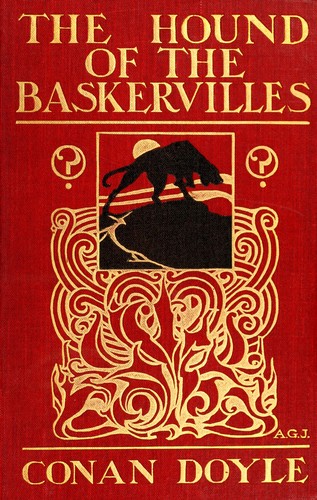
"The Hound of the Baskervilles is a short book, easily read in an afternoon. I first heard of it when I was about seven and a picture and short summary featured in a diary I was given. It was already enough to send shivers down my spine. The book opens in London, in Baker Street, with the usual back-and-forth between Sherlock Holmes and Dr. Watson as they deduce what kind of man has left behind his walking stick. The plot quickly draws you in with its combination of a family curse, the unforgettable setting of the bleak, Devon moors and the hellish, spectral hound that haunts them. Sir Charles Baskerville feared his own death and duly died—will the last of the Baskervilles, Sir Henry, fresh back from the colonies, also fall victim if he returns to Baskerville Hall? It’s very, very cleverly done. Our interview about Sherlock Holmes (or Arthur Conan Doyle) is with Washington Post literary critic Michael Dirda"
Agatha Christie · Buy on Amazon
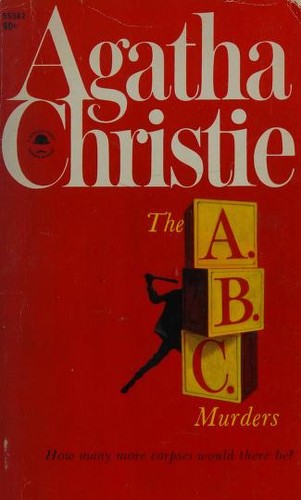
"I can’t remember which was the first Agatha Christie I came across, but I’ve tried to read all of her crime novels. It’s primarily about the plots. Only rarely does the twist in a contemporary mystery book give me the satisfaction that Agatha Christie does. I suppose it’s also the familiarity: with each book I know I’m going to get the same thing and yet cleverly different. The ABC Murders features her Belgian detective, Hercule Poirot, before she got really fed up of him. The story is mainly told through the eyes of his old friend, Captain Hastings, who comes back from South America to find Poirot dying his hair. Poirot has received an anonymous letter signed A.B.C., challenging him about a mystery which he won’t be able to solve. The plot revolves around the ABC Rail Guide— the train timetable book that was widely used at that time—and is one of her cleverest. When I spoke to Agatha Christie’s grandson, Mathew Prichard , he speculated at how she came up with it: “There was always a copy of the ABC railway guide beside my grandmother’s telephone. I’m sure that’s where the story originated. I can see her sitting there, talking to one of her friends and staring at the book, the plot forming in her mind.” It gets at what I like in my crime fiction—a writer taking an ordinary object, situation, or person and making it into something menacing, but also having a bit of fun with the reader: this is a train timetable we’re talking about."
Josephine Tey · Buy on Amazon
"I love books from the golden age of mystery. The British Library does a nice series, republishing some of them, and when I see one I almost always buy it. I’ve also read books by other popular golden age crime writers, like Ngaio Marsh and Margery Allingham. Josephine Tey is the only one that made me want to read all her books. There aren’t many, as she died young, but they’re all a little bit different. Some feature Detective Inspector Alan Grant of Scotland Yard. In one, The Daughter of Time, Grant solves a historical crime, showing (rightly or wrongly) that Richard III was not a murderer. Brat Farrar is my favourite and just a beautifully done book. The setting is a house in the English countryside on the south coast, surrounded by paddocks with horses, where Aunt Bee is bringing up her four nephews and nieces. Simon, the oldest, is about to come of age, which will finally solve all their money problems, however… Books by Josephine Tey, listed in order of publication"
Patricia Highsmith · Buy on Amazon
"I came across Patricia Highsmith when I was first working as a journalist in London in the mid-1990s and ended up at a media event that was a bit more glamorous than my normal beat. I think Andrew Neil or another British media figure was hosting it; I don’t recall. What I’ll never forget is being handed a goody bag containing a book called The Talented Mr Ripley . It’s the first book I read where I was absolutely rooting for the villain, my entire emotional energy focused on willing him not to get caught. Even if you’ve seen the 1999 movie, the book is still worth reading. I love the rags-to-riches element, the settings: 1950s New York, the fictional Mongibello on the coast south of Naples, Venice. Highsmith wrote four more books featuring Tom Ripley, as well as other psychological thrillers. Books by Patricia Highsmith recommended on Five Books"

Award-Winning Crime Novels of 2024 (2024)

Scraped from fivebooks.com (2024-12-07).

Source: fivebooks.com

James Lee Burke · Buy on Amazon
"In the US, the most highly regarded crime writing prize is probably the Edgar Allan Poe Award for Best Novel. The Edgars have been running since 1954 and are organized by the Mystery Writers of America , the professional organization for crime writers. Previous winners in the best novel category include Patricia Highsmith, John Le Carre , Attica Locke and Ruth Rendell. In 2024, the winning novel was Flags on the Bayou, a historical novel set in Louisiana during the American Civil War. It’s by James Lee Burke, who has won the award three times before. The story is told from the point of view of an eclectic cast of tormented characters against a diabolical backdrop. Slavery lies at the heart of the story. As one of the main protagonists says, “If they, meaning my fellow human beings, had not cursed themselves with the enslavement of their fellow man, they would have lived in a near-perfect society.” At the back of the book James Lee Burke writes that he considers it his best book yet. There’s a lot more to the book, but in terms of the thriller genre, it’s an ‘on the run from justice’ story."
Cover of All the Sinners Bleed
S.A. Cosby · 2023 · Buy on Amazon
"Also based in the US is the International Thriller Writers association or ITW, which “represents professional thriller authors from around the world.” Its first award dates to 2007 and winners include Stephen King, Jeffrey Deaver, Lisa Gardner and Robert Harris. In 2024, the winner was All the Sinners Bleed by S.A. Cosby, whose previous books, Razorblade Tears and Blacktop Wasteland also won best novel. All the Sinners Bleed is probably my favourite of the three because the main protagonist is on the right side of the law, so you don’t spend the entire book thinking, “No! No! Don’t do that! It’s not worth it. You’re going to get caught!” Instead, he’s a former FBI agent, now a sheriff in rural Virginia. In terms of genre, this is a police procedural, with a serial killer at the heart of it and race relations as the backdrop. As Stephen King wrote in his review of the book in the New York Times , “As in S.A. Cosby’s previous two novels…the body count is high and the action pretty much nonstop.”"
Una Mannion · Buy on Amazon
"In the UK, the most prestigious thriller prize is probably the Gold Dagger, issued by the Crime Writers Association (CWA), and awarded “for the best crime novel by an author of any nationality, originally written in English and first published in the UK”. The first Gold Dagger was awarded in 1960 for The Night of Wenceslas by Lionel Davidson, one of my favourite thriller writers (the award actually ran from 1955, but was known as the ‘Crossed Red Herring Award’). The 2024 Gold Dagger was awarded to Tell Me What I Am by Una Mannion, another US author, but who is based in Ireland (Her debut novel, A Crooked Tree, was a bestseller in Ireland). “Haunting and beautifully written, this is a story of a young woman navigating the complexities of a traumatic and unknown past,” the judges of the prize wrote about the winning book. “Mannion deftly explores the impact of crime on all those affected, and will leave readers questioning what it means to be family, and how far they might go for someone they love.” This is really an exploration of domestic violence and control, using elements of the thriller genre to move the story forward."
Jordan Harper · Buy on Amazon
"Also awarded by the CWA is the Ian Fleming Steel Dagger, named after the author of the James Bond books. Fleming’s criterion for a good thriller (apparently) was that “one simply has to turn the pages.” The 2024 winner was Everybody Knows by Jordan Harper. It’s set in LA and is very much a commentary on that world (I found myself googling words I’d never heard before a lot). The main character is a ‘black bag’ publicist, a term coined by Harper. Her job is keeping bad news about celebrities (drug overdoses etc.) from getting out and clearing up literal and metaphorical vomit. In an interview, Harper said his working title for the book had been Hollywood Sickos. In terms of genre, this is firmly LA noir."
I.S. Berry · Buy on Amazon
"Nearly all the thriller awards have a category for debut novelists. This year’s clear winner—winning both an Edgar and an ITW award as well as appearing on numerous best-of-the-year lists in the UK—was The Peacock and the Sparrow by former CIA operative I.S. Berry. This is a classic spy novel, set in Bahrain during the Arab Spring. It was Shane Whaley of the Spybrary podcast who first alerted me to the book last year, pointing out that “it’s very reminiscent of Graham Greene’s The Quiet American , which she says is her favourite book. It’s different, but it’s definitely a love letter, an homage to that work.” As I read it, I occasionally had to remind myself that the main character was an American working for the CIA and not a debauched British journalist. What’s so valuable about a thriller like The Peacock and the Sparrow is that not only is it a good read, but it’s also a great way into the politics of the Middle East, including how that intersects with US foreign policy—a subject we probably should all know more about. December 7, 2024. Updated: June 11, 2025 Five Books aims to keep its book recommendations and interviews up to date. If you are the interviewee and would like to update your choice of books (or even just what you say about them) please email us at [email protected] Support Five Books Five Books interviews are expensive to produce. If you've enjoyed this interview, please support us by donating a small amount ."

Nonfiction Books to Look Out for in Early 2024 (2024)

Scraped from fivebooks.com (2024-02-11).

Source: fivebooks.com

Katherine D. Van Schaik · Buy on Amazon
"In Princeton University Press’s Ancient Wisdom for Modern Life series (which includes text in the original Latin or Greek facing the translation), there’s How to Be Healthy: An Ancient Guide to Wellness , about the ancient Greek physician Galen (129-c216). Medical knowledge has advanced quite a bit since the 3rd century, so the book is somewhat tongue-in-cheek, with the author and translator, Katherine Van Schaik, admitting she had to omit many of his better-known works. But we can still see the advice on (say) “Avoiding Distress” from this “careful physician” who offers “some ancient wisdom that we today might consider modern, were it not so old.” In OUP’s excellent Very Short Introduction series , there are new books about French philosopher Simone Weil and Russian novelist Fyodor Dostoevsky ."
Sophie Elmhirst · Buy on Amazon
"The early months of the year are grey and muddy in my corner of the world and it’s fun to dream of adventure in the year ahead. Maurice and Maralyn by Sophie Elmshirst is about an ordinary couple from Derby who set out to sail around the world in the early 1970s. The reason we know about them is that theirs turned into a survival story: their boat was sunk by a sperm whale and they were left adrift on a raft in the Pacific Ocean for 118 days. It’s an easy and engaging read: I started it one evening after dinner and stayed up to finish it just after midnight."
D J Taylor · Buy on Amazon
"On the subject of political dystopias, Orwell biographer D.J. Taylor has a new book out about him: Who is Big Brother? A Reader’s Guide to George Orwel l. You’ll learn a lot about Orwell’s life and how it made its way into his books."
S. Frederick Starr · Buy on Amazon
"Also hailing from central Asia are the main protagonists of The Genius of Their Age: Ibn Sina, Biruni and the Lost Enlightenment by S. Frederick Starr . It’s a dual biography of Ibn Sina (aka Avicenna) and Biruni, key figures in the flowering of science and philosophy that took place in the Islamic world in the Middle Ages. Both men were born in the 10th century in modern-day Uzbekistan. This is an important period for anyone interested in the history of science, a missing gap in Western curricula (at least in my day)."
Cover of Marcus Aurelius: The Stoic Emperor
Donald J. Robertson · 2024 · Buy on Amazon
"In another Yale series, Ancient Lives , there’s a new biography of the 2nd-century Roman emperor, Marcus Aurelius , whose book, Meditations, is often recommended for those interested in the ancient philosophy of Stoicism . It’s by Donald Robertson, a cognitive behavioural psychotherapist and a firm believer that Stoicism has much to teach us in our daily lives."
David Van Reybrouck · Buy on Amazon
"Also of note is the appearance, in English, of a book about Indonesia’s struggle for independence from the Netherlands after World War II: Revolusi: Indonesia and the Birth of the Modern World by David van Reybrouck."
Christopher Phillips · Buy on Amazon
"Much as I love history as escapism into the past, I do keep an eye out for books that shed light on some of the deeply worrying conflicts going on in the world today. One notable book for those trying to get a handle on the Middle East is a new book by Christopher Phillips, a professor of international relations at Queen Mary University of London. It’s called Battleground: 10 Conflicts that Explain the New Middle East . It’s an accessible introduction to conflicts across the region, written, according to the author, for readers wanting to understand the complex reality of the Middle East and looking for a place to start. He explains that by conflict he means not just outright wars, but also fraught politics and region-wide disputes. He covers Syria, Libya, Yemen, Palestine, Iraq, Egypt, Lebanon, Kurdistan and The Gulf as well as The Horn of Africa."
Cover of Not the End of the World: How We Can Be the First Generation to Build a Sustainable Planet
Hannah Ritchie · 2024 · Buy on Amazon
"For those concerned about what’s happening on Earth, data scientist Hannah Ritchie, head of research at Our World in Data , has a book out on climate change entitled Not the End of the World . Ritchie says she’s inspired by the late Swedish epidemiologist Hans Rosling (author of Factfulness ) and the book is very much in the vein of ‘we’ve achieved a lot, let’s not despair.’ It’s a climate-change pep talk, I suppose, but based on facts and data."
Jonathan Haidt · Buy on Amazon
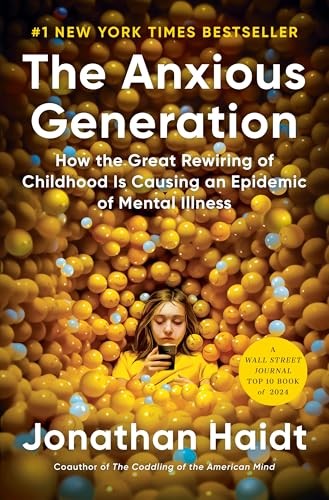
"Another must-read, out in March, is The Anxious Generation: How the Great Rewiring of Childhood Is Causing an Epidemic of Mental Illness . It’s by psychologist Jonathan Haidt, author of one of my favourite books, The Happiness Hypothesis . Since 2010, rates of depression, anxiety, self-harm, and suicide have risen sharply among teenagers around the developed world, and Haidt explores why. This is something that touches all of us: I live in rural Oxfordshire, but the bridge at the end of my road is currently closed after more than one person jumped off it. Instinctively, I blame it on social media, but look forward to reading a more nuanced analysis of what’s going on—as well as some possible solutions."

Award Winning Biographies of 2022 (2022)

Scraped from fivebooks.com (2022-12-17).

Source: fivebooks.com

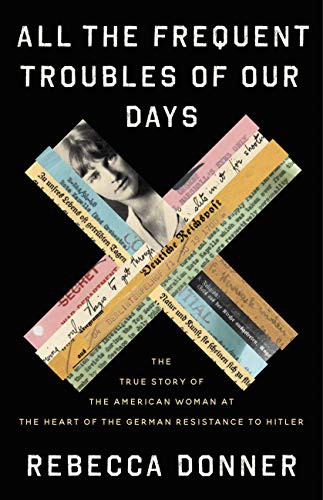
Cover of All the Frequent Troubles of Our Days: The True Story of the Woman at the Heart of the German Resistance to Hitler
Rebecca Donner · Buy on Amazon
"Of the prizes dedicated to biographies, it was a biography of Mildred Harnack that won both the National Book Critics Circle award for biography in 2022 as well as the Jacqueline Bograd Weld award, awarded by PEN America. All the Frequent Troubles of Our Days: The True Story of the Woman at the Heart of the German Resistance to Hitler is the powerful story of an American woman who fell in love with a German student at graduate school at UW–Madison and ended up marrying him and moving to Berlin just as Adolf Hitler was rising to power. Not only is it the life story of an extraordinary person, it’s also a fascinating picture of Berlin in the 1930s (“the very first traffic light in Europe appeared here”). Needless to say, the story ends badly and Harnack was executed after Hitler’s personal intervention, in 1943. The biography is written by Canadian writer Rebecca Donner, Harnack’s great-great-niece."
Cover of The Last King of America: The Misunderstood Reign of George III
Andrew Roberts · Buy on Amazon
"The Elizabeth Longford Prize is an award set up in 20o3 in memory of Elizabeth Longford (1906-2002), a British biographer who wrote biographies of both Queen Victoria and the Duke of Wellington. This year’s prize went to a book about George III: The Last King of America by the British biographer Andrew Roberts. Roberts, who previously wrote an acclaimed biography of Napoleon as well as an excellent one-volume biography of Winston Churchill , tries to restore the reputation of a man who was blamed in England for losing the American colonies and reviled in America for being a tyrant. In Roberts’s telling, George III suffered from bipolar disorder and many of the criticisms of him were just crude distortions by his opponents."
Cover of Burning Boy: The Life and Work of Stephen Crane
Paul Auster · Buy on Amazon
"The LA Times awards a number of book prizes every year. This year’s prize for biography went to a literary biography, American novelist Paul Auster’s Burning Boy, about the life and work of Stephen Crane. Crane is best known as the author of one of the most famous historical novels about the American Civil War: The Red Badge of Courag e, though he wrote prolifically throughout his short life, including a stint as a war correspondent in Cuba, covering the Spanish-American War. Crane died in 1900 aged just 28. Auster writes, “I come at it not as a specialist or a scholar but as an old writer in awe of a young writer’s genius. Having spent the past two years poring over every one of Crane’s work…I find myself just as fascinated by Crane’s frantic, contradictory life as by the work he left us.”"
Cover of The Escape Artist: The Man Who Broke Out of Auschwitz to Warn the World
Jonathan Freedland · Buy on Amazon
"In addition to prizes dedicated to the genre, biographies also loomed large on the shortlist of the UK’s most prestigious nonfiction prize, the Baillie Gifford Prize. A particularly gripping read is The Escape Artist by British journalist Jonathan Freedland, who also writes thrillers under the name Sam Bourne . It’s the story of a Slovakian Jewish teenager, Rudolf Vrba, who along with fellow Slovakian Fred Wetzler managed to escape from Auschwitz in April 1944. They were the first Jews to do so and were able to report what was going on there to the outside world. The book opens with their escape by hiding in a pit under a woodpile and taking advantage of their knowledge of SS protocols to get away. Vrba, who was born Walter Rosenberg, subsequently made his life in the US."
Cover of Super-Infinite: The Transformations of John Donne
Katherine Rundell · Buy on Amazon
"The overall winner of the Baillie Gifford was another literary biography, about the British poet John Donne (1572-1631). It’s called Super-Infinite by Katherine Rundell . Rundell is a children’s author who also specializes in Renaissance literature and makes the case that Donne should be as widely feted as William Shakespeare, his contemporary. She writes, “Donne is the greatest writer of desire in the English language. He wrote about sex in a way that nobody ever has, before or since: he wrote sex as the great insistence on life, the salute, the bodily semaphore for the human living infinite. The word most used across his poetry, part from ‘and’ and ‘the’, is ‘love’.” As she notes: “This is both a biography of Donne and an act of evangelism.”"
Cover of Chasing Me to My Grave: An Artist's Memoir of the Jim Crow South
Winfred Rembert · Buy on Amazon
"The 2022 Pulitzer Prize for Biography (which also includes works of autobiography) went to Chasing Me to My Grave: An Artist’s Memoir of the Jim Crow South by the late Winfred Rembert (1945-2021) . Rembert was from a family of field labourers in Cuthbert, Georgia and taught himself to paint at the age of 51 using leather tooling skills he learned in prison. In the preface, he writes that he had been scared to draw attention to what happened to him in Cuthbert during his lifetime, and so he only composed his memoir as he was dying. It’s a wrenching tale told in a very direct and touching way. The book also includes pictures of his paintings—of cotton fields, of his mother giving him away as a baby. December 17, 2022. Updated: October 17, 2025 Five Books aims to keep its book recommendations and interviews up to date. If you are the interviewee and would like to update your choice of books (or even just what you say about them) please email us at [email protected] Support Five Books Five Books interviews are expensive to produce. If you've enjoyed this interview, please support us by donating a small amount ."

Award Winning Nonfiction Books of 2022 (2022)

Scraped from fivebooks.com (2022-12-04).

Source: fivebooks.com

Cover of Super-Infinite: The Transformations of John Donne
Katherine Rundell · Buy on Amazon
"Here in the UK, it was a biography of the early modern English poet, John Donne (1572-1631) that won the country’s prestigious nonfiction prize, the Baillie Gifford Prize (known as the Samuel Johnson Prize until 2015). Donne’s meditations on the meaning of life and death speak to us across the centuries, in poems like “Death Be Not Proud” and passages that remind us that “No Man is An Island,/Entire of itself…Send not to know/For whom the bell tolls,/It tolls for thee.” In Super-Infinite: The Transformations of John Donne, Katherine Rundell , a children’s author who is also a Renaissance literature specialist, conveys not only the ups and downs of Donne’s life, but her passion for his poetry. Other prizewinning books in the general nonfiction category include South to America by Imani Perry , which won the National Book Award for nonfiction. Perry is a professor of African American Studies at Princeton and it’s a reflective book about a trip to the southern United States, starting in the historically significant town of Harpers Ferry. Invisible Child by Andrea Elliott , tracing the life of a homeless girl in New York City over many years, won the Pulitzer Prize for Nonfiction. It’s hard to believe, but amidst New York’s enormous wealth, there are 22,000 homeless children."
Cover of Devil-Land: England Under Siege, 1588-1688
Clare Jackson · Buy on Amazon
"The UK’s most important history book prize is the Wolfson History Prize . Books are selected for their readability, but the books shortlisted represent serious—rather than popular—history. This year’s winner was Devil-Land: England Under Siege, 1588-1688 by Cambridge historian Clare Jackson , who presents this era as a time when England was something of a failed state. All That She Carried: The Journey of Ashley’s Sack, a Black Family’s Keepsake by Harvard historian Tiya Miles won the Cundill History Prize, which often brings to light very interesting, international books (previous winners include Blood on the River , about a 1763 slave revolt in Guyana and Fifth Sun , about the Aztecs). The Cundill History Prize is run by McGill University and any history book in English—or translated into English—is eligible. All That She Carried is the story of three generations of women, told using the very little evidence that remains of their lives: a bag with a beautiful inscription sewed into it. In the US the Pulitzer Prize for History went to two books. One is Cuba: An American History by Ada Ferrer, which covers 500 years of history, from just before the arrival of Christopher Columbus to the death of Fidel Castro in 2016. The book opens with Ferrer’s own departure from Cuba to New York as a baby. The other book is Covered with Night: A Story of Murder and Indigenous Justice in Early America by Nicole Eustace and focuses on a single year, 1722. The Pulitzer jury describes it as “A gripping account of Indigenous justice in early America, and how the aftermath of a settler’s murder of a Native American man led to the oldest continuously recognized treaty in the United States.” Both authors are history professors at NYU."
Cover of A (Very) Short History of Life on Earth: 4.6 Billion Years in 12 Chapters
Henry Gee · Buy on Amazon
"Back in early modern England, scientists (called ‘natural philosophers’ at the time), set up a Royal Society to discuss their work. Their first meeting took place on 28 November 1660. Not only is the Royal Society still going today as an “independent scientific academy….dedicated to promoting excellence in science for the benefit of humanity” they also have a book prize that picks out popular science books for the general public. This year’s winner was A (Very) Short History of Life on Earth , a book that covers 4.6 billion years in 12 relatively short chapters. It’s by Henry Gee, an editor at Nature . The Royal Society also has a kids’ science book prize which is excellent. A panel of scientists draw up the shortlist, but it’s children who vote the winner from the final six. This year’s winner will be announced in March 2023; last year’s winner was I am a book. I am a portal to the Universe by Stefanie Posavec and illustrated by Miriam Quick."
Cover of Not One Inch: America, Russia, and the Making of Post-Cold War Stalemate
M E Sarotte · Buy on Amazon
"I like prizes that are quite specific, and I was delighted a few years ago to discover the Pushkin House Book Prize. The prize goes to the year’s best nonfiction book about Russia. This year’s winner was Not One Inch: America, Russia, and the Making of Post-Cold War Stalemate by Mary Elise Sarotte, a professor at Johns Hopkins. It looks at the missed opportunities of the 1990s—in the hopeful years after the fall of Soviet communism—for rapprochement between the US and Russia. These two countries still possess more than 90% of the world’s nuclear warheads, so it’s a history worth understanding."
Cover of My Fourth Time, We Drowned
Sally Hayden · Buy on Amazon
"My Fourth Time, We Drowned by Irish journalist Sally Hayden was a clear winner this year in the politics category. It’s about the awful things going on in the migration route from North Africa to Europe, and what a bad job the EU and international organizations are doing in protecting very vulnerable people. The tragic situation in the Sahara desert and the Mediterranean is truly horrifying, and although there is no easy solution, this is a major failing of our age. The book won both the Orwell Prize for Political Writing , as well as the British Academy Book Prize , which focuses on books that enhance ‘global cultural understanding.’"
Cover of Chip War: The Fight for the World’s Most Critical Technology
Chris Miller · Buy on Amazon
"Another prize that is well worth keeping an eye on is the Financial Times book prize . In principle, it’s a business book prize, but in practice, it covers any book that might be relevant to business or economics. This prize is a good way of getting acquainted with issues that are often really important for the functioning of the world economy and hence our everyday lives, written in a way that’s accessible to the general reader. This year’s winner was Chip War: The Fight for the World’s Most Critical Technology by Chris Miller , a professor at the Fletcher School at Tufts University. Last year’s winner was This Is How They Tell Me the World Ends: The Cyberweapons Arms Race by Nicole Perlroth, which highlighted another issue we all need to be aware of, but many of us choose to ignore. December 4, 2022. Updated: March 18, 2025 Five Books aims to keep its book recommendations and interviews up to date. If you are the interviewee and would like to update your choice of books (or even just what you say about them) please email us at [email protected] Support Five Books Five Books interviews are expensive to produce. If you've enjoyed this interview, please support us by donating a small amount ."

Award-Winning Nonfiction Books of 2025 (2025)

Scraped from fivebooks.com (2025-12-27).

Source: fivebooks.com

Cover of How to End a Story: Collected Diaries
Helen Garner · Buy on Amazon
"The UK’s most prestigious nonfiction book prize is the Baillie Gifford Prize for Non-Fiction , formerly known as the Samuel Johnson Prize. Books that win this prize are going to be highly accessible, well-written, and could be about almost anything. Last year, a book about the Japanese prisoner of war experience that was “part memoir, part science, part history” won , in previous years, we’ve seen books about subjects as broad as the Chernobyl disaster , the Beatles, North Korea and John Donne take home the £50,000 prize (browse the full list of winners here .) The judges for the prize change every year, so the book that wins in any particular year will tend to reflect the makeup of the judging panel and the dynamics between them. This year, the winner was completely unexpected—both to me and, based on my conversation with him, perhaps also to Robbie Millen, the literary editor of the Times, who was chair of the 2025 judging panel. How to End a Story is the collected diaries of Helen Garner , a talented Australian writer. The book of hers that has been recommended on Five Books is This House of Grief , about a father who stood accused of killing his children by driving them into a reservoir. How to End a Story is very different. It reads like little snippets, and the book is quite hard to get into, at least initially. But this is the story of a life, of a marriage, told without taking any prisoners and, as a result, gives a very unusual and unfiltered insight into what it is to be a human being. “It felt like being privy to very raw emotions,” Millen told me. “It surprises me that she hasn’t published it posthumously. Obviously, she’s edited it and shaped it, but there are parts where she is very unsparing of herself. There are some completely embarrassing moments, yet she puts it all out there.”"
Cover of The Burning Earth: An Environmental History of the Last 500 Years
Sunil Amrith · Buy on Amazon
"Another important nonfiction prize is the annual British Academy Prize. This is a prize we particularly value at Five Books because it aims to narrow the divide between academic work—the British Academy is the UK’s national academy for the humanities and social sciences—and writing that is enjoyable to read and accessible to a general audience. The prize is also quite internationalist in outlook, aiming to promote a broader understanding of the world and between different countries and cultures. This year’s winner was an environmental history of the past 500+ years, The Burning Earth , by Sunil Amrith , a professor of history at Yale who also has an appointment in the Yale School of the Environment. Despite the tough topic, this book is fun to read because of its range—you learn, for example, about the Mongol expansion and how many horses each of Genghis Khan’s horde had, amongst many other historical details. The ultimate message of the book is that “the environment is not something that’s happening on the side of history. They’re intertwined, and you can’t separate them out,” historian Rebecca Earle, one of the prize’s judges, explained to me. “The book shows this really compellingly.”"
Cover of Wild Thing: A Life of Paul Gauguin
Sue Prideaux · Buy on Amazon
"Another nonfiction prize we cover at Five Books is the Duff Cooper Prize, named after the British diplomat who wrote Talleyrand , a biography of the French statesman and one of my father’s favourite books. Despite being a nonfiction prize, it does tend to gravitate towards history books, so is worth keeping an eye on if you like history. This year’s winner was Wild Thing , a biography of Paul Gauguin, the French painter who ended up on Tahiti, and whose reputation biographer Sue Prideaux tries to rehabilitate in this book. She reports, for example, that he was not responsible for bringing syphilis to Tahiti. I was also moved by the chapter on Gauguin’s visit to his friend Vincent van Gogh in southern France, shortly before the Dutch painter’s mental illness got the better of him. Van Gogh painted the sunflowers specially for Gauguin’s visit, to decorate his bedroom."
Cover of The Story of a Heart
Rachel Clarke · Buy on Amazon
"If you want a nonfiction book that will make you cry, the book to go for is The Story of a Heart , written by British doctor Rachel Clarke . This book was the winner of the 2025 Women’s Prize for Non-Fiction, a new prize that was first awarded in 2024 for nonfiction books by women and judged by women. The Story of a Heart is the story of a girl who died, and a boy who lived because he received her donated heart. I don’t want to give away too many details, but as journalist Isabel Hilton told me: “It’s a book that once read is never forgotten. It’s told with extraordinary insight, medical knowledge and extraordinary sensitivity to the people involved. She tells their story, of something we take for granted, heart transplants, in a way that I’ve never seen it told before. It’s profoundly moving.” According to Kavita Puri, who chaired the prize, “I cried throughout reading this book. So did a lot of my fellow judges. There’s such dignity in how she deals with the subject matter, and in the behaviour of both sets of parents. There is also dignity in the medical staff.”"
Cover of To the Success of Our Hopeless Cause: The Many Lives of the Soviet Dissident Movement
Benjamin Nathans · 2024 · Buy on Amazon
"Lastly of the general nonfiction book prizes, we have the Pulitzer Prize for Nonfiction, awarded to an American author. This year, it went to a book about the Soviet dissident movement, To the Success of Our Hopeless Cause by Benjamin Nathans , a historian at the University of Pennsylvania. As Russian political scientist Gulnaz Sharafutdinova explained it to me, “This book is a very important, groundbreaking study of the dissident movement in the Soviet Union, not as a group of people with values that were pro-Western or liberal, but as a group of people who grew up as second-generation Soviet citizens and within that Soviet system, found the space and impulse to question the foundations of how that system worked in their time. They came up with very original strategies for confronting the issues they were not happy about…They came from a belief in the system they lived in, and used a legalist approach to keep the Soviet leaders true to their word.” Communist systems tend to the legalistic, and one can’t help but wonder whether Chinese dissidents are taking note of this book and the methods used to confront the Soviet system. Lastly, a shout-out to all the book prizes aimed at the general public that aim to improve our understanding of specialist subjects, including business, politics, philosophy, foreign affairs, sports, and science. I’m so grateful to you for trying to separate the wheat from the chaff and reliable information from successful marketing. Here’s a list of some of those award-winning books, starting with The Thinking Machine , which won the Financial Times Business Book of the Year Award and is all about the computer chips that are changing our world and what a single person with a big appetite for risk and a relentless focus can achieve: Buy now Listen now The Thinking Machine: Jensen Huang, Nvidia, and the World’s Most Coveted Microchip by Stephen Witt 🏆 Winner of the 2025 Financial Times Business Book of the Year Award Read expert recommendations The Best Business Books of 2025: the Financial Times Business Book of the Year Award Andrew Hill , Journalist 🏆 Winner of the 2025 Royal Society Trivedi Science Book Prize Read expert recommendations The Best Popular Science Books of 2025: The Royal Society Book Prize Sandra Knapp , Biologist 🏆 Winner of the 2025 Royal Institute of Philosophy Book Prize Read expert recommendations The Best Philosophy Books of 2024 Nigel Warburton , Philosopher 🏆 Winner of the 2025 William Hill Sports Book of the Year Read expert recommendations The Best Sports Books of 2025 Alyson Rudd , Journalist 🏆 Winner of the 2025 Arthur Ross Award for “an outstanding contribution to the understanding of foreign policy or international relations” Read expert recommendations The Best Politics Books of 2024: The Orwell Prize for Political Writing 🏆 Winner of the 2025 Orwell Prize for Political Writing Read expert recommendations The Best Politics Books of 2025: The Orwell Prize for Political Writing The judges of the 2025 Orwell Prize for Political Writing , 🏆 Winner of the 2025 Edward Stanford Travel Writing Award Read expert recommendations The Best Travel Books of 2025 Tom Parfitt , Journalist Other award-winning books of 2025 lists: fiction | biographies | memoirs | history (still to come) December 27, 2025. Updated: February 4, 2026 Five Books aims to keep its book recommendations and interviews up to date. If you are the interviewee and would like to update your choice of books (or even just what you say about them) please email us at [email protected] Support Five Books Five Books interviews are expensive to produce. If you've enjoyed this interview, please support us by donating a small amount ."

The Best Crime Fiction of 2021 (2021)

Scraped from fivebooks.com (2021-12-09).

Source: fivebooks.com

Jane Harper · Buy on Amazon
"150 miles south of the Australian mainland is the island of Tasmania, named after Abel Tasman, the Dutch merchant and explorer who landed there in 1642, although Aboriginal people had lived there for tens of thousands of years before. It’s a wild place, with the temperate rainforest of Savage River National Park so inaccessible that it’s possible extinct species may still roam. The Survivors , by one of my favourite crime writers, British/Australian crime novelist Jane Harper, is set in a small beach town on the island, where the wildness comes not from the forest but from the ocean, stretching thousands of miles down to Antarctica. Everyone in the town knows each other, except in summer when lots of backpackers pass through. The backdrop of the menacing ocean, where terrible tragedy struck more than a decade before, is what makes this such an unsettling read. You feel the aftereffects of that trauma, a father with dementia, the frustrations of small-town life. On top of all that, there’s a murder. As always with Jane Harper, the pace is slow and measured but the book is hard to put down."
Peter May · Buy on Amazon
"The Night Gate takes the reader to the Dordogne region of France , both during World War II and in the present, during Covid. Part of the action also takes place in Berlin and the Outer Hebrides, where a young French girl trains to be dropped behind enemy lines in France during the war. The book is the finale of a series by Peter May featuring a detective called Enzo MacLeod. I haven’t read any of the others, but The Night Gate features such a large cast of characters, and events taking place on such a broad canvas, that lots of scenes from the book stick with me. There’s Charles de Gaulle , stolen art, both Adolf Hitler and Hermann Göring trying to get their hands on the Mona Lisa. The book is fiction, but it’s based on fact, and how Louvre paintings were kept safe from the Nazis. Some of the minor characters in the book, like French art historian Rose Valland, were real people. Peter May lives in the Dordogne, and many of the paintings were hidden in nearby Château de Montal; some had even spent time in his garage."
Allie Reynolds · Buy on Amazon
"I’ve never been snowboarding in my life and have never been tempted to try it. But I love books that give insights into passions I don’t share, and give a feel for how and why they’re so alluring. This is about a group of competitive snowboarders and is a combination of flashbacks—to when they were all competing, ten years ago—and the present, when they attend a reunion and get stuck up a mountain. The book gives a real feel for what it’s like to be in a resort in the French Alps: the drinking, the snow, the lifts, the camaraderie. I was not surprised, after finishing the book, to find out the author, Allie Reynolds, was once a top UK freestyle snowboarder who spent five winters in the mountains of France, Switzerland, Austria and Canada. All in all, it’s a classic Agatha Christie -style locked-room mystery combined with very vivid accounts of being in the mountains and risking life and limb going down the halfpipe."
Femi Kayode · Buy on Amazon
"I’ve been excited in the past couple of years to see more crime fiction that took me to Africa. One of my favourite books last year was The Missing American , set in Ghana. Light Seekers is set in Nigeria , with the action starting off in Lagos and taking the reader to Okriki, a small university town near Port Harcourt, a big centre for the Nigerian oil industry. There is never any mystery about the crime—mob violence that leads to the brutal killing of three students—but the lead character, an investigative psychologist who has recently returned from the United States, has been tasked to find out why it happened. Along the way, we pick up bits and pieces about the Biafran War, local history, tensions, corruption and the feelings of the main character as he adjusts to life back in Nigeria. Like Peter May’s book, Light Seekers is partly based on real events, in this case the horrific killing of four students in Aluu, Nigeria in 2012. That makes the book harder to read, but more important. Get the weekly Five Books newsletter"
R.J. McBrien · Buy on Amazon
"All the books I’ve chosen so far are serious, but given I read crime fiction mainly for entertainment, I do love books that make me laugh. I think others do too, hence the popularity of Richard Osman’s books, the second of which, The Man Who Died Twice , also came out this year. Reckless is by R.J. McBrien who normally writes for television but decided during lockdown it was time to make a crime fiction debut. The (anti)-heroine is a middle-aged married woman who makes wry asides—a bit in the style of Bridget Jones—drinking lots of wine and making fun of modern life, parenthood and marriage as her desire for physical intimacy leads her into an increasingly tricky situation. A typical line: “I’d read enough magazine articles to know most young women waxed with pre-op thoroughness. Would a new lover expect that?” A few other books I enjoyed this year include: The Others , by Sarah Blau , set in Tel Aviv and translated from Hebrew. It’s a weird, quirky book, but an image of clumps of hair she finds around her apartment stays with me. I also read The Chateau by Catherine Cooper , a nicely told book of crime fiction set in France. The Therapist by B.A. Paris , set in London, is another good one and could easily have been on my best crime fiction of 2021 list. The Plot by Jean Hanff Korelitz is also very memorable, the main protagonist’s anguish about his writing and success (or lack of it) making the reader almost ready to murder him themselves. It’s good, especially in the second half as he stops thinking and starts investigating. Part of our best books of 2021 series."

The Best Crime Novels of 2023 (2023)

Scraped from fivebooks.com (2023-12-23).

Source: fivebooks.com

Robert Galbraith · Buy on Amazon
"For me, the best crime series currently being published is the one featuring private detective Cormoran Strike. It’s written by Robert Galbraith (aka JK Rowling) and so it’s widely marketed and hard to miss when you pass a bookstore. Galbraith/Rowling is now at the 7th book in the series, The Running Grave , published exactly a decade on from the first. These books are a slow-burn, for people who like long books and living alongside the characters. If you haven’t read one yet, it is important to start from the beginning and read them in order so you get to know the protagonists. I listen to them as audiobooks , and believe the narrator—British actor Robert Glenister—helps make the series exceptional (the only book in the series I haven’t enjoyed as much was the one I read as a physical book). In The Running Grave , Strike’s partner Robin Ellacott—who in my mind looks exactly like JK Rowling—goes undercover at a religious cult in Norfolk. The Cormoran Strike series by Robert Galbraith"
Simon Scarrow · Buy on Amazon
"Simon Scarrow is a British author best known for his historical novels set in Ancient Rome. Dead of Night, in contrast, is a police procedural set in Berlin in 1941, under the Nazis. It’s the second in a series featuring Inspector Horst Schenke, who works for the Kriminalpolizei or Kripo (The first in the series was Blackout ). Schenke is not a Nazi, but works for a state run by the Nazis. I read the book shortly after it came out in February, and the creepiness of the atmosphere has stayed with me. I suppose it meets one of my criteria for a good crime novel—does it make me feel like I’ve been there? I also like the fact that American journalist William Shirer features in the book. (In real life Shirer lived in Berlin through 1940. His book, The Rise and Fall of the Third Reich , is a great account of what it was actually like in Berlin under the Nazis). World War II historical novels on Five Books If you like police procedurals in a more conventional setting, another good one published in 2023 is The Broken Afternoon by Simon Mason . It’s set in Oxford and has two detectives with virtually the same name (but very different personalities) as the main protagonists: Ray Wilkins and Ryan Wilkins. This is the second book in the series, and opens with Ryan working as a security guard having been thrown out of Thames Valley Police. A child disappears from her nursery school, snatched away as her mum talks to one of the staff at pickup time."
Femi Kayode · Buy on Amazon
"Travelling to countries I haven’t visited by way of a crime novel is always a treat for me. Gaslight is the second in a series set in Nigeria, featuring an investigative psychologist as the main protagonist. His name is Philip Taiwo and he first appeared in Lightseekers, set in a small university town near the oil town of Port Harcourt. In this novel, Taiwo is asked by his sister to investigate the disappearance of the wife of the pastor of a Christian megachurch. The pastor is charismatic, worth millions, and stands accused of his wife’s murder. Taiwo has moved to Nigeria from the United States with his wife and children, and his experience of that move makes up part of the backdrop to the story. One thing you get an overwhelming sense of in the book: Lagos traffic. More African crime fiction on Five Books"
Jane Harper · Buy on Amazon
"Jane Harper is an Australian writer of crime fiction who I’m a big fan of. Exiles is set in Australia’s wine country and features Aaron Falk, an investigator who has appeared in some of her other novels. Harper’s books are always atmospheric and well-crafted. As in The Dry , Falk is not investigating in a formal capacity, but in this case goes down south to celebrate being godfather to a friend’s son. Exiles opens with a six-week-old baby in a pram being found on its own at a food and wine festival: the mother has disappeared. The best Australian crime fiction"
Zijin Chen · Buy on Amazon
"I tend to read quite a bit of crime fiction translated from other languages and 2023 was no exception. Bad Kids was first published in China in 2014—where it has (apparently) been turned into a wildly popular online TV show—but only came out in English last year. It opens with a man pushing his parents-in-law to their deaths off the side of a mountain. The book has quite a lot of fun horrifying the reader by completely upending Confucian norms—which emphasize respecting your elders and your parents in particular—and exploring what it takes to derail the perfect student. It’s set in Ningbo, the city near Shanghai where the author lives. One book I enjoyed for its setting was Reykjavík , written in Icelandic by Ragnar Jónasson and Katrín Jakobsdóttir and translated into English by Victoria Cribb. It’s a bit of a trip down memory lane as it’s set in 1986 and revolves around a murder committed in the 1950s. We see the development of Iceland and the Reykjavík Summit, when Ronald Reagan and Mikhail Gorbachev met. It’s also the only book on this list written by a national leader: Jakobsdóttir has been prime minister of Iceland since 2017."

The Best Nonfiction Books of 2021 (2021)

Scraped from fivebooks.com (2021-12-24).

Source: fivebooks.com

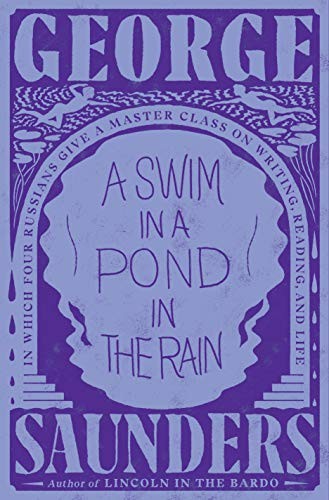
George Saunders · Buy on Amazon
"A Swim in the Pond in the Rain is the most surprising book I’ve read this year. Most of the great Russian writers of the 19th century wrote short stories and, in this book, American author George Saunders teaches us what a handful of his favourites are about. It’s based on a class on Russian short stories he teaches to talented aspiring writers at Syracuse University. After class one day, he realized that “some of the best moments of my life, the moments during which I’ve really felt myself offering something of value to the world, have been spent teaching that Russian class.” He then tries to recreate that teaching experience in the pages that follow. It’s an extraordinarily successful effort. I don’t particularly enjoy short stories: I find them too short to be satisfying, but I was completely mesmerized by his explanations of what they meant to him, and what they can teach us about how to write effectively. After reading it, not only had I read some stories—by Leo Tolstoy , Anton Chekhov , Ivan Turgenev, and Nikolai Gogol—which I would never have embarked on otherwise, but I felt I’d spent a few days in 19th century Russia."
Chris Bail · Buy on Amazon
"I’m fascinated by the toxicity of online debate, and how people can write detestable things to each other in a way they never would face-to-face. Living in the UK and with family in the US, I’m also slightly shocked by how polarized these two societies seem to have become. Each side seems to almost hate the other. Breaking the Social Media Prism by Chris Bail, a sociologist at Duke, takes on both these issues. Bail runs a ‘Polarization Lab’ at Duke (you can read more about it and even try out some of their interactive tools here ). The book outlines not only what he’s learnt from his research, but what we can do to make things better. And ‘we’ is the operative word here, because while it’s easy to blame Facebook, the Russians, Cambridge Analytica etc. for everything that’s gone wrong, ultimately it is about us, and how each of us behaves. As he writes, “our focus upon Silicon Valley obscures a much more unsettling truth: the root source of political tribalism on social media lies deep inside ourselves.”"
Anne Sebba · Buy on Amazon
"“It was a queer, sultry summer, the summer they electrocuted the Rosenbergs, and I didn’t know what I was doing in New York,” writes Sylvia Plath in the opening lines of her only novel, The Bell Jar . The execution of an American Jewish couple, Julian (‘Julie’) and Ethel Rosenberg in 1953 for espionage was one of those moments that rocked the world. In this book, historian Anne Sebba stops looking at them as a couple and tells Ethel’s story. She was born into poverty but was blessed with brains and a great voice and wanted to become a singer. She cared deeply about social justice and thought communism might be a solution. Through her activism, she met her husband. They had kids. She worried about being a bad mother and read piles of parenting books. Her husband was a spy for the Soviet Union, she probably wasn’t. She was executed by electric chair, leaving behind two boys, aged 10 and 6. As the subtitle says, it was a Cold War tragedy indeed."
Claudia Goldin · Buy on Amazon
"Claudia Goldin is an economist, in fact the first female economist ever to get tenure at Harvard. Career & Family is a book everyone should read because it analyses an issue that affects many of us: the wide disparities in pay that develop after people have children. The fact is, it’s very hard to both care for kids and be at the top of your profession. In the economy, the highest paying jobs go to workers who are prepared to work crazy hours and are available 24/7: they either don’t have children or have someone else who is prepared to look after them. This, Goldin has long argued, is the reason women with college degrees still earn so much less than men, especially in jobs like law and investment banking. It’s not so much about sexism or women being worse at bargaining for higher pay than men (say), it’s about a system. If that structure isn’t changed, no number of workshops training people to be less sexist, better at negotiating etc. is going to make a difference. This book is full of data looking at different cohorts of American women through the 20th century, though I love that there are also lots of examples of what prominent women did regarding marriage and children. Goldin remains outraged at the current situation but is also at pains to show that women have come a long way: a century ago, women who had a career did not, in general, get married and have children, now they can have both (even if they’re paid less for their efforts). Get the weekly Five Books newsletter"
Cat Jarman · Buy on Amazon
"I’m always interested in books about the Vikings , this violent group who wreaked havoc around Europe in the medieval period, traded slaves, and had astonishing seafaring skills. Cat Jarman is a bioarchaeologist, and this book looks at what the latest findings in her field can tell us about them. Her own research focuses on a burial site in Repton, in Derbyshire and many miles from the sea, where nearly 300 bodies were found that were very likely from the Great Viking Army that invaded England. Lots of iron nails used for ships were also found at the site, indicating they got there by river. As the title of the book suggests, even if it’s crossing the Atlantic in a ship that seems more impressive, Vikings were a group who were able to flourish because of their ability to sail down rivers. In particular, they sailed along rivers in Russia, down to Byzantium and traded with the Middle East. I love the texture of the book, the information gleaned from Viking skeletons and objects found at burial sites: lots of playing pieces (Vikings liked playing games, apparently useful for strategy), a ring with Arabic script, beads from India, a coin from Afghanistan—and then the DNA evidence as techniques get more sophisticated. One Viking warrior turned out to be a woman, another one was bald, there was quite a bit of immigration to Scandinavia, even from the Middle East. Also, I found out a fact I never learned in school: Harald Hardrada—who famously invaded England just a few weeks before William of Normandy, another Viking, in 1066—spent time as a bodyguard to the Roman emperor in Constantinople."

Best Crime Fiction of 2020 (2020)

Scraped from fivebooks.com (2020-12-17).

Source: fivebooks.com

Ruth Ware · Buy on Amazon
"Ruth Ware is amazing. I only recently discovered her, thanks to Robin Whitten, editor of AudioFile magazine, who recommended the year’s best audiobooks for us . She says that audiobooks work particularly well for the suspense/crime fiction genre and I’m inclined to agree. The first book I read of Ruth Ware’s was The Turn of the Key , which was fabulously unputdownable and atmospheric and came out this year in paperback. One by One is her latest book and I’ve been listening to it as an audiobook with my daughters. It’s not exactly appropriate because there’s a lot of swearing, but the girls get very upset if I listen to it without them. It’s set in a fancy ski chalet in France and that’s all I’m going to say about it, because anything else will detract from the suspense (tip for crime fiction: never read the book blurb). Generally, I can say that Ruth Ware is hilarious on out-of-control tech and dreams up these things that you almost wish existed. I also like the way she looks at how outward professionalism interacts with what’s really going on in the main protagonist’s mind."
Lucy Atkins · Buy on Amazon
"When we spoke to Lucy Atkins about what makes a great thriller , she explained that suspense, when done well, is “powered by oddness and creepiness and things that are just a bit off and unsettling.” When I started reading Magpie Lane , I could see exactly what she was getting at. The book is set in Oxford, at the lodgings of the new Master of one of the colleges. The Master’s Scandinavian wife is busy renovating the house, including whitewashing the floorboards (which I loved, because the dark wood panelling always got me down when I was a student in Oxford). Again, I’m not going to reveal anything, but this book is probably in the domestic noir genre of crime fiction, though at the glamorous end. These are books where I slightly see my own life mirrored—grappling with parenthood and a household, loving work but being over-busy as a result and scared of losing track of what’s important while being over-obsessive about other things. The other book I read in that genre and really enjoyed was Stop at Nothing , by Tammy Cohen, who did an interview with us on the best psychological thrillers ."
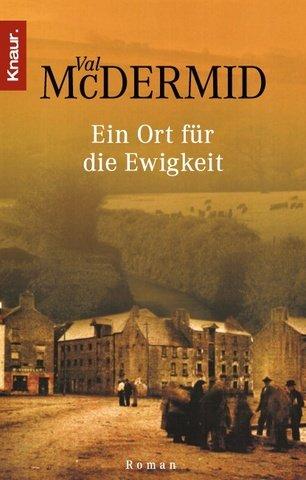
Val McDermid · Buy on Amazon
"When it comes to atmospheric, A Place of Execution by Val McDermid takes the prize. The setting is very bleak, with a lot of action taking place in a tiny, closed community in Derbyshire with grey stone houses and a bleak, hilly backdrop. The book was first published in 1999, but was reissued this year, which is why I bought it for my pile of books to be considered for best of 2020 crime fiction (by the time I realized it wasn’t officially 2020 it was too late). It takes you into the past, the 1960s, which I really enjoyed, especially since this is a period when McDermid was around (though very young). In an interview I heard her say that the inspiration for A Place of Execution came when she moved to Derbyshire in 1979—a place of limestone peaks and narrow, twisting vales. It felt to her like a place with secrets, where anything could happen. Again, I don’t want to say much about the plot but yes, the worst does happen."
Roger Clark (narrator) & Tana French · Buy on Amazon
"The Searcher has been on quite a few best of 2020 lists this year, and again, I thank Robin Whitten for pointing out the brilliance of the audiobook in particular. The Searcher takes us to a village in Ireland and a retired Chicago cop who has just moved there and is doing up a rundown old house. His character is completely credible, and I can see him in front of his house, sanding down a piece of wood, as I write this. The book is slow-moving but absolutely absorbing. Get the weekly Five Books newsletter So far, despite the fact that they are so dominant in terms of the crime fiction that’s published, I haven’t chosen any series for my best of 2020 list, where a detective or other character makes a regular outing in every new book. It’s partly that the novelty of a standalone book has been more my thing this year, and I’ve been a bit disappointed by the series books I’ve read. Also, you do really have to start at the beginning of the series, so they’re not ideal for a best of 2020 list. That said, a few of my favourite series did have new books out this year. Troubled Blood was the latest book featuring ex-Afghan war vet Cormoran Strike and his detective partner, Robin Ellacott. This series by Robert Galbraith (aka JK Rowling) is brilliant; I’m a huge fan. I also always look out for the latest Helen Fields novels, about two Edinburgh police detectives, Luc Callanach and Ava Turner. I’ve listened to all of them while running—including the latest, Perfect Kill , and haven’t been disappointed yet."
Simon Brett · Buy on Amazon
"Finally, I want to mention one of my old favourites, Simon Brett ( the writer, “not to be confused with Simon Brett, the wood engraver” ). As a crime writer, Simon Brett is definitely one who enjoys the ridiculousness of the genre, and when my kids were tiny, I would rely on both him and MC Beaton (who sadly died in 2019) to keep me laughing with their various detectives’ ludicrous escapades. 2020 saw a new book by Simon Brett in the Fethering mysteries series, which are set in a seaside village and feature a middle-aged sleuthing duo, Jude and Carole (with an e). One practises alternative medicine, the other is a prim ex-civil servant. I’ve read 20 of them, and the latest I enjoyed—published in November 2020, so very much eligible for my best crime fiction of 2020 list—was Guilt at the Garage. Part of our best books of 2020 series."

The Best Crime Novels of 2024 (2024)

Scraped from fivebooks.com (2024-12-29).

Source: fivebooks.com

Joël Dicker · Buy on Amazon
"L ike many readers who enjoy crime, there are authors whose books I look out for every year. I was delighted to see, in September, a new book by the Swiss novelist Joël Dicker. Dicker writes in French and his books are quickly translated into other European languages, but are often slower to appear in English. The Alaska Sanders Affair is the third book he’s written that features Marcus Goldman, an American writer who always seems to end up investigating crimes. The first book is The Truth About the Harry Quebert Affair , which it may be worth reading first, though it’s not strictly necessary. Dicker’s style is quirky but the book has the feel of a traditional detective novel, with a good number of unexpected twists."
Cover of The Hunter
Tana French · 2024 · Buy on Amazon
"Also among my favourite crime novels this year was The Hunter by Tana French , a sequel to her book The Searcher (which it’s probably best to read first). The main protagonist, Cal Hooper, is a retired Chicago police detective who ends up living in the Irish countryside. Like The Searcher , The Hunter is an extremely slow-burn mystery, as much about the relationships between various characters in a small Irish village as it is about the crime that gets committed. I’ve read a couple of psychological thrillers this year with strong female main characters which I really enjoyed. First Lie Wins by Ashley Elston was first recommended to me as an audiobook by Michele Cobb of AudioFile magazine. It’s a lot of fun, with the main character making her way in the world by pretending to be various made-up characters. You’re wishing her well all the way, in awe at her bravado as she carries out criminal activities."
Amy Tintera · Buy on Amazon
"Another highlight was Listen for the Lie by Amy Tintera, which revolves around a main character who does not know whether or not she committed the crime of murdering her best friend. Everyone else, however, thinks she did it. Five years later, a true crime podcaster gets involved and all is revealed. Again, the main character is strong with a wry sense of humour, and you find yourself wanting to be as blunt as she is. Support Five Books Five Books interviews are expensive to produce. If you're enjoying this interview, please support us by donating a small amount ."
Lucy Foley · Buy on Amazon
"I’m a big fan of some of the British crime writers who come out with books every year or so. The Midnight Feast is the latest by Lucy Foley, set at a luxury manor on the Dorset coast. It’s a satire of wellness retreats and at times very funny, but also an affecting story of growing up, and the mistakes you can make as a teenager. Ruth Ware, meanwhile, has a new book out called One Perfect Couple , where the sinister plot unfolds from a reality TV show set on an Indonesian island. Like many of Ware’s books, it’s quite dark but a good read."
Helen Fields · Buy on Amazon
"On the extremely sinister side is The Profiler by Helen Fields. Fields is the author of a series of novels featuring Edinburgh-based police detective duo Luc Callanach and Ava Turner. These are excellent, but quite tough in the awful crimes they revolve around. The Profiler is equally scary because of the technology mixed with corporate greed it depicts. As I read it, I couldn’t help thinking, ‘This isn’t happening yet, but it will…’ If you’re into more cozy crime, Nita Prose has a new book out featuring Molly, the star of The Maid . It’s called The Mystery Guest and I found it as delightful as the first. The audiobook, narrated by Lauren Ambrose, is really nicely done. In The Mystery Guest, a writer drops dead while visiting the Regency Grand hotel and Molly, now head maid, again falls under some sort of suspicion. On the subject of writers getting murdered, it’s worth mentioning that Jean Hanff Korelitz has published a sequel to The Plot , her 2021 bestseller. It’s called The Sequel with Anna, the villain (heroine?) of The Plot , as the main character. I haven’t finished it yet, but am enjoying it so far, propelled along (much like in The Talented Mr Ripley ) by not wanting the main character to get caught. Like The Plot , it is very focused on satirizing writers and the publishing world, which may not be everyone’s cup of tea. Finally, I should mention that while I read a lot of crime novels as they come out, I am a big fan of older books. New to me this year was Margaret Millar, and her book A Stranger in My Grave . Although it was published in 1960, this definitely qualifies as one of my favourite crime reads of 2024, not least because it’s so fascinating to be taken back to the California of nearly three-quarters of a century ago."

Editors' Picks: Children's Books (2019)

Scraped from fivebooks.com (2019-12-29).

Source: fivebooks.com

Philip Pullman · Buy on Amazon
"What to say about Philip Pullman and The Secret Commonwealth ? It’s the fifth book in his series about Lyra, a girl from Oxford. They’re not chronological, but you probably do need to read them in order, starting with Northern Lights , the first book of His Dark Materials trilogy. The Book of Dust , the second trilogy, is both about when Lyra is a baby ( La Belle Sauvage , published in 2017) and when she’s a student, in this book. There’s some discussion in our family about whether The Secret Commonwealth is as good as the previous ones. Philip Pullman is a born storyteller and he can make almost any scene interesting, but as my husband says, in this book it does seem as if he’s making it up as he goes along. Sign up here for our newsletter featuring the best children’s and young adult books, as recommended by authors, teachers, librarians and, of course, kids. And yet, sitting down to read it in the evenings is always one of the highlights of the day. My children are now in their tweens, but since they were little we’ve always had one book (or preferably series) that we read together as a family. It has to appeal to both grown-ups and children, and spin a fine yarn so that the kids are keen to get their teeth brushed and into bed early enough to have time to listen to it. The Secret Commonwealth fits the bill, and we’re already looking forward to the final installment, which will presumably be out either this year or in 2021."
Sophie Cleverly · Buy on Amazon
"My 11-year-old daughter reads a lot and loves books in general, but Scarlet and Ivy is the series she loves above all others. It’s about twins called Scarlet and Ivy who go to a school called Rookwood and solve mysteries. The plots are always really good, it’s well written and if you read one book you’ll always want to read the next, so they’re quite ‘hooking’ (as she puts it). The Last Secret is the latest and probably the last in the series, but according to her it’s also the best (though The Whispers in the Walls , the second in the series, is amazing too)."
Jan Terlouw & Laura Watkinson (translator) · Buy on Amazon
"Winter in Wartime by Jan Terlouw was not exactly published in 2019; it first came out in 1972 as Oorlogswinter , and was one of my favourite books as a child. But this is the first time it’s been translated into English, part of a fabulous initiative by Pushkin Children’s to publish classics of children’s literature from other countries in the English language. War in Winter has been nominated by my 13-year old son as his favourite book of the year. He’s interested in war anyway (his favourite Christmas present last year was Battles that Changed History ) but this is a work of fiction. Set in the Netherlands during World War II, it’s about a young boy and the things he gets up to during the German occupation. Jan Terlouw, now in his 80s, based it partly on his own experiences, but the book has all the nice plot twists you expect from fiction. Also, as a children’s book written nearly half a century ago about a period of Dutch history that the country still struggles to come to terms with, I thought it might be a bit black-and-white: but it actually isn’t."
Katherine Rundell · Buy on Amazon
"The Good Thieves is by Katherine Rundell which, according to my kids, is already enough of a recommendation: the book needs no further introduction. But if you need a bit more detail, it’s an adventure story and a lot happens in it. It’s about a girl who goes to New York to look after her grandfather. She tries to put together a band of kid robbers (including two from the circus) to help steal an emerald to get back her grandfather’s home that was stolen from him."
David Walliams · Buy on Amazon
"Now we’re in the realms of the mega bestsellers, books that you see in the window of every British bookshop and for sale at airports. Gangsta Granny , Awful Auntie , The Demon Dentist , Fing : British kids who like to read have often read all of David Walliams’s books. The Beast of Buckingham Palace is the latest and I was a bit reluctant to buy it, thinking that the formula might be wearing thin. But in this book the formula is, according to my kids, different. All Walliams’s other books are about daily life (in some sense). This one is set in the future, in 2120. There’s a king in power but anarchy and revolution rule. And yet, the characters are still funny. It’s one of his best, according to my son, while my 11-year old daughter states unequivocally, “This is the best book he’s ever written.” Finally a roundup of books that the kids read in 2019 and really enjoyed, even though they weren’t published this year. Top of the list is The Snow Angel by Lauren St John. “It’s amazing,” says my 11-year-old daughter. It’s sad (because the heroine is an orphan) but apparently that’s a good thing. Also recommended by the kids: I Am Malala —because it’s a true story about Malala’s life—and The Potion Diaries , a series of 3 books, with adventure and magic. Meanwhile my 13-year old son amassed and read the entire CHERUB series by Five Books interviewee Robert Muchamore."

Editors' Picks: Favourite Nonfiction of 2018 (2018)

Scraped from fivebooks.com (2018-12-21).

Source: fivebooks.com

Erica Benner · Buy on Amazon
"It’s hard not be intrigued by Niccolò Machiavelli, a man whose name is synonymous with evil genius in many European languages. His most famous work, The Prince , has been recommended a number of times on Five Books. Erica Benner’s Be Like the Fox , which came out in paperback this year, blew me away for a number of reasons. One, Niccolò comes across as such an enthusiastic, principled, humorous character; it’s hard not to find him immensely likeable as you live through the ups and downs of his life with him. Secondly, this period when Italy was the battleground of Europe, the Pope out of control and the Medicis up to this, that and the other, is just fascinating, and one I’ve long wanted to know more about. Lastly, the style Erica Benner uses to tell this story is immensely appealing. I’m a huge fan of primary sources, i.e., if you want to know about Machiavelli, just read Machiavelli. The problem is, if you don’t know enough of the history, you’re constantly looking up footnotes or doing searches on Wikipedia (“Who was Cesare Borgia?”) which is disruptive. What Erica Benner does is incorporate direct quotes of Machiavelli’s into her account. So I am reading both the original, and an interpretation at the same time. I really couldn’t put this book down. Many awful things happen in the world, and I am always keen to understand how they happen, I suppose in the hope that will make it less likely they happen again in future. For this reason, I consider We Wish to Inform You that Tomorrow We Will be Killed With Our Families by Philip Gourevitch, about the Rwandan genocide, one of the best books I’ve ever read. Syria’s civil war is an equally upsetting subject, and that’s why I regard this as an extremely important book. The author, Nikolaos van Dam, is a Dutch diplomat and Syria specialist. English is probably his 3rd or 4th language, so it’s not a book you turn to for its lyrical writing, nor for heart-breaking stories of individuals who have lost everything in the catastrophe. But in its analysis, it’s absolutely top notch. All the questions I had about the Syrian civil war—why it happened, whether it could have been avoided, why a UK-trained ophthalmologist could be the perpetrator of such violence and why so many people have been killed—were answered. And those were questions I felt I needed to know the answers to."
Lane Greene · Buy on Amazon
"I love learning languages. Lane Greene, who is the Johnson language columnist at the Economist , is one of my favourite linguists. He speaks umpteen languages and is eerily convincing, even in languages of which he knows only a sentence or two. But I’ve never studied linguistics or thought about language as a whole. This book is an entertaining introduction to the central dilemma: on the one hand, we think its bad to spell things wrong alot and put apostrophe’s where they don’t belong. On the other hand, language is constantly changing and evolving as a response to how people actually use it. At what point should a mistake become accepted as common usage? And who makes the decisions about what’s allowed and what isn’t? This book is a lot of fun—with examples from the Sherlock Holmes TV series and Donald Trump speeches. Not only will you have a comeback when someone tries to correct your grammar, but you’ll also find out lots of interesting facts about words along the way. For example, did you know that “silly” once meant “holy”?"
Eleanor Rosamund Barraclough · Buy on Amazon
"Everyone has heard of the Vikings, but before I read this book I didn’t know what was fact and what was fiction. I didn’t know who Leif Eriksson was or whether he had really reached America. I presumed Vikings wore horned helmets and didn’t know they came as far south as Baghdad. This book, by historian Eleanor Rosamund Barraclough, separates some of the myths from reality and is also a wonderful way of going on a voyage of discovery with her. I felt like I was following in the footsteps of Erik the Red and Co. and imagined what it would be like crossing icy oceans in a longboat. I also love the photographs of sites in Greenland and her descriptions of the landscape."
Jonathan Boff · Buy on Amazon
"With the centenary of its end in November, 2018 has been a big year for commemorating World War I. On the way home from a wedding in Brabant I took my tween-aged kids to visit some of the cemeteries and sites in Flanders and Northern France and cried buckets watching Testament of Youth on TV. But because of my British education, I’ve only ever heard about World War I from the British side. This is a fantastic book because it tells the military history of World War I through German eyes, specifically the eyes of one of the German generals, Crown Prince Rupprecht of Bavaria. German unification had happened relatively recently so Bavaria had sensibilities and interests that did not correspond exactly with the Prussian Kaiser’s. It’s a tragic tale, because while Rupprecht comes across as a man who gets on and does his duty, he loses everything. I always find in biographies I overly identify with the protagonist, so by the end I was wishing the Germans would win the war. Ah, liberalism! I know it’s important, but I’ve never had a firm grasp on what the word actually means. It seems to mean opposite things on different sides of the Atlantic. I loved this book for basically teaching me about liberalism the only way that could really work for me: by holding my hand and taking me through the history of the word. Starting with the Ancient Romans, “the word stems from the Latin term liber , meaning both free and generous and liberalis , “befitting a freeborn person.”"
Alev Scott · Buy on Amazon
"My mother’s family were Austrian Jewish bankers and did a lot of business with the Ottoman Empire. For this reason, both my mother and my grandmother were born in Istanbul. Of course in those days it was still called Constantinople—city of Constantine and to me, a city of dreams. Just before getting married, I found boxes of stuff in my parents’ house, and in the early days of married life, I’d spend hours looking at photos and poring over letters and accounts of life in this multicultural city in the last days of the Sultan and the first decades of the Turkish Republic under Mustafa Kemal Ataturk. In this book, journalist Alev Scott is banned from Turkey and takes a wonderful journey through the lands of the Ottoman Empire instead. It’s the multinational aspect of it I find so fascinating and she visits 12 countries on her travels. It’s a gentle read, and you can dip in and out of it. I love reading passages in it after a stressful day. I was first introduced to Stoicism when I interviewed Emrys Westacott, a philosopher at Alfred University, about ‘philosophy and everyday living.’ I was fascinated by the book he recommended, William Irvine’s A Guide to the Good Life , and I subsequently really enjoyed Massimo Pigliucci’s How to be a Stoic , which came out in 2017, as well. I don’t think Stoicism is the right philosophy for me, but I still find it a very interesting reflection on—and approach to—life’s challenges. But, back to primary sources, it wasn’t till I came across this book that I read some Epictetus, the freed slave who was one of the early proponents of Stoicism (note: as with Socrates, what survives are words recorded by one of his pupils rather than his own writings). Like the Loeb Classical Library, this edition, part of a Princeton University Press series that also includes other Classical authors, has the ancient Greek on the left hand page and a modern translation on the right which, if you’ve studied ancient Greek, is a bonus. This book actually is dynamite. I started reading it because our philosophy editor, Nigel Warburton , chose it as one of the best philosophy books of 2018 and I couldn’t put it down. Sue Prideaux is a biographer, not a philosopher, which is probably why it’s a nice way into Nietzsche for me, a non-philosopher. And Nietzsche is one of those people I felt I needed to know more about. I went into the book suspecting him of being a proto-Nazi and came out ( following my conversation with Nigel as well ) convinced he’s a proto-existentialist. One nice feature of the book is that Sue Prideaux has collected all Nietzsche’s wonderful aphorisms at the back, so you too can turn to people and say, “What doesn’t kill you makes you stronger.” I’m a big fan of Alex Rosenberg’s previous book, An Atheist’s Guide to Reality: Enjoying Life Without Illusions , and I can’t resist adding this book to my list not because I necessarily agree with its premise, but because it made me laugh and it made me think. As the saying goes, those who cannot remember the past are doomed to repeat it, but as Rosenberg points out, even those who do remember it (e.g. military strategists who do nothing but study military history) make the same mistakes over and over and over again. What is the purpose of studying history, then? What are the lessons of history? This is a really great book for reflecting on those kinds of questions. Some of Rosenberg’s criticisms are spot on but if, like me, you’re a fan of history, it’s also quite fun to read just because it made me want to rise indignantly to history’s defence. Wishing you a very happy holiday from all of us here at Five Books! —Sophie Roell"

Gifts for Book Lovers (2022)

Scraped from fivebooks.com (2022-03-19).

Source: fivebooks.com

Amazon · Buy on Amazon
"Like many people in the world today, I still prefer to read print books rather than electronic versions, but it isn’t always practical and I do end up relying heavily on my e-reader. After a big refresh of the Kindle range last year (which led to the discontinuation of my favourite Kindle, the Kindle Oasis, 😞), the current ‘best’ Kindle is most likely the Kindle Paperwhite . “It has all the best features that you would want for a Kindle,” Maneetpaul Singh, who has tested all of them, told us . “It has a seven-inch display, which is a very comfortable screen size—very similar to reading a physical book page.” It’s also better than previous versions. “The biggest improvement that I noticed was the speed,” Singh told us. “It just feels like a snappier device.” If you’re looking for the cheapest Kindle, the basic Kindle does the job just fine. Other options now include colour Kindles and Kindles designed mainly for writing. Here are our descriptions by device: Basic Kindle | Kindle Paperwhite | Colour Kindle | Kindle Scribe"

The Lord of the Rings Books in Order (2024)

Scraped from fivebooks.com (2024-11-02).

Source: fivebooks.com

J R R Tolkien · Buy on Amazon
"The Hobbit introduces the creature known as a hobbit, about half the height of a human, beardless, and with hairy feet. In particular, the book introduces the figure of Bilbo Baggins, a hobbit in his 50s who enjoys eating, smoking his pipe and taking it easy, and who is very emphatically NOT in search of an adventure. Unfortunately, a visit from Gandalf, a wizard, and 13 dwarves changes all that. Mr Baggins is dragged off from his comfortable home on a quest to recover a treasure. The Hobbit is fun and light-hearted but has a slightly two-dimensional feel—featuring elves, goblins and dragons: creatures you might expect in a magical story for kids. It does not yet have the epic and ‘real’ feel of The Lord of the Rings . However, it’s in The Hobbit that a magical ring first makes its appearance, as does the creature who is obsessed with it—called Gollum because of the strange noise he makes in his throat when he talks. It’s clear that the ring’s power and the role it would play in the narrative of The Lord of the Rings had yet to take shape in Tolkien’s mind."
J R R Tolkien · Buy on Amazon
"The Fellowship of the Ring , published in 1954, comprises books 1 and 2 of The Lord of the Rings, Tolkien’s thousand-page plus fantasy novel. As book 1 opens, we learn that Bilbo Baggins, the hobbit, has remained a bachelor, but adopted a distant cousin, Frodo Baggins, as his heir. More surprisingly, Bilbo is about to turn 111 without, apparently, having aged at all. The power of the ring Bilbo picked up in The Hobbit is gradually revealed and it becomes clear that Frodo too must leave home to keep both himself and the world safe. He takes flight just in time, in the company of three hobbit friends. In book 2, the company escorting the ring expands to nine, who call themselves the ‘Fellowship of the Ring.’ The fellowship represents ‘the Free Peoples of the World’ and includes not only hobbits but also elves, dwarves and men, as well as the magician, Gandalf. The book’s appeal lies in its brilliant evocation of being on the run from danger and the meaning of fear, as well as the power of camaraderie and the challenge of distinguishing friend from foe, and those you can trust from those you can’t. Tolkien is able to make the agents of evil in The Fellowship of the Ring truly terrifying."
J R R Tolkien · Buy on Amazon
"The Two Towers includes books 3 and 4 of JRR Tolkien’s Lord of the Rings epic , opening just after the fellowship of the ring splits up. At this point in the story, it may be useful to have a map to hand, as the geography, while beautifully described, can be hard to follow. Maps (drawn by Christopher Tolkien, JRR Tolkien’s son and literary executor) are included in the book but don’t trace the characters’ routes. For that, it’s worth exploring online, where you can find resources like this one . Book 3 follows the fate of most of the members of the fellowship, and is largely about the coming together of forces to do battle against Saruman, a wizard gone bad. Men, trees and orcs (goblins) feature in a fight, which even if you’re not generally big on battle scenes is gripping. Book 4, by contrast, follows only Frodo, ‘the ringbearer’, and his friend Sam on their lonely journey to Mordor, the home of the enemy but also the only place where the ring of power can be destroyed. It’s about doing what you least want to do because you must. JRR Tolkien was very emphatic that his books were in no way an allegory for anything, but he did live through both World War I (in which many of his friends died) and II and the idea of duty and sacrifice for a cause is strong."
J R R Tolkien · Buy on Amazon
"The Return of the King is the 5th and 6th book of The Lord of the Rings epic and its final instalment. In book 5, the members of the fellowship become increasingly embedded in the world of men, as they fight against evil alongside two kingdoms: Gondor and Rohan. It’s almost a medieval military story, with sieges and battles, and a king returning to claim his throne. A few magical elements here and there keep the fantasy aspect alive. Book 6 follows Frodo and Sam on the last part of their journey to Mount Doom to destroy the ring. Quite a substantial part of the book is about the journey home, which works well as by this stage of the book, you’re thoroughly invested in quite a few of the characters. One additional thing to note: the appendices at the back of The Return of the King are quite an eye-opener in terms of the scope of Tolkien’s world-building. There are substantial family trees and chronologies, additional historical details and a large section devoted to the languages of Middle-earth, including an alphabet and a pronunciation guide."

Favourite Books (2013)

Scraped from fivebooks.com (2013-06-30).

Source: fivebooks.com

Robert Graves · Buy on Amazon
"I’m a child of the 1970s and watching my parents avidly following the I, Claudius, BBC series on Masterpiece Theatre was a formative childhood memory. I thought it was incredibly boring at the time, but when I was in grad school, and my father living in Rome again, I picked up the book in a bookstore one day. From the opening lines, I was completely hooked. It’s very funny in that way of English writers of a certain generation (to the extent that, inexcusably perhaps, I tend to get the author confused with Roald Dahl ). I once saw an interview with Robert Graves and apparently he just wrote I, Claudius to make a bit of money, he didn’t take it seriously at all. But he was a great classical scholar and so the book feels real. It’s written in the first person, pretending to be an autobiography of the Roman Emperor Claudius, and although I know, deep down, it’s only Robert Graves pretending to be Claudius, I came away feeling I really knew Clau-Clau (as my husband and I affectionately refer to him as). If you enjoy it, I strongly recommend the sequel, Claudius the God , too."
Isak Dinesen · Buy on Amazon
"Karen Blixen (pen name Isak Dinesen) never did win the Nobel prize for literature, which is a pity as I do think this, her memoir of living in British East Africa, is one of the most beautifully written books of all time. I am thrilled it got turned into a movie with Robert Redford and Meryl Streep because it made her more famous, and was the way I, personally, got introduced to her. I was 15 at the time, and had always ignored the green and white book sitting on my parents’ shelf but, afterwards, I was inspired. When I left high school in 1988, I went to Kenya for a few days by myself and then spent the year teaching in Zimbabwe (it was a scheme organized by my high school and they didn’t have anything in Kenya). In short, as far as my poor father is concerned, this is probably not a book to share with your teenage daughters. (“How I suffered,” he said recently, about my year in Africa, in the days when there were no mobile phones and letters took weeks to arrive. But I digress…) In the book, her romance with Denys Finch Hatton does not feature at all . It’s much more about her love affair with Africa, making for some absolutely gorgeous descriptions, including this one, where she is wondering whether Africa can, in fact, love her back: “If I know a song of Africa, of the giraffe and the African new moon lying on her back, of the plows in the fields and the sweaty faces of the coffee pickers, does Africa know a song of me? Will the air over the plain quiver with a color that I have had on, or the children invent a game in which my name is, or the full moon throw a shadow over the gravel of the drive that was like me, or will the eagles of the Ngong Hills look out for me?”"
Wilkie Collins · Buy on Amazon
"I love reading mysteries to unwind — it’s my equivalent of watching TV — and I have to admit, i have read a lot. And when I say a lot, I mean a lot — sometimes even two in one day (Don’t tell my husband, who finds my habit frustrating). I have interviewed some of my favourite mystery writer s for this site, and I really love their books. But I admit that, again like TV, there’s very few books in the genre that give lasting satisfaction. At the same time, my preference when it comes to novels in general is pre-20th century. I just have more time for voices speaking from the past than I do contemporary fiction authors. This is perhaps why, for me, The Woman in White is the perfect book. I love the plot, I love the characters, I love the settings, I just absolutely adore it. If you haven’t read it yet, I envy you, that you still have that experience in life ahead of you. After I read it, I proceeded to read almost everything Wilkie Collins — who was a friend of Charles Dickens ’s — wrote. The Moonstone is as good as The Woman in White , Armadale is still well worth reading. After that, there are still some good things here and there, but it may be worth exercising a bit more restraint than I did…."
Jerry Coyne · Buy on Amazon
"I started reading this book because I never did study evolution or much biology at school. I really started feeling that deficit when even my aged four-and-under children could fox me with questions like, “Do snakes lay eggs?” I never expected reading this book to be a profound experience, but it was. The fact that the book is setting out to prove, to potentially sceptical US citizens, that evolution is indeed true, makes it highly readable and engaging: it’s not just a textbook saying “This happened and then that happened.” And the writing at the end, when Coyne tries to explain why evolution is a wonderful thing, something to embrace rather than run away from, is really beautiful. It made me look at the world around me — the leaves on the trees, the groundhog on my backdoor step — with a new kind of wonder. Plus my children are very well-informed now, and know they are apes (at least on their father’s side)."
Cover of Influence
Robert B Cialdini · 1984 · Buy on Amazon
"It might seem a bit odd to put a book about psychology dating from the early eighties among my all time favourites: reading the media these days you’d think that all the quirks in people’s thinking (known formally as ‘ behavioral economics ‘) were only discovered yesterday. But this book tells you something absolutely fundamental about our interactions with other people, which is how we get other people to do what we want, and how other people get us to do what they want. And while academic research may have made some discoveries since then, at least some of the insights are simply a more formal description of human traits that successful second hand car salesmen (one of the groups Cialdini studied) have known about — and exploited — since time immemorial. When you start thinking about it, most of daily life — whether professional or personal — is about getting other people to cooperate with whatever we have in mind, or vice versa, and after reading the book I couldn’t have a telephone conversation or email exchange without reflecting on what was going on. The book is also very funny. Cialdini describes someone coming up with a really crap plan to break into the Watergate building in Washington DC in 1972. Though most of the people involved thought it was a bad idea and generally pointless, the persuasive techniques used by one of the conspirators led to the others just going along with it. The rest, as they say, is history."
Burton Malkiel · Buy on Amazon
"This is a book everyone should read. Finance is so important these days, people who work in it make such massive salaries compared to the rest of us, that you really have to be armed to deal with the mumbo jumbo. I get the sense that Burton Malkiel is a bit on the defensive these days because this book is a lot about the ‘efficient market hypothesis’ — the idea that the market is good at determining the prices of things — and how can that be true when you have all these bubbles? That just doesn’t bother me too much. You need a tool for getting a handle on how markets operate, and, even if the theory itself isn’t foolproof, what’s really great about the book is that it teaches you to develop a sceptical attitude to financial service professionals in general, and fund managers in particular. Other than lining their pockets, you really are not doing anyone else any favours by investing with them. This book gave me the foundation for a whole decade in financial journalism, culminating in a stint as a staff reporter covering the Shanghai stock market for Dow Jones and even reporting on North Korean bond issues. So while I can’t claim I know what I’m talking about, it is an area where I’ve spent a bit of time in the trenches. If you like Burt’s book, you might also like to read some of the books on investing he recommended . He didn’t want do an interview with us, but he gave me the titles of his top five. Our interview with Jason Zweig is also highly informative and in the same skeptical vein."

The Best Nonfiction Books of 2020 (2020)

Scraped from fivebooks.com (2020-11-27).

Source: fivebooks.com

Daniel Kaufman, Massimo Pigliucci & Skye C Cleary · Buy on Amazon
"How to Live a Good Life is a fantastic book. I dare anyone not to do something differently in their daily life at least once after reading it. There are 15 chapters, each devoted to a different philosophy , and written by a scholar who is a specialist in that field. It goes from “Ancient Philosophies from the East” (Buddhism, Confucianism, Daoism) over to “Ancient Philosophies from the West” (Aristotelianism, Stoicism, Epicureanism) through to “Religious Traditions” (Hinduism, Judaism, Christianity, Progressive Islam, Ethical Culture), and, finally, “Modern Philosophies” (existentialism, pragmatism, effective altruism and secular humanism). It’s a wonderful summary of the collected wisdom of humanity in a highly readable book of less than 300 pages. You can dip in and out of it when the mood takes you. Also, it’s written by scholars, so while these are obviously summaries, none offer glib advice on how [insert philosophy] can change your life, though I expect some of them maybe can. For other philosophy books, here’s our philosophy editor Nigel Warburton’s personal selection of the best philosophy books of 2020."
Gaia Vince · Buy on Amazon
"Transcendence was my favourite science book this year. I studied history in the UK and learned how and when the Tudors came to power, but never how and when humans started, which, as an adult, seems to me a much more important piece of historical information. Gaia Vince is a science journalist, and this is a really fabulous summary of the entire history of the human race, starting with the Big Bang (as she points out, “Our genesis is a story of physics, chemistry and biology”). It chronicles when we started using fire, when we started talking, the role of beauty, how we started keeping time. She also makes predictions about where we might be going, and while the book ends up on an upbeat note, some of that was slightly chilling. The book is quite a dense read—there’s a lot of science to cover—but lightened by little introductory stories at the beginning of each chapter. It’s really nicely done and my next step, which I’ll do in the upcoming holidays, is to use the bits of the book I’ve underlined to make a timeline for my wall and finally fill in those gaps in my historical education. Support Five Books Five Books interviews are expensive to produce. If you're enjoying this interview, please support us by donating a small amount . Other science books I’ve enjoyed this year include Quantum Reality by Jim Baggott, a quantum physics-obsessed popular science writer who’s great at explaining what’s what in physics and Jim Al-Khalili’s The World According to Physics . I’m just now embarking on biologist Sean Carroll’s A Series of Fortunate Events , a funny book (it starts with a Stephen Colbert quote) about the enormous role chance plays in our lives as humans beings generally and individually. I also really loved reading Naturalist , a graphic adaptation of the memoir of American biologist EO Wilson."
GM Best · Buy on Amazon
"As lockdown began in March 2020 in the UK, I finally sat down on the sofa to read a book which had long been on my nonfiction reading list: The Interesting Narrative of the Life of Olaudah Equiano . I love reading primary sources (many of which are available as free ebooks ) and here was a book written in the 18th century by a man who had been kidnapped from Africa and sold into slavery. I was completely hooked. I’m a slightly obsessive reader and from there I embarked on a number of slave narratives, though I finally stopped when, late one night, sitting in bed and about to start a second Frederick Douglass autobiography, my husband suggested one was probably enough. Of the books published in 2020 about the history of slavery, two caught my attention. One was Slavery and Bristol , which was sent to me by the New Room, a Methodist charity. As the title suggests, this book is about slavery and Bristol and the author is relentless in outlining all the connections between the two. “The slave trade was called the Guinea trade. That is commemorated in one of Bristol’s streets being called Guinea Street.” We learn that between 1730 and 1746 Bristol merchants were responsible for organising 40% of all British voyages to Africa, and overall was responsible for trading around half a million people. Although this was very much a collective effort, the author goes through which individuals should be particularly held to account, and which not so much, investigating whether it matters if you’re a slave trader, or just using slavery to get rich in some other way. He starts with a quick survey of the pre-18th century period and takes it to up to 2020 and the toppling of the statue of Edward Colston. The book has great illustrations and pull-out quotes. I’ve only been to Bristol twice and have no connection with the city per se , but it’s that combination of the sweep of history, with a very precise evaluation of one specific locality’s connection to that history, which makes the book so compelling. The other book, shortlisted for the 2020 Baillie Gifford Prize for Nonfiction, is Black Spartacus , a biography of Toussaint Louverture. It’s by Oxford historian Sudhir Hazareesingh and is about the first successful revolution by slaves against an imperial power (France) in what is now Haiti."
Margaret MacMillan · Buy on Amazon
"As editor of Five Books, I have access to Google Analytics and get a glimpse what people do and do not like reading about. Paradoxically, while military history and military strategy are popular subjects, war is not. It was funny to find, when I started reading Canadian historian Margaret MacMillan’s latest book, her making a similar observation. To attract students, she was encouraged to change a course she was teaching on “war and society” to “a history of peace” instead. War: How Conflict Shaped Us is a book compiled out of her Reith Lectures ( you can also listen to the lectures here ) and investigates various aspects of humanity and its relationship to war. As one would expect from a book based on lectures, it’s a quick read, and gives a good sweep of the subject, but lacks the granularity to be fully satisfying. But Margaret MacMillan is a leading historian, an expert on World War I (amongst other things), and it’s great to be taken on a tour of such a critical subject, pointing out the paradoxes and contradictions of war along the way. It’s a book to reread and take notes on. While on the subject of war, another of the books on my to-be-read pile for 2020 is Missionaries by Phil Klay, whose writing comes highly recommended by our US editor Eve Gerber. It’s a novel about US veterans of Iraq and Afghanistan fighting in Colombia. Klay is a veteran of the US Marine Corps, and fiction seems to be one of the few ways ex-soldiers seem to be able to write directly about their experience, so I’m cheating and including it here under nonfiction."
Daniel Susskind · Buy on Amazon
"A World Without Work by Daniel Susskind was published in January 2020, before Covid-19 really got going, but the global pandemic brought the world the book describes immeasurably closer. Susskind is an economist at Oxford, which means he’s good at explaining the economics with words instead of equations, and that’s what this book tries to do. He goes into the economic history and lays out the relationship between technology and employment that has held in the past (covering, for example, the Luddites. Apparently Ned Ludd, from whom they took their name, was not a real person). As I understand it, however, the future is likely to be different from the past, and robots really are going to be taking our jobs. For that reason, we need to be looking at things like Universal Basic Income (UBI) to give people financial support but beyond that, sources of meaning in life other than work. Whether Susskind turns out to be overly dramatic or scarily prescient only time will tell, but it’s definitely something to be aware of and ties in, I think, with the book below."
Anne Applebaum · Buy on Amazon
"I wanted to include a book on what might broadly be called the state of the world today. In the United States, United Kingdom, India, Brazil—around the world leaders have got into power by offering xenophobic, nationalistic messages. Why? Anne Applebaum’ s book is her personal experience of this trend, as an American journalist and author who has spent a lot of time in Poland (amongst other places). What’s fascinating is how a random event, a plane crash that killed the Polish prime minister Lech Kaczyński in 2010, seems to have been the trigger for the craziness and conspiracy theories that have followed, some of which have targeted Applebaum herself. In the UK, it was Brexit, and, again, there’s a personal connection. Applebaum knows the British prime minister Boris Johnson, because her husband was a contemporary of his at Oxford (they were both members of the Bullingdon, an all-male dining club). Applebaum chronicles how Johnson basically got into the EU-bashing because it went down well when he was a journalist in Brussels and has continued to pursue it haphazardly ever since for opportunistic reasons. There’s a lot to think about after reading this book, and it doesn’t offer any easy answers. Get the weekly Five Books newsletter Finally, as editor of Five Books I’m a big believer in some of the book prizes that systematically go through hundreds of books and choose the best of the year as a somewhat more objective way of getting at the best nonfiction books of 2020. I’d particularly like to highlight t he British Academy’s Nayef Al-Rodhan Prize , named after the sponsor of the prize, which really has a fantastic shortlist this year, including a book about Lakota America with a different vision of what the United States might have been. The Baillie Gifford Prize for Nonfiction, meanwhile, is a less academic approach, and this year’s winner is a book about The Beatles by Craig Brown , who is an excellent and entertaining writer. Lastly, there’s the Financial Times , which also has a book prize, of which McKinsey is the sponsor. It’s supposedly about business books, but in reality is more about good, important nonfiction about the world. For example, this year’s shortlist includes Deaths of Despair by economists Anne Case and Angus Deaton, about rising mortality rates among non-college-educated whites in the United States. We interviewed FT Management Editor Andrew Hill about the shortlist , but I’ve also been buying books after looking at its longlist: including a book about Samsung, which I’ve currently got by my bedside, and two about Mohammed bin Salman, the 35-year-old Saudi Crown Prince who came to international prominence after dissident Saudi journalist Jamal Khashoggi was chopped to pieces in the country’s consulate in Turkey. Part of our best books of 2020 series."

Notable Nonfiction Books of Mid-2024 (2024)

Scraped from fivebooks.com (2024-08-06).

Source: fivebooks.com

Quincy Jones · Buy on Amazon
"One of my favourite places to be is the ancient world and judging from the number of books published about it, I’m not the only one. The Cleopatras by Lloyd Llewellyn-Jones is about all the queens called Cleopatra: the one most of us know about being, in fact, Cleopatra VII. “The final century and a half of three millennia of male rulership in Egypt was a golden age for royal women, a period when queens finally came into their own,” he argues. You learn a lot about Ptolemaic Egypt as well as what was happening further East (the first Cleopatra was from Syria). Very striking is the marriage of brothers to their sisters within the royal family, and why that was seen as a good thing."
Catherine Fletcher · Buy on Amazon
"Another book that captured my attention was The Roads to Rome by Catherine Fletcher, which looks at the ancient road network across the Roman Empire but also across the centuries since they were built. It’s a travelogue, kind of: you join her going around Rome—including to the Via Appia Antica where, even today, the giant stones continue to give an idea of what parts of this 100,000-kilometer network of roads once looked like—and then out across 14 countries. It’s an account of how the roads captured people’s imagination, from writers like Goethe to dictators like Hitler ."
Ross King · Buy on Amazon
"If you like Italy and history, one book that’s a lot of fun is The Shortest History of Italy , by Ross King, author of Brunelleschi’s Dome . In 234 pages, it covers the entire history from Aeneas’s mythical arrival and the founding of Rome to the present. It’s really satisfying to have Italy’s history told as a whole rather than the Roman Empire/ Renaissance / Risorgimento etc. as separate history books . While we’re on the subject of short nonfiction books encapsulating vast swathes of knowledge in a couple of hundred pages, there’s a new book in the Little Histories series (inspired by Ernest Gombrich’s classic A Little History of the World , aimed at young adults). A Little History of Psychology by British psychologist Nicky Hayes takes psychology from its study under the Greeks to the present. In the Shortest History series economist Ian Goldin takes on migration ."
Adam Higginbotham · Buy on Amazon
"Also in that genre is Adam Higginbotham’s Challenger, about the 1986 space shuttle disaster. Space exploration is a topic I got into at the time of the 50th anniversary of the moon landings: the combination of what human beings are able to figure out, and then willing to risk trying out, is just something I find compelling. That space travel is not something I would do for love or money seems to add, rather than detract, from my interest in reading about people who do."
Gregory Makoff · Buy on Amazon
"Though books by Michael Lewis are a great example, it’s often a challenge to make economics books entertaining, which is a pity as it’s such an important subject. Financial disasters are an exception. Default by Gregory Makoff takes on Argentina’s 2001 default, and the battle over the restructuring of $100 billion in debt. On the face of it, it seems like a niche subject, but it’s one way of getting insight into how capitalism works—the billions at stake and what some players do to get their hands on that money. Don’t dismiss Argentina as a faraway case of no relevance to the country you live in: some of those players are active in government and other debt near you. Perhaps they even own your country’s biggest bookstore chain."

Notable Nonfiction Books of Fall 2024 (2024)

Scraped from fivebooks.com (2024-11-10).

Source: fivebooks.com

Cover of Patriot: A Memoir
Alexei Navalny, translated by Arch Tait with Stephen Dalziel · Buy on Amazon
"One unmissable book is Patriot by Alexei Navalny (1976-2024), the memoir of the Russian opposition leader and anti-corruption campaigner who was poisoned while campaigning in Siberia, made it to Germany for medical treatment and recovered, returned to Russia, was arrested, and was likely killed in a prison in the Arctic Circle. Navalny was a brave man, and despite the tragic end of his challenge to Putin, the memoir is very funny—in a dark, Russian humour kind of way. The tone is colloquial, as if he’s talking and joking with you. He makes fun of everything, including himself. Navalny was an avid reader, so there are lots of references to books and authors. For example, describing falling ill on a flight back to Moscow after being poisoned with Novichok, he writes, “When I am asked what it’s like to die from a chemical weapon, two associations come to mind: the Dementors in Harry Potter and the Nazgûl in Tolkien’s Lord of the Rings .” Elsewhere he writes that War and Peace is his favourite book but disagrees with its overall thesis about the irrelevance of individuals to historical events—without Mikhail Gorbachev , he doesn’t believe the Soviet Union would have ended. Navalny goes back through his whole life, so you learn a lot about life in the Soviet Union, about what drove him to politics (the Chernobyl disaster, when he was ten, was a formative experience) and what it means to be an opposition politician in a country that has the trappings of democracy and the rule of law (there are regular elections and Navalny is constantly appearing before judges) but not the real thing. The book is also a love story—of Alexei for his wife, Yulia, as well as for his country, Russia (which he distinguishes from its very poor government down the years). Patriot is the best book I’ve read all year."
Stephanie Baker · Buy on Amazon
"Another Russia-related book I read avidly was Punishing Putin by Stephanie Baker, a Bloomberg journalist who while now based in London lived in Russia for many years. Waging war costs money and this is about the economic war against Putin and trying to hamper his ability to pursue the war in Ukraine . The book opens with the seizure of oligarchs’ superyachts and in addition to sanctions also looks at the impact of Western businesses (like McDonalds, which famously opened in Russia in 1990) leaving Russia. What’s interesting is that while it looks on paper as if the West has an enormous amount of leverage, in practice—partly because we live in countries governed by the rule of law—it’s hard to use all the possible tools effectively. This is a very readable book and I learned a lot, including about the Russian oligarchs, several of whom Baker knows."
Richard J. Evans · Buy on Amazon
"With a surge in the success of populist politicians in recent years—and warnings how we face a possible re-run of the 1930s and the rise of Fascism —I probably wasn’t the only one who picked up Hitler’s People, a new book by historian Richard Evans , with a partial eye to the present. It can perhaps be described as a group biography, offering short portraits of major and minor players in the Third Reich, and what motivated them. It opens with a section on Adolf Hitler himself. I’ve never read any biographies of any of the men surrounding Hitler, so reading about their background and how they ended up getting involved made for interesting reading. Education and appreciation for culture were absolutely no guard against becoming a devout Nazi (some had PhDs, one or two were skilled pianists). One ray of hope for the present: most countries have not recently been through a catastrophe on the scale of World War I for Germany."
William Dalrymple · Buy on Amazon
"Another history book out recently I enjoyed is The Golden Road by William Dalrymple, who specialises in India and writes for a popular audience. Dalrymple previously wrote an excellent book called The Anarchy , detailing how it was not Britain but (even worse) a corporation backed by a private army—the British East India company—that colonised Mughal India in the 18th century . The Golden Road also tries to put history to rights. It makes the case for India as a major driver of cultural change from about 250 BCE to 1200 CE. It tracks two things: the spread of Buddhism and the spread of Indian mathematics across the region and around the world. I recently read the Chinese classic, The Monkey King or Journey to the West , which is based on the travels of a 7th-century Chinese monk, Xuanzang, to seek Buddhist wisdom and texts in India. In terms of Indian science, an excellent book giving a global history of maths, The Secret Lives of Numbers, was on my list of best nonfiction books of 2023. So while I was familiar with the broad outlines of the story told in The Golden Road , most of the details I was not. Once I got past the introduction, I found the book hard to put down."
Geoffrey Wawro · Buy on Amazon
"Also in military history and getting good reviews is The Vietnam War by Geoffrey Wawro. If you’re interested in the SAS , the British army’s special forces unit, Ben Macintyre , a genius at writing nonfiction books that read like thrillers has a book out, The Siege , about the terrorist attack and hostage drama at the Iranian embassy in London in 1980."
Wright Thompson · Buy on Amazon
"Other notable new books in the true crime genre include The Barn, by Wright Thompson, about the torture and murder of a 14-year-old, Emmett Till, in Mississippi in 1955. There’s also the strange story told in Eden Undone by Abbott Kahler , about a search for utopia in the Galápagos islands before World War II that ends badly."
Cover of Wild Thing: A Life of Paul Gauguin
Sue Prideaux · Buy on Amazon
"In the book, Wild Thing: A Life of Paul Gauguin , Prideaux somewhat rescues Gauguin’s reputation. For example, analysis of Gauguin’s teeth shows that he did not bring syphilis to Tahiti, the Pacific island where he spent the last years of his life and painted many of his most striking pictures. As a fan of both Gauguin and Vincent van Gogh’s art, I was quite moved by the chapter on Gauguin’s visit to the Dutch painter in southern France, shortly before van Gogh’s mental illness got the better of him. Van Gogh painted the sunflowers specially for Gauguin’s visit, to decorate his bedroom."

Nonfiction of 2022: Fall Roundup (2022)

Scraped from fivebooks.com (2022-09-11).

Source: fivebooks.com

Orlando Figes · Buy on Amazon
"“Those who cannot remember the past are condemned to repeat it,” said Spanish-born philosopher George Santayana (1863–1952), in a quote that often does the rounds on social media to emphasize the importance of understanding history. The problem is that history is highly subjective, and its study, especially in school, traditionally part of a country’s nation-building project. The Story of Russia by British historian Orlando Figes explores the history that Russians tell themselves, an important narrative to be aware of if we’re to make sense of Vladimir Putin’s invasion of Ukraine . Get the weekly Five Books newsletter The book opens in 2016 with the unveiling of a statue in front of the Kremlin to Grand Prince Vladimir, ruler of Kievan Rus, ‘the first Russian state’, between 980 and 1015. Vladimir Putin gave the opening address. “The Ukrainians were furious,” Figes writes. “They had their own statue of grand prince, Volodymyr as they call him. It was built in 1853…high up on the right bank of the Dnieper River overlooking Kiev.” As he notes, “What we have in the conflict over Volodymr/Vladimir is not a genuine historical dispute, but two incompatible foundation myths.” The book is a highly readable overview of more than a millennium of Russian history in fewer than 300 pages with, as the title suggests, an eye on the ‘story’ that’s being told and how it is relevant to the present. Not only does the book make you think about Russia, it also makes you think about the history of every country and the power of these ‘imagined communities.’"
Sabine Hossenfelder · Buy on Amazon
"I aspire to live in a world where my decisions are based on evidence, facts and reality. If I’d lived pre-Charles Darwin I’d have believed in God; unfortunately I was born in 1970 to Dutch parents so I can’t. Instead of looking to a religious figure, I turn to physicists to understand the universe. Existential Physics is by Sabine Hossenfelder , a German theoretical physicist and physics popularizer, and is her take on some of the big questions. The book was not easy for me—I had to reread parts—but I loved the opening lines, based on a young man’s question to her. He asked: “A shaman told me that my grandmother is still alive. Because of quantum mechanics. She is just not alive here and now. Is this right?” And Hossenfelder’s response, addressed to the reader: “As you can tell, I am still thinking about this. The brief answer is, it’s not totally wrong.”"
Jody Rosen · Buy on Amazon
"Many congested cities around the world have been experimenting with bicycles as a solution, with public electric bike and scooter schemes making lots of European cities much easier and more fun to get around. As I biked across Rome, Italy, late one night this summer to catch the train back to my childhood home in Frascati—the wind in my hair and without even breaking a sweat—I said to myself, ‘This is it! This is the answer to life, the universe and everything!’ Reading Two Wheels Good by American journalist Jody Rosen was a robust antidote to my euphoric bicycle moment. It’s not only a history of the bicycle but a history of our attitudes to bicycles, both for and against. The current bike craze is only one of many since Karl van Drais unveiled his Laufsmachine in Mannheim, Germany, in 1817 and I still seem to spend more time in my car stuck in traffic than on my bike. I like books that look at how to live and explore what specific thinkers or traditions down the ages have to say on the subject that might help me get a better perspective on why we’re here. In How to Be Authentic , Skye Cleary writes about how the French philosopher Simone de Beauvoir —author of The Second Sex amongst many other writings both fiction and nonfiction—has influenced her life. This is an existentialist take on being a human being, in other words, you have to make your own meaning and even your own person–there’s no mould you can just slip into. The chapters are divided into themes “Friendship”, “Happiness” etc. I recommend dipping into them one at a time rather than reading the book to cover-to-cover, as this is an impressive but exhausting personal philosophy. Another book to look out for, out at the end of September, is How To Be Good (in the UK) and The Quest for Character (in the US) by Massimo Pigliucci, a philosopher whose interview on Stoicism —the personal philosophy he’s adopted to get through life—is one of the most read interviews on our site. The book takes a historical approach—the subtitle is ‘What Socrates Can Teach Us About the Art of Living Well’—and focuses on the qualities that make a good leader, a question many of us here in the UK have been reflecting on in recent years."
Brad DeLong · Buy on Amazon
"A book that’s received a lot of coverage—including from Paul Krugman in the New York Times , who called it “magisterial”—is Slouching Towards Utopia by Brad DeLong . ‘Slouching’ is one of my favourite words, so I was happy to see it in a book title, though I don’t think it does justice to what’s been achieved in economic terms over the long 20th century he covers. It’s been more of an exciting hurdle race with frequent and sometimes catastrophic crashes. DeLong is a macroeconomist at UC Berkeley who is also very interested in history (he first came to my attention for his ‘Liveblogging’ of World War II), and this book is valuable because it’s a global history of the 20th century told by someone who understands economics. Over more than 500 pages, you’ll get historical details (eg why the Nazis were called the Nazis) but also his analysis of why, for example, China was economically behind Japan in the early 20th century or Argentina has not been able to join the ranks of the wealthiest nations. After reading this book, you’ll want to read some Hayek and Polanyi , if you haven’t already. Also in economic history highly relevant to the present is a book called Free Market: The History of an Idea by Jacob Soll , a professor of history and accounting at the University of Southern California. Here in the UK, we’ve just had a new prime minister chosen for us who believes that free markets—meaning, in the case of British Conservatives , lower taxes and less regulation—can solve everything. Unfortunately, the evidence suggests otherwise, as the sewage currently flowing into the river outside my office due to poor regulation attests. As an ideology, however, it’s an enticing one and this is a historic account that traces its allure, starting with Cicero."
Lindsey Fitzharris · Buy on Amazon
"Lastly, if you enjoy medical history (I do, partly because it’s a reminder of how far we’ve come in the last century-and-a-half), Lindsey Fitzharris, author of the Wolfson History Prize-shortlisted The Butchering Art, about Joseph Lister , had a new book out this summer. Set in World War I, it’s called The Facemaker and tells the story of another extraordinary surgeon, Harold Gillies, who used his skills to help to restore the looks of young men who came out of the trenches horribly disfigured. Like her previous book, this one is not for the squeamish. Part of our best books of 2022 series."

Notable Nonfiction of Spring 2022 (2022)

Scraped from fivebooks.com (2022-05-22).

Source: fivebooks.com

Lucy Ward · Buy on Amazon
"I love history and I find medical history in particular very gripping (especially the discovery of vaccines ), so I really enjoyed The Empress and the English Doctor: How Catherine the Great Defied a Deadly Virus . The author, Lucy Ward, is a journalist so it’s good bedtime reading, bringing home the story of the fight against the horrors of smallpox as well as focusing on Catherine the Great , who I’ve been wanting to know more about. Staying with Russia and popular history , Antony Beevor , the bestselling military historian, has a big book coming out on the Russian Revolution (and subsequent civil war) next week, already described by more than one reviewer as a “masterpiece.” If you’re interested in naval history , you may already have come across Victory at Sea , by Yale historian Paul Kennedy (author of the iconic The Rise and Fall of Great Powers ), which charts the rise of America as a superpower. Other books I liked the look of are A Village in the Third Reich by Julia Boyd (and Angelika Patel), a microhistory of how one small German mountain village—Oberstdorf in Bavaria—responded to the rise of Nazism. Already out in the US but out in the UK later this month is The Road to Dien Bien Phu — when Vietnamese forces defeated French colonisers in a pitched battle. Christopher Goscha, a professor at the Université du Québec à Montréal, looks at how, from almost nothing in 1945, Ho Chi Minh managed to build up an army strong enough to send the French packing by 1954 (setting the stage for the Americans to be sent packing two decades later). Turning to the more distant past, there’s a good introduction to the Nile civilisation of more than three millennia ago, Tutankhamun’s Trumpet: The Story of Ancient Egypt in 100 Objects , by Cambridge Egyptologist Toby Wilkinson . The Persian Empire may be less written about in English but deserves as much attention. Persians: The Age of the Great Kings by Lloyd Llewellyn-Jones of Cardiff University is now out, his books always a good antidote to the Greek-centric view of ancient history where Persians only feature as the baddies. The Young Alexander by TV documentary producer Alex Rowson looks at the man who brought the Persian Achaemenid Empire to its end, Alexander III of Macedon (aka the Great). Rowson uses the archaeological finds at Vergina in Northern Greece—the tomb of Philip II of Macedon, Alexander’s father—as a springboard to weave a picture of Alexander beyond the one many of us have from reading Mary Renault’s Fire from Heaven. Empires as a subject have been popular this spring, with different emperors across time and space featuring in I n the Shadow of the Gods: the Emperor in World History by Cambridge historian Dominic Lieven. In Empires of Eurasia , Jeffrey Mankoff looks at how the imperial past of Russia, Turkey, Iran and China affects their current geopolitical outlook. Though not out till the end of the month, what looks to be a refreshing take on world history is a look at all the people who didn’t settle down across the millennia: Nomads: The Wanderers Who Shaped Our World by British travel writer Anthony Sattin. I was also excited to see a new book about Ferdinand Magellan, the disaster-ridden Portuguese explorer, by global historian Felipe Fernández-Armesto. It’s called Straits: Beyond the Myth of Magellan , and is also a detailed look at the place and period he lived in."
Charlotte Mullins · Buy on Amazon
"Brief informed surveys of complicated subjects are always helpful so I was pleased to see a new book in the Yale University Press Little Histories series: art critic Charlotte Mullins taking on 100,000 years of art history in A Little History of Art . Theoretically aimed at young adults, these books are great for older adults too. Along similar lines, Australian historian and 20th century Russia specialist Sheila Fitzpatrick has published The Shortest History of the Soviet Union, covering its seven-decade, complex history in just 230 pages (with comfortable spacing and quite a few illustrations). It’s part of ‘The Shortest History of…’series, which also had a highly recommended short history of China by Linda Jaivin last year."
Cover of My Fourth Time, We Drowned
Sally Hayden · Buy on Amazon
"Much as I love escaping to the past, it’s irresponsible to ignore the present, and probably the most important and touching book I’ve read this year is My Fourth Time, We Drowned by Irish journalist Sally Hayden . This is the story of refugees trying to get from countries in Africa to Europe, and what they go through. It’s horrific and nobody comes out looking good, least of all us citizens of Europe, who have allowed terrible things to go on in our name. The book is particularly poignant for me as there is quite a bit on what’s happening in Eritrea, a country I was staying in when it became independent in 1993 when the future was full of hope. Also important to be aware of is what’s going on in China’s Xinjiang province. No Escape by Nury Turkel is the memoir of a Uyghur (now American) human rights lawyer and tells the story through his eyes."
Thomas Piketty · Buy on Amazon
"One of the big challenges of our age is economic inequality , a topic we’ve been tracking since Five Books started more than a decade ago. Three economists wrote a pioneering paper with data on inequality over the long-term : Thomas Piketty, Emmanuel Saez, and Tony Atkinson (1944-2017). Piketty’s doorstopper books have since become bestsellers but his latest, A Brief History of Equality , is short and so a nice introduction to his approach. As some commentators have pointed out, it’s also a little more optimistic, which we probably all need right now. If you’re just interested in the data, the 2022 World Inequality Report will be out as a book in July , though you can already access it here . The populist politicians who find a convenient scapegoat to blame for everything and whose policies normally make problems worse are well covered this spring. In Beef, Bible and Bullets: Brazil in the Age of Bolsonaro , FT journalist Richard Lapper tracks the phenomenon in Brazil where former military officer Jair Bolsonaro is in power. For the US, American political historian Julian Zelizer has edited a volume with a range of contributors: The Presidency of Donald J. Trump: A First Historical Assessment . Also new out this spring is a biography of Xi Jinping by Alfred Chan (including details such as at what age baby Jinping was weaned). If you’re looking for a general survey of authoritarian leaders around the world, The Age of the Strongman by Gideon Rachman , the FT’s chief foreign affairs columnist, looks at a number of them, starting with Vladimir Putin. All in all, it’s a good time to reflect on liberal democracy, and Francis Fukuyama has a new, short, book out: Liberalism and its Discontents , addressing both what it is and some of the challenges it faces. He’s a clear thinker and also talked about what other books to read about liberal democracy in our most recent interview with him."
Serhii Plokhy · Buy on Amazon
"In the wake of Russia’s invasion of Ukraine, it was hard not to think again about all things nuclear —not just the danger of nuclear weapons but also whether there should be more of a role for nuclear power. In Atoms and Ashes, Ukrainian historian Serhii Plokhy , author of a brilliant book on Chernobyl , looks at six nuclear disasters around the world—starting with the testing of a hydrogen bomb in Bikini Atoll in 1954 and ending with Fukushima—to see what lessons can be learned from them. As citizens, the pros and cons of nuclear power is something we have a duty to think about, and this book is a gripping way in. For those who have made it this far, it’s worth mentioning that Five Books is based in the UK, which means that soon we’ll be have a weekend of celebrations for the Queen’s Platinum Jubilee . Elizabeth II’s father, George VI , died in 1952 and she was crowned on June 2nd, 1953, making her the country’s longest-ever serving monarch (though she still has to beat Louis XIV of France for the world title). Many, many books about her have also been published in recent weeks, the one I most liked the look of by journalist Richard Hardman, Queen of Our Times . Finally, it’s worth mentioning an absolutely charming, meditative travel/philosophy book, Looking for Theophrastus: Travels in Search of a Lost Philosopher . Theophrastus attended Plato’s academy and worked closely with Aristotle and has all but been forgotten, but Laura Beatty, a British writer of fiction and literary nonfiction, brings his words to life across the millennia. “Once, when asked who his friends were, Theophrastus answered quickly, How would I know? I am rich.” Part of our best books of 2022 series."

Notable Nonfiction of Early Summer 2023 (2023)

Scraped from fivebooks.com (2023-07-02).

Source: fivebooks.com

Serhii Plokhy · Buy on Amazon
"Following Russia’s full-scale invasion of Ukraine last year, books have gradually been coming out about the largest military conflict in Europe since World War II. The Russo-Ukrainian War is by Serhii Plokhy, a Ukrainian historian at Harvard who looks to history to understand the conflict, seeing it as an “old-fashioned imperial war” with its roots in the 19th and 20th centuries. As he notes in the preface, “I take a longue durée approach to understanding the current war. I decline the temptation to identify the date of February, 2022, as its beginning, no matter the shock and drama of the all-out Russian assault on Ukraine, for the simple reason that the war began eight years earlier, on February 27, 2014, when Russian armed forces seized the building of the Crimean parliament.” Also out recently is The Politics of the Past in Putin’s Russia by Jade McGlynn, a researcher at King’s College London, who looks at how the Russian propaganda machine weaponizes history to achieve its ends. This is a fascinating work of research, more academic in tone (it cites references in the text). It makes you think not only about Russia, but how every government wanting to solidify its power uses history to its own ends and what that means. If you like spy books, there’s a new history of the intelligence war between Russia and the West (but very much focused on understanding the current conflict): Spies by Calder Walton. On war in general, there’s a new volume on a subject that’s always popular on Five Books : military strategy . The New Makers of Modern Strategy: From the Ancient World to the Digital Age is a collection of essays from a variety of leading scholars in the field, edited by Hal Brands of Johns Hopkins SAIS. Also out are new books on the West’s devastating exit from Afghanistan . August in Kabul by journalist Andrew Quilty tells the story by someone who was there (and indeed flew back to Kabul just as those who could were fleeing)."
Cover of King: A Life
Jonathan Eig · 2023 · Buy on Amazon
"Since last year, I’ve been keeping a closer eye on biographies , a genre I enjoy. When you see the world through someone’s eyes, it’s hard not to sympathize with them. I was excited to see a new biography of Martin Luther King Jr. by American journalist and biographer Jonathan Eig. Like many foreigners who have spent time in the US, I was aware who Martin Luther King Jr. was and his importance, but not the details nor why he shared a name with a 16th-century German monk (who my history professors at Oxford seemed to think important). This biography is highly readable and, according to the introduction, draws on new information, particularly on Mike’s father. Other biographies out these past three months include Ramesses the Great by Toby Wilkinson , the Cambridge Egyptologist, as well as an account of the life of Sultan Suleyman of the Ottoman Empire (also often called ‘the Great’ in Western languages) by Turkish historian Kaya Şahin. Both rulers spent a lot of time and energy building their reputations, which may be why we’re reading about them three millennia and five centuries later, respectively. Messalina, the wife of the Roman emperor Claudius, was not so lucky, going down in the history books as a debauched adulteress. In Messalina: A Story of Empire, Slander and Adultery , PhD student Honor Cargill-Martin makes a valiant attempt to restore her reputation, though it’s hard going as little is known about her, beyond that she was a young (perhaps very young) bride."
Marion Gibson · Buy on Amazon
"Witchcraft: A History in Thirteen Trials is by Marion Gibson, Professor of Renaissance and Magical Literatures at the University of Exeter. This is a very easy way into a tough topic and the book is very informative and nicely done. Sadly, it also remains highly relevant: I’ve recently got involved in local politics, and though only a few women run as candidates where I live in West Oxfordshire, two have already been called witches on social media. Of global history books out this spring, there’s The World of Sugar by Dutch historian Ulbe Bosma . It covers the history of the sweet stuff, first produced in granulated form in the 6th century BC, but not a huge commodity until more than two millennia later. This is not a quirky book about a single commodity in the style of Mark Kurlansky , but very much a reckoning with sugar. As he points out early on, two-thirds of the 12.5 million Africans shipped across the Atlantic went to sugar plantations. He writes, “The ubiquity of sugar tells us about progress but also reveals a darker story of human exploitation, racism, obesity, and environmental destruction. Since sugar is a relatively recent phenomenon, we have not yet learned how to control it and bring it back to what it once was: a sweet luxury.” For a lighter read there’s A Little History of Music , in one of my favourite series, the Yale University Press Littles Histories series . In principle, the series is aimed at young adults, and this book opens with the basic question: “What is music?” Also out now is Revolutionary Spring, a new book by Christopher Clark , author of The Sleepwalkers: How Europe Went to War in 1914 , a book that made waves with its analysis of the outbreak of World War I. In Revolutionary Spring, Clarke takes on the revolutions that spread across Europe in 1848. These are the revolutions from which ‘the Arab Spring’ would take its name, and, like its namesake, things did not go well for the revolutionaries. This is a doorstopper of a book, so not one to take on for a quick read, though well worth pursuing if you like long history books. Also in European history, there is a new book on the Franco-Prussian war, Bismarck’s War by Rachel Chrastil, a professor of history at Xavier University. If a grisly story of adventure on the high seas is what you’re after, David Grann, writer of wonderful tales of narrative nonfiction, had a new book out in May: The Wager: A Tale of Shipwreck, Mutiny and Murder about an 18th-century British man-of-war which was shipwrecked off Patagonia. For a new coffee table book , there’s Ancient Rome: The Definitive Visual History . Two University of Oxford academics, Andrew James Sillett and Matthew Nicholls, consulted on the book. Nicholls specializes in 3D digital reconstruction of ancient Rome. The book starts in 753 BCE and goes through to the death of the last emperor in the West, Romulus Augustulus, in 476 CE. There is also some coverage of the Byzantine Empire, including Justinian’s legal code."
Aristotle & Susan Sauvé Meyer (translator) · Buy on Amazon
"Aristotle’s Nicomachean Ethics has been recommended many times on Five Books , and I also met a man at a lunch last summer (he was Greek, admittedly) who told me that it was all I needed to read to understand everything about life. As a result, I was very pleased to see a new book in Princeton University Press’s Ancient Wisdom for Modern Readers series, offering selections from it. The books in this series provide the important parts of the text in the original language, a translation on the facing page, as well as explanations of what it’s all about. Susan Sauvé Meyer of the University of Pennsylvania takes on the task in How to Flourish: An Ancient Guide to Living Well, which includes about a quarter of the text of The Nicomachean Ethics. This is not, I would say, an introductory book—it starts with a close look at the Greek word for living well, eudaimonia , and how best to translate it—but more a way to dip your toe into an important primary source without being overwhelmed. Also new in ethics books, there’s a “fully updated and expanded” version of Ethics in the Real World by Peter Singer , the Australian-American philosopher behind the effective altruism movement, one of our best philosophy books of 2016. These are short essays, mostly from Singer’s Project Syndicate column, addressing issues like: “Can Ethics Be Taught?”, “The Case for Going Vegan” and “Why Google War Wrong” to fire James Damore for his comments about women in tech. Also newly republished and updated is his 1975 classic, Animal Liberation Now ."
Daron Acemoglu & Simon Johnson · Buy on Amazon
"Economics is the big issue of the moment, and I was very grateful when Martin Wolf, chief economics commentator of the Financial Times , agreed to recommend books to better understand what’s going wrong with the world economy . Since we spoke, there has been a new book by Daron Acemoglu and Simon Johnson , Power and Progress , both economists who like to look at the lessons of history and the bigger picture (this book starts with a discussion of Jeremy Bentham and his panopticon ). Power and Progress is above all a call to action. As the authors write, “Today’s ‘progress’ is again enriching a small group of entrepreneurs and investors, whereas most people are disempowered and benefit little…Confronting the prevailing vision and wresting the direction of technology away from the control of a narrow elite may even be more difficult today than it was in nineteenth-century Britain and America. But it is no less essential.” There’s also a very readable, eye-opening book by British journalist Ed Conway called Material World , which looks at the mining and consumption of six commodities: sand, salt, iron, copper, oil and lithium. It opens with him watching gold being mined and, having witnessed what’s involved, feeling a bit guilty about his wedding ring. This year marks the 400th anniversary of Shakespeare’s First Folio, when his plays were first put together as a book, under the title Mr. William Shakespeares Comedies, Histories, & Tragedies. There’s a new edition of Emma Smith’s book about it, Shakespeare’s First Folio: Four Centuries of an Iconic Book , which is well worth reading if you missed it first time round. Another new book about the Bard is Shakespeare Without a Life by Margreta de Grazia of the University of Pennsylvania, which looks at the 200 years when there was little interest in the life of William Shakespeare beyond the date of his death. After reading so much about quantum mechanics, multiverses and things that are beyond my brain, it was nice to get a straight up book about planets (both near and far), what we know about them, and how we know it. Worlds Without End: Exoplanets, Habitability, and the Future of Humanity is by Chris Impey , a professor (and public science enthusiast) at the University of Arizona. In his sober assessment, we’re like to find out if there is alien life out there in the next five to seven years, so keep your eyes on the headlines. Also in new science books is Cambridge physicist Athene Donald’s Not Just for the Boys: Why We Need More Women in Science , looking at why after decades of effort, the numbers of women pursuing careers in the physical sciences and engineering still remain low, and women aren’t adequately represented at the top of biomedical research either. In Oxford University Press’s Very Short Introduction series there’s a new book on Pseudoscience (again, a popular subject subject on Five Books ) by Princeton historian of science Michael Gordin. One final—somewhat niche—book to mention: Peter Brown, the historian often credited with creating the field of ‘late antiquity’, has a memoir out, Journeys of the Mind: A Life in History . Born in 1935 in Ireland, this is a snapshot of growing up in the last days of the British Empire (his father worked in Sudan) and what it was like as an Irish Protestant in the UK, as well as a lot of details on Brown’s intellectual formation and influences. The memoir is nearly 700 pages but Brown is a beautiful writer, and he has nice, wry observations about all sorts of things. If you know someone who enjoys intellectual memoirs, this is a rather lovely one."

Notable Nonfiction Books of Early 2025 (2025)

Scraped from fivebooks.com (2025-03-30).

Source: fivebooks.com

Jakub Beneš · Buy on Amazon
"Other history books out since January draw attention to aspects of history that get left out of mainstream narratives. In The Last Peasant War , Jakub Beneš, a historian at UCL, focuses on the peasant revolution that swept across eastern Europe from 1917 to 1921. These rural uprisings stretched from the Alps to the Urals, changing the course of the Russian revolution and contributing to the collapse of the Austro-Hungarian empire. A big part of the story is deserters from the army who had learned how to fight in World War I and took to the woods to fight. This a serious academic work about that fills a big gap, certainly in my knowledge of what happened between World War I and II."
Josiah Osgood · Buy on Amazon
"Also in ancient history, there is a new biography of Cicero told by way of his legal cases: Lawless Republic by Josiah Osgood, who teaches Classics at Georgetown University. The combination of murder trials and brilliant oratory by Cicero, with rebellions and the fall of the Roman Republic as the backdrop, makes for a good read."
Oliver Moody · Buy on Amazon
"For those more worried about 21st-century geopolitics, and want to know more about a place where Putin might try his luck against NATO, there’s Baltic: The Future of Europe by British journalist Oliver Moody. A good introduction to and review of the book by Owen Matthews can be found in the Literary Review ."
Michael Joseph Gross · Buy on Amazon
"If personal rather than strategic strength is your focus, there’s Stronger: The Untold Story of Muscle in Our Lives by journalist Michael Joseph Gross, which argues that we need to revise our attitude to the tissue that makes up 30-40% of our bodies. He writes, “Think how the world could look different if every time you heard someone say muscle, the first person you thought of was not some big guy who had taken steriods, but your grandmother. Making that shift is one of the best things you can do for yourself and the people you love.”"
Diane Coyle · Buy on Amazon
"In a technical but important book, The Measure of Progress: Counting What Really Matters , economist Diane Coyle, who previously wrote about GDP , argues that we as the economy has changed, we need to be able to measure what matters to us. As she writes, “These big questions—are things getting better? For whom? What does ‘better’ mean?”—motivate this book. It reflects over a decade’s worth of research on questions of economic statistics and measurement, particularly on the digital economy."

Notable Nonfiction Books of Mid-2025 (2025)

Scraped from fivebooks.com (2025-07-27).

Source: fivebooks.com

Linda Jaivin · Buy on Amazon
"One of my favourite discoveries of the last few years is Old Street Publishing, a London-based publisher which comes out with some excellent and extremely short nonfiction books on subjects that often appeal to me. In the last few months, they’ve started a new series based on important events, and kicked off with two books. One was a book on the Cultural Revolution, which, in an age of a rising China, is important to understand for the dark shadow it casts over the present. To grossly oversimplify, Mao Zedong, feeling his leadership under threat after making some terrible mistakes, encouraged attacks on other Chinese Communist Party leaders. The populist movement he unleashed tore China to pieces from 1966-1976 and left hundreds of thousands—possibly millions—of people dead. It’s a well-known story, but what’s so good about Bombard the Headquarters! is that it’s by Linda Jaivin, an Australian Sinologist who really knows China. The book takes about three hours to read and even has good photos."
Sheila Fitzpatrick · Buy on Amazon
Nicholas Parsons · Buy on Amazon
"In an existing series, The Shortest History of Austria is now out. This is effectively a history of Europe over nearly a millennium. The Habsburgs ruled over vast swathes of the continent for 600+ years until losing everything at the end of World War I. It’s by Vienna-based writer and translator Nicholas Parsons and, again, packs a lifetime of study into a short book."
Candace Rondeaux · Buy on Amazon
"For really drilling down into a topic, my favourite, unputdownable nonfiction book of the last few months was Putin’s Sledgehammer by Candace Rondeaux. This is about the Wagner Group and its leader, Yevgeny Prigozhin, a hotdog seller from St. Petersburg who rose high but was ultimately killed after challenging Vladimir Putin and marching on Moscow in 2023. The book takes us through every step of that evolution, and is a jaw-dropping account of Russian mercenary activities in Syria, several African countries and Ukraine, featuring troll farms, PR campaigns and information warfare as well as gruesome murders and even cannibalism. Inevitably, you don’t get to know Prigozhin himself (or Putin, the man at the top of the pyramid), but it’s a very full picture of a world he built and operated, and that I knew absolutely nothing about."
Manvir Singh · Buy on Amazon
"Another eye-opening book that’s a lot of fun to read is Shamanism by anthropologist Manvir Singh. The book combines Singh’s attempts to visit or live amongst shamans in Indonesia and other places around the world with his scholarly insights into what shamanism actually is and how it has persisted around the world. One moment, he is covered in vomit after taking a hallucinogenic substance called yopo, the next, sharing insights shamanistic healing brings to how Western medicine treats patients."
Fawaz A. Gerges · Buy on Amazon
"The Middle East looms large in the news at the moment, and there are a number of new books about it. The Great Betrayal: The Struggle for Freedom and Democracy in the Middle East is by Fawaz Gerges, a professor at LSE, and represents more than a decade of work “trying to answer a recurring question posed by my students: Why has the Middle East reached this seeming low point after a century of state- and nation-building?” The book covers the region from the end of the Ottoman Empire to the Arab Spring and highlights the interaction of foreign intervention and domestic authoritarianism as the root cause of the problems."
Vali Nasr · Buy on Amazon
"Iran’s Grand Strategy by Vali Nasr is a more manageable read because it focuses on just one country. It’s also interesting because it’s a country whose perspective we don’t often take the time to consider. Why is Iran’s government so focused on opposing the US, when the price of resistance has been so high, impoverishing the country’s people and gutting the middle classes? Tracing Iran’s turbulent 20th-century history, Nasr argues it’s not about religious ideology and that our understanding of Iran’s strategic calculations is “hopelessly inadequate and dangerously outdated.’ Rather, it is about resisting imperialism and maintaining national sovereignty. Even the signature moniker the Ayatollah Khomeini used for the US—’Great Satan’—was apparently “lifted from communist propaganda literature of the 1950s.” Interestingly, the book came out before US air strikes on Iran, and one can’t help but wonder what impact they have had on the ‘grand strategy.’"

Notable Nonfiction of Early 2023 (2023)

Scraped from fivebooks.com (2023-01-28).

Source: fivebooks.com

Ghaith Abdul-Ahad · Buy on Amazon
"This March is the 20th anniversary of the US invasion of Iraq. There is never going to be a clear figure of how many people died as a result of that catastrophic foreign policy decision, but it’s in the hundreds of thousands . A Stranger in Your Own City by Ghaith Abdul-Ahad is a beautiful book which tells that story from the point of view of a local resident, an architect, who later ended up working for foreign media, first as a fixer and then as a photographer and writer. The book opens with a chapter on “My First War”—about the Iran-Iraq war, talks about the years of sanctions, and then goes through everything that happened from 2003 up to the present. I couldn’t put it down. It’s like having a friend telling you what they lived through and finally being able to understand what happened and why things went so wrong. The chapters are short and manageable and the book includes his watercolours and line drawings (in an early chapter he references his Tintin books , always a good sign). Another important thing about this book: in spite of the awful subject matter, every now and then it’s very, very funny. Abdul-Ahad is scathing about foreign journalists’ crass approach to Sunni and Shia identities in Iraq in the wake of the invasion, so if that’s something you want to understand more fully, you may also want to look at The Caliph and the Imam: The Making of Sunnism and Shiism . It’s a global history of Sunni-Shia relations by Toby Matthiesen, a Middle East specialist at the University of Oxford."
Sarah Bakewell · Buy on Amazon
"When I first heard about ‘humanism’ at school, I remember only that it was connected with a person called Erasmus (1466-1536), who lived in Rotterdam. Later, when I interviewed Andrew Copson, the CEO of Humanists UK, about humanism , I gathered it could also mean a non-bleak/more positive approach to atheism. I’m not the only one confused. As Sarah Bakewell puts it at the beginning of Humanly Possible, “it all seems gently foggy.” The book tries to trace the evolution of humanist thinking over 700 years. The book starts in 1300, though the philosophy of Brhaspati (who inspired “the first text to understand human life non-supernaturally” in the 6th century BCE) and Democritus also make an appearance. It’s a wonderful gallop through the lives and ideas of dozens of interesting thinkers and writers, including Michel de Montaigne , the subject of a previous book by Bakewell and coiner of the word “essay” (from essais —meaning try outs or attempts). By the end, the word ‘humanism’ is still not quite in focus, but I feel more comfortable with the bleariness: it makes sense that we all have our own opinions about why we’re here and what we should do with our brief lives. Another book that clarifies an ‘ism’ is The Invention of Marxism by Professor Christina Morina , a historian at the University of Bielefeld. Translated from German, it’s a “search for the origins of Marxism ,” which looks at the biographies of nine 19th-century individuals, including Lenin and Rosa Luxemburg as well as (to me) lesser-known figures. By doing so, it helps shed light on how Karl Marx —a penniless German philosopher who lived in exile in London—came to be what she calls the “(unintended) godfather of one of the most destructive social experiments in human history.”"
Jeremy Jennings · Buy on Amazon
"If there’s a book I enjoyed for personal reasons, it’s Travels with Tocqueville Beyond America by Jeremy Jennings, a political theorist at King’s College London. Tocqueville’s book on the French Revolution was the bane of my life during my undergraduate degree in history at Oxford where, week after week in our first term, we had to analyze passages from it in what were known as ‘gobbets.’ Taking refuge in bad behaviour, my tutorial partner and I would compete in reading out passages in terrible, slow French, trying to delay the inevitable moment when we had to say something about it. I had no idea at the time who Alexis de Tocqueville was, but after I set up Five Books with some friends in 2009, he came back into my life in a big way: Tocqueville’s books were recommended by George Bush’s chief of staff Karl Rove , eminent historian Lynn Hunter, political scientist Francis Fukuyama and even a US Supreme Court Justice, Stephen Breyer . Support Five Books Five Books interviews are expensive to produce. If you're enjoying this interview, please support us by donating a small amount . It turns out that Tocqueville was a person after my heart. He travelled a great deal, wanting to understand other countries, how they worked, and what he could learn from them. He even liked learning languages, as I do. The book takes us through his trip to the United States (age 19), the basis of his book, Democracy in America , as well as his less-known trips to Algeria, Italy, England and Ireland. Even on his honeymoon to Switzerland, Tocqueville found time to analyse the local system of government, expressing a “lofty disdain for the federal constitution of Switzerland” which he felt was “the most lax, powerless, blundering and incapable that one could imagine.” Given how smoothly Switzerland functions today, it’s quite funny; his mistakes on Algeria less so. This is a book which makes heavy use of primary sources, i.e. you are constantly reading about Tocqueville in his own voice. I love this as a narrative technique, but if you’re interested in Tocqueville and want more of a biography, The Man Who Understood Democracy: The Life of Alexis de Tocqueville (2022) by Olivier Zunz is an alternative."
Peter Frankopan · Buy on Amazon
"One thing that’s great about history books at the moment is the burgeoning of the world history genre. History as learned at school is traditionally national history, taught to create good, patriotic citizens, not understand the story of humanity. Peter Frankopan is a professor of global history at the University of Oxford who already took a much broader approach in his bestselling book, The Silk Roads . His latest, The Earth Transformed: An Untold History , takes an even wider approach, telling the whole of human history through the lens of the natural world. As you would expect from a book that covers several millennia, The Earth Transformed is long (650 pages), but Frankopan is an excellent writer so it’s easy to read. You can dip into the chapters and periods that particularly interest you (e.g. “The Medieval Warm Period c900-c1250”). Not surprisingly, given it’s about climate change (past, not future), science inevitably plays a big role in the book. As you’re reading it, Frankopan makes you aware of how much advances in science (including data science) can contribute to understanding history in general. There are at least two new books out related to the Soviet Union. The story of its collapse has come to the forefront again as we try to understand Russia’s 2022 invasion of Ukraine. “What came to an end was not history itself, but an empire whose time had run out,” writes Karl Schlögel, the German historian, in his newly translated book, The Soviet Century . Schlögel first visited the Soviet Union in 1966 and has travelled all around. It’s a quirky book, a huge and highly knowledgeable catalogue of the Soviet Union’s various parts—from flea markets to the gulag at Kolyma. There’s also an interesting and readable new biography of George Kennan (1904-2005)—the American diplomat who was the brains behind the ‘containment’ policy towards the Soviet Union after World War II. Kennan was a Russophile—he cried while watching The Cherry Orchard and hoped to write a biography of Chekhov. He was in Moscow amidst the enormous optimism about US-Soviet relations in 1934, when Stalin kissed the US ambassador on the lips. That soon fell apart and Kennan was again in Moscow during Stalin’s show trials, translating most of the trial transcripts in 1937. Some of those executed were friends and he was emotionally devastated. “The effect was never to leave me,” he wrote. According to biographer Frank Costigliola, while Kennan advocated containment in 1946-7, he spent most of his subsequent life criticizing it, but the American foreign policy establishment didn’t want to know. If you’re interested in China, a new book to read is Red Memory by Tania Branigan , a journalist for the Guardian . It’s about the Cultural Revolution (1966-76) and when or if the Chinese people can come to terms with the terrible things that happened. As many as two million people were killed and a further 36 million hounded, largely on the basis of ‘thoughtcrimes.’ The book explains what the Cultural Revolution was while mixing in personal stories and its relevance to current Chinese politics. As Branigan writes, “It is impossible to understand China today without understanding the Cultural Revolution….In some regards it echoes Stalinist purges, but with enthusiastic mass participation.”"
Marion Turner · Buy on Amazon
"When it comes to books, medieval women have been getting lots of attention recently; what’s unusual about The Wife of Bath is that it’s about a fictional character, Alison of Bath. The book is by Marion Turner, a professor of English literature at Oxford, whose excellent biography of Chaucer was shortlisted for the Wolfson History Prize . Alison, as you may know, is a character in Geoffrey Chaucer ’s The Canterbury Tales. She famously introduces herself in the prologue by saying she’s been married five times (the first time at age 12). If you haven’t read The Canterbury Tales you may find this book quite hard to follow and it’s probably worth reading The Wife of Bath’s Prologue and Tale quickly first. (It’s short, entertaining and available in modern English ). The first half of The Wife of Bath: A Biography uses Chaucer’s text to explore various aspects of the lives of/attitudes to medieval women. The second half looks at Alison’s afterlife, from the early scribes who responded to her story as they copied it out to Zadie Smith’s 2021 play. The book is very focused on the text, so it’s probably going to appeal more to people who enjoy literary analysis. If you’re looking for a historian’s approach to the lives of medieval women, Femina by Janina Ramirez is another good option. Part of our best books of 2023 series"

Notable Nonfiction of Fall 2023 (2023)

Scraped from fivebooks.com (2023-10-08).

Source: fivebooks.com

Tom Holland · Buy on Amazon
"If you’re looking for more of a narrative read, the third volume in Tom Holland’s Roman Empire trilogy is now out in the US. Following Rubicon and Dynasty , we now have Pax: War and Peace in Rome’s Golden Age . This is the heyday of the Roman Empire from 68 (the year Augustus’s last male descendent, Nero, committed suicide) up to the death of Hadrian in 138. It covers ‘the year of the four emperors’ (Galba, Otho, Vitellius), the Flavian dynasty (Vespasian, Titus, Domitian) and the Antonine emperors (Nerva, Trajan, Hadrian). At 360 pages, this is not a book to read if you want to quickly find out what happened. It’s for anyone who really enjoys going up the Rhine with Vitellius and learning about the armies stationed in Upper Germany or reading about local politics in Pompeii in the run-up to the eruption of Vesuvius. Tom Holland knows a phenomenal amount about ancient Rome, and he shares his knowledge generously in the book."
Sarah Ruden · Buy on Amazon
"One interesting book for fans of the great epic poem of the Augustus years, the Aeneid, is a literary biography of its author, Vergil. Vergil: The Poet’s Life is by American scholar and translator Sarah Ruden. Other than his poem, we don’t know much about the author, so Ruden has to do a lot of heavy lifting, but why not? Ruden recently translated the Aeneid , and you can read her Five Books interview about Vergil here. There are also new books out, or due out shortly, about some of the later Roman rulers, including Julian, the subject of Gore Vidal’s 1964 historical novel . Philip Freeman, a professor at Pepperdine University, brings us Julian: Rome’s Last Pagan Emperor , about the man who tried to ditch Christianity and return the empire—by then based in Constantinople—to paganism. Newly translated from the German, there is also Theoderic the Great: King of Goths, Ruler of Romans , by Hans-Ulrich Weimer , about the man who ruled over the Western Roman Empire from Ravenna and whose mausoleum you can still visit there. Delving further into the past and much broader in scope is a new book called Ancient Africa: A Global History, to 300 CE by Christopher Ehret , a professor at UCLA. Ehret rejects the “artificial separation of our human story into something called ‘history’ and something else called ‘prehistory’” and starts his story in 68,000 BCE. I love this approach and just wish it was taught more in school. As he writes, “Barely more than fifty thousand years ago, the primary ancestors of every single human being alive today lived in eastern Africa. World history to that point was African history.” Another new history book that’s reliant on other disciplines is the latest by Cat Jarman, a bioarchaeologist. In her book, The Bone Chests: Unlocking the Secrets of the Anglo Saxons , she turns her attention to chests at Winchester Cathedral that are purported to contain the bones of various kings—and one queen, Emma—of the kingdoms that sprang up in the British Isles after the Romans left. Winchester was in Wessex, the kingdom of the West Saxons, and one of the more powerful ones. As in her previous book (about the Vikings ), Jarman likes to combine straight history with imagining what it must have been like. The new knowledge that DNA brings to this period, when England was so much in flux, is fascinating. There have been a host of new biographies out recently. If you like reading about tech bros, Walter Isaacson, author of the fantastic Steve Jobs biography , has turned his pen to Elon Musk . It’s not as good a book—it’s doubtless hard to write with the distance a biographer needs about someone who is not only alive but very vocal and opinionated—but the chapters are short and it’s a very easy read for an overview of where Musk came from and how he got to where he is. Also out is a book by the great Michael Lewis on Sam Bankman-Fried, the one-time cryptocurrency billionaire who is now on trial for fraud. As always with Lewis it’s a good read for anyone who wants to understand what that was all about and the sheer scale of money involved. However, in the preface, Lewis admits to having been completely taken (in) by Bankman-Fried, who is always referred to in the book as Sam. In addition to the Vergil book, there are a couple of other books about writers out. Eva Hoffman has taken on the Polish poet and Nobel Prize in Literature winner, Czesław Miłosz, in her latest book: On Czesław Miłosz . It’s a personal response to Milosz’s life and work, about a man who experienced firsthand some of the horrors of the 20th century."
Nicholas Shakespeare · Buy on Amazon
"Another is Nicholas Shakespeare’s biography of Ian Fleming, author of the James Bond books. Ian Fleming: The Complete Man is an authorized biography and offsets some of the more negative accounts of his life as a train wreck which ended early (he died of heart disease at age 56). I’ve always enjoyed Fleming’s writing (which in addition to all the Bond books includes the children’s book, Chitty Chitty Bang Bang ) and growing up, seeing the new James Bond movie was always a family event. Both my parents were Dutch and I suppose like others around the world we half-believed that James Bond/Ian Fleming was a typical mid-20th century Englishman. With this book, we find out a bit more what Fleming was actually like. Other biographies published recently include one about the Austrian composer Franz Schubert (1797-1828). It’s called Schubert: A Musical Wayfarer by Lorraine Byrne Bodley, a professor of musicology at Maynooth University. Schubert famously died aged just 31, but striking early in the book is how old that was compared to some of his siblings. This book is written so it’s accessible to non-musicians, but this is a serious work of scholarship. One genre that’s had a strong showing this quarter is science. The Globe: How the Earth Became Round by James Hannam looks at how human beings figured out the Earth was round, a nice read for those of us who are still impressed by that feat. Hannam points out the extent to which people misunderstand the history, including Barack Obama in a speech. As he writes, “The truth is that, after AD 800, we don’t know of anyone in western Europe with a modicum of literacy who didn’t think that the Earth is spherical.”"
Kate Kitagawa & Timothy Revell · Buy on Amazon
"I can also highly recommend a book about the history of math, The Secret Lives of Numbers: A Global History of Mathematics & its Unsung Trailblazers by Kate Kitagawa and Timothy Revell. I love global history and mathematics is a really interesting lens to look at it through. Early on, we learn that we should perhaps not be calling it Pythagoras’ theorem, but the Gugou Theorem, as it had been earlier proved in China. Notable in the book is the extent to which similar concepts were discovered independently around the world. (I was also interested in the references to the I Ching, a book I was curious about because it features in the detective novel I’m currently listening to ). Looking beyond our planet, The Little Book of Exoplanets by astrophysicist Joshua Winn has already been recommended on Five Books as a great introduction to the exciting area of exoplanets, a key part of the search to find out if there is anybody else out there in our universe. Finally, I’d like to mention a book by a friend, Caspar Henderson, whose latest book, A Book of Noises: Notes on the Auraculous, is about sound. It’s a science book, but it’s also a book about appreciating nature and life. It’s beautifully, beautifully done. “For me, writing this book has been part of an attempt to listen more deeply and hold on to a sense of aliveness,” Caspar writes. You can read his interview with our deputy editor, Cal Flyn here ."
Sebastian Edwards · Buy on Amazon
"Growing up, one topic of debate at the dinner table (other than World War II) was Chile. My father and his brothers were all Delft-trained Dutch engineers, and one of them ended up living in Chile in the 1980s, as part of his work. He was sympathetic to the economic prosperity Augusto Pinochet had brought while my dad (who also ended up working in Chile in the 1980s, though he didn’t live there) focused on the human rights horrors and indignation at the role of the CIA in supporting Pinochet in his military coup against Salvador Allende. The Chile Project: The Story of the Chicago Boys and the Downfall of Neoliberalism would have added useful fuel to their debate. The book is by Sebastián Edwards, himself one of the Chicago boys—a Chilean-born economist trained at the University of Chicago—but he tries to be even-handed. Visiting Chile during the 2019 demonstrations he notes the furious crowds and graffiti around Santiago: “Neoliberalism was born and will die in Chile!” The book has a broader interest, beyond Chile, for the debate on neoliberalism generally and what it does and does not mean. Two final books I want to mention are on inequality. In Visions of Inequality: From the French Revolution to the End of the Cold War e conomist Branko Milanović (who did a Five Books interview in 2011 on inequality ) looks at how various economic thinkers looked at inequality, from Francois Quesnay and Adam Smith down to Simon Kuznets and Thomas Piketty. Nobel Prize winner Angus Deaton offers a more personal account in his book: Economics in America: An Immigrant Economist Explores the Land of Inequality . It’s a collection of essays written over a quarter of a century but updated for the book. It’s a wide-ranging reflection on economics and the economics profession but ultimately downbeat about his adopted country: “The United States has become a darker society since I arrived in 1983. The hopes of the immigrant have been tempered by reality, but even more by the corruption of the American economy and its politics, a corruption that threatens our democracy.”"

Notable Nonfiction of Early 2022 (2022)

Scraped from fivebooks.com (2022-02-05).

Source: fivebooks.com

Edward Shawcross · Buy on Amazon
"It’s looking, so far, like a good year for history, with a nice selection of books published in the UK in the first couple of months of 2022 (and more to come throughout the spring: I’ll do an update in early March). The Last Emperor of Mexico particularly appealed to me, just the madness of a Habsburg archduke, in line to the Austrian throne, somehow thinking that taking on this position thousands of miles away was a good idea, and the general setting, in 19th-century Mexico, a history I’m not familiar with. While we’re on the Habsburg family, there’s also a new biography of Maria Theresa , the Holy Roman Empress who ruled swathes of Europe for 40 years in the 18th century as well as having 16 children. It’s by German historian Barbara Stollberg-Rilinger, a specialist on the Holy Roman Empire, and quite apart from insights it gives into women and power is quite a nice route into the complicated European history of that period. (Afterwards, if you want to move into the 19th century and Germany’s Second Reich, Katja Hoyer’s Blood and Iron: The Rise and Fall of the German Empire , was published in the US in December). On British history , Penelope Corfield has a book out on The Georgians (normally neglected at school, but that’s a pity: the 18th was a lively and important century, with lots going on). There’s also Conquering the Ocean , by archaeologist Richard Hingley , on the Roman invasion of Britain (the first question to ask: why did they do it?). Edging back into the Bronze Age, How to Build Stonehenge by Michael Pitts also looks really interesting. On social and cultural history, a book that’s been getting quite a bit of reviewer attention is Worn: A People’s History of Clothing , by Sofi Thanhauser . Unlike the author, I’m not someone who delights in clothes per se , but I do love anything that sheds light on how people lived in the past and clothing is a vital part of that (I now know, for example, what kind of underpants people wore before stretch fabrics were available). Another book that may interest some is Sweat: A History of Exercise by Bill Hayes. I wasn’t quite sure what to make of the book: it reads more like a book about writing a book about the history of exercise than a book about the history of exercise—the author goes to the library to do his research between mad sessions at the gym—but quirkiness is good, I guess."
Geoffrey Roberts · Buy on Amazon
"New books on Russian history include two Stalin-related ones, the Georgian dictator remaining ever popular as a subject of interest. Not surprisingly given my job, I was particularly intrigued by the one on his voracious reading habits: Stalin’s Library: A Dictator and His Books. It’s by British historian Geoffrey Roberts, author of several books on the Russian leader (plus one on Zhukov). The other book is only tangentially related to Stalin, and is more of an insight into the agony of intellectual life under his rule: Playing with Fire: The Story of Maria Yudina, Pianist in Stalin’s Russia by Elizabeth Wilson . You’ll have come across Maria Yudina (or a fictionalized version of her) if you’ve watched the movie Death of Stalin."
Togzhan Kassenova · Buy on Amazon
"When things started going wrong in Kazakhstan earlier this year, I started dipping into a few books about it and found its history fascinating. The vast, wide-open steppe made it a place of herders for millennia, but during the Soviet era it was also a convenient location for deporting entire populations, locating gulags, and carrying out nuclear testing, which is what Atomic Steppe: How Kazakhstan Gave Up the Bomb focuses on. It’s by Togzhan Kassenova, a Fellow at the Carnegie Endowment for International Peace in the United States, but also a Kazakh. She writes of her “immense gratitude for the privilege of telling the story of my land and its people.” It’s scholarly and yet touching. Also, as many world powers seem to be heading closer to war rather than away from it, it’s perhaps hopeful that in the not-too-distant past a country that had more than 1,000 nuclear weapons when it became independent ended up nuclear-free. If you’re interested in Asian history, Eugene Y. Park, Professor in History at the University of Nevada, covers the entire history of Korea across the millennia—from the earliest humans to arrive there to the present day—in Korea: A History , a nice survey of a country that’s often overlooked compared to its bigger neighbours but important to understanding not only East Asia but successful transitions to democracy. A new book of Chinese history, Kingdom of Characters: The Language Revolution That Made China Modern , looks at the script and the people who made possible its simplification and adaptation in the 20th century (wonderful and evocative as Chinese characters are, having thousands of complex symbols representing words has drawbacks). I recently read a thriller set in Tibet at the time of its initial invasion by China in 1950-1 by Lionel Davidson , so I also found myself very drawn to a book about that whole period in Tibetan history by Jianglin Li: When the Iron Bird Flies: China’s Secret War in Tibet. (Also: if you want an introduction to the other outlying region the Chinese Communist Party has treated very badly, Xinjiang, In the Camps: Life in China’s High-Tech Penal Colony by Darren Byler is out in paperback in February). On India, the distinguished historian Ramachandra Guha—whose book India After Gandhi has been frequently recommended on our site—has a new book: Rebels Against the Raj . It’s about the foreigners who gave up everything to help India gain independence. It’s written partly as an antidote to a world that’s currently “governed by paranoia and nationalist xenophobia, with the rise of jingoism in country after country,” Guha says. Excitingly, Garrett Graff, who put together a brilliant oral history of 9/11 (the best audiobook of 2020) has done the same for the Watergate scandal. His Watergate: A New History , is out on the 15th of February. Also of interest in contemporary history is They Said They Wanted Revolution: A Memoir of My Parents by Neda Toloui-Semnani, about the Iranian Revolution. It’s a heartbreaking tale, very much also about her feelings as she goes about her day and does research on her family and the past. Science Books One thing that really struck me about the books being published in early 2022 is how many science books are coming out that are fun to read, often by top scientists. This Way to the Universe: A Journey into Physics is a nice introduction to physics (including the history) by American theoretical physicist Michael Dine. The End of Genetics looks at where we are in genetics and is by David B. Goldstein, Professor of Genetics and Development and director of the Institute for Genomic Medicine at Columbia University Medical Center. It’s a gripping and accessible book (though his conclusions are a little scary, especially as I carry a genetic mutation myself). There’s also a book about nuclear fusion—potentially the answer to all our energy problems, but still a work in progress—by Alain Bécoulet, Head of Engineering at ITER , the world’s largest fusion experiment. It’s called Star Power . There are also some nice introductory books. Geometry: A Very Short Introduction is by Maciej Dunajski of the University of Cambridge and is ready to take anyone along for the ride: “I assume little prior mathematical knowledge…but you should be willing to use a pencil, paper, compass and ruler as you read”. If astronomy interests you, MIT Press has a new book in its ‘Essential Knowledge’ series: Supernova by Or Graur."
Andrew Doig · Buy on Amazon
"One of my favourites is an upbeat book about death: This Mortal Coil: A History of Death by biochemist Andrew Doig. The first chapter is entitled “What is Death?” which turns out to be a great starting point for a highly readable book that really does put the work of the Grim Reaper in perspective. If skeletons are your thing, forensic anthropologist Sue Black’s latest book is out in paperback: Written in Bone: Hidden Stories in What We Leave Behind. It won the ALCS Gold Dagger for Non-Fiction award last year, awarded by the UK’s Crime Writers’ Association. While we’re on the subject of crime, A Taste for Poison: Eleven Deadly Molecules and the Killers Who Used Them by scientist, teacher and writer Neil Bradbury has gone down very well with readers (including Sue Black ) as both entertaining and informative. Dark and Magical Places is really fascinating on the neuroscience of navigation, written by someone who seems to have an even worse sense of direction than I do, scientist and author Christopher Kemp. Another book that’s been very well-received is Otherlands by palaeobiologist Thomas Halliday , taking us on a trip into pre-human history and written almost as a work of nature or travel writing. If you’ve always wondered what it would have been like to live in Alaska during the Pleistocene or Liaoning in China during the Cretaceous, this is the book for you. Psychology Books I always look out for psychology books as I find it fascinating reading about what my brain might be up to and am always slightly battling anxiety. T he Expectation Effect: How Your Mindset Can Change Your World by science writer David Robson looks at how our expectations about what will happen affect outcomes (short answer: quite a lot). Emotional: The New Thinking About Feelings by theoretical physicist and bestselling author Leonard Mlodinow is told with gripping stories (even if, thanks to Lisa Feldman Barrett, I already know some of the underlying science he’s conveying). Business Books"
Julia Hobsbawm · Buy on Amazon
"A crisis can also be an opportunity, and one of the notable effects of being forced to work from home during the global pandemic has been to shine the spotlight on whether working in an office every day of the week is something we want or indeed need—and if it’s not, to make sure we don’t go back to how things were before. This is something Julia Hobsbawm has been looking at as Chair of the Demos Workshift Commission . As she pointed out on taking charge, “Covid presents a once-in-a-generation opportunity to shift the dial on the manifest problems around working life.” The book promises to be an important contribution at a pivotal moment. Get the weekly Five Books newsletter Economist journalist Sebastian Mallaby takes on venture capital in The Power Law: Venture Capital and the Art of Disruption . Venture capitalists do determine our future in many ways, so this is well worth reading. For me, it’s the difference between Five Books (run on a shoestring but freely available to any English speaker anywhere in the world) and Blinkist (which has raised over $35 million from venture capitalists, and constantly bombards me with Twitter ads about what Elon Musk is reading). The Founders by Jimmy Soni is a book about Paypal and its billionaire founders–Elon Musk, Peter Thiel and Reid Hoffman—though its subtitle “The Company that Made the Modern Internet” suggests that it might be a bit too boosterish for my own tastes. Literary Books For the more literary-inclined readers of nonfiction, there’s a newly translated biography of Dante by Alessandro Barbero (though bear in mind that Dante is so embedded in Italian culture, that the book may be a little too granular for the Anglophone reader who isn’t quite as familiar with The Divine Comedy ). Also, if you’ve never read Ulysses by James Joyce , there’s a really nice guide to reading it just out by Patrick Hastings, who runs the Ulysses.com site. He also gave us some tips on how to embark on this project in a Q&A . Maybe if there’s another lockdown I’ll finally be able to knock Ulysses off my bucket list, a project I last attempted when I was 22. Part of our best books of 2022 series."

VE Day Books: A Personal List (2022)

Scraped from fivebooks.com (2022-05-05).

Source: fivebooks.com

Jan Terlouw & Laura Watkinson (translator) · Buy on Amazon
Cornelius Ryan · Buy on Amazon
"We stayed at a guesthouse near his old house and explored some of the places he’d known as a boy. We visited the Airborne Museum . The most well-known book about the Battle of Arnhem is Irish war correspondent Cornelius Ryan’s A Bridge Too Far . The movie of the book, directed by Richard Attenborough and with Sean Connery, Robert Redford and a star-studded cast, is unmissable. My father’s only criticism of the book was the title: it was not ‘a bridge too far’, but ‘a bridge not far enough’, because the Allies failed to get over the Rhine (my Dad always had extremely low tolerance for poetic license). I have not read bestselling British historian Antony Beevor’s more recent book, Arnhem , but expect it might be a better place to start for a contemporary reader—bringing in the German perspective and new source material. ( Antony Beevor’s interview about World War II is one of the most popular on Five Books , so I presume quite a few people reading this are fans)."
Anne Frank · Buy on Amazon
"As my Dad and I were leaving the hotel near Arnhem where we were staying, I saw a copy of an old postcard pinned to the wall. It was from a girl called Anne Frank, who had spent a summer there, less than a kilometre from where my father had lived. Many people have read her diary . If you haven’t, it’s not too late. I gather from the introduction by Mirjam Pressler that there are three main versions: the one she kept for herself, the one she kept for public consumption and edited at age 15 (after she heard from the Dutch government in exile that after the war they might collect eyewitness accounts) and the version her father Otto put together, which excluded the sex bits and rude comments about her mother. She’s just so lovely and writes about everything that happened so clearly. She was born in Frankfurt in 1929, but moved to Holland with her family when she was five, because things had already gotten so bad for Jews in Germany. Later on, as Holland too became unsafe for Jews, her father Otto tried to move the family to America, but was unable to get a visa. They survived two whole years in hiding but were discovered nine months before the end of the war. It’s just so sad."
Johanna Reiss · Buy on Amazon
"Anne’s story ended tragically, but as an aside I should mention that when I was living in New York, I met a Dutch woman called Johanna Reiss. I was lucky enough to have her as my Dutch teacher, and she lived only a couple of blocks from me in the East Village. She was Jewish and had survived the war with one of her sisters by hiding with a farmer in the eastern Netherlands. Her book about that, The Upstairs Room , written for children, won a Newbery Honor. I like to think of it as Anne Frank but with a less sad ending. She also has another book, The Journey Back , about reintegrating after the war, and how weird and uncomfortable it was."
Laurence Rees · Buy on Amazon
"It was from my father that I inherited my interest in the history of World War II, and history in general. For an overview of key events, there is nothing that I can recommend more highly than the BBC History of World War II DVD box set. What makes it so brilliant is the combination of contemporary footage, excellent re-enactments (the Germans on D-Day responding slowly because Hitler, a notorious late riser, was still asleep and no one dared to wake him up, sticks in my mind), as well as—and this was the most amazing bit for me—interviews with survivors of all nationalities: British, German, Russian, French etc. The segments on the war in the Atlantic, D-Day and Hitler versus Stalin are particularly good."
Antony Beevor · Buy on Amazon
"Other books I’m curious about that have been recommended (by military historian Sir Hew Strachan) on Five Books include a novel by a British soldier who was at Anzio—another Allied operation which did not go as planned—called Vessel of Sadness by William Woodruff . Italy is where I grew up (partly), near a town called Frascati just south of Rome where, during the war, the German general Kesselring was based for a while. Near our house there were a number of bomb craters made by the Allies trying to get him. Finding them in the woods beyond our garden added to the feeling, growing up, that World War II was still very much with us. The other book I’d like to read, but haven’t yet, is Antony Beevor’s account of World War II overall , as I’ve never read a book encompassing the entire conflict."
Anna Reid · Buy on Amazon
"There’s a picture I have of all of the cousins in a row, from the smallest to the oldest, a row of cute, smiling children taken, I guess, in the early 1930s. But after World War II broke out, they ended up fighting on opposite sides. One cousin was conscripted into the German army and was killed at the siege of Leningrad (on which battle, Leningrad: The Epic Siege of World War II, 1941-1944 is highly recommended on Five Books and my husband absolutely loved this one, for young adults , as well). My mum’s favourite cousin, Guy Schubert, fled to England and died, aged 20, flying a bomber for the RAF over the Netherlands. (My daughter and I are currently listening to this memoir by an RAF pilot in World War II, also much recommended on this site). One cousin, Hubert, went into hiding in the part of France that had not been occupied. Meanwhile my mother’s great aunt, Hélène, who lived in Paris and had never married, was taken to a camp at Drancy and died en route to Auschwitz. She had been registered in Paris as Czech Jewish."
Primo Levi · Buy on Amazon
"There are quite a few books about the Holocaust that have been recommended multiple times on Five Books : I’ve read Night by Elie Wiesel and Viktor Frankl’s Man’s Search for Meaning , a reflection on what being a human is about, based on Frankl’s experience in the death camps. Most frequently recommended is Primo Levi’s If This is a Man , though I have to confess that I’ve avoided reading it. Instead, I read his book The Periodic Table , about his life as a chemist before the war, which is a beautiful, beautiful book. (I also recommend In the Garden of the Finzi-Continis by Giorigo Bassano , a novel about a Jewish family that’s also set during that twilight period in Italy before Jews were deported)."
Art Spiegelman · Buy on Amazon
Christopher Browning · Buy on Amazon
"The other book I always recommend (and even gave my husband for Christmas one year) is Ordinary Men by historian Christopher Browning . I’ve written about it on the book page linked there, so click for more information, but it looks at the question of how a group of middle-aged men, most not even Nazis, ended up perpetrating some of the worst crimes of the Holocaust. At the end of the day, that seems to me the fundamental question of World War II, how human beings could do such things to one another, and how to keep an eye on the present so that it never happens again. Where was my mother during all this? She should have been safe in Turkey which, after the disasters of World War I, had successfully managed to stay neutral in World War II. Unfortunately, some time after Hitler came to power, her father had taken strongly against some of the things being taught at the German school in Istanbul. It started with a geography book that depicted Holland as part of Germany. When students started having to Sieg Heil , it was the last straw. In 1939, a year before the Netherlands was occupied, my mother and brother arrived in Haarlem in northern Holland to continue their schooling, boarding with a family. As Rotterdam was bombed and the Netherlands surrendered to Hitler, my grandmother, back in Turkey, was devastated. The Netherlands had been neutral in World War I, but this time around, it would not be spared. According to the family story (and as with many family stories, perhaps not entirely true), my grandmother, who had a reputation for turning men’s heads, had known a German staff officer stationed in Istanbul just after World War I called Joachim von Ribbentrop. She now asked his help to get her children out of Holland and back to safety in Turkey. He was happy to help, but my grandfather was opposed. Some German soldiers went around to check on my mother, but she stayed in Holland and would not see her parents again till after the war. It was now the winter of 1944, and because of the outcome of the Battle of Arnhem, northern Holland remained occupied by the Germans. That was Holland’s ‘hunger winter’ , when many people starved to death and ate tulip bulbs to survive. By then, Anne Frank was in a concentration camp. On May 22nd, 1944, she had pondered whether or not Holland would be rescued. “What obligations do the British have towards us? What have the Dutch done to deserve the generous help they so clearly expect?” It was too late for poor Anne, but in the end the Allies did come to the rescue of the Netherlands. On May 5th, 1945, Holland was finally liberated, almost five years to the week after the country had surrendered. That summer, my mother saw her parents again, for the first time in six years. My father took a bicycle and went cycling around France. They would meet five years later, when both were at university."

The Best Crime Novels of 2025 (2025)

Scraped from fivebooks.com (2025-12-20).

Source: fivebooks.com

Dervla McTiernan · Buy on Amazon
"Probably my favourite was The Unquiet Grave by Dervla McTiernan, with its bleak setting on a peat bog outside Galway in the west of Ireland. A body is found in the bog by a visiting German family who reassure their daughter that it dates from ancient times, and the plot takes off from there. The Unquiet Grave is the fourth book featuring police detective Cormac Reilly, and in what’s always a good sign for a crime novel, it led me to read the previous books in the series too ( The Ruin , The Scholar and The Good Turn )"
Simon Mason · Buy on Amazon
"Another series I have been following for a while and is now hitting its stride is by Simon Mason and is set in Oxford. It features two police detectives with the same last name, but otherwise very different from each other. Both are in disgrace at the beginning of the book, but still forced to work together. A Voice in the Night opens with an old man’s body found on a lawn in a hotel off the Abingdon Road."
Tom Hindle · Buy on Amazon
"Also in the traditional mystery genre is Death in the Arctic by Tom Hindle, which wins the prize for most unusual setting—with the murder taking place on a luxury airship journeying to the North Pole. I wasn’t blown away by the plot, but the descriptions of the airship and the Arctic below are, for me at least, pretty unforgetable."
S.J. Fleet · Buy on Amazon
"In legal thrillers, this year saw the publication of The Cut-Throat Trial by S.J. Fleet, an alias for ‘the Secret Barrister,’ a junior trial lawyer who has written a couple of nonfiction books about the law in the U.K., including Stories of the Law and How It’s Broken . A big part of the attraction for me was that though The Cut-Throat Trial is fiction, it isn’t too far from reality, at least in the system it describes and some of the details of how it functions (you can read our interview with The Secret Barrister from 2019 here )."
Eve Smith · Buy on Amazon
"Finally, I always like to highlight one or two books by writers who aren’t household names yet. This year, both my husband and I enjoyed The Cure by Eve Smith, a dystopian/medical thriller in which a cure has been found for ageing. Though this book, again, is fiction, one can’t help but feel it’s depicting a world that’s not too far off. It gave me quite a bit of food for thought—about health inequality, our approach to death, and what the boundaries of medicine should be."

The Best Mystery Books of 2026 (2026)

Scraped from fivebooks.com (2026-03-14).

Source: fivebooks.com

Trisha Sakhlecha · Buy on Amazon
"The Inheritance by Trisha Sakhlecha takes place in a familiar setting for a whodunnit: an isolated island. In this case, it’s off the coast of Scotland, and the protagonists are a rich family from Delhi who have come to celebrate their parents’ wedding anniversary and the retirement of the family patriarch. As other reviews have pointed out, it’s a bit Succession-meets-Agatha Christie, making for a very readable page-turner."
Scott Turow · Buy on Amazon
"Presumed Guilty is Scott Turow’s second follow-up to his 1986 bestselling legal thriller, Presumed Innocent (subsequently turned into the brilliant 1990 movie with Harrison Ford, Bonnie Bedelia and Greta Scacchi). In Presumed Guilty, Rusty Sabich, the main protagonist, is in his late 70s after an illustrious career as a prosecutor and a judge. He has also found love again. Unfortunately, his stepson-to-be gets arrested for murder after the death of his girlfriend. Presumed Guilty is a long book (500+ pages) and gets really into the weeds of both Rusty’s life and the ins and outs of criminal procedure."
Cover of The Dream Hotel
Laila Lalami · 2025 · Buy on Amazon
"The Dream Hotel by Laila Lalami has not only been shortlisted for a 2026 Edgar but was also longlisted for the Women’s Prize for Fiction in 2025 , suggesting a literary merit beyond the boundaries of the crime genre. It’s a dystopian vision of a future where tech will predict if you’re going to commit a crime, preventing it from happening in the first place. This is quite a painful read, as you empathise with the unfairness of what the main character has to put up with. It also makes you want to switch off your phone and not give it any more information that might be used against you."
Adam Plantinga · Buy on Amazon
"Hard Town by Adam Plantinga is the second book in a series featuring Kurt Argento, an extremely tough ex-cop from Detroit (the first, set in a high security prison, is The Ascent ). In Hard Town , he is housesitting for a friend near the Arizona desert, when a plea for help from a woman with a young child sucks him into a mysterious set-up involving ex-soldiers and a brilliant scientist."
Charlotte McConaghy · Buy on Amazon
"Wild Dark Shore by Charlotte McConaghy is an eco-thriller set on a lonely island filled with penguins, seals and other wildlife in the Southern Ocean, between Australia and Antarctica. A research station is gradually being abandoned due to climate change and only one family remains, taking care of the island until they, too, are evacuated. The novel is suffused with beautiful writing about the natural world."
Robert Crais · Buy on Amazon
"The Big Empty by Robert Crais is the 20th book in a series featuring Elvis Cole, a private investigator in Los Angeles, and his partner, Joe Pike. It’s also the third book in the series to be nominated for an Edgar Award for best novel ( Freefall was nominated in 1994 and L.A. Requiem in 2000). The main character has a bit of the Philip Marlowe feel about him, though with 21st-century sensibilities. The plot revolves around an influencer who hires Cole to find her father, missing for the past decade."
Allison Epstein · Buy on Amazon
"Fagin the Thief by Allison Epstein tells the story of the villain of Charles Dickens’s Oliver Twist from his point of view. We follow Fagin as he grows up in the Jewish community in East London and, despite his mother’s best efforts, gradually turns to pickpocketing as the only way of getting by. His father is already dead, but we see his desperate—and unsuccessful—efforts to save his mother after she gets sick, and being ripped off by doctors. We see how he starts taking in street boys more out of altruism and loneliness than anything else. It’s a really sad tale, of the hardships of life in 19th-century London, but also occasionally comradeship and friendship. If you enjoy the setting of Fagin the Thief, you might want to read Moll Flanders (1722) by Daniel Defoe, in its sympathetic portrayal of life as a petty criminal in London, and partly based on a real person."

Suggest an update?