← All books
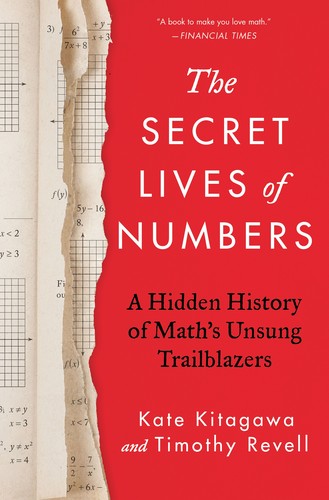
The Secret Lives of Numbers: A Global History of Mathematics & its Unsung Trailblazers
by Kate Kitagawa & Timothy Revell
Buy on Amazon
Mathematics shapes almost everything we do. But despite its reputation as the study of fundamental truths, the stories we have been told about it are wrong. In The Secret Lives of Numbers, historian Kate Kitagawa and journalist Timothy Revell introduce readers to the mathematical boundary-smashers who have been erased by history because of their race, gender or nationality. From the brilliant Arabic scholars of the ninth-century House of Wisdom, and the pioneering African American mathematicians of the twentieth century, to the 'lady computers' around the world who revolutionised our knowledge of the night sky, we meet these fascinating trailblazers and see how they contributed to our global knowledge today.…
Recommended by
"One of the things that appealed to us hugely about this book was the fact that they make it easy to understand. I must admit that I’m not very numerate but I surprised myself by really enjoying the book, and I think many of the others did as well. There are the extraordinary conundrums people began to grapple with, and they make it exciting and interesting. They range across time and across the globe. For example, there was the first use of zero, which was a phenomenal achievement in 7th century India. Somebody realized you can add it, subtract it, multiply by it, and treat it like another number, not just a placeholder. Again, it’s written very accessibly. Reading the book was the first time I understood properly what calculus was about, by reading how it was developed, step by step. What they have managed to do is to give mathematics a narrative history that can be understood by non-mathematicians, and this requires a lot of skill. There’s a wonderful phrase they use at some point in the book: ‘Mathematics is a relay’. They bring out very fluently the ways in which the baton is passed on. Sometimes it’s dropped and a concept is forgotten for a while. Sometimes it is discovered in parallel—people in different parts of the world coming up with very similar solutions to mathematical conundrums. The book is also about giving people their proper due. Women have been largely written out of the history of mathematics, but here you get accounts of women who advanced the subject in some form from 300 CE and even before that, in China. They tell a very human story. If you’re focusing on the women who were outstanding mathematicians, you cannot help but focus on the horrendous struggles they went through—by being unrecognized, by being persecuted, and then written out of history. There are also people of African American descent who were written out of the history but here get their proper due. It’s about what mathematics has meant to people, not just to individual mathematicians, but to the society they live in. Mathematics is connected not just to physics and astronomy, but also to religion, to philosophy, to social relations, to politics. These are all part of it, and I think the authors bring that out with great skill across a huge span of time."
The 2024 British Academy Book Prize for Global Cultural Understanding ·
fivebooks.com
"I can also highly recommend a book about the history of math, The Secret Lives of Numbers: A Global History of Mathematics & its Unsung Trailblazers by Kate Kitagawa and Timothy Revell. I love global history and mathematics is a really interesting lens to look at it through. Early on, we learn that we should perhaps not be calling it Pythagoras’ theorem, but the Gugou Theorem, as it had been earlier proved in China. Notable in the book is the extent to which similar concepts were discovered independently around the world. (I was also interested in the references to the I Ching, a book I was curious about because it features in the detective novel I’m currently listening to ). Looking beyond our planet, The Little Book of Exoplanets by astrophysicist Joshua Winn has already been recommended on Five Books as a great introduction to the exciting area of exoplanets, a key part of the search to find out if there is anybody else out there in our universe. Finally, I’d like to mention a book by a friend, Caspar Henderson, whose latest book, A Book of Noises: Notes on the Auraculous, is about sound. It’s a science book, but it’s also a book about appreciating nature and life. It’s beautifully, beautifully done. “For me, writing this book has been part of an attempt to listen more deeply and hold on to a sense of aliveness,” Caspar writes. You can read his interview with our deputy editor, Cal Flyn here ."