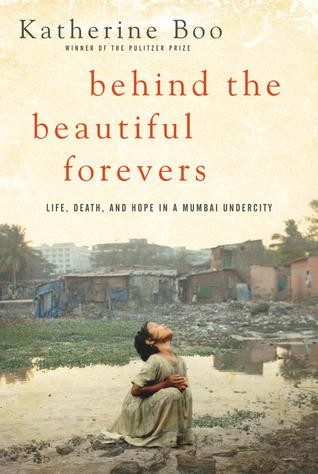
Behind the Beautiful Forevers
by Katherine Boo · 2012
Buy on AmazonThe dramatic and sometimes heartbreaking story of families striving toward a better life in one of the twenty-first century's great, unequal cities. In this fast-paced book, based on three years of uncompromising reporting, a bewildering age of global change and inequality is made human. Annawadi is a makeshift settlement in the shadow of luxury hotels near the Mumbai airport, and as India starts to prosper, Annawadians are electric with hope. Abdul, a reflective and enterprising Muslim teenager, sees fortune in the recyclable garbage of richer people. Asha, a woman of formidable wit and deep scars from a rural childhood, has identified an alternate route to the middle class: political corruption.…
Recommended by
"Finalist"
Pulitzer Prize for General Nonfiction 2013 · pulitzer.org
"What I love about this book is how it highlights the point I made earlier about the dignity of working with scrap. We have the image of garbage pickers in China and India as exploited masses, but it’s a far more complicated story than that, and in many ways it’s a business story. Katherine Boo, better than any writer I’ve encountered, was able to tell that story by going into the slum, spending time with families and with characters like Abdul, a teenage garbage picker. She teases out the various things that these people do, not only to acquire the trash, but what they do with it once they have it. Clever trash pickers are able to better themselves and their neighbours by creating a business and a future. To me it’s a really attractive message, and it’s a very tender and sympathetic portrait of these people. There are very vivid scenes in the book of walking down Mumbai’s Airport Road, which is lined by shacks and trash pickers, and then behind them are walls, and behind them are some of the finest five star hotels in India. I’ve been to some of those places, but it hadn’t occurred to me before I read this book how dependent these trash pickers are on the volume of travellers coming through Mumbai. Boo also points out how in 2008, with the global financial crash, global demand for raw materials crashed and it had a very deleterious effect on the ability of these trash pickers to make a living. At one point, when there aren’t enough people in the hotels, they’re resorting to eating frogs because there is just not enough trash being generated by the wealthy. It depends how you look at it. Roughly 60% of scrap that’s generated in the US remains in the US, and that probably holds true for Europe as well. But the stuff that flows into the developing world is significant. Scrap recyclables is the number one export to China both in the US and the EU. Modern China was, in part, built on the developed world’s waste. It’s not a matter of dumping – there’s very much a transaction going on."
The Trash Trade · fivebooks.com
"This is an extraordinary book. Katherine Boo is an American writer for The New Yorker who married an Indian man and moved to Mumbai. This is a micro-portrait of a small community who live in a slum there, just near the airport, and it is an absolutely heartbreaking portrait of what life is like in the slums today. It’s not Slumdog Millionaire . She takes a handful of characters and follows them over two or three years. She really gets into family life, and what it’s like being at the bottom of society, invisible – as well as the deep desire that everyone has in the slums of making it, becoming somebody, and moving out to the next stage of life, as it were. That’s certainly part of it. I would say there are three reasons why people have rushed to the city. Firstly, there’s always the promise of jobs. Most people in slums are in full-time work, saving money, and when they are lucky they send money back to their villages. The second reason is that life in the countryside, in India at least, is incredibly difficult. People lose their land and their rights to the land, so they are forced to come to the city. And the third reason is that a slum is a halfway house between being in the countryside and getting into the city proper. Get the weekly Five Books newsletter Slums are what [journalist and author] Doug Saunders calls an “arrival city”. They can be the incubator of the next middle class – the place that people learn about city life, and start climbing up the ladder. When one walks around slums, one does see signs of self-improvement. There might be poor sanitation, but a lot of people have mobile phones, there is television, the Internet, and people are saving so that their children can go to school and can wear pristine, ironed school uniforms. There is a sense of sacrifice in order to invest in the future. Undoubtedly it will. Over the next 50 years cities are going to grow massively, and the majority of that will be in Africa and Asia. Mumbai already has a 50% slum population, and the majority of its growth over the next years will be into those slums. What we must do is tackle the situation that slums cannot continue as they are. How we solve that issue is a huge debate. One of the first things we need to do is stop using the word “slums”. Because they’re not the 19th century slums that we imagine; they are different. This is why we have new concepts like “arrival cities”. One solution is to use huge amounts of government money to demolish slums and move people. Another is to use speculators to rebuild housing for slum dwellers. My belief is that the best people to deal with the problems of the slums are the slum dwellers themselves – improving from within. There is no silver bullet or instant solution, but we can find a long-term solution by giving people the means to improve their own lives. I hope they would look fairly similar – and that anything built over the next 50 years would be sustainable and carbon neutral. I hope there will be fewer cars or more efficient cars on the road and new forms of public transport, as well as whatever the bicycle turns into. And I think one will see an interconnectedness between major cities. When you imagine the number of people who are going to move into the city, it’s important that we start planning for it now. That’s why debates on things like Boris Island [a proposed estuary airport in London] are crucial. My warning, however, is that as cities grow bigger and stronger, the rest of the country around and beyond them will need more and more governmental support. London is becoming so incredibly powerful that if you’re not within two hours of it by train then you really struggle. What this creates is mega-regions which will become the major power source and power base of the future, to the extent that cities will almost become states in their own rights. It has to be London. Absolutely. I think London delivers on historical liveliness, and I think heritage and history are important. It’s a deeply creative, beautiful city with real diversity – a world city in which the world has come to it as much as it goes out to the rest of the world. It produces excellence in a number of different areas which makes it a very exciting place to be and a magnet for culture. I think it has a difficult relationship with the financial markets, which clearly are important to its bottom line but also warp some parts of the fabric of the city. I can’t see any political solution to that in the next few years, although one needs to be worked out. And most importantly of all, it’s home. That is the most important thing. Feeling at home in the city."
Why Cities Are Good For You · fivebooks.com
"It’s a really interesting book. Katherine Boo is an American journalist, and this is an incredibly detailed, very novelistic—even more so than the others I’ve mentioned—account of life in a slum in Mumbai, India. She researched it over the course of several years, and reveals in a quite detailed author’s note at the end that not only did she spend substantial time there with translators,—and interviewed people hundreds of times in some cases—she gave some residents GoPros, cameras and recording devices so they could record things even when she wasn’t there. Then she pieced it all together. There’s something quite amazing about reading this note right at the end of the book, because, to be honest, when I was reading it the first time, I found myself thinking, ‘how could you possibly know this?’ and assuming that she must be extrapolating her own observations, presenting them as if they were her characters’ thoughts. In fact, you get to the end, and you realise that she did know what this place looked like when this guy was on the run from the police… because he was wearing a GoPro and filmed it. So it’s a pretty amazing level of attention to detail. It’s a bold stylistic choice. Most of the books we are talking about today use, as I said, devices of fiction. But I think this one does that the most. You hear what people were thinking during certain moments in a way you wouldn’t necessarily associate with journalism. It’s confronting to read, but it’s quite amazing, and amazingly in depth. Exactly. The other books have amazing personal stories but this is different. It has a plot. It follows three families, primarily, and gears up to this big climax where one neighbour sets herself on fire to incriminate another family. We see the escalating tension that leads up to it, and the fall out that follows. It’s quite remarkable that this was captured. Of course, real life never feels like a plot, and – going back to what I was saying about working on my own book – you select your material and shape it. This is on a whole different scale in terms of the amount of material she must have had. It’s got a shape that means it doesn’t read like nonfiction at all. I was very conscious while researching my book that you are taking up a lot of people’s time, and often asking them to recount quite traumatic memories. Plus, people’s memories of traumatic incidents, in my experience, can be quite inconsistent. Sometimes you’ll ask someone something and they’ll give you an anecdote, then you’ll ask about it again three months later and they’ll give you a different version of it. That’s just how memory works. All of those things are challenging, and what you’re asking people to do is really exposing. I was almost surprised that anyone would agree to it, and I’m extremely grateful that they did. The amount of time people gave me was so generous, and you have to be mindful of that. Support Five Books Five Books interviews are expensive to produce. If you're enjoying this interview, please support us by donating a small amount . I’m assuming in the case of Katherine Boo that she must have become part of the furniture in the slum, if she’s doing this over the course of several years. But it’s definitely something to consider—you might be preventing people from getting stuff done. People have kids, or work to do, things that don’t involve sitting around and talking to you. So it’s a balance you need to strike."
The Best Narrative Nonfiction Books · fivebooks.com
Goodreads Choice Awards — 2012 · goodreads.com