Peter Stothard's Reading List
Peter Stothard is an author, journalist and critic. He is a former editor of The Times and of The Times Literary Supplement . His books include Alexandria: The Last Nights of Cleopatra and On the Spartacus Road: A Spectacular Journey through Ancient Italy.
Open in WellRead Daily app →Editing Newspapers (2009)
Scraped from fivebooks.com (2009-12-31).
Source: fivebooks.com

Peter Forster · Buy on Amazon
"Yes. Instead of describing high politics, the prime minister on the phone, proprietors breathing down your neck and all that tends to make up the caricature notion, he talks about the problems between the editor’s secretary and the secretary in the sports department, and the problems of having too many lunches in the same week with people you don’t need to have lunch with, and how easy it is to waste your time. He talks about primadonnas on the brink of resignation, and how lawyers and diarists have different standards of truth… “It’s always possible to forget the effect of what you are writing on the people you are writing about.” It’s not a great novel. To some extent it’s a novel of management with a romantic plot, but it does at least attempt to deal with the personal aspects of editing a newspaper. It’s a kind of cautionary tale. It’s got a wonderful opening line: “He eased himself into the chair behind the big desk and thought, ‘Well now it will be different’.” Now he was editor! And it describes all the things he thought he would do before he became the editor, and how they would be done. And the things that stop him doing all these things are not big things. They’re all the little things that I can recall so well. It is one book which describes the experience from the inside. Most of the books about newspaper editors tell it from the outside, from the point of view of people who are critical – of which Trollope’s is one of the most famous."
Anthony Trollope · Buy on Amazon
"The plot of The Warden has been a familiar one this year. It’s about middle-ranking, mostly decent people who have had financial privileges, which to them – in terms of their own internal logic and their own rules – are absolutely OK. Then there’s a protest and a leak. The Times gets hold of the story and suddenly everything is upside down… There are no bad people in The Warden. The comparison with our own MPs is quite telling. The top churchmen always had most of the money once bequeathed to support the local pensioners. They justify that to themselves on the grounds that the church should make its own rules, and that society was better if it did. And only when it was given a harsh write-up in the press did it become clear that the internal, moral logic that they thought was perfectly fine actually wasn’t. And the warden loses his job, even though the whistleblower takes pity on him, goes to the man at The Times and says, look, can we call this whole thing off? And, of course, he can’t, because the thing by that stage had its own media momentum. It’s always good to learn from critics of newspapers. Sometimes newspaper people feel that everyone is getting at them. In fact, newspaper editors do have a great deal of power, and it is sometimes possible to put abstract principles above the ordinary good. It’s always possible to forget the effect of what you are writing on the people you are writing about. However much newspaper editors try to stay close to their readers and to ordinary life, the prospect of becoming a distant figure is always there. The fictional editor of The Jupiter wasn’t called Tom Towers for nothing. He may not have been exactly in an ivory tower, but he was not easy to meet. And the notion that he could send off “the thunderbolt” from so far away was what upset Trollope so much, the power to fire and forget at no risk to yourself. Now, I’m not saying that Trollope was correct, or that what Tom Towers does in The Warden wasn’t exactly the right thing to do – I’m sure it was – but, what Trollope explains is the effect the newspaper has not just on “bad people”, the people cleaning their moats at public expense, but the people doing things they thought were ordinary. There’s a clear link with what happened over the MPs’ expenses scandal last autumn: good people are dragged down with the bad. It is a nuanced book, which draws attention to that, and a good one for any editor to read."
Philip Knightley · Buy on Amazon
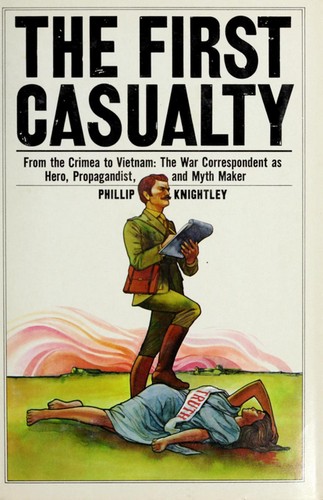
"Yes. It’s a pretty terrifying book for an editor to read, but I think it’s essential reading for anyone sending reporters into war. I think modern editors tend to feel quite superior to their predecessors, the ones who sent official reporters to the First World War, whose job was nothing but to make sure that people at home felt that everything was OK. We don’t do that any more. We also, I think, have tended to feel quite superior to the shadowy editors of Scoop, the ones who are obsessed only with having some identifiable “good cause” they can play to their tabloid readers and having a low telex bill at the end of the day. But, actually, the chapter on Kosovo in the new Knightley, whose coverage you and I watched together at The Times and whose direction we played a part in, makes quite a grim story about us. Those Serbian rape camps, a huge issue for the justification of the aerial bombing, were, it seems, based on one source. The original journalist was totally blameless, of course, but Robin Cook was asked if he could confirm the suspicions about the rape camps, and he confirmed that there were suspicions! And that created an astonishingly widespread account. Well, I’m not sure that even now we’re clear on what happened and what didn’t, but the journalism analysed by Knightley does suggest that it wasn’t journalism’s finest hour. Get the weekly Five Books newsletter As for how patronising we are about the journalists in the First World War, well, at least those journalists were actually there. Because Kosovo was an aerial war (remember it was the first war in history where no military personnel suffered even a scratch) there was no way of knowing exactly what was going on. The best that we could do was to attempt the widest possible range of reporting – say, one person from the Serb side, others embedded with Nato, and some guy hammering around the battlefield trying to get to wherever there were smoke and flashes. That way you could just about get an idea of what was going on for a very “first draft of history”. And again, it’s useful for an editor to read the book. It will not help you avoid every mistake. Some of these mistakes are woven into the very fabric of producing a newspaper, for all the technological changes that have taken place since the Crimean War."

Michael Frayn · Buy on Amazon
"This book is often recalled for a very famous portrait of lunchtime seen from a Fleet Street window. Everybody’s going out for lunch. The literary editor and the foreign editor are going off to the Garrick by taxi, the subs are going off on foot to the cafe, the advertising bosses on a stroll to El Vino. And then: “The editor shuffled out, unnoticed by anyone, and caught a number 15 bus to the Athenaeum.” The editor is totally invisible in Frayn’s account of rivalry between the “old lads” and the “young turks” in what was then the new age of TV and celebrity. The beauty of the Frayn account is the invisibility of the editor, which in some respects is probably the best model of all. Well… no. Not the bus. But there weren’t many going past Wapping…"

Harold Evans · Buy on Amazon
"Well, editing is not something that you can learn from books. That’s true of many things. But a book that can still be of inspiration. A bit of inspiration doesn’t go amiss. This one is not hostile, like the Trollope. Nor does it see editors as dysfunctional figures, as Forster does. Harry’s book is not much about leaders and opinion at all. It’s mostly about investigation and communication and presentation and making your readers aware of what’s going on. I think that once you’ve read all the way from one end to the other, and then thought how we’re going to maintain that particular tradition of journalism in the internet era, it’s a worthy end to a set of books which otherwise might be rather depressing. The First Casualty suggests that editors’ control over things is straying; in Towards the End of the Morning they are probably doing well, but are rather invisible; in The Warden they do bad things even for good motives and it’s not always easy to separate out the two. But My Paper Chase is a rather inspirational book, about the highlights of some of the best things editors have achieved."
Julius Caesar (2020)
Scraped from fivebooks.com (2020-11-20).
Source: fivebooks.com

Greg Woolf · Buy on Amazon
"Having to choose five books about Julius Caesar has been a great challenge. Caesar is someone whom you have to look at through many different lenses and prisms. He is not an easy character to see straight up. Looking at him might be compared to looking at the sun. He wasn’t the sun, except to some of his most extreme admirers. But if you try to look at him from one sole direction, it is rather blinding. So, the books I’ve chosen—and Greg Woolf is a very good introduction to this—try to look around Julius Caesar, to look at the ways different people saw him at the time and have seen him since. Woolf’s is a good account of how Caesar got to the Ides of March and what happened on the day. It’s quick and short and a very good start. But there’s also a long section on how the assassination reverberated through history, across Europe and across the Atlantic. ‘ Et tu, Brute? ’ was one of Shakespeare ’s many contributions. If he said something like it, it is more likely he said the Greek words, ‘kai su, teknon’ , which means ‘and you, my child’ and has been variously interpreted to mean ‘even you, who I’ve loved so much’ and ‘even you, the son of my mistress’ or ‘you, too, are going to be assassinated in your turn.’ Maybe it meant ‘I’ll see you in hell’ or a version of ‘up yours, Brutus.’ The Greek phrase has been interpreted in many different ways and Shakespeare’s ‘Et Tu, Brute?’ was just a convenient way of Shakespeare saying what a Roman might have said. He was born into a good family. All the people we’re talking about in the story, all Caesar’s assassins, were part of the elite, if you like, although the man that I have recently become most interested in, Cassius Parmensis, the last surviving assassin , wasn’t one of the top ones, which in some ways made his eyes a good lens through which to watch the action. Caesar was a member of one of the elite families which had been rivals, squabbled and cooperated with each other, and fought against each other for hundreds of years, and had made Rome the extraordinary conqueror of so much. Gradually, it turned out that the bigger Rome’s empire, and the bigger the army its generals had, the more impossible it was to control them from the centre. So, Caesar, out in Gaul, with a lot of legions, was a lot more powerful than the Senate, which was supposed to be his master. So the system risked toppling over under its own weight. “Caesar had many friends…But it turned out that some of those friends, for various reasons, were also his greatest enemies” But there were still people who thought they could prop it up, that the problem was not the system but Caesar himself. These people were also within the elite—not among the people or the army, who largely loved Caesar, as the assassins found to their cost. These killers thought that, if they could just get rid of Caesar, they could go back to divvying up power in Rome between themselves, as they’d always done."

William Manchester · Buy on Amazon
"This book is a great example of how long the idea of Caesar lived in the minds of people writing about soldiers and politicians. MacArthur was an extraordinary figure. He prided himself on his superiority to everybody else, to his speed and imagination. He didn’t like trench warfare or anything that was slow. He prized the unexpected. He was an egomaniac—not for nothing claimed by Donald Trump as his favourite general—and often cited by people who want to fight the establishment, who want to argue that the establishment is always plodding and slow and wants to do things the way it’s always done them. Get the weekly Five Books newsletter Donald Trump liked to compare himself to Douglas MacArthur just as MacArthur’s biographer liked the comparison to Julius Caesar. They were people who did things differently, who subverted the ideas of the elite to really work for the people. This is a continuous strand of thought since the death of Caesar—and the background to a big bit of Donald Trump’s mind. Yes, he did, in many different respects. Caesar’s writings were designed to make him a hero back home, even when fighting a long way away. And MacArthur in the Pacific Islands was a master of making sure that everybody back home knew what he was doing and who was setting the big policies. He was never in retreat—only ‘advancing in another direction’, a very Julius Caesar-like thought. When MacArthur said, ‘the most important rules are the ones you break’, he was also echoing Caesar. He ruled postwar Japan like a Caesar. Eventually the American president at the time, Harry Truman, got fed up with this, decided that he was risking a war with China over Korea and, in April 1951, ordered him home. He made a lot of fuss for a long time, stamping up and down the country. He made a fortune speaking. And it was a long time before he gave up the idea that he might have political ambitions of his own. He was an egomaniac. He did have political ambitions, but he was thwarted. He died just a very short few months after the assassination of President Kennedy . One of his great lines was that old soldiers never die, they just fade away. Douglas MacArthur, once President Truman had sacked him, did fade away—until Donald Trump brought the American Caesar back. That might have been the Roman Caesar’s fate, too, but because he was assassinated, a certain idea of Caesar was propelled thousands of years ahead."
George Bernard Shaw · Buy on Amazon
"Shaw had a very high view of himself and compared himself constantly to Shakespeare. He thought that, in respect of the handling of power, Shakespeare had got the Romans wrong. His idea was that Shakespeare was very good at dealing with failure and romance, but not very good at dealing with the great hero. Shaw paints a portrait of Caesar in which his motivations, those that romantic biographers and filmmakers like to show as being all about love, were actually formed by hard-nosed, brutal political calculations and realities. Shaw was making comments, in a sense, on the British occupation of Egypt, which had started in 1882, and relating it to the Roman occupation. He took the hardest-nosed, de-romanticised view of that part of Caesar’s life—in contrast to the view put up by so many storywriters, balladeers and Shakespeare. Shaw was very interested in Nietzsche and he thought that Caesar was an example of ‘the New Man’ who would solve the problems of the old world. He saw Pompey, whom Caesar had defeated after his crossing of the Rubicon, as part of the old world that had to be pushed aside. Shaw was writing at a time a time when many people were keen to dismiss the old and corrupt and find new superheroes. He thought that Caesar was a great man who had not been able to find a vehicle to show his greatness. It’s fun and gritty and it was a huge hit on Broadway in its day. It would probably now be considered a bit old-fashioned, but Shaw is a great playwright to read. He always wrote long introductions to his plays explaining what the play was all about. You know what Shaw was trying to say about Julius Caesar, even if the performance doesn’t quite say it."

Julius Caesar · Buy on Amazon
"He had the talent and he had extraordinary stamina. He had people who helped him, secretaries and copiers. Some of his adjutants were effectively people helping him with his writing. One of the things they all said about him was that he had this gift for what we might now call multi-tasking. He could dictate six or seven letters, write a speech and watch where the enemy was going all at the same time. This was probably massively exaggerated but, clearly, then as now, some people are much better at that than others. Exactly. And I think if you’ve got that skill and other people don’t, it’s useful to play it up because it does make you seem somewhat superhuman, even if actually you’re doing something that lots of ordinary people can do as well. We all know people who can only concentrate on one thing and people who can do four or five things at once. If one of those skills is elegant, clear writing, that is a rare and very useful gift. “‘Et tu, Brute?’ was one of Shakespeare’s many contributions.” One of the reasons why Caesar’s Gallic Wars became a set text for generations and generations of British, German, French and American schoolboys was not just because it showed a hero in his own voice—if you thought of Caesar as a hero—but it also had this extraordinarily disciplined, economical and beautiful use of language. He was an extraordinary writer and I don’t think Five Books on Julius Caesar would be complete without the Complete Works . These include the famous Gallic Wars but also books for the period covered by Shaw’s play, the so-called Alexandrian War, the time when he was fighting to get Cleopatra established in Egypt. This one was probably written by admirers of Caesar, the so-called ‘continuators’, who fought with him in Gaul and other war zones and who finished the books off after he died. And you really can tell the difference in style between the books that Caesar wrote himself and the rest. The continuators keep the character of Caesar going but are unable to match Caesar’s Latin. The Commentaries absolutely served a political purpose, which is one of the reasons why they’re so clear and focused. He was fighting away from Rome for years and years at a time. But he still needed the support of the Romans and so he wanted them to know what he was doing, just like MacArthur, following him, did. So the Commentaries on every year of the war in Gaul found their way, pretty deliberately, back to Rome and they were copied and people talked about them and said, ‘Isn’t Caesar doing fantastically well?’ And that’s where the assassins really got it so wrong, because the people knew that Caesar was doing all these great things, the soldiers knew that he was doing these great things. By modern standards, he was a genocidal egomaniac but on their terms he was doing very well by Rome. Support Five Books Five Books interviews are expensive to produce. If you're enjoying this interview, please support us by donating a small amount . That view was much advanced by the image of Caesar that Caesar had created himself. The Commentaries were a very important part of projecting that image, as it were over the top of the Senate, to the Roman people. Again, it’s that kind of language you get from Trump and other populists : you can bypass the elite and somehow get your message straight to the ordinary people. Although we don’t know a lot about the publication of Caesar’s work, it is pretty clear that people in Rome had a very good idea of what he had achieved and these Commentaries were his way of making sure they did. To some extent. But they were more extensive and connected than that. They were more like newsreels, really. They were long and described every battle, or rather every battle he wanted you to know about. Any battle that he lost or nearly lost could be deemed not a battle at all and quietly edited out. But he was judicious. Not everything went well for him. When it came to Britain he wrote an account of his two attempts to conquer Britain, both of which were failures. He found reasons to explain that. He didn’t pretend that everything was absolutely wonderful which, of course, probably in itself improved the credibility of what he did say. No, there is no sense of what he was doing at night. That would have been unusual. I don’t think that meant that Caesar was particularly secretive. It’s just not the particular style of that particular book, any more than Douglas MacArthur, when he was relaying his exploits back home, would have told you about the mistress in his hotel bedroom. You do get an impression of someone who was swift, decisive, successful and brutal when he had to be. His writings also stress strongly his capacity for clemency, a virtue that was very important to Caesar but also would shame and irritate some of those who became his assassins."
Sandra R. Joshel (Ed) · Buy on Amazon
"Yes. It’s a good part of a very good book. Carry on Cleo , one of the most popular of the Carry On films, is another important way of looking at Julius Caesar. The people who made the films would have probably laughed at the idea that they were a socio-political text, but Nicholas Cull is right to present them in that way. The plot of Carry On Cleo is a mishmash of the stories of Caesar and Cleopatra, Antony and Cleopatra, plus a bit about the invasion of Britain all mixed into one. It is quite a good reminder that a lot of the history we read, which all seems so clear-cut, might be just as much of a mash-up. But it’s also a sort of triple satire—on Caesar himself, on the British Empire (which by the 1960s was fading fast) and, perhaps most importantly, a satire on the new American hegemony. The whole film is based on the set of the great Richard Burton/Elizabeth Taylor Cleopatra film . Get the weekly Five Books newsletter The Carry On producers said they could make a whole film about Cleopatra in the time that it would take Joseph Mankiewicz and his team to paint one wall of a set. Carry On Cleo was done on the cheap, very quickly, and had a wonderful script. And it has the amazing line of the assassination where Kenneth Williams, as a very camp Julius Caesar, comes storming out of a door with a dagger in his back and a lot of angry assassins behind him, and shouts, ‘Infamy! Infamy! They’ve all got it in for me!’ Many fans of British comedy in the postwar period say that the line was never bettered anywhere."