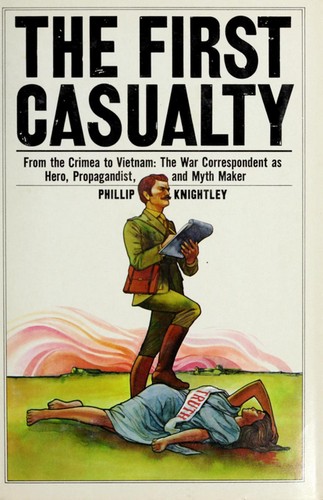
The First Casualty
by Philip Knightley
Buy on AmazonThe First Casualty when war comes, is truth," said American Senator Hiram Johnson in 1917. In his gripping, now-classic history of war journalism, Phillip Knightley shows just how right Johnson was. From William Howard Russell, who described the appalling conditions of the Crimean War in the Times of London, to the ranks of reporters, photographers, and cameramen who captured the realities of war in Vietnam, The First Casualty tells a fascinating story of heroism and collusion, censorship and suppression. Since Vietnam, Knightley reveals, governments have become much more adept at managing the media, as highlighted in chapters on the Falklands War, the Gulf War, and the conflict between NATO and Serbia over Kosovo.…
Recommended by
"Yes. It’s a pretty terrifying book for an editor to read, but I think it’s essential reading for anyone sending reporters into war. I think modern editors tend to feel quite superior to their predecessors, the ones who sent official reporters to the First World War, whose job was nothing but to make sure that people at home felt that everything was OK. We don’t do that any more. We also, I think, have tended to feel quite superior to the shadowy editors of Scoop, the ones who are obsessed only with having some identifiable “good cause” they can play to their tabloid readers and having a low telex bill at the end of the day. But, actually, the chapter on Kosovo in the new Knightley, whose coverage you and I watched together at The Times and whose direction we played a part in, makes quite a grim story about us. Those Serbian rape camps, a huge issue for the justification of the aerial bombing, were, it seems, based on one source. The original journalist was totally blameless, of course, but Robin Cook was asked if he could confirm the suspicions about the rape camps, and he confirmed that there were suspicions! And that created an astonishingly widespread account. Well, I’m not sure that even now we’re clear on what happened and what didn’t, but the journalism analysed by Knightley does suggest that it wasn’t journalism’s finest hour. Get the weekly Five Books newsletter As for how patronising we are about the journalists in the First World War, well, at least those journalists were actually there. Because Kosovo was an aerial war (remember it was the first war in history where no military personnel suffered even a scratch) there was no way of knowing exactly what was going on. The best that we could do was to attempt the widest possible range of reporting – say, one person from the Serb side, others embedded with Nato, and some guy hammering around the battlefield trying to get to wherever there were smoke and flashes. That way you could just about get an idea of what was going on for a very “first draft of history”. And again, it’s useful for an editor to read the book. It will not help you avoid every mistake. Some of these mistakes are woven into the very fabric of producing a newspaper, for all the technological changes that have taken place since the Crimean War."
Editing Newspapers · fivebooks.com