David Marquand's Reading List
Open in WellRead Daily app →The End of The West (2011)
Scraped from fivebooks.com (2011-08-12).
Source: fivebooks.com

Tony Judt · 2005 · Buy on Amazon
"This book is all about the way that Europe has managed – not always totally successfully, but managed nevertheless – to come to terms with its bloody and horrible past. Europe was one of the most war-torn parts of the earth for a very long time and yet it has managed to construct a community which, though not perfect, has laid the demons of European history to rest. It is a mixed picture, as real world pictures usually are. But I think Judt’s book is an absolutely superb portrayal of that process. The European project has been incredibly successful in lots and lots of ways. But now I think it has rather sadly run into the sands. Because of that, it is finding it extremely difficult to adjust to the changes that are taking place in the wider world, of which the end of the West is a central part. Yes, it does. The idea of Europe coming to terms with the end of the West has a particular sub-theme, in that Europe always thought of itself as the West from the time of the ancient Greeks. Europe used to be the epitome of the West, but World War II knocked Europe off its perch. It used to be the heartland of the West but then, when it needed America’s help to win World War II, America took over. There has been this rather dangerous assumption for the past 50 years, in the back of the minds of Europeans, that because we are the West and America is the West, we can always rely on America to save us from difficulties. And one of the things that is happening in the world now, which is very graphically illustrated by the present situation in Libya, is that the Americans aren’t able to do that any more. Although France and Britain have seen this need for Europe to get its own act together, the rest of Europe hasn’t. The Germans in particular have been dragging their feet hugely, saying it’s the Americans’ job to save the chance of democracy in Libya, not ours. Libya is, of course, on our doorstep and much further away from America."

Fareed Zakaria · Buy on Amazon
"Zakaria is Indian by origin and he went to America in his youth. He is now a very prominent journalist in America. His thesis is that America, while still being a superpower, has got to contend with the rise of other countries. It can no longer call the shots in the new world that is developing. This is not a new thesis, but he puts it forward very powerfully and very well. He also looks at the question of whether America can continue to succeed in a world where other countries are catching up in terms of markets and economic progress. Because other countries are rising, America is falling relatively. He is asking the question rather than answering it. You can’t be sure. I think it is a very difficult and painful thing for a country that was the unchallenged top dog to come to terms with a situation where there are some other dogs around – which may not be quite as big and powerful as it is but are still, in the aggregate, not a threat necessarily but too powerful for the top dog to control the kennels. It is not easy and British history shows it is not easy. We were the top dog in the middle of the 19th century, and we lost our top dog position in the course of the second half of that century and the early part of the 20th century. We were challenged by the United States and by Germany, and it was very tough to come to terms with it. We did in the end but we had perhaps more time to deal with it than the US has now. I don’t know whether the US will come to terms with it or not. I think the present Obama administration is doing so, and thank goodness we have in Obama an extraordinarily adept American president who I think understands this shift in the global balance, not just intellectually but in his gut. Partly because this is the world that he lives in – he is existentially part of this world in a sense that no American president before has ever been. This is a man whose father was a black Kenyan who started life as a goat herder, and who himself spent a very considerable part of his life in Indonesia. It is an extraordinary career trajectory for an American president, so I think he does get it. He doesn’t always deduce perfect solutions from it, but he is in tune with it emotionally. I think Obama represents hope, but you can easily imagine a different response, a surly inward-looking kind of response – common, it seemed, amongst the neo-cons who were clustering around George W Bush at the start of the 21st century. It is by no means certain that they will find a benign way out. Maybe because I am an incorrigible optimist I think the odds are that they will, but one can’t count on it."

Alistair Horne · Buy on Amazon
"I included this because I was hugely influenced both by the book and by actually visiting Verdun, which I did at the beginning of my work on my recent book . The point about Verdun is that it was the most unbelievably destructive battle ever fought on the European continent, west of the old Soviet Union. It had an enormous symbolic significance for me and also for a whole generation of French people. The coming together of France and Germany, which was the very beginning of the European project, is to me one of the most remarkable things that has ever happened in world history. Verdun was the most horrific example, where at least 700,000 men were wounded or killed in a front of 15 miles. By a stroke of genius, the elites of battered post-war Germany and equally battered post-war France realised that they couldn’t go on like this, and that is what Verdun symbolises for me. It is also a very good book."

Maria Rosa Menocal · Buy on Amazon
"This had a huge influence on me when I was researching my latest book. I think the biggest threat to the values of pluralist democracy in present day Europe is Islamophobia. There is a very serious danger that this will be to the 21st century what anti-semitism was to the last century. I don’t think it has done so yet, but it could. I found the Rosa Menocal book quite inspiring because of what it showed about the possibility of the Muslim, Christian and Jewish civilisations living together. They managed to co-exist peacefully and to learn from each other in the period that we think of as the Middle Ages or even the Dark Ages. That’s right. And in a brilliant way because it showed, among other things, that this notion about how the West is infinitely superior to the East is misplaced. You could argue Spain was Eastern or Western in terms of culture rather than geography. I think it was a number of things. The myth goes back to ancient Greece, but it was taken over by the Romans and then by the Christian church. Then it takes a slightly different form. It is not that the West is necessarily more technologically advanced than the East, but that the West is saved in religious terms while the East is full of enemies of Christ. I think it was different. I don’t think the Chinese ever wanted to go on crusades against the West. They just thought they were superior to everyone else. Oh yes. Human beings aren’t always very nice people."
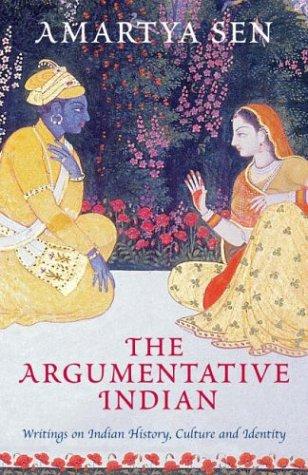
Amartya Sen · Buy on Amazon
"I found this book extraordinary. I think that Amartya Sen is one of the most remarkable intellectuals of our time. He is a great economist who won the Nobel prize for economics, but he is also fascinated by the history of his own country – which is of course India. In this book, he shows that it is not the case that India is a democracy now just because it was fortunate enough to be ruled over by the British, who exported democracy to India. He shows that in fact there were roots of a democratic culture in India long before the British ever got there, and that is what he means by the “argumentative Indian”. Indians were argumentative, and his take on democracy is that it is above all about what he calls “public reasoning” – and that the Indians were doing that already. They were also very multicultural. It was essentially a civilisation that was extraordinarily tolerant by European standards. I don’t think we should think of ourselves as the West any longer. I think that the notion of a homogeneous West – which has uniquely important values that are under threat from other places – is a very dangerous way of looking at ourselves and at the world as a whole. I think we can learn from Rosa Menocal’s Spain. We can learn tolerance. We can learn to be a bit less hubristic about ourselves and a bit more willing to listen to other people. That may sound very bland, but that is what we have to try to do."