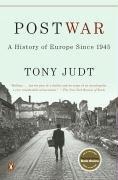
Postwar: A History of Europe Since 1945
by Tony Judt · 2005
Buy on AmazonThe first truly European history of contemporary Europe, from Lisbon to Leningrad, based on research in six languages, covering 34 countries across 60 years, using a great deal of material from newly available sources. The book integrates international relations, domestic politics, ideas, social change, economic development, and culture--high and low--into a single grand narrative. Every country has its chance to play the lead, and although the big themes are handled--including the cold war, the love/hate relationship with America, cultural and economic malaise and rebirth, and the myth and reality of unification--none of them is allowed to overshadow the rich pageant that is the whole.--From publisher description.
Recommended by
"A book that deeply informs my journalist sense. History does not exist to comfort us."
Ta-Nehisi Coates's Top Ten Books · onegrandbooks.com
"There are several reasons why I have chosen this particular book. Firstly, I wanted to choose a book that was a general book on postwar Europe and there are surprisingly few of them about, which is one of the reasons I wrote my latest book. Judt’s book is a comprehensive history of the whole of Europe from 1945 almost up to the present day. What makes it so good is not only the scholarship that shines on every page but also his wonderful writing style and his ability to take difficult and complicated issues and summarise them in a way that is easily understandable. So despite the fact that it’s a really comprehensive book – it’s about 1,000 pages long – it doesn’t feel like a heavy read. “Hundreds of thousands of people were either directly killed or died through starvation or mistreatment in the aftermath of the war.” As a reference book, this is really the starting point of everything. If you want to read about the postwar period, you have to start with Tony Judt. Another thing that is so good about it is that it’s both chronological and thematic at the same time, which is quite a difficult feat to pull off for any writer. So he starts in 1945 and goes through to 2005, but along the way he picks out the main themes that are relevant to that particular period in history and goes through them one by one within the block of years that he happens to be talking about. It’s extremely shocking but, if you think about it, it makes perfect sense. All the people who were left behind after the Jews had been shipped off to concentration camps profited quite well from it. Jewish property was shared around the community. There were plenty of poor people who had decent clothes and furniture for the first time because the possessions of Jews had been stolen and given to them. The last thing these people wanted was for the Jews to come back and reclaim their property. So, in the instances when they did come back, there was a lot of resentment, which slowly developed into the same old anti-Semitism that existed before and during the war. The pogroms which happened in Poland, Slovakia and Hungary speak for themselves. They certainly were in denial for decades. To a certain degree they are still in denial, but not nearly as much as they were. A lot of time has passed and it is a lot less painful for people to admit things now. Nobody likes to think badly of themselves. So for several decades after the war, people liked to think of themselves as being the heroes of the war. The French resistance is a perfect example. Suddenly at the end of the war everybody in France was a member of the resistance and the idea of collaboration was very conveniently swept under the carpet. It’s just a matter of people wanting to feel good about themselves and in order to do that they shifted all the blame on to Germany and the Germans – it was the easy psychological thing to do."
Books on the Aftermath of World War II · fivebooks.com
"This book is all about the way that Europe has managed – not always totally successfully, but managed nevertheless – to come to terms with its bloody and horrible past. Europe was one of the most war-torn parts of the earth for a very long time and yet it has managed to construct a community which, though not perfect, has laid the demons of European history to rest. It is a mixed picture, as real world pictures usually are. But I think Judt’s book is an absolutely superb portrayal of that process. The European project has been incredibly successful in lots and lots of ways. But now I think it has rather sadly run into the sands. Because of that, it is finding it extremely difficult to adjust to the changes that are taking place in the wider world, of which the end of the West is a central part. Yes, it does. The idea of Europe coming to terms with the end of the West has a particular sub-theme, in that Europe always thought of itself as the West from the time of the ancient Greeks. Europe used to be the epitome of the West, but World War II knocked Europe off its perch. It used to be the heartland of the West but then, when it needed America’s help to win World War II, America took over. There has been this rather dangerous assumption for the past 50 years, in the back of the minds of Europeans, that because we are the West and America is the West, we can always rely on America to save us from difficulties. And one of the things that is happening in the world now, which is very graphically illustrated by the present situation in Libya, is that the Americans aren’t able to do that any more. Although France and Britain have seen this need for Europe to get its own act together, the rest of Europe hasn’t. The Germans in particular have been dragging their feet hugely, saying it’s the Americans’ job to save the chance of democracy in Libya, not ours. Libya is, of course, on our doorstep and much further away from America."
The End of The West · fivebooks.com
"I thought this book was important for our conversation because in order to understand the euro, one really has to understand how Europeans see their own history. One has to understand the priority that European leaders and the intellectual elite attach to political reconciliation and integration. The book is not about the European economy or the euro per se – although the author understands economics, and monetary economics specifically, perfectly well. What the book does, above all, is to give one a sense of origins of the European project and of the depth of the political commitment to deeper integration, of which the euro is part. The idea that European integration is a mechanism for delivering peace and harmony is now deeply ingrained – the fact that the disputes over how best to resolve the euro crisis are creating political tensions and schisms notwithstanding to the contrary. As a result, each time that Europe has reached a crisis and had to decide whether to go forward or go back, it goes forward towards deeper integration. Angela Merkel’s personal preferences notwithstanding, I think she will feel strong pressure to do likewise. It was Jean Monnet, the father of European integration, who once said something to the effect that “Europe will be forged in crises”."
The Euro · fivebooks.com