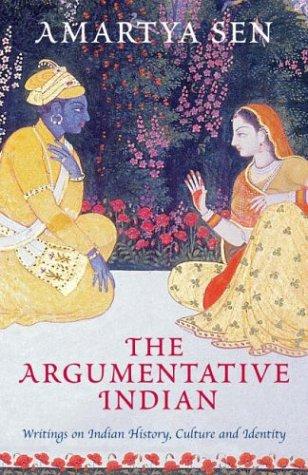
The Argumentative Indian
by Amartya Sen
Buy on Amazon"The Argumentative Indian brings together a selection of writings from Nobel prize-winning economist Amartya Sen that outline the need to understand contemporary India, including its thriving democracy, in the light of its long argumentative tradition." "Understanding the political, social, cultural and economic challenges that contemporary India faces demands an adequate appreciation of its pluralist, interactive and dynamic heritage. Sen argues that external views also affect the national perception of identity through an interactive process, especially in the post-colonial world. The West has often perceived India as a place of endless spirituality and unreasoning mysticism.…
Recommended by
"I found this book extraordinary. I think that Amartya Sen is one of the most remarkable intellectuals of our time. He is a great economist who won the Nobel prize for economics, but he is also fascinated by the history of his own country – which is of course India. In this book, he shows that it is not the case that India is a democracy now just because it was fortunate enough to be ruled over by the British, who exported democracy to India. He shows that in fact there were roots of a democratic culture in India long before the British ever got there, and that is what he means by the “argumentative Indian”. Indians were argumentative, and his take on democracy is that it is above all about what he calls “public reasoning” – and that the Indians were doing that already. They were also very multicultural. It was essentially a civilisation that was extraordinarily tolerant by European standards. I don’t think we should think of ourselves as the West any longer. I think that the notion of a homogeneous West – which has uniquely important values that are under threat from other places – is a very dangerous way of looking at ourselves and at the world as a whole. I think we can learn from Rosa Menocal’s Spain. We can learn tolerance. We can learn to be a bit less hubristic about ourselves and a bit more willing to listen to other people. That may sound very bland, but that is what we have to try to do."
The End of The West · fivebooks.com
"This is another interesting book, in a very different way though. Again, it’s by a person who began as a theorist. Amartya’s early work was virtually all as a logician: he did absolutely first-rate work on symbolic logic and choice theory. The Argumentative Indian is his post-Nobel prize book. And if the name of the author were suppressed from this book, you would never guess that it was written by the same person who wrote some of the early mathematical economics and symbolic logic works. In this book Amartya Sen manages to reinvent himself and that is remarkable. It’s a beautifully written book. It revolves around a thesis which is not the most persuasive part of the book, I have to say. The thesis is that India is a particularly argumentative nation, and that even the ancient texts, for instance, in terms of number of pages outstripped the Iliad or the Odyssey by – I forget the exact number – 20 times or so. The verbosity of the nation stands out from long back into history. I don’t know about that. Depending how you count, almost any nation could be portrayed as argumentative. But he uses this central theme to range over an amazing breadth of scholarship, from early Indian religious documents, to contemporary concerns about caste, the role of group identity, community identity, religious identity and also nationalism. The sweep is magnificent, and also Amartya is very funny. He was my PhD adviser by the way, so I have some first-hand experience. He writes with a lot of wit and that’s very evident in this book. Speaking of argumentative or talkative Indians, I’m just remembering Alfred Marshall. Alfred Marshall is one of the gurus of our field, and wrote a classic book, Principles of Economics , in 1890. There was an Indian who wrote a letter to Alfred Marshall, the gist of which was, “Great master, how can India do as well as Japan?” And Marshall’s reply, again in gist, was – “If Indians worked more and talked less, the way the Japanese do”. This speaks to Amartya’s theme; this belief that Indians are argumentative and that they talk too much. But it is the stories in the book that appeal to me. Let me give you an example that is just marvellous and quintessential Sen. The major religious text for the Hindus is the Gita, and the book has a lot of discussion of that. There is one part where the warrior king Arjuna and the god Krishna are having an argument on the battlefield about whether to go to war or not. Arjunais feeling weakened at the thought of the massacre that will occur and doesn’t want to go, and Krishna tells him about the importance of duty: that it is his duty as a warrior king to do it, and he must not think about the fruits of it, which can be good or bad. The standard Hindu interpretation is that Lord Krishna’s advice is the right advice. But Sen says that when you look at the desolation and death caused by the war that occurred you begin to wonder if Arjuna wasn’t right in his hesitation to go into war – and maybe the lesson that we could take away is that one. There is also a wide-ranging discussion about other writers – the atheists and agnostics and their traditions. Also, something which appeals to me, he talks about the importance of India having a broad, humanist, international identity, and being an open society. Sen writes about the early Indian rulers Akbar and Ashoka, who were in this tradition. I wrote a review of this book a couple of years ago, where I discussed India’s first prime minister, Nehru, at length. For Nehru too, internationalism was extremely important. In fact, there is a marvellous letter that Nehru wrote to all the chief ministers, saying, “We can’t do away with nationalism at this stage of history. Nationalism is an important instrument. But we have to remember that a time must come when we have to go beyond nationalism, and celebrate only our international identity”. For a prime minister to say this is quite remarkable. A lot of Sen’s book is in this tradition. It’s not economics, it’s political economy, history. It’s a book that I could recommend to anybody."
The Indian Economy · fivebooks.com
"I think Amartya Sen’s The Argumentative Indian. What it does – especially if you read it after reading the previous three books – is supplement all the knowledge you have gained; it deepens and enriches it. And complicates it, of course. The book is actually a collection of essays, which sounds very dull. But if you read these books in this particular order, you’ll find that suddenly new avenues of thinking and experience open up to you. It helps you to understand a lot of things that may surprise you in India when you go there for the first time – or even after you’ve been many, many times. I’ve spent most of my life there and am still surprised and bemused by the place. The book does a tremendous job of giving you a sense of the many, many layers of history, of identities, that constitute this society. It goes back way into the past: it talks about medieval India, it talks about Islam in India, it talks about Buddhism, it talks about the Indian calendar. There’s an article on how India has many different calendars. Different people, different communities have had a very different sense of time. It really attests to the particular character of Indian society that it can accommodate within itself people living at very many different levels time-wise. It is very much him. The broad thesis that he offers is that there is a particular philosophical tradition – in fact not just one tradition but many traditions – in India that really stress the idea of discussion, of consensus-building through argumentation. He goes back to various philosophical discourses, various conversations that are part of Indian philosophy and part of Indian history, to stress this notion that the whole construction of what we now know as India, the modern nation state, the world’s largest democracy, isn’t something that’s just happened in the last 50 to 60 years. There are traditions going back hundreds and hundreds of years, sometimes all the way back to the Buddha who was alive in the 5th-6th century BC. That this notion of different communities living and working together, of soliciting advice from other people, of thrashing ideas out in public, of pluralism, all this was very much part of the Indian tradition. Democracy is not just something India borrowed from the British. Or that rational and scientific thought is not a preserve of the West. There is a lot of defective and persisting Western knowledge about pre-colonial India, which makes it seem like a setting for Oriental despots and superstitious and irrational people. Sen wants to overturn these clichés. He resurrects people from ancient and medieval India, such as Emperor Ashoka and Akbar, and shows how liberal and pluralist in temperament and practice they were. So it’s an attempt to define Indian ways of looking at political and ethical questions – the kind of work that was done in Europe in the 18th and 19th centuries when historians systematised Western lineages of political and philosophical thought going back to ancient Greece and Rome."
India · fivebooks.com
"I like this book because it argues that Indians are by their very nature deliberative, they like discussing. I like this because I think it is one of the great features of India which people in the West can learn from – that Indians don’t see things in black and white in the way that we do. They don’t take polar opposite positions in the way that we do. Instead they like to discuss and to debate. I would argue, although this isn’t absolutely spelt out in the book, that this is all about trying to find the middle way, trying to find compromise rather than having conflict. Get the weekly Five Books newsletter Yes, it is a multi-religious society and it accommodates different religions because its basic philosophy does not say that there is only one way to God. Its basic philosophy says that whenever you speak about God you always have to add “not this, not this” – in other words, indicating that nobody has a monopoly over the knowledge of God, and nobody can exactly describe God. If you contrast that with the semitic religions, you can see why India is able to accommodate a wide variety of religions and culture. This is absolutely true. Of course if you look at the greatest Indian of the last century – Gandhi – one of his greatest messages was that you need democracy from the bottom up, which I think is a very important lesson. For Gandhi this meant democracy from the village level upwards. The most functioning democracies are really those where as much power as possible is put down to the village level. Interestingly, this coincides with the whole European Commission idea of subsidiarity."
India · fivebooks.com
"He is an economist, but this is not a book on economics. It’s a book of essays on history and culture. It’s definitely not the first book you should read on India, it’s for someone who knows the country well, but it’s a wonderfully erudite, discursive, witty, clever book. Support Five Books Five Books interviews are expensive to produce. If you're enjoying this interview, please support us by donating a small amount . He writes on a range of topics, including the extraordinary atheist tradition in India, which is often forgotten about, taking on the V S Naipal Hindu fundamentalist line, of India being this pure Hindu land. He’s very good on the degree to which India is shared between Muslims and Hindus. India is multi-faith, multi-cultural, multi-lingual. And it’s this pluralism and then endless debate going on between these different ways of looking at the world, different value systems: Islam, Hindu, Christian , Buddhist , Sikh, Jain, atheist. It’s a wonderful vision of India, and of how India has this long, argumentative tradition of fighting about everything. So it’s a great title, it’s very true. Definitely a book for someone who knows India well. It’s a very necessary antidote to all sorts of myth-making by a variety of different people."
India, Ancient and Modern · fivebooks.com