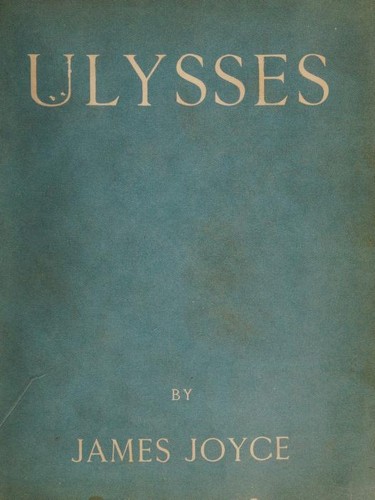
Ulysses
by James Joyce · 1922
Buy on AmazonWritten over a seven-year period, from 1914 to 1921, this book has survived bowdlerization, legal action and controversy. The novel deals with the events of one day in Dublin, 16th June 1904, now known as "Bloomsday". The principal characters are Stephen Dedalus, Leopold Bloom and his wife Molly. Ulysses has been labelled dirty, blasphemous and unreadable. In a famous 1933 court decision, Judge John M. Woolsey declared it an emetic book-although he found it not quite obscene enough to disallow its importation into the United States-and Virginia Woolf was moved to decry James Joyce's "cloacal obsession". None of these descriptions, however, do the slightest justice to the novel.…
Recommended by
"A story about what it is to be human as one middle-class guy goes about one day."
Pete Buttigieg's 10 Favorite Books · onegrandbooks.com
"Its dense, experimental prose and exploration of the human condition through a single day aligns with McCarthy's own challenging narratives and philosophical depth. An expected read for someone exploring the limits of literary form."
Cormac McCarthy's Great Novels · lithub.com
"Asked by a friend who the greatest character in literature was, Joyce replied that, obviously, it was Odysseus—the all-around man. Thus was born Ulysses , the Roman name for Odysseus. Joyce’s man is Leopold Bloom, and in Ulysses , the 24 books of Homer’s Odyssey become 18 discrete episodes. (You’ll finish it having both a favorite book—mine’s Nausicaa—and one [or a few] you found interminable—for me, Proteus or The Oxen of the Sun). It’s challenging, learned, filthy, and hilarious. In it, Joyce pushes the boundaries of language and the novel form. It’s easy to see how it was thwarted and censored four times during publication. At first, no one wanted to print it, because they could’ve been found liable for publishing pornography (enter Sylvia Beach, owner of the famous Paris bookstore Shakespeare and Company .) Ulysses is one of those great novels that demands a level of concentration one can only get in isolation. Yes, it’s difficult and frustrating, but that’s because it wants to frustrate you—and the payoff is immense pleasure: no book gets closer to the ineffable experience of human play and tragedy, of being a fleshy mass of blood and bones in the modern world. It pays dividends for the reader who pays it serious attention. Reading Joyce, you feel incredibly close to the mind of a writer whose conviction was that he could do anything with language; no novel I’ve ever read has been more daring or eye-opening. (Though, if you start on Ulysses and find it’s just too hard going, I’d recommend picking up Dubliners or A Portrait of the Artist as a Young Man ; they’re better introductions to him.) As for actually reading it, I recommend Jeri Johnson’s Oxford World’s Classics edition (above) or the more expansive Gabler edition , which includes thousands of corrections to earlier iterations. Ulysses is chock full of allusions, jokes and tricks the modern reader may not understand, so you’ll also want to get your hands on two guides that I kept within reach at all times when I was reading it. The first is Ulysses Annotated by Don Gifford and Robert J Seidman; it’s the most extensive guide by far for breaking down each and every word, phrase, allusion in the book, as well as providing cogent summaries of all the episodes. Reading it cover to cover slowed me down quite a bit while reading Ulysses , but I don’t regret it, for without it I could’ve never gotten the historical context. The Bloomsday Book by Harry Blamires is also useful for summaries; it’s like an intelligent version of Spark Notes (which is no knock against it). —Stephanie Kelley, Literary Editor"
The Best Long Novels · fivebooks.com
"Interestingly, that’s the same year as The Waste Land . You get these two modernist masterpieces in the same year—one at the beginning of the year, one at the end. One barely fifteen pages—one closer to a thousand pages. It’s like the North and the South Pole. It’s a novel published after about 1910. It’s a novel that takes the traditional elements of place and time and mashes them up and reorders them. It attempts to capture the flow of human thought and human experience on the page in words and has no apparent interest in the conventions of the Victorian novel . It’s trying to represent the ordinary world in prose. Ulysses is a very brilliant, highly original attempt to put one man’s experience on one day to the pages of a book. That’s certainly true about a lot of novels. I was reading this year’s Booker Prize shortlist and every one of those feels like a footnote. They’re just so trivial—each doing one thing that Joyce is probably doing a hundred times more brilliantly and in more different ways on any given page of Ulysses . Get the weekly Five Books newsletter Listening to it is a good way because you hear it differently. Also because Joyce’s ear for the music of language is so extraordinary. I recommend it very highly. It helps, yes. The more you know about Joyce the more you understand and Ulysses certainly repays close attention and study. But you don’t need to bother with Finnegan’s Wake . I don’t think anyone has ever managed to read all the way though Finnegans Wake , it’s almost impossible. It’s about Leopold Bloom’s day in Dublin. It’s about the trials of a middle-aged man, essentially, flashing backwards and forwards in time. It’s about his relationship to his wife. It’s also a portrait of a man in a place: a portrait of a man in Dublin—a Dublin that you can’t find anymore because it’s been so modernised. It used to be quite easy to find Joyce’s Dublin, it was quite available, but it has disappeared, I’m afraid. Not necessarily. There are some books which do make that demand and are taken more seriously because they make that demand. But it’s not a cast-iron rule. There are plenty of Dickenses which are a romp. I think some of the trouble we’ve got into in the near past was the idea that the more difficult it was the better it was."
The Best Novels in English · fivebooks.com
"It is seen as the archetypal stream of consciousness novel. With more ambition than possibly any other writer, Joyce tries to get us into the inner monologues and dialogues of Leopold Bloom, Molly Bloom, and Stephen Dedalus. He didn’t invent the technique. He credited the French writer Édouard Dujardin in a novel from the 1880s as starting to explore this technique, but others have argued that the stream of consciousness style started much earlier than that. In fact, the term ‘stream of consciousness’ appeared in literature for the first time in a discussion of the British novelist Dorothy Richardson’s work. So Joyce didn’t invent it, but he makes it flourish in the most extraordinary way. I’m particularly interested in how he depicts inner speech. He gives us a stream of consciousness that doesn’t seem like a standard novelistic narrative. He is trying to capture the particular qualities you would notice if you listened to someone else’s inner speech. “If Joyce was trying to depict inner speech as it really is, he must also have been aware that that’s an impossible task” It aligns beautifully with the psychological work on how inner speech develops that inspired me. For example, one theory posits that inner speech develops out of social dialogues: it should have a dialogic quality. When you’re talking to yourself, it really should be like a conversation with yourself. You can see this in passages of Leopold Bloom in a monologue. He is actually in dialogue. He is talking to himself, asking himself questions and then answering them; making statements and then commenting on them. Another feature of inner speech is called abbreviation. When you are sitting in your living room late at night and you hear a loud crash from outside, you don’t say to yourself, ‘The cat has knocked over the dustbin,’ you just say to yourself, ‘the cat,’ or, ‘the dustbin.’ That way you abbreviate what you are thinking to yourself for all sorts of reasons, including the fact that you already know much of what the topic of conversation is, so you can cut it down like that. And again, Joyce depicts this absolutely beautifully, particularly in Leopold Bloom’s inner dialogue. I think there’s certainly a historical story. I think you can make that case. What’s interesting is that some people, possibly quite a lot of people, reject the Joycean view of inner dialogue. They say, ‘Actually, I don’t think my inner speech is like that.’ And then, of course, you get into the fascinating scientific questions of how we can find out what people’s inner speech is like. I think it is an open question and, in fact, when we come to discuss the other two novels, the reasons for choosing these three novels is so illustrative that these three writers are trying to do something similar, but going about it in quite different ways. Well, writers certainly are very different, thank God. I think it is also worth pointing out that even if Joyce was trying to depict inner speech as it really is, he must also have been aware that that’s an impossible task. Not least because if he had really been able to depict Leopold Bloom’s inner speech, it probably would have been completely incomprehensible. If I could listen into your inner speech, I really wouldn’t make any sense of it, I’m sure. What Joyce gives us is something that is reconstituted or represented in a way that makes it an enjoyable reading experience. But, of course, even within Ulysses , you get this variability. Molly Bloom’s inner speech is really quite different to Leopold’s, isn’t it? Different people will have different styles of talking to themselves and, of course, writers will have different ways of approaching it. It is hard to see that any other art form tries to do this particular thing, and in the great modernist novelists of the early 20th century that this experiment comes to a high."
Streams of Consciousness · fivebooks.com
"“Got no feelings, in any way whatsoever, for that evil bitch.” An obvious choice, but this novel is still—after nearly a century—powerful, innovative and exhilarating. There is more going on in one sentence in Ulysses than there is in most contemporary novels."
Books that Influenced Him · fivebooks.com
"the genius was to use the resources of the English language... by issuing punctuation and doing many other things came as close as possible to using the resources of the English language to render a stream of Consciousness. He's a great writer."
Books from Intelligence Squared: Steven Pinker on Good Writing, with Ian McEwan · youtube.com
Favorite books · radicalreads.com
"The only way I could ever read Joyce's Ulysses was to return to it again and again — eventually I read it from start to finish."
By the Book: 05bkr Bythebook_davis · nytimes.com
"The last great book I read was Joyce's Ulysses, and the last great book I reread was also Joyce's Ulysses."
By the Book: Billy Collins · nytimes.com
"Lastly, that citadel that is "Ulysses," "a strife of tongues" — he put down all the people, "the great talkers . . . and the things they forgot." He put down a lot more than that."
By the Book: Edna Obrien · nytimes.com
"Joyce’s “Ulysses”... Joyce’s claim that “imagination is memory”... became part of the foundations of my sense of taste."
By the Book: Edward St. Aubyn · nytimes.com
By the Book: Ian Buruma · nytimes.com
"James Joyce’s “Ulysses.” In June of this year I reread this ever astonishing classic with my neuroscientist husband, who had not read it before, in preparation for a trip to Dublin, which overlapped, just barely, with the annual Bloomsday celebration."
By the Book: Joyce Carol Oates · nytimes.com
"Among them are Flaubert's Letters; Proust's In Search of Lost Time; Joyce's Ulysses and Dubliners."
By the Book: Juan Gabriel Vasquez · nytimes.com
"The novelist who has most profoundly reflected on technology's penetration — saturation — of human experience is Joyce."
By the Book: Tom Mccarthy · nytimes.com