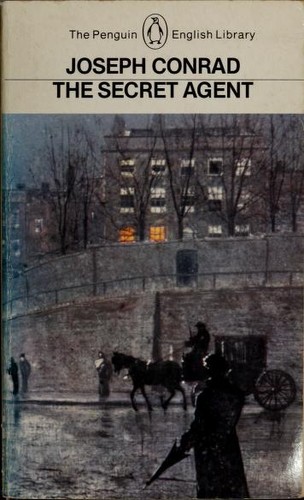
The Secret Agent
by Joseph Conrad
Buy on AmazonThe Secret Agent: A Simple Tale is a novel by Joseph Conrad, first published in 1907. The story is set in London in 1886 and deals with Mr. Adolf Verloc and his work as a spy for an unnamed country (presumably Russia). The Secret Agent is one of Conrad's later political novels in which he moved away from his former tales of seafaring. The novel is dedicated to H. G. Wells and deals broadly with anarchism, espionage, and terrorism. It also deals with exploitation of the vulnerable in Verloc's relationship with his brother-in-law Stevie, who has an intellectual disability. Conrad’s gloomy portrait of London depicted in the novel was influenced by Charles Dickens’ Bleak House. (Source: Wikipedia)
Recommended by
"Basically, anything you want to know about how terrorism works you can find in this book. It is not necessarily about who is behind terrorism because in this book it is a shadowy foreign state that wants an agent provocateur in London to explode Greenwich Observatory to make a point. But the broad picture that Conrad paints of how ideologies work, of how people get drawn into violence and how amateurish it can so often be, is true of much of terrorism worldwide. It goes wrong in The Secret Agent , by the way, and the wrong person ends up getting killed. Get the weekly Five Books newsletter And thankfully, militants are often very amateurish as well. So this book strikes me as a deeply useful reminder of what this kind of religious or political activism is about. I would just like to mention a brilliant line in the book when Conrad is talking about violence and he says, “the way of even the most justifiable revolutions is prepared by personal impulses disguised into creeds”."
Islamic Militancy · fivebooks.com
"Yes, I thought I was being clever and unique and didn’t realise so many other people had made the connection. The book is based on an incident that actually did occur when an anarchist tried to blow up the Royal Observatory. In the novel, a group of hapless anarchists are trying to incite a rebellion. Their main concern is that British society is too liberal and they want to demonstrate that this kind of thing can occur. What I loved about this book is the cynicism that Conrad has in looking at the zealot. He makes clear that a person may start out as a true believer but over time they are doing work that they may or may not believe it. It is the silliness of zealotry that becomes really clear. Did bin Laden and his close circle of followers really believe that what they were doing was making the world a better place? It’s ironic that the mission of this organisation shifts so regularly and is so highly dependent on the audience they are trying to reach that you do question the extent to which bin Laden believes his own rhetoric. Bin Laden started out with the goal of forcing Soviet troops out of Afghanistan. Next he aimed to force US troops out of Saudi Arabia. Next he claims to be representing the interests of all the world’s oppressed. At one point Zawahiri tried recruiting African-Americans with messages referring to Malcolm X. Now al Qaeda claims to be fighting global warming and is urging followers to help those suffering from the floods in Pakistan. Yes, I do."
Who Terrorists Are · fivebooks.com
"There are lots of reasons I’m very fond of Conrad as a writer. I like visions of London that come translated or diffused or refracted through other cultures. In that way, I suppose, I like this book in the same way I like my first choice, the Céline. Coming here out of his Polish background, Conrad picked up on the elements you were talking about in terms of Dickens — the city as a labyrinth of conspiracies and overloads. In The Secret Agent , you go from a shop in Soho into a space like Greenwich Park, where the bomb incident takes place – quite an interesting journey in itself – and then, at the end, there’s an extraordinary marching-away into the suburbs of one of the characters who walks through endless anonymous, curious areas. So it’s another navigation of London, but this time it’s the London of conspiracy and paranoia, the London of imported terror groups or anarchist groups who come from other places but enact their dramas here. I like the way the doubling-up of the protagonist’s shop – with its almost Dickensian sense of eccentricity, a shop selling porn in a sort of mild way, as a secret – relates to things like Jekyll and Hyde, where you get a single house with a respectable doctor living in front, and a savage underworld out the back door. This splitting, the idea of two things coexisting in one city, has always been one of London’s major themes. All London writing, or at least the best kind, has had this conceit of the double place — the respectable and the savage. I think Dickens has continued to be visible, because he’s been reinterpreted for the television age. Seeing Bleak House broken down into Coronation Street-type segments was pretty bizarre. But it still works, so in a sense that’s alive – and its original form is there, if you want to read the whole book. The basic paradigms of how the fiction works – with the mystery, the romance, the sense of the baroque city, the gothic city – all of that works beautifully, and most of the other books, you could say, relate to that. They’re current extensions of that theme. Some of Patrick Hamilton’s characters have a Dickensian eccentricity; Moorcock’s book has its multiple characters, and each part of London behaving in a different way. All of these things could easily be drawn back to Dickens. So I guess in a sense the London we read about in Dickens – even though it’s the oldest – is the one that’s most visible still."
The Best London Novels · fivebooks.com
"The Secret Agent by Joseph Conrad may be one of the first espionage thrillers. That’s something we could argue about, but it’s a very early example. It’s about anarchists in London at the turn of the century. The character at the heart of the book is instructed by his handler—a sinister foreign agent based in Britain, we don’t really know who they are—to go and plant a bomb at the Greenwich Observatory, an important landmark in London to this day. And without giving too much away, it all goes wrong. It’s tragic but it’s got a dark humor, which people who are fans of Joseph Conrad will be familiar with. It also explores a lot about the world of espionage—the manipulation, the betrayal. The story it’s based on is a French anarchist, Martial Bourdin, who in 1894 died gruesomely when he was walking towards the Greenwich Observatory. People believe that he was probably trying to plant a bomb. At that time, anarchism was a serious global terror movement. It has some similarities with the violent Islamism of Islamic State, in the sense that its political goals were quite hard to understand. But it carried out violent attacks aimed at the pillars of civilization in Western Europe at that time. There were also allegations that anarchism was being exploited by hostile powers. So, the people carrying out these attacks may have been deluded extremists, but they were being manipulated by unfriendly foreign governments. That’s something that to modern ears might sound like a very familiar story. Even if it had no basis in reality, it would be a really interesting, brilliant book. But it also tells us about a period of turbulent European history that many of us have forgotten."
Spy Novels Based on Real Events · fivebooks.com