Iain Sinclair's Reading List
Iain Sinclair is a writer of fiction, poetry and non-fiction. The Spectator calls him “our greatest guide to London”. He is the author of London: City of Disappearances , and lives in Hackney in east London Iain Sinclair on Wikipedia Iain Sinclair's website
Open in WellRead Daily app →The Best London Novels (2011)
Scraped from fivebooks.com (2011-05-17).
Source: fivebooks.com

Louis-Ferdinand Céline · Buy on Amazon
"I chose London Bridge because I love the idea of a totally non-Anglicised consciousness looking at our city as a construct. Because Céline is a deeply French writer, in a totally different tradition, he sees London mythologised as a fictional entity – and he treats it with a dynamism and an energy that I don’t find in English writing. Also, he makes these wonderful, crazy trajectories across the city, from Willesden down to the docks and so on, as a way of trying to configure how he would escape from the incredible density and multitude and magnificence of this mad place in which he finds himself. For me, that’s a wonderfully inspiring way to look at London, as compared to the account of a local writer, who might tend to stratify society and deal with its movements in the classic sense that you find in Thackeray or Dickens or Trollope. Céline came here at the time of World War One, with shrapnel wounds in his head, recovering from the madness of the conflict and looking at the city as a post-traumatic city – in a way, it’s similar to what TS Eliot does in The Wasteland . That sort of London is the London of the imagination: the dream city. I really think that this is the biggest battleground London has seen since the age of the railways. When the railways were first put in, there was devastation, because there were so many competing companies who just ripped up houses right, left, and centre. In the name of catching the spirit of the age and indulging in this technological process (and the idea of progress through science), London was savagely remade. It took a long time to absorb, recover and discover itself through that. At the moment, we’re in this sort of management age – an age of the virtual – in which you can change reality by looking at digitised, computer-generated images and projecting a fantastic city of the future, like a science fiction. People have come to believe that this is reality, even though they are contradicted by observation, which shows you devastated fields, radioactive materials buried in the ground that have been ripped up fast, and absolute destruction. I mean, I just walked round our local Victoria Park this morning – it looks like a war zone! The lake has been drained and the wild habitat of the island has been stripped bare, all in the name of this sort of cosmeticised version of the future. So it is a devastating moment for the city, which I don’t think has ever been under such a prolonged form of invasion by the virtual. To deal with all this, you have to come up with different forms of writing. That’s what I’ve tried to do, to some extent, in Ghost Milk – by using things that would almost be essay material, plus dialogue, fictionalised elements, images (I’ve got thousands of photographs – not that they’re in the book, but I’ve used them as a reference), old films and so on. You have to make a complex construction that really deals with the city, to counteract this smooth, moony-like visual world of the computer-generated project."

Michael Moorcock · Buy on Amazon
"In a sense, Mother London connects with what I’ve just been talking about. Michael Moorcock is probably best known generally for a series of sword and sorcery novels, but he’s also very much in the tradition of the earlier writing I mentioned: Victorian-Edwardian ideas of fiction, of the man of letters, the guy who turns his hand to any form of writing and is very much a person of London. Support Five Books Five Books interviews are expensive to produce. If you're enjoying this interview, please support us by donating a small amount . Mike grew up in South London and began writing around the age of 15. But this particular book is really the testament of his whole experience and career, which also back-references entire forms of popular London generic writing for generations and generations. It shows the Blitz [when Nazi Germany bombarded London in World War Two ] as another moment of great psychological trauma and describes how the city deals with it. The characters are, in a sense, damaged sleepwalkers, but they’re also taken up with a kind of visionary reality. There’s a woman who walks through the flames of the Blitz and survives. The others are trying to come to terms with the contemporary city that’s emerging, the one we’ve been talking about, which hasn’t actually arrived yet (this is still the Thatcher period). In a sense, Moorcock is a perfect pivotal figure for me: he anticipates the mood of what’s coming through new, neoconservative policies, but also reaches back to acknowledge and deal with the forms of a larger, more generous kind of Dickensian fiction, which he has lurking in his background. Yes. It’s a blow against cultural amnesia. There seems to be a belief now, with the world of cyberspace, that people don’t need to make the old archaeological journeys into the literature of the past – that they can download or access elements or fragments and that it will give them enough to know where they are. So there’s a cut-off from a long tradition, which has gone on through various forms of education for several hundred years, whereby you were grounded deeply in the literature of the past (either the classic past or your own, recent past) that really doesn’t exist anymore. When I see new pieces of work about the city, they’re always grounded in the contemporary landscape and topography – they deal with what happens on the streets, in the clubs, et cetera. The writers don’t seem to feel obliged – or they don’t have the urge – to understand what was there before, or other versions of what people have done with the same stuff. Moorcock’s the last of the great memory men."

Charles Dickens · Buy on Amazon
"This book comes very late in Dickens’s own career, but it has a powerful sense – a sense that’s been crucial to me – of London depending on the river. It begins with this fantastic scene of corpse-fishing: a family that literally gets their living from the drowned. That’s a terrific metaphor for one whole aspect of London fiction, wherein London keeps itself alive by transfusions of the exotic from other countries. In this period, obviously, the idea of the colonial was very vivid – people would disappear into Australia or Canada or New Zealand or South Africa and come back reinvented or richer. This book is the great archaeological articulation of that. And a lot of the characters depart on huge walks, deranged walks where they’re chased by their demons across miles of riverbank. It’s a book that absolutely haunts me, this one. Yes, he did. He had various troubled periods of his life. He used the walks as a form of research – and as a form of de-programming himself from the long hours he spent intensely writing. He would go off for these 15-or-so-mile journeys, often at night – there are very good journalistic accounts he’s done of his nocturnal ramblings. Sometimes he’ll see some building and go into it and investigate it – he weaves it all in. He’s absorbing this material and generally letting it sit in his mind until it forms a fictional form. Often, the resulting work is serially published, almost like a modern television programme, so it has that kind of drama and excitement, but it also always has the deeper reach of his knowledge of the city. Yes, that’s true. Dickens has a slightly conversational rhythm, an extravagant rhythm. He also has the kind of long rhythm of a person who walks great distances and lets sentences pour out in a rich-tongued kind of way. It’s certainly part of his way of seeing the city. Whereas now, I guess, people would generally be shorter, sharper – and certainly the writing would tend to be very visual. Someone like JG Ballard, say, is almost like a painter. He’s so specific and precise in his physical details, and there’s no excess in the writing, there’s no rhetorical style or flourish. So it’s a pared-down, scientific, technological prose – as is suitable to the kind of buildings and areas he’s describing."

Patrick Hamilton · Buy on Amazon
"I chose Patrick Hamilton because he hits, in particular, on the derangement of the city. He was a big drinker. His writing is like the hallucination or the delirium of an alcoholic dream, and sees London as a kind of nightmare. I wanted to have one book, at least, that views the city in that way. Hamilton is quite parallel, in his period of writing and in some of his subjects, to Graham Greene – but it’s a very different tone and texture. With Hamilton, it’s as if he disappears himself into it. Various of his books I could have chosen, but this one, I think, is the most demented and committed. We seem to keep coming back to periods of war – with this story, you’re coming into World War Two, and there’s an element of fascism and sexual sadomasochism. It’s somewhere between a crime novel and a political novel, created out of the madness of drink and derangement. In part. It has a brutal quality to it, absolutely. It’s always been a city of business, a city of collision and conflict, and you need to survive that. But equally there have always been visionary characters who have gone hard against this spirit of the place and survived in their own corners. London is so huge that it can encapsulate a lot of eccentrics hidden away in their caves doing interesting, curious things. And at the moment, it’s also a place where every possible language and culture is put together into a sort of seething mix – which gives it qualities that other places don’t have."
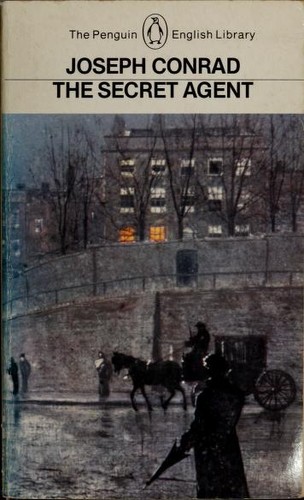
Joseph Conrad · Buy on Amazon
"There are lots of reasons I’m very fond of Conrad as a writer. I like visions of London that come translated or diffused or refracted through other cultures. In that way, I suppose, I like this book in the same way I like my first choice, the Céline. Coming here out of his Polish background, Conrad picked up on the elements you were talking about in terms of Dickens — the city as a labyrinth of conspiracies and overloads. In The Secret Agent , you go from a shop in Soho into a space like Greenwich Park, where the bomb incident takes place – quite an interesting journey in itself – and then, at the end, there’s an extraordinary marching-away into the suburbs of one of the characters who walks through endless anonymous, curious areas. So it’s another navigation of London, but this time it’s the London of conspiracy and paranoia, the London of imported terror groups or anarchist groups who come from other places but enact their dramas here. I like the way the doubling-up of the protagonist’s shop – with its almost Dickensian sense of eccentricity, a shop selling porn in a sort of mild way, as a secret – relates to things like Jekyll and Hyde, where you get a single house with a respectable doctor living in front, and a savage underworld out the back door. This splitting, the idea of two things coexisting in one city, has always been one of London’s major themes. All London writing, or at least the best kind, has had this conceit of the double place — the respectable and the savage. I think Dickens has continued to be visible, because he’s been reinterpreted for the television age. Seeing Bleak House broken down into Coronation Street-type segments was pretty bizarre. But it still works, so in a sense that’s alive – and its original form is there, if you want to read the whole book. The basic paradigms of how the fiction works – with the mystery, the romance, the sense of the baroque city, the gothic city – all of that works beautifully, and most of the other books, you could say, relate to that. They’re current extensions of that theme. Some of Patrick Hamilton’s characters have a Dickensian eccentricity; Moorcock’s book has its multiple characters, and each part of London behaving in a different way. All of these things could easily be drawn back to Dickens. So I guess in a sense the London we read about in Dickens – even though it’s the oldest – is the one that’s most visible still."