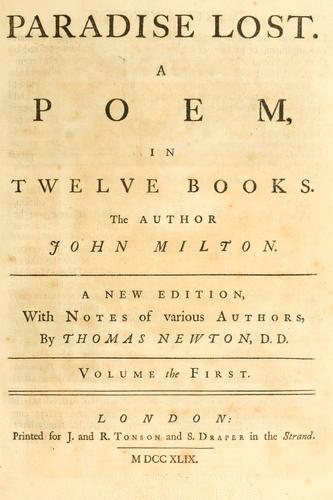
Paradise Lost
by John Milton
Buy on AmazonJohn Milton's Paradise Lost is one of the greatest epic poems in the English language. It tells the story of the Fall of Man, a tale of immense drama and excitement, of rebellion and treachery, of innocence pitted against corruption, in which God and Satan fight a bitter battle for control of mankind's destiny. The struggle rages across three worlds - heaven, hell, and earth - as Satan and his band of rebel angels plot their revenge against God. At the center of the conflict are Adam and Eve, who are motivated by all too human temptations but whose ultimate downfall is unyielding love. Marked by Milton's characteristic erudition, Paradise Lost is a work epic both in scale and, notoriously, in ambition.…
Recommended by
"Milton is a profound inheritor of Augustine and the whole Christian theological tradition. But, at the same time, he’s ferociously independent and determined to think through everything for himself. He won’t simply take anything on faith, embracing it without thinking it through. To question and decide for himself is essential to Milton’s whole sense of what it means to be a free human being. “Milton gives a brilliant and painful description that anyone who has been in a relationship for more than five minutes will understand” In his astonishing intervention in the Adam and Eve story, Milton considers how it was possible not for ignorant children, but for knowing, thoughtful, complex human beings to do what they did. Specifically, he asks, why was the woman alone when she had her fateful conversation with the serpent, and why did she then do what she did? It’s characteristic of Milton that he works out in the most exquisite and excruciating detail the conversation between the man and the woman when they decided briefly to separate. It wasn’t at all accidental that they were apart; it was a choice that Eve made after her conversation with Adam. And so too it wasn’t mere hunger that led her to eat the fruit. Milton gives a brilliant and painful description that anyone who has been in a relationship for more than five minutes will understand, a description of trying to negotiate your separateness from someone you love and to whom you are committed. Yes. She’s told that constantly by Raphael, by Adam. Everyone agrees. She agrees, too, and she’s trying to figure out what to do as a result. Milton depicts her as deeply thoughtful. Given where Milton and his whole culture was coming from, I’m in awe of what he did with her. We can and should grasp the misogyny that shapes this theological vision. Milton buys into it, of course, but he burrows so deeply into these materials that he comes out the other side. Not in a brief for feminism, but in a deep embrace and celebration of Eve’s decision, in the face of the prohibition and the subordination, to be free. I think Milton’s poem is an extraordinary celebration of Eve—the most powerful one that was ever written. Two points to pick up from what you’ve just said. One is that when Eve proposes to go off by herself, and when Adam objects, saying, ‘No, we have an enemy out there, we should stay together,’ Eve perfectly reasonably wonders, ‘What does he mean, we have an enemy out there? Does he think we have to cling constantly to each other?’ After all, she reflects, they’re in paradise, and they’re planning to live there forever. She quips, ‘Well, if that’s the case, I might as well have just stayed a rib in your side!’ It’s the humans’ first joke. “He wants this particular woman, the woman who is part of his very being” The second point is what is meant by consubstantiality. In a very clear-sighted way, Adam grasps that God could take another rib and make another rib for him. But he doesn’t want that; he wants this particular woman, the woman who is part of his very being. Each of the books we’ve been discussing are intensely biographical and personal. All great interventions in the Adam and Eve story are only great because people bring themselves 100% to the table, and don’t leave anything behind. Milton, Augustine or any of these figures—they’re completely there, body and soul."
Adam and Eve · fivebooks.com
"Paradise Lost had an enormous impact on Satanism. Ironically so, because John Milton was a Christian, and he did not write Paradise Lost in any way to honor the Devil. But because he’s such a tremendous writer, he ends up making Satan, for the first time, a nuanced and compassionate character. Before that, in medieval works, Satan is pretty one-dimensional. He’s just the bad guy and that’s it. But then, in Paradise Lost , you see his motivations. You start to feel sympathy for the Devil. It talks about how he’s cast out of heaven, and you hear about his struggles. You end up rooting for him. There’s the great quote, “Better to reign in Hell than//serve in Heaven.” Milton ended up making the Devil seem like a very appealing character. Later on, during the Romantic era, writers started reading Paradise Lost again. It was republished and became very popular. Poets were inspired by it and Satan was held up as an antihero. For the first time, Satan was depicted in art as this classical, muscular and beautiful Greek god-type character. Baudelaire and others wrote these tremendous odes to Lucifer and how he was courageous for standing up against tyranny, how he was to be honored for being a rebel who questioned arbitrary dogma. So Paradise Lost really influenced the way Satan is seen today as this rebel, the underdog who stands up, a heroic figure rather than this figure of evil. That’s the thing that gets confusing to people. There isn’t one definition of who these characters are and how they relate to each other. It’s very fluid and changes over the centuries. Sometimes Lucifer is seen as the same as the Devil/Satan. Sometimes he’s seen as a separate entity. But, generally, Satan, the Devil and Lucifer are seen as the same—the angel that was cast out of heaven. Then demons like Mephistopheles, Beelzebub and Belial are seen as his demonic agents, his helpers, though sometimes they’re conflated with Satan."
Satanism · fivebooks.com
"This speaks to the way that allusion, working with earlier texts, can be a way of enriching what an author can say in narrative. Part of what Milton is doing is putting together multiple different epics as well as the “epic” of Genesis. It’s the Iliad , the Odyssey , the Aeneid , and The Faerie Queene all moulded together, along with the Biblical narrative. But the Odyssey specifically is interesting to think about in Paradise Lost because it’s both the wrong story and the right story. When he makes his journey, Satan is explicitly compared to Ulysses. He’s wandering through dark places in the universe; he doesn’t know where he’s going. That’s actually because, like Odysseus, he’s a deceptive, seductive leader whose rhetoric is going to lead people astray. Get the weekly Five Books newsletter On one level, Odysseus is the wrong kind of hero to be, but in later books the reunion of Adam and Eve after the Fall has elements of the reunion of Penelope and Odysseus. They also have to get back home, but they’re going to be away from home for a very long time. Paradise Lost is a homecoming story of marital breakup and martial reunion, just as the Odyssey is. They’re also both epics about redefining a community in the wake of a devastating war, and about whether there will ever be an end to war. The Odyssey existed in, and was passed down through, well-established scholarly texts, from at the very latest the C2-C3 BCE—the time of the Alexandrian Homeric scholars. It seems misleading to say it passed down orally till the end of Rome. Some people love the idea of the always-oral tradition, but honestly I don’t see any good evidence for it; there were oral performances, but there were also written texts. It’s almost like saying that Hamlet has always been passed down orally for the past four hundred years; it’s sort of true, but it seems insane to ignore the fact that actors use texts, and the same was true of rhapsodes. “It’s almost like saying that Hamlet has always been passed down orally for the past four hundred years; it’s sort of true, but it seems insane to ignore the fact that actors use texts” Paradise Lost is, like the Odyssey , an oral poem, in the sense that its author composed in his head and recited it to amanuenses, when he was being “milked” of poetry in the mornings. Milton’s literary and social position was still entirely different: Paradise Lost draws on multiple textual antecedents, rather than on a long, purely oral tradition. In some big sense, the Odyssey is a political poem. It’s about different social structures, about how to deal with cultural difference, class difference and economic difference, and about how societies cohere and fragment. Both the Odyssey and Paradise Lost are poems engaged with questions about what the ideal structure of a society is, and also both poems about conflict within a household, and within a community. Epistemologically, Paradise Lost is different because we know the poem is engaged with a specific civil war, with dates attached to it, whereas the Odyssey isn’t engaged with a specific civil war, and there isn’t an expectation on the part of the listener or the reader that this is about any particular Mycenaean palace, or any particular moment in history. “ Paradise Lost is, like the Odyssey , an oral poem, in the sense that its author composed in his head and recited it to amanuenses, when he was being “milked” of poetry in the mornings.” Of course there have been many attempts, in antiquity and more recently, to plot the places of the Odyssey onto real maps, and to locate the Trojan War in real historical time. We know that there were in fact many Trojan Wars; the city was destroyed and rebuilt several times. As I read it, the Odyssey itself isn’t so much interested in the historical specificity of real events at a particular date; Troy is a holy city far away to the east. That’s different from the way that Paradise Lost evokes a mythic Civil War (the War in Heaven), with specific allusion to the English Civil War which is still a fresh wound in the author’s memory. In the slaughter of the suitors and the (at least partial) outbreak on Ithaca in the final book of the Odyssey , what the poem is doing at least in part is tracing the question of how one war relates to another. Paradise Lost , too, is engaged with the question of how the war in heaven is related to later wars and future conflicts. Milton wonders, ‘How is the War in Heaven like or unlike the English Civil War?’ I think of Milton’s Eve as, in all senses, a much less veiled character than Penelope: she’s naked, and she’s in a position to be much more explicit about what she thinks and wants. We have hints at what Penelope wants, what she needs, what she feels, what she thinks, but they come through in her narratives of her dreams, rather than actual monologues in which she is able to communicate her thoughts and feelings. For instance, we get the great goose dream in Book 19, in which she weeps because the eagle killed her geese, which hints that she has some kind of attachment to the suitors. There’s an ambiguity there. Does she actually want Odysseus to come home and kill the suitors, or might there be other things she might want that wouldn’t be that? Or even if that’s the best outcome Penelope can hope for, are there ways that it’s not an ideal one? It’s not like she has infinite choices. It’s not that she could ever choose to be in a relationship where her spouse would be subordinate to her, rather than the other way around—whereas Odysseus, in choosing between Calypso and Penelope, has exactly that choice. The poem is very clear on the constraints that her position as a mortal woman entails; even though she’s clever, beautiful, rich and elite, powerful over a multitude of slaves and animals, she still spends most of the poem in her bedroom, crying, dreaming and sleeping. The pains that comes from being a mortal woman are really clear in the poem. Milton’s depiction of Eve is fascinating. We have that wonderful scene of when she’s first created (IV.450-465): I first awaked, and found myself reposed Under a shade on flowers, much wondering where And what I was, whence thither brought, and how. Not distant far from thence a murmuring sound Of waters issued from a cave and spread Into a liquid plain, then stood unmoved Pure as the expanse of heaven; I thither went With unexperienced thought; and laid me down On the green bank, to look into the clear Smooth lake, that to me seemed another sky. As I bent down to look, just opposite, A shape within the watery gleam appeared Bending to look on me, I started back, It started back, but pleased I soon returned, Pleased it returned as soon with answering looks Of sympathy and love; Early critics connect this passage to the myth of Narcissus, and of course Milton is using the Narcissus story from Ovid’s Metamorphoses . But Narcissus isn’t a narcissist; he doesn’t know his image is himself. And Milton’s Eve is certainly not a narcissist either. She’s not in love with herself; she’s in love with a figure who’s both beautiful and able to respond to her and listen to her—something she doesn’t get in her marriage. She’s excluded from the direct angelic education and careful tutoring that Adam gets given. She’s not heard, but objectified and thought to be mere external appearance. The image in the water gives her a reciprocity missing from the marriage that is nonetheless the only plausible marriage for her. “Part of what Eve gets from Satan is being taken seriously intellectually—having her ideas be heard.” Remember how the marriage to Adam is framed in terms of oxymorons: “thy gentle hand/ seized mine”. It’s gentle, but it’s a violent verb, and she doesn’t have much of a choice; she wants to stay in the reciprocal relationship with the image, but a booming male voice, maybe God’s, is telling her that her desires are wrong. Part of what Eve gets from Satan is being taken seriously intellectually—having her ideas be heard."
The Odyssey · fivebooks.com
Patrick Collison's Bookshelf · patrickcollison.com
Favorite books · radicalreads.com