Stephen Greenblatt's Reading List
Stephen Greenblatt is Cogan University Professor of the Humanities at Harvard University and one of the founders of New Historicism . He is the author of twelve books, including Will in the World: How Shakespeare Became Shakespeare and Renaissance Self-Fashioning . He won the National Book Award in 2011 and the Pulitzer Prize in 2012 for The Swerve: How the World Became Modern .
Open in WellRead Daily app →Adam and Eve (2017)
Scraped from fivebooks.com (2017-05-07).
Source: fivebooks.com

Robert Alter · Buy on Amazon
"The story as we have it is told in chapters 1-3 of Genesis in very few lines, 50 verses or so. It’s next to nothing, and yet it is unforgettable. I chose the Robert Alter translation because it’s extremely sensitive to the Hebrew original. You can find online a word-by-word translation of the Hebrew original, but that has no poetic power. Robert Alter has a profound literary sensibility and he’s highly alert to the implications of the Biblical Hebrew. To take a single example, in the King James version of the Bible, it says that Eve was hungry and saw the tree was ‘pleasant’ to look at. The translators deliberately chose a rather neutral word. Alter points out in the notes that the Hebrew word is actually ‘ ta’awah, ’ which means ‘ lust for the eyes.’ You wouldn’t know, if you didn’t read Hebrew, that the tree is described as an object that arouses intense desire . “You wouldn’t know, if you didn’t read Hebrew, that the tree is described as an object that arouses intense desire” Why is it so interesting that God creates a particularly alluring tree? The United States is filling the world with potentially disastrous nuclear waste. We naturally desire to put this waste somewhere where people can’t get their hands on it and destroy themselves. We bury it deep underground, and we worry about the signs we put up to guard it, because we take in that someone coming upon the sign in 10,000 years may not understand our words and images. Genesis too is a story about an evil that will poison the entire human race; indeed God knows that it will poison the entire human race. He says to Adam—not to Eve, but to Adam—‘Do not eat this, lest you die.’ He does not explain to the human what death is. He puts the tree in the middle of the garden. He doesn’t build a fence around it. And the tree produces fruit that is ‘lust for the eyes.’ That’s a turn of the screw, and one that people for several thousand years have brooded about. Ta-awah focuses the story on the relationship between freedom and desire and raises questions about the responsibility of god as well as humans. It’s quite important that they’re not there. No motivation is given to the serpent; there’s no account of original sin. It’s unclear from the verses whether mortality—either for humans or all creatures—is an actual consequence of this act, or that it was part of a natural fate that eating the fruit of the tree of life might have averted, had the humans not been expelled. Many questions are left open. The story cunningly, brilliantly represents the fatal transgression as the eating of a piece of fruit. Not the digging of a tuber, not the killing of an animal, not the planting of wheat. We still represent, in fact we still experience the plucking and eating of fruit as one of the fundamental human pleasures. I’ve never killed a chicken in my life, but I’ve eaten a lot of apples off trees. The eating of fruit is human survival in its perfect form, in the Bible’s own account and in our lives, and yet that is the act that causes the disaster. At least according to al-Kisa’I’s early 13th-century Tales of the Prophets , yes. It’s a particularly beautiful, alluring camel. In the Quran, the serpent is identified as Iblis, the Satanic tempter who stood up and resisted Allah out of pride and arrogance. It’s a nice, long life, but it’s not a round number like one thousand. At least in one account, he gave seventy to King David. But there’s a dauntingly long record of commentary and speculation."

Augustine · Buy on Amazon
"There are relatively few figures who make a huge intervening difference in the transmission and reception of the story, and Augustine is one of these in a crucial way. The reason I chose this particular edition is that it brings together Augustine’s mature and profoundly influential attempt to read the story in a literal way with his earlier, relatively Manichean account, which allegorises the most disturbing elements. Augustine went back to the Adam and Eve story over the course of his lifetime and changed his views. The book follows his development through to the moment he repudiated the allegorical interpretation and embraced the literal interpretation. Get the weekly Five Books newsletter As so often in the history of religion, what appears to us to be a cruder and coarser account trumped what looks like a more sophisticated account. Allegory allows you to avoid all kinds of problems with it, whereas a literal reading of the story is an unbelievable headache. Augustine, who knew the allegorical tradition inside and out, made the decision to bequeath to western Christianity an insistence on the literal truth. In my book, I speculate that a key factor was Augustine’s experience of his own body, and I focus on the scene in the Confessions in which, as a sixteen-year-old with his father in the bathhouse in Thagaste, he has an erection. But I don’t suggest that’s the only factor. “Augustine concluded that if you think that Adam is an allegorical figure, eventually you’ll wind up thinking that Jesus is an allegorical figure, too” From a theological point of view, Augustine thought that if you believe that Adam is an allegorical figure and not real, eventually you’ll wind up believing that Jesus is an allegorical figure, too. Paul said, after all, that Jesus is the new Adam. Augustine felt this was a slippery slope toward the allegorising of everything: that the bread would be allegorical and not the body of Christ; that salvation, redemption and the afterlife would be allegorical. Did it actually? Probably not. But Augustine seemed to think so. In the long tradition, there were plenty of Christians and Jews who resisted literalisation. But Augustine is the single most important theologian in the entire Christian tradition and he decided, ‘Yes, this is where I’m going to plant my stake—on taking this story literally.’ “Determining what counts as a metaphor is a huge psychological, anthropological and moral challenge” He took 15 years trying to write his literal interpretation, and he couldn’t finish it. The trouble is, you can’t actually interpret the Book of Genesis literally, any more than you can when Jesus says, ‘I am the door; I am the vine.’ Is he a door? Is he a vine? Of course not. It’s a metaphor. There are plenty of moments in the story of Adam and Eve when you bump your head against what seems to be a metaphor. To take a single example: “their eyes were opened and they were ashamed”—after they’ve eaten the fruit. There were people who asked, ‘Hey, does that mean they were blind before? And stumbling around, and just happened not even to know what tree they were picking from?’ No! They had to have been sighted.’ So, ‘Opened their eyes’ must not mean that they literally opened their eyes; it must be a metaphor. But the challenge of determining what counts as a metaphor and what doesn’t—essentially a literary critical challenge—turns out to be a huge psychological, anthropological and moral challenge, too. He certainly does add original sin. That turns out to be his poisoned apple, so to speak, though of course it was a brilliant one. From our perspective—living in Oxford or the Upper East Side or in Cambridge, Massachusetts—many of us think that the British-born Pelagius had the right idea. Infants are not born wicked. We don’t inherit some kind of evil from something that was done by our remotest ancestors. Sin is not a sexually transmitted disease—all of which seemed to be Augustine’s positions. But Augustine effectively knocked Pelagius out by saying, ‘Look around. It can’t be that human beings behave this way just because they follow bad examples or make mistakes. There must be something fundamentally, doctrinally wrong with us from the beginning as creatures, in the way we have been made and reproduced.’ It’s a little hard looking around, at least at the present moment in my country, not to conclude that he was right. There’s something seriously wrong with us as a species. It’s fascinating, isn’t it? By a rich tradition of interpretation, Adam and Eve saw themselves for the first time not simply as vulnerable and without clothing, but as sexual beings—hence, nakedness refers to genitals. In Augustine’s account, nakedness particularly shows what it means to be aroused if you’re a male. It’s visible, and you’re not in control of it. What’s in the story? Nothing and everything. In some sense, the story gives you so little, but by giving you so little, it invites you to wonder. That’s part of its brilliance."
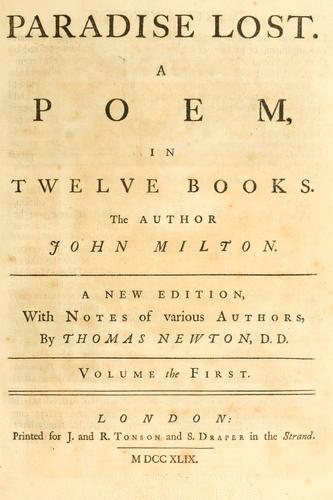
John Milton · Buy on Amazon
"Milton is a profound inheritor of Augustine and the whole Christian theological tradition. But, at the same time, he’s ferociously independent and determined to think through everything for himself. He won’t simply take anything on faith, embracing it without thinking it through. To question and decide for himself is essential to Milton’s whole sense of what it means to be a free human being. “Milton gives a brilliant and painful description that anyone who has been in a relationship for more than five minutes will understand” In his astonishing intervention in the Adam and Eve story, Milton considers how it was possible not for ignorant children, but for knowing, thoughtful, complex human beings to do what they did. Specifically, he asks, why was the woman alone when she had her fateful conversation with the serpent, and why did she then do what she did? It’s characteristic of Milton that he works out in the most exquisite and excruciating detail the conversation between the man and the woman when they decided briefly to separate. It wasn’t at all accidental that they were apart; it was a choice that Eve made after her conversation with Adam. And so too it wasn’t mere hunger that led her to eat the fruit. Milton gives a brilliant and painful description that anyone who has been in a relationship for more than five minutes will understand, a description of trying to negotiate your separateness from someone you love and to whom you are committed. Yes. She’s told that constantly by Raphael, by Adam. Everyone agrees. She agrees, too, and she’s trying to figure out what to do as a result. Milton depicts her as deeply thoughtful. Given where Milton and his whole culture was coming from, I’m in awe of what he did with her. We can and should grasp the misogyny that shapes this theological vision. Milton buys into it, of course, but he burrows so deeply into these materials that he comes out the other side. Not in a brief for feminism, but in a deep embrace and celebration of Eve’s decision, in the face of the prohibition and the subordination, to be free. I think Milton’s poem is an extraordinary celebration of Eve—the most powerful one that was ever written. Two points to pick up from what you’ve just said. One is that when Eve proposes to go off by herself, and when Adam objects, saying, ‘No, we have an enemy out there, we should stay together,’ Eve perfectly reasonably wonders, ‘What does he mean, we have an enemy out there? Does he think we have to cling constantly to each other?’ After all, she reflects, they’re in paradise, and they’re planning to live there forever. She quips, ‘Well, if that’s the case, I might as well have just stayed a rib in your side!’ It’s the humans’ first joke. “He wants this particular woman, the woman who is part of his very being” The second point is what is meant by consubstantiality. In a very clear-sighted way, Adam grasps that God could take another rib and make another rib for him. But he doesn’t want that; he wants this particular woman, the woman who is part of his very being. Each of the books we’ve been discussing are intensely biographical and personal. All great interventions in the Adam and Eve story are only great because people bring themselves 100% to the table, and don’t leave anything behind. Milton, Augustine or any of these figures—they’re completely there, body and soul."
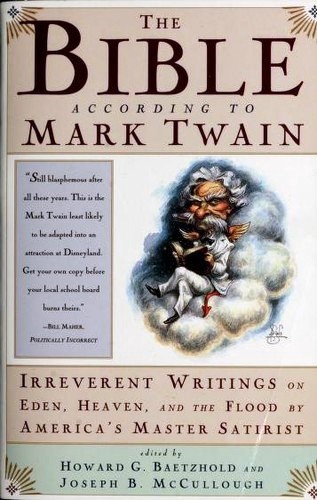
Mark Twain · Buy on Amazon
"Mark Twain is no Augustine or Milton, but he’s wonderfully wry and funny and touching. His imaginary diaries give you access to the whole Enlightenment push against the biblical origin story. One of the themes in my book is that under the impulse of Augustine, the characters of Adam and Eve are made more and more real. As in the story of Pinocchio, the strings are eventually cut, and the figures, ceasing to be mere puppets, seem to be actual agents in the world. This is another way of saying they become more like great characters in fiction—Hamlet, or Dorothea Brooke, or Isabel Archer. “Under the impulse of Augustine, the characters of Adam and Eve are made more and more real.” In both ‘Eve’s Diary’ and ‘Adam’s Diary,’ Mark Twain is playing, very delicately and beautifully I think, with that development into fiction. He imagines what the consequences are of treating them as real, and he is trying to provoke both an ironic laughter at these characters and also anger at the kind of God that would expose them to terrible danger without trying to protect them. Samuel Clemens was perfectly capable of ridiculing the Bible. My point is that he isn’t Voltaire. Mark Twain’s is a different kind of project, more playful, funnier, and more poignant. Not in my country! Notwithstanding the endless New Yorker cartoons, a large segment of the population of the United States has an astonishing reverence for the story of Adam and Eve and has embraced the Augustinian literalism. In truth, the story is very hard to get rid of, and I’m not sure that getting rid of it would be a great triumph. Not until we come up with a more convincing account of human responsibility. “It’s confusing and confounding, but the way Kafka stories are confusing and confounding” The story is a myth about taking responsibility for what happens to you. In some ways, that’s a monstrous idea. You think of little children getting cancer, and you wonder, ‘Did Augustine really think this is because they are sinful as a consequence of the sin of Adam and Eve?’ (The answer is yes, that is really what he thought.) Nonetheless, the story explores deep questions that our contemporary scientific culture has not by any means addressed adequately. The ancient story remains good to think with: it’s confusing and confounding, but the way Kafka stories are confusing and confounding."

Paul Ricoeur · Buy on Amazon
"Ricoeur’s book is brilliant at teasing out what it means to have taken on this particular myth, as opposed to—going full circle to where we started—the Babylonian myths. Those myths do not explain suffering and death as the consequence of human responsibility and sin. They center instead on the simple fact that human beings are incredibly noisy. Infants in particular make an appalling racket. That’s what the senior god is furious about. Unable to take his afternoon nap, the god reduces the population by introducing death—particularly death in childbirth and infant mortality—to keep the population down. The Bible offers an alternative account, one that involves love and pair bonding. And then in the Bible, a human choice, a deliberate act, brings down the catastrophe. Ricoeur is not saying that freedom is evil. He’s saying you cannot have a conception of responsibility without developing a conception of evil. As opposed, let’s say, to the myth of Philoctetes from Sophocles, where the disaster comes simply from inadvertently wandering into a sacred precinct you’re not supposed to be. Ricoeur teases out the tiny piece of intentionality that needs to be there for the whole tangled philosophical history of evil and responsibility to be developed. You have to make a choice—Eve’s choice."