← All books
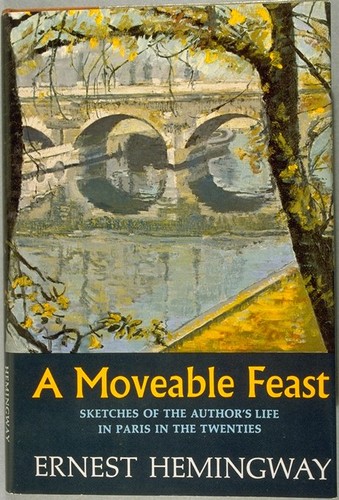
A Moveable Feast
by Ernest Hemingway
Buy on Amazon
A Moveable Feast is a 1964 memoir belles-lettres by American author Ernest Hemingway about his years as a struggling expat journalist and writer in Paris during the 1920s. It was published posthumously.[1] The book details Hemingway's first marriage to Hadley Richardson and his associations with other cultural figures of the Lost Generation in Interwar France. The memoir consists of various personal accounts by Hemingway and involves many notable figures of the time, such as Sylvia Beach, Hilaire Belloc, Bror von Blixen-Finecke, Aleister Crowley, John Dos Passos, F. Scott and Zelda Fitzgerald, Ford Madox Ford, James Joyce, Wyndham Lewis, Pascin, Ezra Pound, Evan Shipman, Gertrude Stein, Alice B. Toklas, and Hermann von Wedderkop.…
Recommended by
"This is a memoir by Hemingway about his time in Paris, which includes sketches of people like F Scott Fitzgerald and Hadley, and the birth of their son, Mr Bumby. More than anything else it shows us what a serious writer he was, or imagined himself to be. Writing was a total obsession for Hemingway. In many ways, all his women were like punctuation marks for him. He would spend the day writing and then go home to people like Hadley to complete the rhythm. He said that for him, the definition of a perfect day was writing one true sentence. That is what it meant for him to be living well. Well he only started writing it in 1956, when a trunk stored in the basement of the Ritz hotel in Paris was returned to him, which contained a series of his manuscripts from his time in Paris in the 1920s. When he died in 1961 it wasn’t quite finished, so the first version of it was an edited volume by his fourth wife Mary Hemingway, which came out in 1964. In fact there is some controversy, because a new restored edition came out in 2009 which claims to be closer to the original. The bone of contention mainly has to do with the final chapter. The editor of the new edition, Sean Hemingway, along with his uncle Patrick – the grandson and son of Pauline, Hemingway’s second wife – believe that Mary had deliberately highlighted Pauline’s predatory nature and downplayed Hemingway’s expression of remorse for his own responsibility in the breakup of his first marriage. These pages are now taken out of that final chapter, and put separately as an appendix to the new edition under the heading “The Pilot Fish and the Rich”. Many Hemingway aficionados are outraged. It’s clear that this new edition can’t be taken as the definitive edition, maybe no more than the 1964 edition could be. Interestingly, it seemed that Hemingway did call Hadley very late in his life, so there is a return to his beginning when he was thinking about her and reevaluating his relationship with her. It was also likely because he was looking back on his material from Paris, and thinking about that time once again."
"Hemingway ’s such a jerk in many ways. He’s so macho and he treated his wives terribly – until the last one. She kind of turned the tables. He was cruel to Fitzgerald who was a more fragile figure and probably a better writer, but I love this book. This book is written from a point of weakness, late in his life when his wife was caring for him but bullying him, and he’s looking back on his life as a young man – his first love! His first wife. He treated her terribly, of course, and left her for her friend, but here he’s talking about Paris and being poor with a baby and his wife, and there is something so moving about this macho man looking back at his life with regret. I live on the Rue Notre Dame des Champs which is where they lived in this period he’s writing about, and I walk past the apartment every day and think about them. It’s not just a portrait of a lost generation, but it’s about longing for youth and about regret. I mean, he was such an arsehole, but this is his best work, I think. Just writing about Paris and being young."
"A Moveable Feast, by Ernest Hemingway, to remind me of Paris, which I fell even more in love with during my term teaching there."
"About France, I don't know. But about Paris, I would recommend an American book: "A Moveable Feast," by Ernest Hemingway."
"We think of Hemingway as an American writer, but much of his writing is set outside of the United States, just as much of his life was set outside of the United States. Farewell to Arms was set in Italy and Switzerland. For Whom the Bell Tolls is set in Spain. The Old Man and the Sea takes place in the Caribbean. A Moveable Feast takes place in Paris . It’s Hemingway’s memoir of the time he spent there with his first wife and it was stitched together by his last wife. It gives you the sense that he yearns for his first wife and the time when they were young together in France. “One never gets the sense that Hemingway questions whether he can or should be in Paris. There seem to be no visa issues or racial questions.” It is important to this topic for a couple of reasons. One is that it reminds us that not all transnational stories move towards America. There is a long and illustrious tradition of literature about moving away from America. Hemingway is changed in important ways by his time away from America. The title refers to the change that Paris works on him. It’s a “moveable feast.” Very often transnational literature is concerned with abrogating an implicit border of belonging. And very often it concerns the question: Does one have the right to be where one is or where one wishes to be? But in A Moveable Feast one never gets the sense that Hemingway questions whether he can or should be in Paris. There seem to be no visa issues or racial questions. Perhaps there is a sense of entitlement to the expatriate experience that the rest of transnational literature lacks. At the same time, it’s a book about a border that cannot be crossed—the border between past and present. Hemingway is reaching back into his past. It turns out even our most manly of writers can be wistful."