Wai Chee Dimock's Reading List
Wai Chee Dimock is the William Lampson Professor of English and American Studies at Yale University. She has written widely on American literature and culture, from Thoreau, Melville and Whitman to Star Trek and the Grateful Dead. Her lecture course on Hemingway, Faulkner and Fitzgerald is available through Open Yale Courses
Open in WellRead Daily app →Hemingway in Paris (2012)
Scraped from fivebooks.com (2012-07-02).
Source: fivebooks.com

Ernest Hemingway · Buy on Amazon
"Many people don’t appreciate what a big commitment writing this novel was for Hemingway. He was used to writing short stories . It meant he had to spend a lot of time on one book that could have been spent more profitably writing short stories. Like many of Hemingway’s later novels, it is stitched together from shorter pieces – in this case, what he’d already written about Pamplona. It can be summed up by the phrase “grace under pressure”, and looks at the code of ethics that emerges from bullfighting. It starts in Paris and then goes to Spain . The main event is a bullfight in Pamplona. The main characters are a group of expatriates, including a Jewish man, Robert Cohn, who was a boxing champion at Princeton. The narrator, Jake Barnes, was injured in World War One and his impotence is strongly suggested. This makes it impossible for him to consummate his relationship with Lady Brett Ashley, the femme fatale of the novel. Very closely. The book is dedicated to his first wife Hadley Richardson, who went to Pamplona with him twice. Some of the details in the book come from real life episodes. Hadley was the one given the ear of a bull by the bullfighter, although in the book Brett Ashley is the recipient. So he isn’t afraid to use real life episodes, even though he mixes them up to suit his needs. Brett is also based on the English socialite Lady Duff Twysden, a famous figure in Paris at the time and part of a group that went with Hemingway and Hadley to Pamplona. When the book came out, all his Paris acquaintances had great fun speculating about who he had based his characters on."
Ernest Hemingway · Buy on Amazon
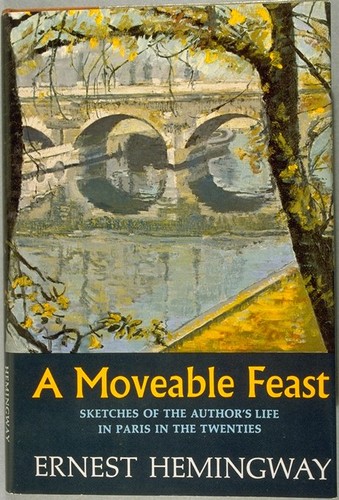
"This is a memoir by Hemingway about his time in Paris, which includes sketches of people like F Scott Fitzgerald and Hadley, and the birth of their son, Mr Bumby. More than anything else it shows us what a serious writer he was, or imagined himself to be. Writing was a total obsession for Hemingway. In many ways, all his women were like punctuation marks for him. He would spend the day writing and then go home to people like Hadley to complete the rhythm. He said that for him, the definition of a perfect day was writing one true sentence. That is what it meant for him to be living well. Well he only started writing it in 1956, when a trunk stored in the basement of the Ritz hotel in Paris was returned to him, which contained a series of his manuscripts from his time in Paris in the 1920s. When he died in 1961 it wasn’t quite finished, so the first version of it was an edited volume by his fourth wife Mary Hemingway, which came out in 1964. In fact there is some controversy, because a new restored edition came out in 2009 which claims to be closer to the original. The bone of contention mainly has to do with the final chapter. The editor of the new edition, Sean Hemingway, along with his uncle Patrick – the grandson and son of Pauline, Hemingway’s second wife – believe that Mary had deliberately highlighted Pauline’s predatory nature and downplayed Hemingway’s expression of remorse for his own responsibility in the breakup of his first marriage. These pages are now taken out of that final chapter, and put separately as an appendix to the new edition under the heading “The Pilot Fish and the Rich”. Many Hemingway aficionados are outraged. It’s clear that this new edition can’t be taken as the definitive edition, maybe no more than the 1964 edition could be. Interestingly, it seemed that Hemingway did call Hadley very late in his life, so there is a return to his beginning when he was thinking about her and reevaluating his relationship with her. It was also likely because he was looking back on his material from Paris, and thinking about that time once again."

Gertrude Stein · Buy on Amazon
"Gertrude Stein and Hemingway appear in Woody Allen’s recent film, Midnight in Paris. She’s the person who would read everyone’s work and give her opinion. That was historically the case with Hemingway. He was struggling, and at that early point would have been very happy to have one of his stories taken. Stein encouraged him to leave his paid job with the Toronto Star and concentrate on writing. Get the weekly Five Books newsletter In a famous episode, Hadley was travelling to meet Hemingway in Switzerland and she had all his manuscripts with her for him to work on. She somehow managed to lose the suitcase with the manuscripts in it when she was on the train. Of course Hemingway was devastated, as all the copies were in that suitcase. Stein persuaded him to move on and write something new. That process freed him, and he went on to start The Sun Also Rises. So in many ways she was a good mentor to him. But according to what he says in A Moveable Feast, he also read a lot of her work and edited it for her. So he stresses that there was mutual benefit. Both Hemingway and Stein talk about the separation in the drawing room of the two groups. There were the “men” on one side and their wives on the other. Stein was very much in the first group. They were the geniuses talking to one another. Stein would be there, talking to Picasso and Hemingway, and Alice would be off to the side talking to Hadley and Picasso’s lover Fernande Olivier. This is a comical moment in the book, written by Stein, supposedly from Alice’s point of view. But the book is all about Stein – why she went to Paris, what she did in the US before she went, and the intense friendships she had in Paris with people like Picasso. Ezra Pound, James Joyce , Sherwood Anderson, Wyndham Lewis and Ford Madox Ford were all there, as of course was F Scott Fitzgerald. The person Hemingway liked the best was Ezra Pound. He had the strange notion that Pound was the most Christian writer he had ever met. It seems so counterintuitive that it has always stuck in my mind, and I still can’t figure out what he means. Stein didn’t really like Pound, but according to Hemingway that’s because Ezra Pound broke one of her chairs."

Monique Truong · Buy on Amazon
"The Book of Salt is a wonderful book, one of my favourites. It’s by a Vietnamese-American author, Monique Truong, who was born in Saigon but now lives in the US. She has a degree from Yale and a law degree from Columbia. She said that she was inspired to write this novel because of Alice B Toklas’s cookbook , which was Alice’s claim to fame. Truong loves food, so she chooses to write about 1920s Paris through the eyes of Binh, the Vietnamese cook employed by Gertrude Stein and Alice B Toklas. Support Five Books Five Books interviews are expensive to produce. If you're enjoying this interview, please support us by donating a small amount . Truong says that being a chef is just as much of a vocation as being a writer. In fact, she thinks that taste is a better aesthetic faculty than sight. She thinks that Gertrude Stein writes only by sight, whereas one should be able to taste what one makes. The other thing about the book is that since the cook is Vietnamese, it enables her to talk about Indochina under French rule, so the book has a very different circumference from other books about that time. The name of the political activist and singer Paul Robeson comes up, and Binh meets a young Ho Chi Minh in disguise, so you get a sense of the different political currents in Paris. So this is a great way to update Gertrude Stein from a different point of view, seeing the comings and goings of the people that visited their house at 27 rue de Fleurus. But you also learn about southeast Asia, because the book takes you back to Binh’s early life in Saigon under colonial rule."

Paula McLain · Buy on Amazon
"This book is told in the first person, in the voice of Hadley. In that way it’s a good complement to Monique Truong’s book, which is told in the voice of the cook. Paula McLain did a good job in terms of historical research, and in fleshing out Hadley’s psychology. I think it is quite close. It’s interesting to cross-reference this book with the two Hemingway books we discussed earlier, because they cover much of the same terrain. McLain has stuck close to those sources and repeats some of Hemingway’s lines, such as the one about writing one true sentence. What is more intensely imagined in this novel is the long drawn-out breakup, with Hemingway slowly drifting away from Hadley and going over to Pauline. That is much more shadowy in A Moveable Feast. There are just a few references to Pauline, and then the apology to Hadley. There isn’t much detail about the breakup itself. But in The Paris Wife you see in vivid detail how Pauline was physically there, with both of them, while the breakup was going on, and how Hadley finally drifted into asking for a divorce. It was very painful, because Pauline insisted during all that time that she was Hadley’s friend as well. I’m persuaded by that imagined sequence, although we will never know exactly what happened, and whether Hemingway was as passive as is suggested in this book. But his unwillingness to make any decision seems right, as well as his strong tie to Hadley up to the very end. Get the weekly Five Books newsletter The book is a good corrective to the image Hemingway liked to portray of himself as a supreme writer who knew exactly what he was doing, always on top of things. It is also a good portrait of Hadley, and shows her as lacking in ruthlessness – someone who wouldn’t fight to keep her man at all costs. That is what makes her so attractive to Hemingway to begin with. There were all these different writers in Paris, like Joyce and Pound, so they were aware of what other people were doing. That was a tremendous spur, especially to Hemingway. There was also experimentation in the visual arts. Gertrude Stein, in many ways, was trying to produce in language what Picasso and Matisse were trying to do structurally in painting. Hemingway would also write, and then look at paintings by Cezanne and others. James Mellow, one of Hemingway’s biographers, thinks he was trying to do with words what Cezanne had already done with brush strokes. So I would say that both the practice and the personalities of other writers, and the challenge coming from the art world, combined to produce Hemingway and Stein’s writings."