← All books
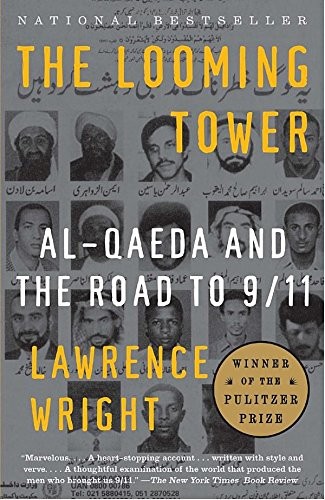
The Looming Tower
by Lawrence Wright · 2006
Buy on Amazon
National Book Award FinalistA Time, Newsweek, Washington Post, Chicago Tribune, and New York Times Book Review Best Book of the YearA gripping narrative that spans five decades, The Looming Tower explains in unprecedented detail the growth of Islamic fundamentalism, the rise of al-Qaeda, and the intelligence failures that culminated in the attacks on the World Trade Center. Lawrence Wright re-creates firsthand the transformation of Osama bin Laden and Ayman al-Zawahiri from incompetent and idealistic soldiers in Afghanistan to leaders of the most successful terrorist group in history. He follows FBI counterterrorism chief John O'Neill as he uncovers the emerging danger from al-Qaeda in the 1990s and struggles to track this new threat.…
Recommended by
"This is the best of all the books about the rise of al-Qaeda, culminating in the attacks of 9/11 . I think reading this one book gives you an excellent grasp of the human story and the context from which al-Qaeda emerged. Wright talks about the development of extreme Salafist Islamist thinking, the origins of al-Qaeda, the transition from the war against the Soviets in Afghanistan to the 9/11 attacks. He also tells the story of those in the CIA and FBI who saw the growth of the movement and tried to meet the threat, but without the bitterness and personal agendas of some of the tell-all accounts. Wright’s book is written in an engaging style, engrossing and entertaining but well-researched, based solidly on facts, and never sensationalistic. There is also a very nice appendix with a summary of the main characters, a big help for those who find it difficult to remember Arabic names. My students consistently love it. There is a reason why The Looming Tower won the Pulitzer Prize. It is a very fine book."
"The Looming Tower is like A Bright Shining Lie , which is about Vietnam. The hero of A Bright Shining Lie, as you may recall, is John Paul Vann, somebody within the US military structure who tried to convince others that the strategy in Vietnam was not working. The book begins by describing his funeral. He was killed in Vietnam. John O’Neill, who died in the World Trade Center attack on 9/11, is the hero of The Looming Tower . He ran the New York field office for the FBI in the pre-9/11 time period and played a central part in trying to take Al-Qaeda apart. He was one of the principal people in the US government saying Al-Qaeda is a big problem. It’s a wonderful read. Larry is an amazing writer. It won the Pulitzer, deservedly so. I don’t agree with everything in it but in a book of that size and scope that wouldn’t be surprising. This book is also, I think, the best account of Zawahiri. They had a symbiotic relationship: Larry views Ayman al-Zawahiri as the brains of the operation and Bin Laden as somebody who went along, but I’ve come to disagree. That was true in the eighties when Zawahiri first met Bin Laden – Bin Laden was an obscure guy who had some money. Zawahiri had been a jihadi since he was 15; he was older than Bin Laden, and he was a very serious revolutionary. But by the nineties Bin Laden was somebody who founded Al-Qaeda without Zawahiri really being around. By that time Bin Laden had become the leader. Zawahiri, in the mid-nineties, had no serious organisation behind him and he basically hitched his wagon to Bin Laden. Importantly, it was Bin Laden who really came up with the idea of attacking the United States. Zawahiri was very focused on overthrowing the Egyptian government. Bin Laden didn’t tell Zawahiri about the 9/11 attacks until the summer of 2001, even though the planning had been going on for years."
"Lawrence Wright ’s book is a marvellous study. It begins with the American education of this very famous Egyptian writer, who became the inspiration of the jihadists in Egypt. This was Sayyid Qutb, who was made a martyr by Nasser. Lawrence Wright goes right through the trial of the people who were accused of the assassination of Sadat, including al-Zawahiri, and then looks at the linkage between the Egyptian Jihad and Al-Qaeda. It is a very worthwhile book to read to try to understand the whole problem. That’s a good question. Of course we supported Mubarak and we turned a blind eye to many of the repressions that he carried out, because it was the feeling at the time that he was helping to keep potential Al-Qaeda people in check. Egypt became used in a very infamous way as a spot for rendition for suspected terrorists sent there by the CIA, because of concern that the same interrogation techniques Mubarak employed would not be legal in the United States. It is a very controversial episode."
"This is a fantastic account of the origins of al Qaeda, the individuals who laid the foundations of the organisation and why they carried out 9/11. It is the best work on the origins and development of al Qaeda in the 1990s. He uses interviews conducted in the 1990s and he also uses captured documents and materials that he integrated after 9/11. The government started releasing documents after 2002 and I’m going to use a lot of them for my next book. The other thing about Lawrence Wright is that he has a very compelling writing style. He shows in a very comprehensive way that the al Qaeda groups had a very coherent concept of what they hoped to achieve and that they were doing all this completely under the radar – only a handful of Americans knew what was going on. The fervour on the one hand and the ignorance on the other is startling."
"I remember reading this book quite a few years ago now and being impressed by two things. One is the detail and the contacts that Lawrence Wright had in writing this book, and second is the way in which it is written. The style is very accessible – it takes nothing for granted on the part of the understanding of its readership – and if anybody wishes to understand what Al-Qaeda is, where it came from and what it is trying to do, I think that this is the key book to read. It was written about events prior to 9/11 and 9/11 itself, so the book doesn’t go beyond that. But I suspect it is being updated, if it hasn’t already been, to coincide with the 10th anniversary of 9/11. He has good contacts like I have good contacts. He has worked on them and established a reputation. He is an academic, and in a way academics in this particular field of terrorism and political violence have more acceptable credentials than journalists do. Also he is in America. I have interviewed many of the people that he has interviewed, like Ali Soufan, an Arab-American FBI agent – a key source – and people have talked to Lawrence Wright because they trust him and he is highly respected as an academic. They know that whatever they say won’t be abused. They think that 9/11 was a legitimate attack in response to the sufferings that they, as Al-Qaeda supporters, believe America and Israel have inflicted on the Ummah – the Muslim community in general and certain parts of the Muslim world in particular. They draw upon what was happening in Iraq, what is happening in Afghanistan, the number of innocent civilians who have been killed by American raids and coalition raids on the ground. At the time, 9/11 was perceived by Al-Qaeda and its supporters as a legitimate attack on the great Satan – America."
"Yes, in that I could just have easily chosen Steve Coll’s excellent Ghost Wars . But, eventually, I went for this because it really does read like dramatic fiction. It is a history of radical Islamism and the road to 9/11. It also explores the failure of the CIA to share vital information with the FBI that might have allowed them to unravel the plot. Certainly for the administration side of al Qaeda there was a lot of information in Yemen that was never properly shared in terms of links to satellite phones that might potentially have led the FBI to uncover the plot. Absolutely. It’s funny, I like conspiracy theories but I really don’t believe in them. I am a great believer in the general incompetence of government. So there is this big problem within the intelligence community of the competition between the agents and their unwillingness to share information. And cultures of secrecy create opportunities that could be exploited by terrorists. My book is based around a bungled assassination attempt on Osama bin Laden in 1999, a flawed cover-up and the fall-out that ensues. The Looming Tower is also exploring those kinds of themes – how terrorism and crime can flourish despite our attempts to stop it. There is a fantastically flawed and divisive hero, John O’Neill, who led the FBI’s fight against bin Laden, but resigned in August 2001 to go and work at the World Trade Centre. He died on 9/11. It was O’Neill who understood that al Qaeda has four distinct arms: intelligence, administration, planning and execution. The book also has a great title – it is taken from a videotaped speech by bin Laden that was found on the computer of one of the members of the Hamburg cell. The cell would go on to bring down the towers. It is a quote from the fourth Sura of the Koran – ‘Death will find you, even in the looming tower.’ The final section of my book is called ‘Death will find you’."
"I have just interviewed him for my show, actually. He is an old friend. This book has similarities with the first, but Lawrence is aware of how to tell a story, how to make it appeal to an audience. He lived in Egypt in 1969-1971 and then in Saudi Arabia where he wrote the book. The title is a quote from the Quran: ‘Wherever you are, death will find you, even in the looming tower.’ He did five years of research and met over 600 people. It is a vast research on how we arrived at 9/11, the circumstances and the mindset. It has a huge scope. He studies the socio-economic background to 9/11 and the people who knew Osama. He had 6,000 pages of notes… It’s not like the last few pages are the conclusions he comes to, but you get a kind of picture. He talks about the socio-economic dependency of women, and the hypocrisy you get in this part of the world. I would like him to have highlighted, or refuted, if that’s what he found, the influence of the political situation and why people would feel strongly enough to kill themselves for a cause, the relationship between the Arab world and the West, the Palestinian situation, Israel. But it’s more about the culture of hypocrisy that doesn’t produce the best. A culture that produces frustration rather than hope."