Peter Bergen's Reading List
Peter Bergen is a national security analyst for CNN, and the author of four books. He has been travelling to Pakistan for nearly 30 years, and has written for publications including The New York Times, Foreign Affairs and Vanity Fair . In 1994 Bergen won the Overseas Press Club’s award for best foreign affairs documentary. His new book is Manhunt
Open in WellRead Daily app →Osama bin Laden (2012)
Scraped from fivebooks.com (2012-06-21).
Source: fivebooks.com

Steve Coll · Buy on Amazon
"It’s not just about the Bin Laden family. It’s as much about how Saudi Arabia developed and interacted with the United States over time. Steve tells the Saudi-US story through the Bin Laden family, who played an important role in how Saudi Arabia developed as a modern state. The Bin Ladens were integrally involved in creating the infrastructure of the kingdom, and they became very rich as a result. The main character in the book is Mohammed Bin Laden, the patriarch of the family. He was a penniless labourer, a construction worker, when he came from Yemen in 1930. He had good timing. Saudi Arabia was formed in 1932 and the Saudi monarchy made its first agreement with an American oil company right around that time. Mohammed was a talented businessman who the king came to trust as he built up the country. As a result Mohammed was able to erect a construction conglomerate. One of the interesting things in the book is that Bin Laden had 53 siblings none of whom went down the route that he went. Steve’s book is a portrait of this family, many of whom took opposed approaches to life. One of the key characters is Salem bin Laden, Osama’s oldest brother, who died in a microlight aircraft accident near San Antonio, Texas in 1988. He was a playboy and pro-American. He was a pilot, he dated all sorts of Western women, he married into the English upper class and, like a lot of Saudis, he had a house in Orlando. Get the weekly Five Books newsletter What the book shows is that there are a lot of different paths that Bin Laden could have taken. Of the 53 siblings I think a quarter studied in the United States and many had houses in the United States. The book, which was nominated for a Pulitzer in biography, is an amazing group portrait of this family and the different paths that they took, and Osama Bin Laden’s path was only one of them. It does explain that there was a religious wing of the family to which Bin Laden belonged, but Bin Laden was the only ultra-fundamentalist. He became a fundamentalist as a teen and that hardened into fanaticism because of his involvement in the Afghan war against the Soviets in his twenties. The struggle against the Soviets in Afghanistan made him start thinking about founding the group which became Al-Qaeda – the Soviet War experience turned Bin Laden from a religious guy with a couple of wives working in a family business into somebody willing to engage in violence and somebody who began to believe in his own leadership capabilities."

Najwa bin Laden, Omar bin Laden and Jean Sasson · Buy on Amazon
"Osama bin Laden does not come out as “Dad of the Year”. Najwa bin Laden, Bin Laden’s first wife who bore him 11 kids, married him when he was 17 and she was 15. When she married him she was a young Syrian girl with no education and certainly had no understanding of her husband’s militant activities. Omar bin Laden, the son, seems to be animated with quite a lot of anger about the way his father treated him and his siblings. I wish I had had that book when I was writing The Osama bin Laden I Know because there are so many interesting first-person anecdotes – I’ll give you one example. Omar bin Laden complains about his dad taking him on 12-hour hikes through the mountains of Tora Bora, which his dad loved doing and the kid dreaded doing. That’s one of the reasons, I believe, Bin Laden was able to escape the battle of Tora Bora because he was instilling toughness in his kids by forcing them to do these practice hikes. Then another anecdote from his wife: He, the son of a billionaire, moved his whole family into Tora Bora, where they lived like medieval peasants, in a place with no electricity. They probably remain the most important construction company in the Middle East and they continue to be the most important construction company in Saudi Arabia. The family is doing pretty well and in fact the United States government, when it was rebuilding a US base in Saudi Arabia, relied on the Bin Laden group. Neither was in the best position to do that. Omar was too young and Najwa was completely excluded from his militant activities."
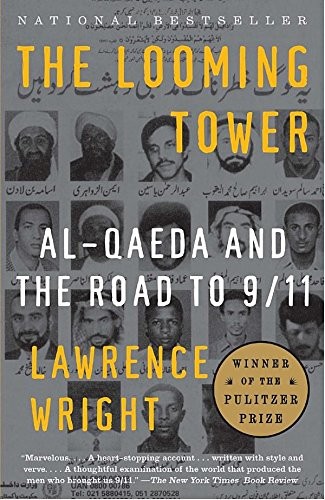
Lawrence Wright · 2006 · Buy on Amazon
"The Looming Tower is like A Bright Shining Lie , which is about Vietnam. The hero of A Bright Shining Lie, as you may recall, is John Paul Vann, somebody within the US military structure who tried to convince others that the strategy in Vietnam was not working. The book begins by describing his funeral. He was killed in Vietnam. John O’Neill, who died in the World Trade Center attack on 9/11, is the hero of The Looming Tower . He ran the New York field office for the FBI in the pre-9/11 time period and played a central part in trying to take Al-Qaeda apart. He was one of the principal people in the US government saying Al-Qaeda is a big problem. It’s a wonderful read. Larry is an amazing writer. It won the Pulitzer, deservedly so. I don’t agree with everything in it but in a book of that size and scope that wouldn’t be surprising. This book is also, I think, the best account of Zawahiri. They had a symbiotic relationship: Larry views Ayman al-Zawahiri as the brains of the operation and Bin Laden as somebody who went along, but I’ve come to disagree. That was true in the eighties when Zawahiri first met Bin Laden – Bin Laden was an obscure guy who had some money. Zawahiri had been a jihadi since he was 15; he was older than Bin Laden, and he was a very serious revolutionary. But by the nineties Bin Laden was somebody who founded Al-Qaeda without Zawahiri really being around. By that time Bin Laden had become the leader. Zawahiri, in the mid-nineties, had no serious organisation behind him and he basically hitched his wagon to Bin Laden. Importantly, it was Bin Laden who really came up with the idea of attacking the United States. Zawahiri was very focused on overthrowing the Egyptian government. Bin Laden didn’t tell Zawahiri about the 9/11 attacks until the summer of 2001, even though the planning had been going on for years."

Michael Scheuer · Buy on Amazon
"Mike was the leader of the Bin Laden unit when it was founded in 1995. His biography gets the story of the Zawahiri/Bin Laden relationship right. Over time it changed. Bin Laden really became the leader and Zawahiri the follower. Al-Qaeda is on life support or possibly even dead. It’s mostly out of business. Bin Laden founded Al-Qaeda. The idea of attacking the United States in a large-scale fashion – 9/11 – was his idea. He ran Al-Qaeda as a dictatorship, not as a democracy. There are obviously huge differences between the Nazi Party and Al-Qaeda but there is one similarity: When you joined the Nazi party you swore a personal oath of allegiance to Adolf Hitler. Similarly, joining Al-Qaeda entailed swearing a personal oath of allegiance to Bin Laden. So Al-Qaeda became a very typical charismatic organisation led by a charismatic leader, and killing him was a final nail in the coffin. Al-Qaeda had been losing the war of ideas for years. They were absent in the Arab Spring. When Bin Laden was killed no one was carrying pictures of him in Cairo or Benghazi. His death is a punctuation point for the story of Al-Qaeda’s decline over many years. Clearly some people have taken up that brand name. The memos found in the compound where Bin Laden was living demonstrate that he was keenly aware that the Al-Qaeda brand had suffered, particularly because of Al-Qaeda’s activities in Iraq where they killed so many Muslims and civilians. He was telling groups that were thinking of using the name that it could be bad for fundraising and attract a lot of negative attention. These groups will linger, there are people who will find Al-Qaeda’s ideas attractive, but the groups are under tremendous pressure from the United States and pretty much every other country in the world. Al-Qaeda hasn’t succeeded in attacking the United States in a decade plus. Even Al-Qaeda in Yemen, which people say is a problem – all their plots against the United States have been foiled."

Jason Burke · Buy on Amazon
"Burke is one of the leading foreign correspondents in the world. He was posted in Pakistan and spent a lot of time in Iraq. This is a very deeply reported book but I don’t agree with its analysis of Al-Qaeda’s structure. Burke sees Al-Qaeda as more of a disorganised movement, which grew up organically in Afghanistan. I think that that is incorrect. Just to give you one example, a draft of Al-Qaeda’s bylaws runs to 36 pages in English. So Al-Qaeda was, in fact, bureaucratised. As a tactic it’s been successful but I think it can be overused. If the success of the drone programme means that we have 180 million people in Pakistan who are irate at the United States that seems like a high price to pay. The drone programme pisses off Pakistanis across the ideological spectrum. This is about their national sovereignty and the perception that these attacks kill many civilians, which is not very true. If Canada was routinely killing mafia members in Buffalo, New York, there would be some Americans who would be pissed off that Canada was invading our air space. Support Five Books Five Books interviews are expensive to produce. If you're enjoying this interview, please support us by donating a small amount . Leftists in the United States and elsewhere have been surprisingly muted about the drone programme. I think there’s a pretty simple reason for that. There was a great deal of human outcry about a lack of due process at Guantanamo. There’s no greater lack of due process than for the Obama administration to act as judge and juror and just kill militants. There’s a cognitive dissonance about Obama and his embrace of covert power, whether it’s drones or Special Forces or cyber attacks. It’s a very complicated question because some of the people killed in these were responsible for the deaths of hundreds of Pakistanis. I think there is an argument to be made for judicious use of drones, particularly when they’re in the common interest of Pakistan and the United States. The counter-argument is that we’re creating a precedent that other countries will feel justified in following. It won’t be long before we have several countries that have armed drones and that could be something we come to rue. He undoubtedly changed history to some degree. Certainly 9/11 had a broad effect on the United States, and through that Afghanistan and Iraq. But the further we get away from the event, the more we can see that Bin Laden’s ideas were not widely accepted in the Muslim world. It was telling that the protests that marked Bin Laden’s death were incredibly small. He became more irrelevant over time. His ideas were proved to be wanting. He had a negative agenda, and no agenda on how to deal with political and economic problems of the Arab world. One of the points I make in my book, Manhunt, is that 9/11 appeared to be the beginning of something – the beginning of Al-Qaeda’s assault on the West which would change the world. But in fact it was really the climax of Al-Qaeda’s activity. It was a kamikaze attack by Al-Qaeda that essentially destroyed their base – and Al-Qaeda means “the base”. The goal of getting the United States out of the Middle East didn’t happen. Quite the reverse. 9/11 was Osama’s Pearl Harbor – a victory that led to strategic defeat."