← All books
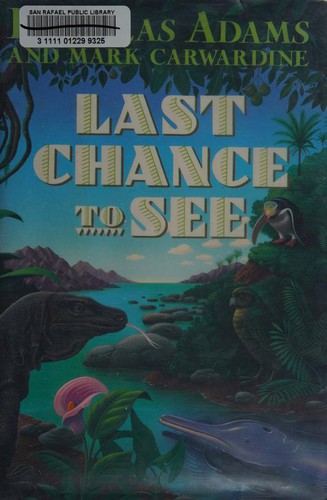
Last Chance to See
by Douglas Adams & Mark Carwardine
Buy on Amazon
This is a funny book, as you would expect from anything Douglas Adams works on, and it’s a book to treasure. It’s one of the finest examples, I think, of popular science writing. It’s got a really strong narrative. You want to turn the page, you don’t feel you’re reading it just to better yourself. It’s also a very powerful book. We’re talking about species—such as white rhinos in the Congo, giant Komodo dragons in Indonesia, and the bizarre aye-aye of Madagascar—that are about to disappear from our planet because of us. They are of absolutely no use to humans, yet this book makes us care about their fate. We feel that without them, the world would be a far poorer place. Exactly. The concept is obvious and it’s very compelling because these are all charismatic species. If they disappeared it might not have huge consequences for humanity, we’re not talking about honeybees going extinct, but what a shame if a species like the rhino were to disappear from our planet. This is a book obviously for readers but it’s also a book for writers of science to understand how to capture the imagination of readers. The science is very lightly put there but there’s enough to make it a science book. It describes the incredible efforts going on around the world by conservationists to save important parts of the natural world from ourselves. Yes, to me the best popular science books are not just a synthesis of the research, you want to feel that the writer has something special to give you and something they have brought to you from around the world. The world could be as small as their room but it has got to be something original, something different, something they have thought about and experienced and can bring to you that you can’t necessarily get yourself. For me that’s what makes a good book. Any book, but also a good science book.
Recommended by
"This is a funny book, as you would expect from anything Douglas Adams works on, and it’s a book to treasure. It’s one of the finest examples, I think, of popular science writing. It’s got a really strong narrative. You want to turn the page, you don’t feel you’re reading it just to better yourself. It’s also a very powerful book. We’re talking about species—such as white rhinos in the Congo, giant Komodo dragons in Indonesia, and the bizarre aye-aye of Madagascar—that are about to disappear from our planet because of us. They are of absolutely no use to humans, yet this book makes us care about their fate. We feel that without them, the world would be a far poorer place. Exactly. The concept is obvious and it’s very compelling because these are all charismatic species. If they disappeared it might not have huge consequences for humanity, we’re not talking about honeybees going extinct, but what a shame if a species like the rhino were to disappear from our planet. This is a book obviously for readers but it’s also a book for writers of science to understand how to capture the imagination of readers. The science is very lightly put there but there’s enough to make it a science book. It describes the incredible efforts going on around the world by conservationists to save important parts of the natural world from ourselves. Yes, to me the best popular science books are not just a synthesis of the research, you want to feel that the writer has something special to give you and something they have brought to you from around the world. The world could be as small as their room but it has got to be something original, something different, something they have thought about and experienced and can bring to you that you can’t necessarily get yourself. For me that’s what makes a good book. Any book, but also a good science book."
"Yes, definitely. It’s his only factual book, and that means it sounds more serious, but I don’t think so. It’s one of his funniest. He wrote the book with Mark, but you can tell it’s mostly Douglas, and I’ve seen the notes Mark wrote to Douglas during the production of the book, saying ‘I’m completely lost here,’ or ‘I don’t know what to say at this point.’ In the end, he just quoted bits from Mark, and most was strung together by Douglas, and presumably its editor. But it’s their journeys, their travel, the real stuff they encountered. There’s a really hilarious bit where they went to meet a snake expert in Australia, because they are about to go somewhere where there are lots of poisonous snakes and creatures. And this guy is basically just saying: don’t. Don’t go there. They ask what would happen if they get bitten, and he says: get bitten, you die. There was a lot in the notes that didn’t make it into the book, so we’ve put some of it into 42. There are adventures with officialdom, on dodgy out-of-the-way airstrips, where they’ve flown in in some rusty tin can bucket of an aircraft, and meet with corrupt officials expecting to have palms crossed with silver, suitably greased, you know. And then suddenly all the problems disappear. It’s a lovely book, with a point to it. I did a really in-depth interview with him about it one year when he couldn’t make it to one of the big Hitchhiker conventions. We sat up on his roof garden in his swanky flat in Islington Green. He was talking about just having come back from Madagascar, where he was on the hunt for a weird and very endangered species of lemur, the aye-aye. He’d enjoyed it so much, despite all the roughing it. I mean, this was a man who travelled the world in luxury hotels and in first class on Concorde. But he loved slogging through the jungle and living in mud huts and tents and hammocks. Adored it. Although at the end of all these trips he would have a few days in a luxury hotel to get back on course. But he loved it, said he wanted to do more of it. And sure enough, a couple of years later—some say for tax reasons—Douglas went away with Mark Cawardine and a radio producer. And wrote the book afterwards. It was initially for the radio; Douglas loved radio. He said the pictures were better on the radio. And twenty years later, his friend Stephen Fry went with Mark again around the world for a TV show to see how the animals had got on. Sadly things like the Yangtze river dolphin had already died out. The noise of the shipping had interfered with their echolocation in that filthy river. He was also patron of charities, including Dian Fossey’s gorilla charity and Save the Rhino International. You don’t have to be any kind of fan of science fiction to love this book. It stands alone."
"I think if people see other people that they respect caring, they might be motivated to care. I only read the book because I read the science fiction series. I picked it because I just love the way he writes. He describes in this book not only the beauty of these animals, but the human landscape they live in and what a disastrous time he has getting to these locations. You’re not surprised these things have gone extinct because the whole idea of how they were being protected just seems so calamitous and disastrous and uncontrolled. Many of these species he talks about in this book are gone, they don’t exist any more. It’s a different way of looking at conservation. When you approach these topics with a different perspective and a different attitude and different eyes you attract a different audience and the more people we can attract to this with different viewpoints and different likes and dislikes, the better off we are going to be if we eventually do want to save any of these species."
"Well, Douglas Adams was one of the most brilliant writers who ever lived. The insight that you get from the Hitchhiker’s stuff is astonishing. For example, when his character Ford Prefect comes to earth and names himself Ford Prefect because he mistakes the dominant life form: he thought it was cars. He just has such a clever and insightful way of looking at the way that we are, as well as making it screamingly funny. His book Last Chance to See is a travelogue where he went around the world with Mark Carwardine, who worked in conservation, and basically looked at disappearing species. They looked at the Yangtze River dolphin and a parrot on an Australian island. For me, Last Chance to See is a real eye-opener, with the idea that you can take a depressing subject – species on the verge of extinction – and present it in a way which is so engaging, so funny and so humane. I would like to be able to do that as a writer. Well I can remember the Yangtze River dolphin, and the authors describing how they were dropping microphones wrapped in condoms into the water (the condoms were to keep the water out) so they could hear the dolphins. But they never did get to see one. I think they were more or less extinct already. It’s a pretty sad tale. Well it isn’t so much global warming that’s an issue. It’s all the other things we do as well. For example, the blue fin tuna – we are literally eating our way through them. Somehow it brings it home more, when it is people just eating things rather than displacing habitat. Yes, the fact that we fish them out until they are all gone. It just brings the greed of it all really to the fore. There is a good chance that the blue fin tuna will be fished out completely and made extinct next year. But I’ve been involved in campaigning on this and one of the good things is that the UK government says it is going to take the case to the Convention on International Trade and Endangered Species. We want them to try and stop the fisheries, because it really is at a critical point now for the tuna in general."