Mark Lynas's Reading List
Open in WellRead Daily app →The Environment (2009)
Scraped from fivebooks.com (2009-06-12).
Source: fivebooks.com
Douglas Adams & Mark Carwardine · Buy on Amazon
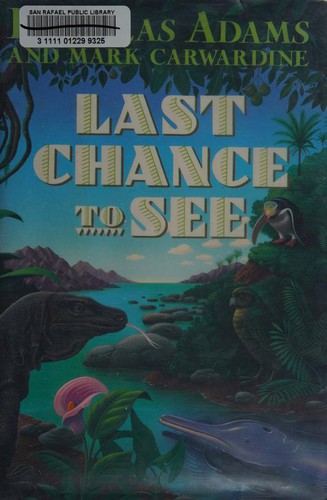
"Well, Douglas Adams was one of the most brilliant writers who ever lived. The insight that you get from the Hitchhiker’s stuff is astonishing. For example, when his character Ford Prefect comes to earth and names himself Ford Prefect because he mistakes the dominant life form: he thought it was cars. He just has such a clever and insightful way of looking at the way that we are, as well as making it screamingly funny. His book Last Chance to See is a travelogue where he went around the world with Mark Carwardine, who worked in conservation, and basically looked at disappearing species. They looked at the Yangtze River dolphin and a parrot on an Australian island. For me, Last Chance to See is a real eye-opener, with the idea that you can take a depressing subject – species on the verge of extinction – and present it in a way which is so engaging, so funny and so humane. I would like to be able to do that as a writer. Well I can remember the Yangtze River dolphin, and the authors describing how they were dropping microphones wrapped in condoms into the water (the condoms were to keep the water out) so they could hear the dolphins. But they never did get to see one. I think they were more or less extinct already. It’s a pretty sad tale. Well it isn’t so much global warming that’s an issue. It’s all the other things we do as well. For example, the blue fin tuna – we are literally eating our way through them. Somehow it brings it home more, when it is people just eating things rather than displacing habitat. Yes, the fact that we fish them out until they are all gone. It just brings the greed of it all really to the fore. There is a good chance that the blue fin tuna will be fished out completely and made extinct next year. But I’ve been involved in campaigning on this and one of the good things is that the UK government says it is going to take the case to the Convention on International Trade and Endangered Species. We want them to try and stop the fisheries, because it really is at a critical point now for the tuna in general."

James Lovelocke · Buy on Amazon
"Yes, James Lovelock wrote The Ages of Gaia, I think, in 1988. It wasn’t his first Gaia book, but it is probably the best written one. I have just been re-reading it recently and certain themes that he picked up on are ones that are still considered novel today. Not just the whole idea of the way the earth works, almost as a living organism. But also looking at the way humanity is going to have to reconcile itself with the constraints and the limits of the planet. The Gaia hypothesis was something which sprung from Lovelock’s work for NASA when he was trying to figure out ways to see whether Mars and other planets had life on them. He realised that having lots of reactive gases altogether in an atmosphere indicated that something must be there constantly producing them, which is life. Mars is obviously a dead planet because there’s nothing in the atmosphere which hasn’t been there for millions of years. Whereas if you look at Earth it’s a churning mixture of dynamically unstable gases. It was that insight which made him think about why these very dynamic systems have been stable for so long. Why levels of oxygen haven’t been below 15 per cent or above 30 per cent for probably close to a billion years. Yes, I mean I don’t buy the Gaia theory completely. I can see all sorts of criticisms. He thinks of life as a sort of self-regulating mechanism keeping the planet habitable with life, and I don’t actually see many ways of how that operates in the real world. It’s a great theory and it seems to be what happens, but I don’t think many scientists can point to the ways in which it supposedly operates. Lovelock is one of the most important thinkers on the environment and science generally in the last 50 years. One of the things that always impress me about people who are interdisciplinary is that he is quite happy to range across different areas. I mean there is a chapter in the book called God and Gaia, talking about theology and whether he can reconcile faith in God with what he sees in terms of biology and so on. So his ability and breadth of knowledge I always find really striking."

John Gray · Buy on Amazon
"What I like about the book is the anti-humanism. The rejection of this idea we all have, that humanity is at the centre of the cosmos, which is a post-Christian thing. John Gray is an unreconstructed pessimist, particularly on environmental issues. Not really, no, it’s not the globalisation stuff that interests me. It’s more about the human ecology. He thinks that we are going to hell in a handcart and there is nothing that we can do about it. A bit like Lovelock’s later books. It’s just refreshing to read stuff where somebody isn’t desperately trying to claw some minor positive out of the situation. There is always the temptation in these books to say there are these horrible trends that are leading to a hellish fiery future but we can still do something about it. Yes, of course. But, it is still quite refreshing to read somebody who doesn’t have any time for that kind of stuff. Yes."
Jared Diamond · Buy on Amazon
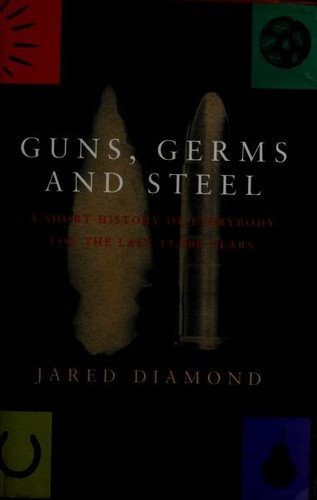
"This is a really useful way of trying to figure out why different humans turned out the way they did, while considering the influences of technology and of the environment. At the beginning of the book, he asked why the Spanish invaded the Inca Empire, rather than the other way round. And most people would have a slightly racist answer to that, even if they don’t dare say so – that it’s something inherent about Europeans that makes them superior. But of course that’s rubbish. It is nothing to do with race. It’s to do with many other factors. Yes, like that Europe has a very wide East-West axis, which goes all the way to China. And we happen to be on the same latitude so there have been all sorts of trade going on for thousands and thousands of years. Things that the Chinese invented, such as gunpowder and the printing press, eventually made their way to Europe. There’s been a lot of cross-fertilisation, whereas in the Americas, which are North-South orientated, there is very little communication between the cultures. So you didn’t get anything like that level of rapidity of development. There were lots of different factors in Diamond’s premise and I think it is a fascinating look at the way humanity works."

Malcolm Gladwell · 2000 · Buy on Amazon
"Malcolm Gladwell is a master at branding himself. He puts brands on all his concepts and they’re very memorable as a result. I’m not sure that it was him who came up with the idea of the tipping point, but he certainly popularised it. His thesis is that the tipping point is a social phenomenon. It could just be a make of trainer, but if enough people wear them, then everybody wants them. There is a tipping point in the social consciousness which suddenly leads to issues becoming wildly popular. In his book he explores the different kinds of things that contribute to something having this global tipping point. But the concept has wider implications. In every single aspect of environmental science there is a tipping point. For example, take a coral reef eco-system. If you put in just a bit too much nitrogen and drive it past the tipping point, then all the coral dies. You get seaweed and algae everywhere. The eco-system can be relatively resilient and then cross the threshold and it will change into a different stage. The same thing is suggested for climate change. We can drive the system so far but then, if we cross a certain threshold which a lot of people (including me) think is some where around two degrees, we cross a tipping point, which will start things like the destruction of the Amazon rainforest, and the release of large quantities of methane in Siberia."