Kevin Jon Davies's Reading List
Kevin Jon Davies is a filmmaker, author, and editor of the new book, 42: The Wildly Improbable Ideas of Douglas Adams .
Open in WellRead Daily app →The Best Douglas Adams Books (2023)
Scraped from fivebooks.com (2023-09-01).
Source: fivebooks.com

Douglas Adams · 1979 · Buy on Amazon
"Sure. Douglas had already worked on various radio programmes before this, and tried his hand at producing—which he was terrible at, not organised enough, too chaotic—and then he was offered the chance to write something new. Originally he planned it would be many different stories of the ends of the Earth; the Earth was going to finish every week, be blown up or destroyed in some way. But then he got into these characters that he created. The Hitchhiker’s Guide to the Galaxy was his idea of an electronic book long before any such thing existed in the real world. That was his notion. It was also used as a narrative device throughout the story. Arthur Dent, his hero, is a very ordinary—dull, some would say—Earth man, who discovers that his house is about to be demolished by bulldozers. As he’s dealing with county council officialdom, a friend called Ford Prefect helps him escape the destruction of the Earth, which is being blown up by alien bureaucrats. It’s one scale up. That’s the joke. Then at that point, you know, we’ve destroyed the Earth. We’ve got no choice: it’s science fiction. We’re off and out into the galaxy. In the TV series, Arthur Dent wanders the galaxy in a dressing gown, because he got up that morning, ran out, and laid in the mud in front of the bulldozer, and so he’s stuck in that dressing gown for the rest of the series. Douglas eventually incorporated that into the novel, so it became canon. It’s hilarious. Some would call it picaresque. Some would say it’s too episodic. But for the novel, he took the first four episodes of the radio show and made them work as a novel with his own unique sense of flair and verve. That sense of humour. People who hate science fiction liked it because they thought it was taking the piss out of science fiction. And people who like science fiction liked it anyway. So it appealed broadly, to different audiences. Primarily, as he said himself, he was a satirist, a comedy writer born of sketch revue at Cambridge. That’s where he first fermented his way of writing, and where, I think, the radio series got that Monty Python -like flavour. I heard someone else observe that the movie was trying to be too real. It was a different generation, and they presented it more as a sort of magical realism, rather than the Python -esque sketch comedy feel. Right. In improv you say ‘yes’ and roll with it. Douglas was writing episodically, he wasn’t planning ahead. Famously, he had the Vogons throw his two heroes out of the airlock in deep space. What will he do next? He said he remembered seeing a television show about judo. It said that if a 16-stone judo expert is flying through the air towards you, turn that into his problem. In other words: roll with it, duck, use his momentum to solve the problem, flip him over. So, what Douglas did was say: okay, well, if I’m throwing them out of the airlock, their survival is completely improbable. So: we’ll have a spaceship powered by improbability. That’s how he got out of that one. Then he had to create a whole backstory to how the improbability drive was invented, how it works, and then that became the thing that propelled them on their adventure. “Primarily, as he said himself, he was a satirist, a comedy writer born of sketch revue” I interviewed Geoffrey Perkins, who produced most of those early radio series—Simon Brett was the first producer, but Perkins did the next 11 episodes—and he said, ‘by episode three, suddenly we had a plot.’ But he was stuck at the time. Douglas had been out of work, unemployed, suffering a bit. And his flatmate John Lloyd got a job producing BBC Radio, where he created The News Quiz , which is still running. Feeling very dejected, but suddenly he was commissioned to write four episodes of Doctor Who and the first six episodes of Hitchhiker , practically at the same time. From his notes, I can’t quite work out which came first, it’s all intermingled. Then he got stuck. So he asked John Lloyd to help. They’d worked together before—a couple of their projects are in our book, and one of Douglas’s job applications—and they wrote the last two episodes of the first radio series together, which is why the novel feels a bit truncated. It stopped when the publishers said stop. Publishers had a lot of trouble getting work out of Douglas. He was a famous procrastinator. That was the line he used again and again, many times over the years. The publisher said: just finish the book. Whatever page you’re on, stop. Or that’s the story—he told stories that were slightly fabricated, elaborations on reality. But part of the problem was that they had been commissioned originally to write the novel together. But then Douglas had some kind of crisis and he decided, no, he wanted to do it on his own. So, he sacked his best mate. John Lloyd has talked about this plenty of times. They patched it up fairly quickly afterward, but he was very upset at the time. He says now that it was the perfect thing for Douglas to have done, because the book has Douglas’s unique turn of phrase, and it was better for it. They went on holiday together, where ostensibly they had been going to write the book together. They still went on the holiday, with a couple of other people, and Douglas would sit there in his room trying to write, before eventually giving up to join them down at the local taverna to play games—which later became The Meaning of Liff. Support Five Books Five Books interviews are expensive to produce. If you're enjoying this interview, please support us by donating a small amount . I first met Douglas that year, 1978. I was just a 17-year-old fan of Doctor Who , and he had just got the job of script editor. I went to interview him. That was when Hitchhiker’s was just taking off. They wanted more of that, he had Christmas special episodes to write and they were talking about a cartoon series—that eventually became the TV show. And he said, ‘Of course, I’ve got this bloody book to write, if only I could finish the bloody thing.’ It’s funny to play that cassette back now. It’s like: No, Douglas, put everything else down! You have no idea. The book became a major, major hit for Pan, the publisher. A huge bestseller. In January of 1984, I went to the ceremony where they presented him with a ‘Golden Pan’ for selling his first million copies. There were several Golden Pans still to come after that. But that was the first big milestone. And again with the deadlines—I remember Douglas’s speech at the event. He said, ‘I’ve known about this award presentation for a few weeks now, and I’m glad to say my acceptance speech is very nearly ready.’"

Douglas Adams & John Lloyd · Buy on Amazon
"That’s right. I think it came from a game Douglas played at school with his English teacher, of whom he was very fond, Frank Halford. He pops up in a couple of documentaries. Douglas would play this game with him, and later Douglas played it as a kind of drinking game. They did it from both angles—sometimes they’d come up with a human experience that doesn’t yet have a name, or an object, or a feeling, something that we’d all recognise but doesn’t have a defined name. Then they’d come up with a string of placenames and try to put them together. Yes. Well, there’s ELY (n.) – The first, tiniest inkling that something, somewhere has gone terribly wrong. WEST WITTERING (ptcpl. vb.) – The uncontrollable twitching which breaks out when you’re trying to get away from someone at a party My son’s favourite is really simple, a one liner: DUNSTABLE (n.) – A retired policeman. He was a big fan of John Cleese and Monty Python , that really comes through. Yes, it has that flavour. There’s a surprising amount of toilet humour which is not everyone’s cup of tea. I was actually present for one— GLASGOW (n.) – The feeling of infinite sadness engendered when walking through a place filled with happy people fifteen years younger than yourself. That was Hitchcon 1, in September 1980, in a hotel in Glasgow. I was also a guest speaker there. I sat at his right hand and accidentally knocked his drink over. I was only nine years younger than Douglas, but I did look up to him as a kind of big brother figure, someone I admired hugely. I mean, we all did look up to him because he was so enormous. Our lives criss-crossed many, many times over 20 years until he sadly died, far too young, at 49."

Douglas Adams · Buy on Amazon
"Well, as I said, he didn’t really see himself as a science fiction writer. And he didn’t want to get stuck writing Hitchhiker’s the whole time. But the publishers were constantly asking him to do more Hitchhiker’s . You can see that in his notebooks. He wrote to himself: We employ you as a sausage factory, where are all the bloody sausages?????? But then he had this idea for a detective novel. And of course, he becomes a time-travelling detective. It’s hard to sum up the plot, you just have to work through it yourself. What you may find—I did—is that you get more out of it the second time you read it. It’s one of those books. You’ve got to concentrate. But it will make you laugh. Stephen Fry has spoken about the elegant phrasing. He compared it to P.G. Wodehouse , of whom they were both massive fans. It’s actually easier to follow as a radio series. You have to start with this one, but I probably prefer the second book, The Long Dark Teatime of the Soul , the one with all the retired Norse gods. They gather together in what was then the disused St. Pancras railway station. I always wanted to see that made into a film, it would have been really moody and wonderful. But of course the place has been done up now. Right. The dialogue in all his books reads just like sketch comedy, it’s where he was coming from. Our book 42: The Wildly Improbable Ideas of Douglas Adams has loads of stuff from that time: programme booklets, bits of script, all sorts of things. Douglas was part of a little comedy troupe called Adam Smith Adams, with two guys called Will Adams and Martin Smith—who was immortalised in Hitchhiker’s as ‘bloody Martin Smith of Croydon’—and they were into the whole Cambridge Footlights thing. They wrote shows, sketches together and performed them. Douglas loved performing. I think he was a terrible performer, actually. I never got on with his talking books, but maybe it’s because I knew Douglas and could hear him reading it, instead of acting."
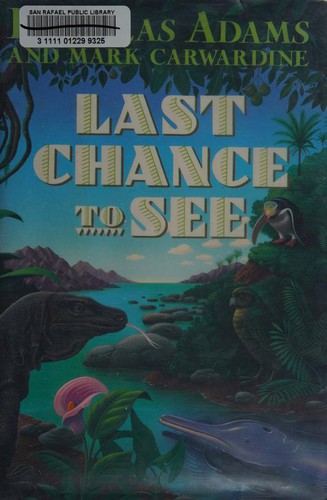
Douglas Adams & Mark Carwardine · Buy on Amazon
"Yes, definitely. It’s his only factual book, and that means it sounds more serious, but I don’t think so. It’s one of his funniest. He wrote the book with Mark, but you can tell it’s mostly Douglas, and I’ve seen the notes Mark wrote to Douglas during the production of the book, saying ‘I’m completely lost here,’ or ‘I don’t know what to say at this point.’ In the end, he just quoted bits from Mark, and most was strung together by Douglas, and presumably its editor. But it’s their journeys, their travel, the real stuff they encountered. There’s a really hilarious bit where they went to meet a snake expert in Australia, because they are about to go somewhere where there are lots of poisonous snakes and creatures. And this guy is basically just saying: don’t. Don’t go there. They ask what would happen if they get bitten, and he says: get bitten, you die. There was a lot in the notes that didn’t make it into the book, so we’ve put some of it into 42. There are adventures with officialdom, on dodgy out-of-the-way airstrips, where they’ve flown in in some rusty tin can bucket of an aircraft, and meet with corrupt officials expecting to have palms crossed with silver, suitably greased, you know. And then suddenly all the problems disappear. It’s a lovely book, with a point to it. I did a really in-depth interview with him about it one year when he couldn’t make it to one of the big Hitchhiker conventions. We sat up on his roof garden in his swanky flat in Islington Green. He was talking about just having come back from Madagascar, where he was on the hunt for a weird and very endangered species of lemur, the aye-aye. He’d enjoyed it so much, despite all the roughing it. I mean, this was a man who travelled the world in luxury hotels and in first class on Concorde. But he loved slogging through the jungle and living in mud huts and tents and hammocks. Adored it. Although at the end of all these trips he would have a few days in a luxury hotel to get back on course. But he loved it, said he wanted to do more of it. And sure enough, a couple of years later—some say for tax reasons—Douglas went away with Mark Cawardine and a radio producer. And wrote the book afterwards. It was initially for the radio; Douglas loved radio. He said the pictures were better on the radio. And twenty years later, his friend Stephen Fry went with Mark again around the world for a TV show to see how the animals had got on. Sadly things like the Yangtze river dolphin had already died out. The noise of the shipping had interfered with their echolocation in that filthy river. He was also patron of charities, including Dian Fossey’s gorilla charity and Save the Rhino International. You don’t have to be any kind of fan of science fiction to love this book. It stands alone."

Nick Webb · Buy on Amazon
"There are several biographies. This is the official one. There’s another by a friend of mine, M. J. Simpson, called Hitchhiker , which is very good for the real anoraks. It’s full of facts, figures, dates. Very well researched. But this one, Nick Webb’s, has a lot of depth to it if you want to read about the publishing landscape of the time, the deals that were going on, how his agent Ed Victor held an auction for his next set of books—which became Dirk Gently —and Douglas found out what he was worth. That was a very big deal at the time, and it took him away from another project he was working on—something like a rollercoaster, or not a rollercoaster but a ‘dark ride’ as they called it for Chessington World of Adventures. He’d just done a few pages of script when he got the massive deal to do Dirk Gently and had to depart from the project reluctantly. We managed to get a few pages of that into our 42 book. When I was first asked to go into the archive, it was for the radio series The Hexagonal Phase . They asked if there were any last bits of Hitchhiker that had never been used, so they could pepper it throughout the radio script. It was based on a book by the Artemis Fowl author Eoin Colfer, commissioned by Douglas’s family after he died. I’ve met Eoin, he’s a lovely guy. I don’t know if all the fans got on with the book—maybe it didn’t hit quite the right note—but the radio show was excellent. And we peppered in a last few snippets from Douglas into the script. So that’s why I’ve been asked to do this book project. It’s a picture book, not a biography. Facsimiles of his papers and his terrible, messy handwriting. His untidy typing full of blobs and crossing outs and xxxxxxxxxxxxx, deleted passages. There was a lot to wade through. I’ve been to the archives seventeen times last year, photographing, then reading it, logging it, working out the chronology. It’s a very similar process to the archive documentaries I make. It’s in vaguely chronological order showing his development and growth: poems from when he was 12-years-old, student comedy stuff, early radio writing, Doctor Who and early Hitchhikers material—the things that got him on the map. And then details of the projects he got invited to work on later once he was famous. We follow that whole story, through his tech company that he started and failed, and a couple that managed to get underway before the dotcom bubble burst. So, his whole life story. If you’re interested in how writers write, and in Douglas as an author, you’ll get something out of it. It will appeal to people of a curious mindset. And you could count Douglas among their number, definitely."