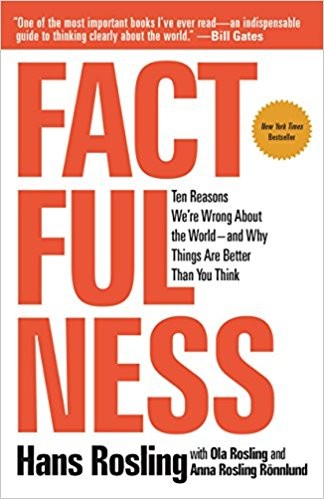
Factfulness: Ten Reasons We're Wrong About The World — And Why Things Are Better Than You Think
by Hans Rosling · 2018
Buy on AmazonFactfulness: The stress-reducing habit of only carrying opinions for which you have strong supporting facts. When asked simple questions about global trends―what percentage of the world’s population live in poverty; why the world’s population is increasing; how many girls finish school―we systematically get the answers wrong. So wrong that a chimpanzee choosing answers at random will consistently outguess teachers, journalists, Nobel laureates, and investment bankers. In Factfulness, Professor of International Health and global TED phenomenon Hans Rosling, together with his two long-time collaborators, Anna and Ola, offers a radical new explanation of why this happens.…
Recommended by
"Rosling was a Swedish statistician and physician, who, amongst other things, gave some very popular TED talks . His book Factfulness , which was published posthumously—his son and daughter-in-law completed the book—is very optimistic, so completely different in tone from Kahneman’s. But he focuses in a similar way on the ways that people make mistakes. We make mistakes, classically, in being overly pessimistic about things that are changing in the world. In one of Rosling’s examples he asks what percentage of the world population is living on less than $2 a day. People almost always overestimate that number, and also the direction in which things are moving, and the speed in which they’re moving. Actually, in 1966, half of the world’s population was in extreme poverty by that measure, but by 2017 it was only 9%, so there’s been a dramatic reduction in global poverty. But most people don’t realise this because they don’t focus on the facts, and are possibly influenced by what they may have known about the situation in the 1960s. If people are asked what percentage of children are vaccinated against common diseases, they almost always underestimate it. The correct answer is a very high proportion, something like 80%. Ask people what the life expectancy for every child born today is, the global average, and again they get it wrong. It’s over 70 now, another surprisingly high figure. What Rosling’s done as a statistician is he’s looked carefully at the way the world is. “Pessimists tend not to notice changes for the better” People assume that the present is like the past, so when they’ve learnt something about the state of world poverty or they’ve learnt about health, they often neglect to take a second reading and see the direction in which things are moving, and the speed with which things are changing. That’s the message of this book. It’s an interesting book; it’s very challenging. It may be over-optimistic. But it does have this startling effect on the readers of challenging widely held assumptions, much as Steven Pinker ‘s The Better Angels of Our Nature has done. It’s a plea to look at the empirical data, and not just assume that you know how things are now. But pessimists tend not to notice changes for the better. In many ways, though clearly not in relation to global warming and climate catastrophe, the statistics are actually very good for humanity. So this is critical thinking of a numerical, statistical kind. It’s a bit different from the more verbally-based critical thinking that I’ve been involved with. I’m really interested to have my my assumptions challenged, and Factfulness is a very readable book. It’s lively and thought-provoking. One of the big problems for an ordinary reader looking at this kind of book is that we are not equipped to judge the reliability of his sources, and so the reliability of the conclusions that he draws. I think we have to take it on trust and authority and hope that, given the division of intellectual labour, there are other statisticians looking at his work and seeing whether he was actually justified in drawing the conclusions that he drew. He made these sorts of public pronouncements for a long time and responded to critics. But you’re right that there is a problem here. I believe that most people can equip themselves with tools for critical thinking that work in everyday life. They can learn something about cognitive biases; they can learn about reasoning and rhetoric, and I believe that we can put ourselves as members of a democracy in a position where we think critically about the evidence and arguments that are being presented to us, politically and in the press. That should be open to all intelligent people, I think. It is not a particularly onerous task to equip yourself with a basic tools of thinking clearly. But statistics requires a kind of numerical dexterity, a comfort working with numbers, and for some people it’s a difficult thing to get to a level where you can think critically about statistics. But it’s interesting to observe it being done, and that’s what I think you’re being invited to do with this book, to see somebody think critically about statistics, on a number of measures."
Critical Thinking · fivebooks.com
"I think it’s a fantastic book. Rosling died last year while completing the book. I think it’s really almost a summation of his life’s work. He was a health expert in Sweden and spent a lot of time in Africa. He became convinced that we were too pessimistic about the world and that it was actually in better shape than we imagine. He accuses us of looking at the world from a thousand feet and therefore not recognising some very important developments among the very poor. I agree. He says we don’t see the gradations of poverty and therefore how people are escaping it. Somebody who is malnourished or who faces a 20% child mortality rate is very different from somebody who is not malnourished and can send their kids to school, where the death rate of their children is approaching the death-rate in richer countries, going from say two hundred per thousand, to forty or thirty or twenty per thousand. These are real advances in countries that we still consider very poor. Similarly, Rosling uncovers a widespread assumption that girls go to school half the time boys do in many poorer countries. In fact, if boys go to school for nine years then girls go to school eight. There are, of course, some terrible pockets of tragedy, poverty, and worse. But Rosling thinks we focus on those and extrapolate from them, partly because of our psychology and partly due to the way journalism and the media work. We come out with a picture that doesn’t really acknowledge that a lot of the world is actually getting better off and catching up with the developed world. It’s interesting from my point of view because what he offers is almost an alternative to GDP. If you look at GDP, you might say “well, look, their GDP is $2000 per capita, ours is $50,000 per capita. They must still be desperately poor and we’re terribly rich.” Now, it’s true that they are much poorer than us. But if you begin to look at things like life expectancy, infant mortality, fertility rates, etc., then that picture can look less severe. At the very least, it tells you something different and something real. One of the aims of my book is to show that we’re obsessed by GDP and that we ought to be thinking of other numbers. Having said that, I spoke to Rosling and, weirdly, he actually thought that GDP was quite a good measure of a poor country’s escape from poverty. It’s part of a discussion in both his book – and mine – about what countries should do as their prosperity increases. How should a country spend its increasing resources and how do you create a virtuous circle where countries escape from poverty, and spend money on the things that ought to be spent on, like setting up a decent health and education system, setting up roads and power so that they can move to the next stage of industrialisation. I just think this is a wonderfully humane book. I defy anyone to read it and not learn something. It’s funny, too. Bill Gates has just said that he’s gifting it to almost any student that wants it on Kindle. So, the book is about to become one of the greatest bestsellers of all time. So, me and Bill Gates are recommending that you read it. And Martin Wolf. That’s right, yes. He provides sensible guides to how to think about statistics and how to test your own assumptions about the world by just applying fairly routine measures and principles to them."
GDP · fivebooks.com
"Yes, that’s a good one to start with. Factfulness was written by Hans Rosling and his son, Ola Rosling, and his daughter-in-law, Anna Rosling. Hans Rosling died in 2017, and the book was actually published a year after. Factfulness is a book that very much embodies what Hans Rosling tried to do in his lifetime. He was a Swedish doctor and academic, who became quite famous because of his TED Talks where he presented, in a very entertaining and insightful way, the state of the world. In particular, he became famous for telling people that they kept getting everything wrong. He used to test Swedish students, politicians, and journalists, and he consistently found that people had a very warped and biased view of the world. In general, what he found is that people did not have an accurate sense of how much progress had been achieved. People, on average, tended to be extremely pessimistic about the state of the world, whether it was about deaths from natural disasters, child mortality, or how many girls in the world go to school now. Possibly the most important argument that Rosling makes is that the concept of dividing the world into “developed” and “developing” countries is outdated. Instead, he proposes we use a four-level model based on income per person. And contrary to what many people tend to believe, the majority of countries fall into the middle levels, and only a small number of countries are either very rich or very poor. People consistently have this view that the world is in a terrible state, when actually, over the last decades and centuries, we’ve made huge progress. So this book, Factfulness , takes the idea of people getting things wrong and describes the actual state of the world as we know it today. It also gives some tips on how people can try to reshape their worldview to be more accurate. Anecdotally, Bill Gates liked the book so much that he offered to send a copy to any college graduate who requested it."
Using Data to Understand the World · fivebooks.com