David Pilling's Reading List
David Pilling is a British journalist. He is currently the Africa editor of the Financial Times . Previously, he was the newspaper's Asia editor and its bureau chief. His FT column, which ranges over business, investment, politics and economics, can be found here.
Open in WellRead Daily app →GDP (2018)
Scraped from fivebooks.com (2018-06-29).
Source: fivebooks.com
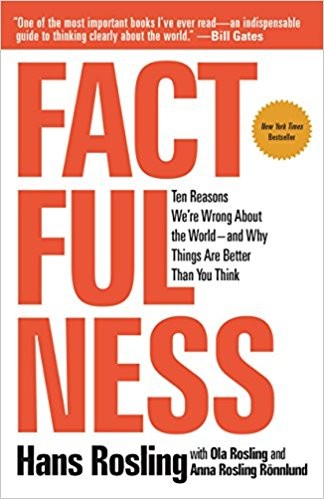
Hans Rosling · 2018 · Buy on Amazon
"I think it’s a fantastic book. Rosling died last year while completing the book. I think it’s really almost a summation of his life’s work. He was a health expert in Sweden and spent a lot of time in Africa. He became convinced that we were too pessimistic about the world and that it was actually in better shape than we imagine. He accuses us of looking at the world from a thousand feet and therefore not recognising some very important developments among the very poor. I agree. He says we don’t see the gradations of poverty and therefore how people are escaping it. Somebody who is malnourished or who faces a 20% child mortality rate is very different from somebody who is not malnourished and can send their kids to school, where the death rate of their children is approaching the death-rate in richer countries, going from say two hundred per thousand, to forty or thirty or twenty per thousand. These are real advances in countries that we still consider very poor. Similarly, Rosling uncovers a widespread assumption that girls go to school half the time boys do in many poorer countries. In fact, if boys go to school for nine years then girls go to school eight. There are, of course, some terrible pockets of tragedy, poverty, and worse. But Rosling thinks we focus on those and extrapolate from them, partly because of our psychology and partly due to the way journalism and the media work. We come out with a picture that doesn’t really acknowledge that a lot of the world is actually getting better off and catching up with the developed world. It’s interesting from my point of view because what he offers is almost an alternative to GDP. If you look at GDP, you might say “well, look, their GDP is $2000 per capita, ours is $50,000 per capita. They must still be desperately poor and we’re terribly rich.” Now, it’s true that they are much poorer than us. But if you begin to look at things like life expectancy, infant mortality, fertility rates, etc., then that picture can look less severe. At the very least, it tells you something different and something real. One of the aims of my book is to show that we’re obsessed by GDP and that we ought to be thinking of other numbers. Having said that, I spoke to Rosling and, weirdly, he actually thought that GDP was quite a good measure of a poor country’s escape from poverty. It’s part of a discussion in both his book – and mine – about what countries should do as their prosperity increases. How should a country spend its increasing resources and how do you create a virtuous circle where countries escape from poverty, and spend money on the things that ought to be spent on, like setting up a decent health and education system, setting up roads and power so that they can move to the next stage of industrialisation. I just think this is a wonderfully humane book. I defy anyone to read it and not learn something. It’s funny, too. Bill Gates has just said that he’s gifting it to almost any student that wants it on Kindle. So, the book is about to become one of the greatest bestsellers of all time. So, me and Bill Gates are recommending that you read it. And Martin Wolf. That’s right, yes. He provides sensible guides to how to think about statistics and how to test your own assumptions about the world by just applying fairly routine measures and principles to them."

Diane Coyle · Buy on Amazon
"Hers is a very sober account and that’s what I like about it. It’s written by a proper economist and it’s very clear. In one hundred and fifty pages or so, you get a very good guide to this number that has come to dominate public discussion. GDP has become a kind of a proxy for things that we ought to care about. I’d argue that she takes a gentler line than I do – hence it’s an “affectionate history” – but hers is a very smart account of the origins, the uses, the calculation, and the shortfalls of this measure as we move from manufacturing to services and as we move from analogue to digital. The real origins of this measure lie in the 1930s when Franklin Roosevelt was elected President of the United States in the midst of the Great Depression . He really wanted a measure that would justify doubling down on the New Deal and spending lots of money. As hard as it is to believe these days, there was no single measure that compacted everything we did as human beings in what we now call “economic activity”. It took Simon Kuznets, a brilliant statistician and data manipulator, to work out a method of doing this, by calculating the value added in an economy. So, at each stage, he would subtract the inputs and work out the total market value of everything produced. There are three measures and they kind of cross-check. He did this in record time and came out with a number that showed that the US economy had halved in three years. So this really gave FDR the ammunition to fight the great depression with Keynesian counter-cyclical spending. I found it very interesting that Kuznets had all sorts of problems with his own invention. He thought that GDP should never be elided with any concept of well-being. He wanted to take off various things from gross domestic product. The clue is in the word “gross”. He wanted to take off armaments and he wanted to take off financial speculation which becomes very important later on, as recently of course as 2008. Coyle discusses at some length how we can calculate the contribution of financial services to our economy and the ways that accounting for those activities can be perverse. Kuznets even wanted to take off things like roads, streets, and trains, because he thought that they took people to work where they produced things. So, they were an input to production. So, just as we don’t count the flour in bread or the wheat in flour, he thought we shouldn’t count the commuter lines that took people to work because that was merely a facilitator of production. The point is, I think, that this thing that we take to be sacrosanct was invented . It was invented by human beings. There could have been other ways of inventing it. In fact, Coyle tells us in a very clear way how, under the Marshall Plan, for example, GDP measures were constructed in Europe because America said it had invented this great way of working out how economies work. It was a case of, “if we’re going to give you lots of money, we need to know if it’s having any effect. So, you must account for it in this way.” The developing world was basically told to do the same by the Bretton Woods institutions like the IMF and the World Bank. And then China and Russia adopted it. So, it became this standard measure. And because it’s so convenient, because it’s one number, and because we can compare countries or at least we have the impression that we can compare countries, it has really stuck. So, Coyle’s book is a very sober, clear, and useful handbook which was very useful to me when writing my book. But I think it can be of use to anyone who has ever thought “I wonder what this thing GDP is. How did it come about? How has it become the standard measure of national economies? What are its strengths and what are its flaws?” For example, in the internet age, there are activities that used to be part of the economy, but no longer are. To give a simple example, booking an airline ticket. You used to call up somebody who was paid to book your ticket and sent it to you through the post. Now you do it yourself. So that’s moved from the economy to the non-economy. Because you do it yourself, we don’t measure it. Exactly the same activity is taking place but it’s not being measured at all. So, the economy is the same size or bigger, and yet through the lens that we’ve chosen to use it looks smaller. It’s moved from the economy to something called household production. We don’t count it when you make your bed, cook your children food, or drive your children to school, because we think that’s what parents do and no money has changed hands, so why should we count it as part of the economy? Now we no longer count the booking of your own airline ticket. We don’t count a house swap. But we would count Airbnb because money does change hands, but less money changes hands than if you were in a hotel bed. Presumably, fewer people build hotels as a result of people swapping those assets that we used to call houses. All of this distorts how we might look at the economy. You could argue, as the chief economist of Spotify does, that things are getting better and better and that our utility is growing. But, at the same time, GDP appears to be getting smaller. This could certainly help explain why progress is everywhere but in the productivity numbers. This could be part of it. It could be that we’re using a measure that’s really not quite up to the task of capturing these changes in the economy."

Lorenzo Fioramonti · Buy on Amazon
"That’s right. Fioramonti is an advisor to the leader of Italy’s Five Star Movement. I met him in Pretoria when I was researching the book. Interestingly, I think Diane Coyle doesn’t like his book. It’s definitely opinionated and iconoclastic. But I like it precisely because of that. It stirs the pot and takes what we think of as this bland, uncontroversial and says, “hang on, this is a construct and this is what’s wrong with it”. He sees many many things wrong with it, but I would highlight two. One, very prominently, is that GDP is really just a measure of income, which implies you need to maximise income. You need to squeeze the planet as hard as possible, produce as much as possible, as quickly as possible, all of that is good for GDP. It suggests that that’s what we crave as people and as societies. Fioramonti is saying, ”hang on, that’s utterly unsustainable”. There are billions of us, there’s a finite planet, and this just leads to wholly unsustainable activities whose negative effects are not captured. If we’re chopping down forests, surely that ought to appear as some kind of negative on the balance sheet. But there is no balance sheet. We don’t measure national balance sheets. We just measure this flow. So, he’s saying that this is very perverse and leads us down blind alleys as societies. The second objection I’d highlight is that he sees GDP as the measure of the rat-race. So, your objective is to get richer so that you’re richer than the person next door, so that you can have a nicer car, so that if you go into a building he might open the door for you because he earns less than you. GDP is the currency of the rat-race, I think he would argue. It monetises everything. Only things that have a monetary value are valued in GDP and, by extension, in society, policy and in politics. Therefore, we don’t value other things. We don’t value community, we don’t value volunteer work, we don’t value housework. He would probably say that, as a consequence, we don’t value women as much as we should. So, he sees a pernicious value system behind this number. I think this book is excellent. I think he’s taken these ideas further in other books and, to some extent, a little too far, down roads that I’m slightly uncomfortable with. But I thought this book was really interesting in exploring the hidden and almost invisible assumptions behind this number and behind that way of looking at our economy. The economy is so sacrosanct now, it has almost become a substitute for society. No politician would stand up and say “I’m going to improve society and strengthen the economy”. They’ve almost become one and the same thing. What Fioramonti is saying is, “hang on, let’s look at this a bit more”. That’s right, and it’s just not accounted for in neoclassical economics."

Angus Deaton · Buy on Amazon
"There are two strands to this book. Funnily enough, it has some overlap with the Hans Rosling book Factfulness because The Great Escape is actually the escape from poverty. The title comes from the movie of the same name , where some people escape from a German prisoner of war camp. His question is: is that good? They are now better off than the poor buggers left behind. So, with the inequality that they’ve created between them and the people who are still in the prisoner of war camp, is that good or is that bad? He’s saying that it’s good, basically, because they’ve escaped, and that’s much better than everyone still being in jail. And maybe that can lead to other people escaping. So, it’s really about how human progress works. He’s saying that we have to accept and tolerate and expect a certain amount of inequality because that’s just how societies progress and escape the past. However – and it’s a big however – we need to explore underneath that inequality. There comes a point when inequality becomes very detrimental. He would argue quite strongly that that point has been reached in many of our advanced economies. He has an anecdote from another economist, Albert Hirschman , which goes as follows: you have two lanes in the Lincoln tunnel and you are driving to an important engagement, let’s say you have opera tickets in New York. Suddenly both lanes stop for twenty minutes. You’re panicking, you think “what on earth is going on? I’m going to miss the opera”. Then, if the lane next door to you starts moving – this is the great escape – then you think, “oh great, that’s moving, soon I’ll be moving”. Twenty minutes later, you’re not moving. You think “well, hang on, the system is rigged against me. Why are they moving and I’m not moving? What’s so good about them?”. In which case, you become enraged and maybe you start cutting into that lane even if that’s illegal. So, here we have crime and frustration. You can see this as a metaphor for bad inequality. It was Deaton and his wife Anne Case who dug around in official American statistics to show us, on average, a country getting richer and richer and richer. But averages don’t tell you very much. They can be highly misleading. They found that, from the start of this century, white males who had not gone to college were dying younger. It took real sleuthing by the two of them to discover what you would have thought should be leaping out of any decent set of national statistics. And yet their paper was a revelation. The American economy has grown for the last nine years but, in the last two, the overall life expectancy has shrunk. We just don’t focus on that. We are happy that the economy is doing well, disproportionately, I would argue, to our concern that life expectancy has shrunk. It’s true that there is a focus on opioid addiction which is some of the explanation. There is also an increasing focus on inequality and on the kind of community despair in places that have been hollowed out. You could argue that this is precisely what has led to Donald Trump. But the fact that it took two very gifted sleuths – one of whom won a Nobel Prize for economics – to dig all of this information out of our statistics shows me there’s something wrong with our statistics. That’s why I found this a very useful and interesting book. He’s very moderately left-of-centre, I would argue. He probably would talk about more tax and redistribution but in quite a mild way. He talks about more training for people who are left out. He absolutely talks about revamping the American health system, which in GDP terms looks excellent because it contributes 17% to the economy, whereas in Japan it only contributes 9%. But health outcomes are better in Japan than they are in America. A lot of that money in America is just wasted money on lawyers, unnecessary interventions, drugs that are too expensive, and on unnecessary drugs. He’s saying that kind of scheme is wasteful and inefficient, and that a lot of people drop through it. So, I think he would definitely argue that we need something that looks more like what some Americans would call a “socialist” health system, or what we would call a national single-payer health system."

Jared Diamond · Buy on Amazon
"Sure. One of the accounts that sticks in my mind is of Easter Island. Easter Island was a very sophisticated society whose physical and spiritual livelihoods depended on the island’s forests. Famously, trees were used to transport the big god heads – these big stone heavy god heads – from the interior, where the stonepits were, to the coasts where they were displayed. Trees were also used for firewood and they protected the land from soil erosion. And yet, as Diamond puts it, the last man of the island had chopped down the last tree, presumably thinking he was adding to the island’s GDP – remember GDP is a measure of a flow of income. I’m not saying this is a measurement issue, this is just a human nature matter of how societies can make catastrophic mistakes. In pursuing something or other, the islanders clearly had not looked after the natural assets that they needed to survive. In striving for something, they drove themselves off the end of a cliff. Support Five Books Five Books interviews are expensive to produce. If you're enjoying this interview, please support us by donating a small amount . This is a warning that societies can do this. We, as a human society, could do this if we’re not careful. If we stretch the earth beyond its planetary limits, we could ruin the soil, we could ruin the ocean, we could ruin the air, and we could drain the ocean of fish. He sees evidence all around that we’re doing precisely that. He sees a limit to technology to solve our problems. Clearly, that is a kind of Malthusian vision and if you’re an anti-Malthusian you would say “hang on, Malthus was saying we were all going to drive ourselves to extinction hundreds of years ago, and technology has always come to rescue”. I put this to Diamond when I interviewed him and he said that you can use energy, for example, to desalinate the ocean so that you get some drinking water in the absence of naturally available drinking water. So, you could do that – technology can come to the rescue – but you need energy to do that. Where will the energy come from? You might say the sun, but then you need to make the solar panels. He basically says that this isn’t an infinitely available solution. There are planetary boundaries. Technology is a wonderful thing, but humans need to think further and harder about how presumably very sensible and sophisticated people in the past thought they could push and push and push, and how actually their societies went from flourishing great societies to total and utter collapse, like Ozymandias. When westerners arrived in this once great and flourishing Easter Island, the insult of choice was “may your grandmother’s flesh stick in my teeth” because they had been reduced to cannibalism. This was a society that had collapsed. So basically, his message is that it happened to them and it could happen to us. So, we need to think about this. That’s right, yes. There are a lot of what I would call “experiments” going on. Remember that I spoke about gross domestic product, and there’s quite of lot of experiments to develop measures of net domestic product where you decided to take off undesirables or adjust for them. In Maryland, for example, they take off money spent on crime prevention. If you destroy a wetland then you adjust your GDP. Sure, you’ve got a shopping mall which is producing income and that counts, but now you don’t have a wetland. So, you make those adjustments. Now, these adjustments are difficult to make and I talk about all the methodologies in the book. But, yes, I think it has escaped from academia. I make my own suggestions in the end of the book. If you go back ten years, Nicolas Sarkozy commissioned a report on how we might measure our world differently, how we might add to GDP at the very least, and he hired people like Stiglitz and Amartya Sen – both of whom are Nobel Prize winners – and also Jean-Paul Fitoussi, a very distinguished French economist, to go away and look at this. A book came out about this study and in the foreword of that book, Sarkozy wrote something that I thought was very interesting. He says that when people don’t see their own lives reflected in the official numbers as told to them by experts, they become angry and nothing is more dangerous to democracy than this. I think that’s very prescient. In the age of Brexit, in the age of Trump, and in the age of all sorts of things that we may struggle to understand, this provides not the whole explanation but a certain part of the explanation. We don’t see parts of our lives reflected in the official data, in the official picture as told to us by experts, so there’s a certain kind of rejection of that. Just finally, some people will say “GDP is such a good number, you will never replace it. It’s lasted this long and that’s because it’s a really good number.” I actually don’t argue that we should replace it. I argue that we should take it down a notch or two. I think that adding to it is actually not that difficult. We can add to it numbers that we already have, to which we need to give more political clout. Let’s take a number as simple as median household income which would look at the typical person. It would look at what the economy is doing for the typical household, not what the typical household can do for the economy. To me, if you were looking at median household income rather than GDP, which tells you at the very best about the average – and we know how dangerous averages are – then public policy might look very different. It might focus on those people who are now said to be so angry and felt so left out by globalisation and all these other forces like technology. So, I think that could change how we make policy. Another very simple number is healthy life expectancy. I think healthy life expectancy is better than life expectancy because, clearly, you can keep people alive a long time if you really intervene aggressively towards the end of their life. But much, much better is to intervene from early on along the life spectrum and keep people healthier for longer. This is something that the Japanese have done much better than many other societies. So, that would be a good measure. I would also argue for CO2 or some kind of proxy of what we do to the environment. It doesn’t mean we have to knit our own clothes and go back to living in caves. You could still progress as a society and you can still, I think, grow very fast but within the parameters of a finite planetary boundary. That’s absolutely true. If you have a hundred, do we want to tax twenty? Thirty? Forty? Or fifty? Do we want to be Hong Kong, America, France, or Sweden? So, it gives you the parameters. That’s absolutely true. That’s one of the ways in which it is a useful tool. I have no dispute with that whatsoever."