← All books
The Day of the Jackal
by Frederick Forsyth
Buy on Amazon
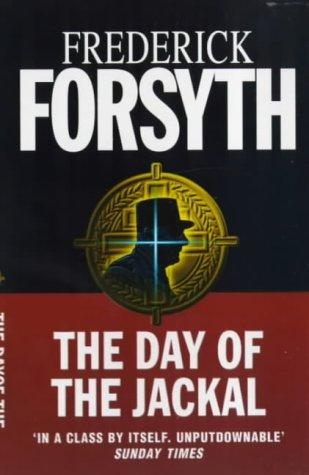
In a class by itself. Unputdownable' Sunday TimesOne of the most celebrated thrillers ever written, The Day of the Jackal is the electrifying story of an anonymous Englishman who in, the spring of 1963, was hired by Colonel Marc Rodin, Operations Chief of the O. A. S., to assassinate General de Gaulle. The Jackal. A tall, blond Englishman with opaque, gray eyes. A killer at the top of his profession. A man unknown to any secret service in the world. An assassin with a contract to kill the world's most heavily guarded man. One man with a rifle who can change the course of history. One man whose mission is so secretive not even his employers know his name. And as the minutes count down to the final act of execution, it seems that there is no power on earth that can stop the Jackal.
Recommended by
"Forsyth wrote the book after he’d been sacked from one of his jobs as a foreign correspondent. He decided to bash out a thriller in six weeks, which is an amazing achievement. And, interestingly, he took as his plotline something that all the readers in 1971 knew hadn’t happened, because de Gaulle had died in his bed. He wasn’t assassinated. Forsyth—preposterously—insinuates that the French can’t manage even to assassinate their own president and had to hire a professional British shooter, from Mayfair, who, it is rumoured, killed Trujillo in the Dominican Republic. In fact, Trujillo wasn’t killed by a lone assassin at all. The CIA provided some submachine guns, which some local people used to kill him. They went after him because they were plotting to murder Castro and they needed to kill a right-wing, Caribbean dictator for presentational reasons. The reason I chose this book is that it very much influenced how I wrote my own. Essentially it consists of two interlinked hunting stories. You have the jackal, the assassin, who is stalking de Gaulle. And then you have the police and the intelligence services trying to pre-empt him, stalking him. To make a huge generalisation, for 90% of our 300,000 years as hominids on this planet, we were hunter gatherers. It is very much in our nature, which I think explains why people are so fascinated by assassination. About a third of everything you can see on Amazon Prime, or Netflix involves assassination, mainly relating to Colombian or Mexican drug cartels. It’s a fascinating subject. So I picked this book because it appeals to that underlying instinct of ours. There’s an exceptionally fine BBC filmmaker from the 1980s and 90s called Alan Clarke, whose most famous movies are Scum and The Firm , which is about football hooligans and launched the career of Gary Oldman. But he made a short, 38-minute quasi-documentary called Elephant, about Northern Ireland, where he took police reports on 18 IRA killings and made a film using a Steadicam. That’s very characteristic of his style, you just have this camera following people walking. So, on each occasion you see one or two blokes walking with no soundtrack, and no dialogue, down a street into a mini cab firm or swimming baths or a warehouse and blasting somebody. Then the camera just lingers a bit too long on the dead body. Then you go on to the next lot of men walking and, at the end of it, they walk or run away. It’s just an incredible depiction of their activity. These guys really are hunting. It gets worse. Never mind Carlos the Jackal. Both Mehmet Ali Aga, who shot Pope John Paul II, and Yigal Amir, who shot and killed Yitzhak Rabin, read The Day of the Jackal several times. It was their favourite book. I’m hoping that no one treats my book as their favourite, I will not be responsible!"
"This is another book you can’t get away from. It’s set in France , a little bit later than the book I’ve written. My book is set in what the French call the Fourth Republic—post-war, post-Vichy, to the ascendancy of Charles de Gaulle. It was a period of tremendous political chaos in France and enormous violence. France was losing its colonies in Algeria and Indochina and it was not going to give them up without a fight. France was thrashing around as it lost its status as a world power. There is an obvious parallel, in my mind, between France of that period and Russia today. Vladimir Putin’s Russia is a country that’s failing to come to terms with its demotion from world power status. It’s behaving with this wounded kind of violence, there’s a self-harm to it. And that was France, really, from 1946 to 1958. The Day of the Jackal is about Charles de Gaulle and an attempted assassination attempt on him. Forsyth is interested in French history, and the darkness in it. This book is about a real-life right-wing group called the OAS. It was a secret organization, a group of authoritarian army officers, who were trying desperately to hold on to Algeria. They didn’t like the fact that de Gaulle eventually, belatedly, realized that there was no hope of Algeria staying part of metropolitan France. And there was an attempted coup and assassination on him in real life. Forsyth writes this book in what is often described as a documentary or journalistic style. He was a journalist and he applies that way of writing to these events. It’s a very interesting book. It’s always longer than you remember and it unfolds over quite some length. Because it’s so tightly written, you forget how much happens in it. I would say that it’s a book that follows the style of Dashiell Hammett in the late 1920s. There’s very little interiority. We spend very little time in the hero’s head. He reveals himself through action and through dialogue. It’s a very disciplined, cinematic way of writing and it reads a bit like a movie script, which I quite like. I think he was, because the book was so huge. There are a few things which entered popular consciousness from it. When I was a journalist, I came across a story which was all about undercover police officers in Britain assembling false identities for themselves. (There was a scandal about it a few years ago—which is still ongoing). Part of the technique you use to establish your false identity is to find a child who was born around the same time as you were, but died in infancy. You finagle your way to getting their birth certificate, and you can then build up the different parts of your identity, in a bureaucratic sense, from there. Eventually, you end up with a driving license and a passport. That piecemeal, bureaucratic process is called ‘doing a jackal.’ That’s how the police officers refer to it because that’s what the anti-hero of The Day of the Jackal does."
"Again, this has a real historical character, De Gaulle, as well as the character of the Jackal himself, the assassin. It’s very well-written in a way that perhaps my next choices aren’t, and it depicts France in the 1960s in an incredibly convincing way. It’s an amazing trick really because we all know De Gaulle wasn’t assassinated, but the whole way along we’re thinking: ‘Shit! Is he going to die?’ I think there’s an implicit contract between the reader and the author – we know he didn’t die but we want to know how close he came. It’s laid out in sections – Plot, Hunt, Kill – so you know someone’s going to die. I mean, all great thrillers make you want to turn the page. In a good heist movie, it’s more about the detail leading up to the heist than about the heist itself. The other thing about The Day of the Jackal is that Forsyth in this book exposed the practice of applying for passports in the name of dead children. People would go to graveyards and look for the graves of children. The government actually had to change the law on the basis of his research."
"Again, the reader knows that Charles De Gaulle was not assassinated and therefore this book in a way should have no suspense, but instead it is full of suspense. I wanted to tip a hat to that. It is a book that excellently understood the importance of detail and process. Plenty of Frederick Forsyth imitators thought that is all you had to do, but actually you have to do a whole lot more. It is hugely important to get right the mechanics of how characters do things, and that can be enormously absorbing. The famous example from The Day of the Jackal is how the central character, the Jackal, creates a fake identity and gets a fake passport. Frederick Forsyth had discovered that there really was a loophole, where as long as you produced a birth certificate of someone who had died – which in those days was pretty easy to do – then you could pretend to be that person and get a passport. I have read somewhere that the loophole was cleared up as a result of the novel. And that is what makes the book compelling – you are observing the mechanics of an assassin who is a really blank character. He is unnamed, apart from being called “the Jackal”. He should be very blank, but it works because you buy into the idea of a traceless, faceless, ruthless killer. That’s right. It is so interesting how rules can be broken, because you would think that a character with no personality would be unengaging but actually it works very well. As you say, we can begin to speculate about what made this man like this. But there is also the procedural tension about how he will get from point A to B to C to D. It is one of those books that completely grips you."