Suzana Herculano-Houzel's Reading List
Suzana Herculano-Houzel is a Brazilian neuroscientist based at Vanderbilt University. She is the author of six popular books about neuroscience, including The Human Advantage, published in 2016 by MIT Press.
Open in WellRead Daily app →The Human Brain (2016)
Scraped from fivebooks.com (2016-06-28).
Source: fivebooks.com
Sebastian Seung · Buy on Amazon
"One of the things that people say about the human brain is that it is the most complex system in the universe, essentially because the number of synapses [connections between neurons] in the cerebral cortex is supposedly the largest. We still have to figure out exactly how numbers of synapses compare across species, but still, its synaptic connectivity requires an impressive amount of information to describe or to set up, and you can’t find that much information in the genome by itself. There are not enough genes, not even by a combinatorial code, to specify all the possible connections between neurons in the cerebral cortex. So the connectivity in the brain is set up initially with the basic biological instructions in your genome, but once that is done it changes through a self-organised process. How you use your brain specifies directly what your brain looks like. “You become more and more yourself as life goes by.” That’s the idea behind the connectome as Sebastian describes it: this highly personalised set of connections, this pattern that defines who you are. Over time, it becomes more and more personalised. You become more and more yourself as life goes by. As your brain gets around, it gets modified by its very activity. Which pretty much answers the question, or solves the paradox, of how could one possibly get this tremendous amount of complexity in the organisation of the human brain with just a handful of genes to set it up. This self-organisation of the brain defines its own connectivity pattern and actually defines the system. Your brain contains all the information that it has lived through."
Antonio Damasio · Buy on Amazon
"What Damasio does that I find so outstanding is that he goes to the trouble of coming up with a useful definition of what is consciousness. Something that people before him used to be very elusive about, because everybody knows, everybody has consciousness, so we all know what we’re talking about, so why bother? I think that Damasio has it right on that the important first step in science is to define what exactly is the question at hand. If you want to talk about consciousness, you have to first define what consciousness is. Damasio actually offers definitions to what he proposes is a nested series of levels of consciousness. He begins with what I think he calls proto-consciousness, which is the most basic representation of your own body, going through self-consciousness, which he refers to as the ability to represent your brain activity as it represents the body. As your brain maps not only the body, but also its own process of mapping the body, he proposes that you gain self-consciousness or self-awareness, which is the basis of what we call insight. Eventually he gets to autobiographical memory, which is essentially your self-awareness over time, which allows you to keep a sense of where you’ve been, what you’ve felt like and where you expect to find yourself over time, and then on eventually to moral consciousness or social consciousness, which is where you fit in the bigger system of other people’s consciousness as well. Get the weekly Five Books newsletter The really cool thing is that he not only proposed all these different levels of consciousness and types of consciousness, but he also reviewed the anatomical evidence that assigns each of these different levels to a nested system of structures in the brain. And so what he had in the end was something that actually made sense and was not only supported by evidence but offered testable hypotheses about the different types of consciousness – what parts of the brain are required or necessary or give rise to the different levels of consciousness; how things should break down when you have problems or disruptions in the different levels of the system. I think his book was really ground breaking and a real turning point for neuroscience. Yes, absolutely. I think it helps organise ideas about how we compare to other species because essentially what he’s saying is that if you have these brain structures, you will have at least some level of functioning of these different types of consciousness. And of course the more processing power, so the more neurons in these different structures, the more complex your cognitive functions or your function at that level of consciousness should be. Because we know that the structures in our brain are very much the same structures you find in any mammalian brain, it really drives home the notion that we are not talking about issues of quality, but we’re talking about quantitative differences across brains. Once more, we’re not special. We’re remarkable, yes, in the level of complexity that we can achieve at all these different levels of consciousness. But we’re not outliers."
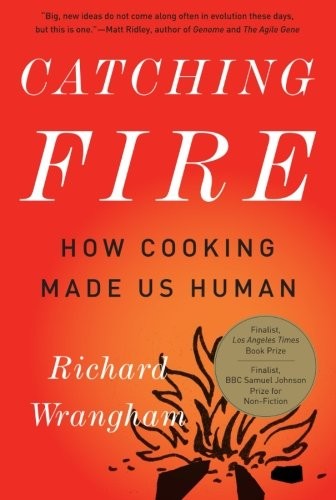
Richard Wrangham · Buy on Amazon
"Essentially what Richard proposes in his book is that the turning point in human evolutionary history was the invention of cooking. As far as I know, he was the first person to propose that something apparently so simple, so prosaic, could have had such an important function in our evolutionary history. We’ve added to his story, as according to our calculations on how much energy bodies of a certain size with brains of a certain number of neurons cost, then we would not be here had it not been for a drastic change in how many calories our ancestors could get. I think he is pretty insistent that the major change was cooking with fire, hence the title of his book, Catching Fire . “If you don’t eat enough calories your body will start breaking itself down to feed the brain first.” I think we have more information today that of course once you modify foods with fire the change is tremendous, but even before using fire to modify foods became a habit, just using tools to break down or modify food – smashing, cutting, turning into mush, like our ancestors could do with stone tools – also helps enormously to get more calories in less time. I use ‘cooking’ in the much broader definition of any processing of food prior to eating, and in that sense, I propose that cooking was the technological revolution that allowed the rapid expansion of the human brain. A human brain needs about 500 calories in a day. And that is a very strict requirement, in the sense that if you don’t eat enough calories your body will start breaking itself down to feed the brain first. Well that’s the thing: surprisingly, no. It’s about 500 calories no matter what. If you just bum around the entire day or if you apply yourself to hard problem solving the whole day, as far as we know you’re using the same total amount of energy – as the brain cranks up activity in some places, it cranks it down in others. But that really is the most energy intensive use in your whole body. Those 500 calories represent 25 per cent of your entire energy requirement for the day. Which is something else that people used to think was special about the human brain. No other brain we know costs relatively as much energy compared to the body. But actually it turns out that it’s simply what is to be expected because of how many neurons we have, and because we’re primates, with more neurons in the brain relative to the body than any other mammal that we know of so far. So that really means that our brain costs just as much energy as expected for its number of neurons: it’s not special in that sense, either. “There’s a very clear metabolic wall to how large a primate can be. At 8 hours of eating per day, that wall is around 180 kilos of body mass.” So we did some calculations on the balance between how many more calories the body needs as it becomes larger, and how many more calories it can actually ingest as it becomes larger, and it turns out that there’s a very clear metabolic wall to how large a primate can be. At 8 hours of eating per day, that wall is around 180 kilos of body mass, and that also limits how many neurons you can afford in your brain. According to our calculations, gorillas and orang utans are right there next to that metabolic wall, living on the edge of what they can afford, so they could not have a brain with any more neurons than they already have. It is actually their brains that are too small for their bodies, making ours appear too large – when it’s actually not. According to those calculations, if our ancestors ate like other primates do to this very day, a raw unmodified diet, an ancestor with a similar makeup to modern humans—with, say, a 60 -70kg body and a brain with 86 billion neurons—would have had to spend almost nine and a half hours per day eating. Which is not feasible. We would not be viable. So that’s where Richard’s idea comes in, that once you have the ability to modify the food you eat, you can multiply the number of calories that you get per unit time. That means that having a large number of neurons is no longer a liability, something that puts your life in danger; actually, to the contrary, once energy is no longer limiting, having more neurons probably becomes an asset. You can use those neurons to do something more interesting than just finding food, and you now have the time to do it, because eating cooked foods requires much less time and effort than eating raw foods."
Daniel Lieberman · Buy on Amazon
"Well Dan Lieberman puts the brain into the context of the body as a whole. He’s friends with Richard Wrangham, but I know they diverge on what exactly was the first factor that really allowed that steep increase in brain size in human evolution. Richard sticks to cooking with fire, while Dan argues that that happened too late and is pretty vocal about wider changes in the human body that also put us on our way to becoming what we are today. That includes the changes that allowed bipedality. A bipedal primate uses one-fourth as much energy to move around as a quadruped. Walking upright is slower, but it also costs less energy so it’s more effective, and he proposes that bipedality was really one of the first components allowing our ancestors to get more food in their day, simply because they could explore larger ranges. “A bipedal primate uses one-fourth as much energy to move around as a quadruped.” Put that together with other anatomical changes in the body that Lieberman explains in his book, like the changes to your gluteus maximus (your butt), your toes, your neck muscles and the position of your head, which all contribute to making human ancestors very good runners. And once you run you also gain access to this new strategy for getting food which is cooperative hunting, and that encourages developing new tools and also communicating across individuals which requires more processing power, so supposedly that would create a positive selective pressure for more neurons in the brain. You also become capable of getting more energy through hunting, through running down other animals, so he puts all those things together and makes a very good case for the beginning of human evolution and rapidly increasing brain size. It also gives an answer to the question of how come only humans cook, and not other primates, because there were all these other anatomical changes that happened to the ancestors of our species alone, and it’s only when all those changes come together that you have a species that is not only anatomically capable of standing on its feet, using its hands and affording enough neurons to actually have the processing power required, but you also have the technology developed along the way, and new problems to solve with it. In the rest of the book, he goes on to talk about how, in a modern context, where we live in houses, eat a less varied diet because of agriculture, use cars not our feet, have refrigerators with plenty of food, how these anatomical characteristics actually have consequences for our health. It’s a really fascinating book."
Joseph Henrich · Buy on Amazon
"I think what Joe’s book does beautifully is develop an idea that I touch on in the last chapter of my book, which is that a number of neurons is necessary but not enough to explain our abilities, because all the things that we like to see as our main abilities are culturally transmitted — you have to learn them. We’re not born with all the knowledge or abilities that we have as adults; we’re born with capabilities, and have to transform those capabilities into actual abilities. That’s where cultural transmission comes in. He gives this beautiful example of elephant hordes where the only ones that were able to survive a drought were ones with females old enough to have survived as youngsters a previous drought 30 years before, and they had the memory of where the other water holes were back then – and they pass the knowledge on to the next generation. You need to acquire that type of knowledge through experience but more than that, we have the ability to develop new technologies and new systems to solve problems and also pass those new technologies on through culture. “How you use your brain is at least as transformative as the biology that you were born with.” I like to ask people how much of what they see around them they would be able to build themselves. Take my desk – I could make some very rough, very rudimentary paper, but then even with my PhD and dozens of years of formal training I would not be capable of making a single pencil to write on that rough paper. I think that goes to show the difference between firstly, our biological capabilities, secondly, our abilities that we can turn those capabilities into through learning, but thirdly, all the things that we can come to do but that require cultural transmission of technology. We as a species have that technology, that culture, but each individual person doesn’t hold all that anymore. We’ve come well past the point where a single person could hold all the cultural knowledge of the species. I think it’s a very humbling experience to realise how much of the world we would individually be capable of recreating. That’s where culture and cultural transmission of technology come in in our evolutionary history, which, by the way, makes a very strong case for keeping people educated about science and technology, because the day we lose this knowledge, everything that we hold so dear as the high achievements of the human species, that all goes away. We’ve become so much more than just the number of neurons that we have. Biology gives you the basics, the starting point – but how you use your brain, what you do with the brain that you have, that is at least as transformative as the biology that you were born with."