← All books
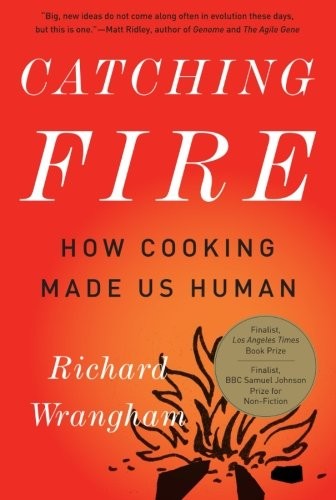
Catching Fire: How Cooking Made Us Human
by Richard Wrangham
Buy on Amazon
Essentially what Richard proposes in his book is that the turning point in human evolutionary history was the invention of cooking. As far as I know, he was the first person to propose that something apparently so simple, so prosaic, could have had such an important function in our evolutionary history. We’ve added to his story, as according to our calculations on how much energy bodies of a certain size with brains of a certain number of neurons cost, then we would not be here had it not been for a drastic change in how many calories our ancestors could get. I think he is pretty insistent that the major change was cooking with fire, hence the title of his book, Catching Fire . “If you don’t eat enough calories your body will start breaking itself down to feed the brain first.” I think we have more information today that of course once you modify foods with fire the change is tremendous, but even before using fire to modify foods became a habit, just using tools to break down or modify food – smashing, cutting, turning into mush, like our ancestors could do with stone tools – also helps enormously to get more calories in less time. I use ‘cooking’ in the much broader definition of any processing of food prior to eating, and in that sense, I propose that cooking was the technological revolution that allowed the rapid expansion of the human brain. A human brain needs about 500 calories in a day. And that is a very strict requirement, in the sense that if you don’t eat enough calories your body will start breaking itself down to feed the brain first. Well that’s the thing: surprisingly, no. It’s about 500 calories no matter what. If you just bum around the entire day or if you apply yourself to hard problem solving the whole day, as far as we know you’re using the same total amount of energy – as the brain cranks up activity in some places, it cranks it down in others. But that really is the most energy intensive use in your whole body. Those 500 calories represent 25 per cent of your entire energy requirement for the day. Which is something else that people used to think was special about the human brain. No other brain we know costs relatively as much energy compared to the body. But actually it turns out that it’s simply what is to be expected because of how many neurons we have, and because we’re primates, with more neurons in the brain relative to the body than any other mammal that we know of so far. So that really means that our brain costs just as much energy as expected for its number of neurons: it’s not special in that sense, either. “There’s a very clear metabolic wall to how large a primate can be. At 8 hours of eating per day, that wall is around 180 kilos of body mass.” So we did some calculations on the balance between how many more calories the body needs as it becomes larger, and how many more calories it can actually ingest as it becomes larger, and it turns out that there’s a very clear metabolic wall to how large a primate can be. At 8 hours of eating per day, that wall is around 180 kilos of body mass, and that also limits how many neurons you can afford in your brain. According to our calculations, gorillas and orang utans are right there next to that metabolic wall, living on the edge of what they can afford, so they could not have a brain with any more neurons than they already have. It is actually their brains that are too small for their bodies, making ours appear too large – when it’s actually not. According to those calculations, if our ancestors ate like other primates do to this very day, a raw unmodified diet, an ancestor with a similar makeup to modern humans—with, say, a 60 -70kg body and a brain with 86 billion neurons—would have had to spend almost nine and a half hours per day eating. Which is not feasible. We would not be viable. So that’s where Richard’s idea comes in, that once you have the ability to modify the food you eat, you can multiply the number of calories that you get per unit time. That means that having a large number of neurons is no longer a liability, something that puts your life in danger; actually, to the contrary, once energy is no longer limiting, having more neurons probably becomes an asset. You can use those neurons to do something more interesting than just finding food, and you now have the time to do it, because eating cooked foods requires much less time and effort than eating raw foods.
Recommended by
"Essentially what Richard proposes in his book is that the turning point in human evolutionary history was the invention of cooking. As far as I know, he was the first person to propose that something apparently so simple, so prosaic, could have had such an important function in our evolutionary history. We’ve added to his story, as according to our calculations on how much energy bodies of a certain size with brains of a certain number of neurons cost, then we would not be here had it not been for a drastic change in how many calories our ancestors could get. I think he is pretty insistent that the major change was cooking with fire, hence the title of his book, Catching Fire . “If you don’t eat enough calories your body will start breaking itself down to feed the brain first.” I think we have more information today that of course once you modify foods with fire the change is tremendous, but even before using fire to modify foods became a habit, just using tools to break down or modify food – smashing, cutting, turning into mush, like our ancestors could do with stone tools – also helps enormously to get more calories in less time. I use ‘cooking’ in the much broader definition of any processing of food prior to eating, and in that sense, I propose that cooking was the technological revolution that allowed the rapid expansion of the human brain. A human brain needs about 500 calories in a day. And that is a very strict requirement, in the sense that if you don’t eat enough calories your body will start breaking itself down to feed the brain first. Well that’s the thing: surprisingly, no. It’s about 500 calories no matter what. If you just bum around the entire day or if you apply yourself to hard problem solving the whole day, as far as we know you’re using the same total amount of energy – as the brain cranks up activity in some places, it cranks it down in others. But that really is the most energy intensive use in your whole body. Those 500 calories represent 25 per cent of your entire energy requirement for the day. Which is something else that people used to think was special about the human brain. No other brain we know costs relatively as much energy compared to the body. But actually it turns out that it’s simply what is to be expected because of how many neurons we have, and because we’re primates, with more neurons in the brain relative to the body than any other mammal that we know of so far. So that really means that our brain costs just as much energy as expected for its number of neurons: it’s not special in that sense, either. “There’s a very clear metabolic wall to how large a primate can be. At 8 hours of eating per day, that wall is around 180 kilos of body mass.” So we did some calculations on the balance between how many more calories the body needs as it becomes larger, and how many more calories it can actually ingest as it becomes larger, and it turns out that there’s a very clear metabolic wall to how large a primate can be. At 8 hours of eating per day, that wall is around 180 kilos of body mass, and that also limits how many neurons you can afford in your brain. According to our calculations, gorillas and orang utans are right there next to that metabolic wall, living on the edge of what they can afford, so they could not have a brain with any more neurons than they already have. It is actually their brains that are too small for their bodies, making ours appear too large – when it’s actually not. According to those calculations, if our ancestors ate like other primates do to this very day, a raw unmodified diet, an ancestor with a similar makeup to modern humans—with, say, a 60 -70kg body and a brain with 86 billion neurons—would have had to spend almost nine and a half hours per day eating. Which is not feasible. We would not be viable. So that’s where Richard’s idea comes in, that once you have the ability to modify the food you eat, you can multiply the number of calories that you get per unit time. That means that having a large number of neurons is no longer a liability, something that puts your life in danger; actually, to the contrary, once energy is no longer limiting, having more neurons probably becomes an asset. You can use those neurons to do something more interesting than just finding food, and you now have the time to do it, because eating cooked foods requires much less time and effort than eating raw foods."
"People have deep emotions about grilling. The act of lighting a fire and creating a barbecue seems to bring a sense of comfort, satisfaction and community that you just don’t get with other cooking methods. Why? There is the pleasure of sitting around a fire, the incredible aromas and flavours you get with cooking over fire and then there’s the long human history of open-fire cooking. “Grilling is part of human DNA and part of our cultural heritage.” About 1.8 million years ago homo erectus roasted an auroch, a prehistoric cow. A human ancestor tasted it and uttered the first grunt of gastronomic satisfaction. When you eat meat cooked, instead of raw, there’s several physiological, social and emotional things that happen. Prior to homo erectus and the application of fire to cooking, our ancestors were eating machines. Their skulls were characterised by giant teeth, giant jaws and very small crania because they spent all their time chewing raw food. After the discovery of cooking with fire, teeth get smaller and brains triple in size. Our ancestors develop a smaller jaw and a more agile tongue so we have the ability to speak. And because cooked food is much more easily metabolised, our ancestors were able to develop larger brains. With this new-found intelligence we evolved to become speaking and thinking animals, which is our evolutionary edge over all the other animals in the world. Additionally, our ancestors developed different kinds of social behaviours. When you cook meat over fire you have a common focal point for a group and we become more social animals. While other primates eat on their own, so they keep their food to themselves, we sit around and share a fire and our food, and cooking becomes a communal activity. Simultaneously, for the first time, you get a division of labour. Female and male gorillas gather and eat food in pretty much the same way. Because human beings had a fire that had to be tended, we get a division of labour. One part of the community stays home to nourish the fire and do hearth-oriented work, while another part of the community goes out to hunt. One brings home the food while the other takes care of the household. So the human face, human intelligence, speech, social organisation and even division of labour – all of these potentially began with the act of cooking meat over fire. You could say that barbecue began human civilisation. Wrangham points out that primates in the wild spend about six hours a day chewing, while fire-using human beings do their chewing and eating in a half-an-hour to an hour a day. Our greater leisure time and better-developed brains gave rise to art. The fact that we shape our environment in creative and meaningful ways helps distinguish us from every other animal. The first art actually did have a fire and barbecue connection. The first carved animal bones are as many as 100,000 years old and the first cave art, portraying hunting scenes and using charcoal, a derivative of fire, was done at least 40,000 years ago. Now fast forward to the modern day, we have evolved art in many different ways. We have musical arts, visual arts, digital arts and we’ve turned cooking into an art. The evolution of cooking into an art has been ongoing for thousands of years. Early humans began seasoning their food in a way that other animals don’t (man is the only animal who cooks). Ancient Greek and Romans had celebrity chefs and celebrity cookbooks. The way today’s human beings spend so much time preparing food, thinking about food, writing about food and relishing food, clearly has less to do with satisfying our nutritional needs than it does with our passion for art."