Susan J Napier's Reading List
Susan J Napier is a Professor of International Literary and Cultural Studies at Tufts University. She is the author of Anime from Akira to Howl's Moving Castle: Experiencing Japanese Animation , From Impressionism to Anime: Japan as Fantasy and Fan Cult in the Mind of the West , The Fantastic in Modern Japanese Literature: The Subversion of Modernity , and Escape from the Wasteland: Romanticism and Realism in the Works of Mishima Yukio and Oe Kenzaburo .
Open in WellRead Daily app →Manga and Anime (2011)
Scraped from fivebooks.com (2011-10-29).
Source: fivebooks.com

Hayao Miyazaki · Buy on Amazon
"Hayao Miyazaki is less well known for the fact that he is a great manga artist. Nausicaa is probably his manga masterpiece. It’s very important in understanding Miyazaki preoccupations and the themes that will come up in his later work, and also his way of looking at the world in a futuristic sense. He’s very prescient. Nausicaa is set in a post-apocalyptic world. Industrial toxins have pretty much destroyed the earth and there are just a few human communities left hanging on. He based this idea on what happened in Japan a decade or so earlier: a bay in Japan was accidentally poisoned by a large industrial chemical country. He drew on that to imagine what the whole world would be like with unchecked industrial toxicity. In his world, insects have grown bigger; humans are trying to get by under these new conditions; there’s still violence; there are still military maneuvers. It’s an epic manga, and a very entertaining work. “For 1981 it was so novel to feature a female lead character who was smart, non-sexualized, great at science, good with a sword and a leader.” From the point of view of understanding Miyazaki and manga, what’s particularly appealing about Nausicaa is it has a very strong female protagonist, a woman named for the Greek princess in Homer’s Odyssey . For 1981 it was so novel to feature a female lead character who was smart, non-sexualized, great at science, good with a sword and a leader. For the period, this was unique. We had no characters like Nausicaa in America. This competent, independent heroine becomes the kind of progenitrix of a long line of competent, independent female leads in Miyazaki’s work. Nausicaa also set a pattern for other manga authors and other anime characters and even infiltrated American culture. For instance, one of my students pointed out that the female protagonist in the Force Awakens , Rey, her actions in the first scene of that film are very clearly modeled on Nausicaa. Nausicaa also had a poignancy and depth to her, that is remarkable not just in manga but in literature in general. She is a really interesting multi-layered character. The style you see in Nausicaa is certainly very popular in manga and anime, and that style also imprinted American movies. The paradigm of stories about epic journeys into a fantastic immersive world filled with alien characters who engage with humans, is something you’ll see in, for instance James Cameron’s Avatar . Miyazaki definitely molded that paradigm."

Frederik L. Schodt · Buy on Amazon
"It’s not the most recent book on the subject, but it’s an excellent history of manga. It catalogues manga’s most important genres, creators, and characters. Fred Schodt really, really knows his stuff. He starts with an eleventh century scroll by a priest in which you see strange little beasts; we can definitely see this as an ancestor of manga and anime. Get the weekly Five Books newsletter You see what he’s talking about when he analyzes a particular genre, because he includes all these wonderful picture from the early Japanese history all the way through to recent Japanese manga. He focuses on Osamu Tezuka, who did Astro Boy . Tezuka is very very famous; he is considered the god of manga and anime. Fred Schodt actually knew Tezuka quite well, and he gives the reader a good sense of what he was like. Overall, Fred Schodt conveys an understanding for why manga are important and the varying ways in which they appeal. Before the internet was everywhere, if you rode the subway in Japan, half the people would be reading some genre of manga. Now more people are reading their phones. Manga have migrated into phones, but people are also checking the internet as well, actually. Manga and anime have also inspired a new media mix—video games and other different sorts of entertainment available through your cell phone. So while perhaps manga are no longer as dominant as they once were, they are still a very, very important component of the media market. As for effects on the culture, manga adopted many of the tropes of traditional culture and reinterpreted texts for contemporary audience, for instance, the classic work of Japanese literature Tale of Genji , which is a real touchstone in Japanese culture. It’s an extraordinarily beautiful and heartbreaking story of a young prince who had many love affairs; it has become a manga and animated movie. You also can see so much of Japanese tradition and folklore in anime. For instance, the amazing supernatural creatures in manga and anime are part of the rich animist history of Japan."

Haruki Murakami · Buy on Amazon
"The Elephant Vanishes shows you the world out of which manga and anime come, which is a very modern, very industrialized, very urban world. I see manga and anime as being a safety valve for the real world, or an alternative reality to the mundane world. Murakami is writer who creates wonderful visions the stranger aspects of our mundane world. Some people call him a magical realist; Murakami has our normal world being invaded by, by strange things. And his characters are very real, you could certainly see them enjoying an anime. “I see manga and anime as being a safety valve for the real world, or an alternative reality to the mundane world” Like Miyazaki, Murakami features very strong women. One thing I like about Japan is that, while on the one hand it has a very strong patriarchal culture, at the same time (at least in its fiction) it foregrounds empowered women. One of my favorite stories in The Elephant Vanishes collection is called “Sleep,” in which a woman who’s leading a very dull life with a nice dentist husband and son stops sleeping. She stays up drinking brandy, eating chocolate and reading nineteenth-century Russian novels. One other thing Murakami has in common with manga and particularly with Miyazaki is a fascination with vanishing women. Many of characters in his novels and his short stories are searching for a woman who they glimpsed once or knew for a while. Many modern manga have similar tropes. One very popular anime, Serial Experiments Lain , is about a girl who may or may not be a technological construct. Certainly we see this is Miyazaki’s work. It all goes back to an old, old folkloric story about a woman who turns into a bird vanishes. So you see how all these cultural forms are linked to traditional forms of culture. It’s a great transition. I’m a great admirer of Takashi Murakami’s work, which is very in line with the manga tradition. His creations are often directly inspired by the manga world The melancholy visual style and apocalyptic settings of many manga and anime , especially Miyazaki, are very related to World War Two and particularly the atomic bombing of Japan. Takashi Murakami’s work is even more directly linked to the traumas of World War Two . In 2005, he put on an exhibit of pop art at the Japan Society in New York that was called “Little Boy,” which of course refers to the code name for the atomic bomb dropped on Hiroshima. What the art of Takashi Murakami and anime have in common is the ability to immerse an audience in apocalyptic scenarios without triggering those audiences to turn off. Pop art and pop culture provide a catharsis and a means of coping with end-of-world scenarios, which were once too real for the Japanese."
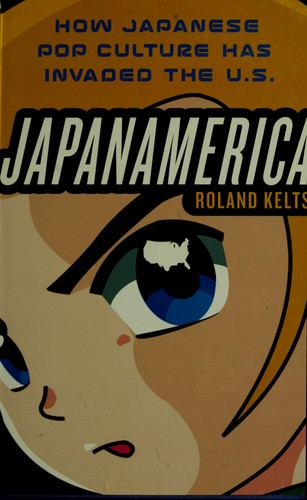
Roland Kelts · Buy on Amazon
"Japanamerica is very well-written. He does a lot of work on how manga and anime became so popular. Roland is someone who knows both Japan and the United States really well. Kelts talks about the late twentieth-, early twenty-first-century moment when Japan and America were influencing each other. He compares this influence loop to a Möbius strip where things come from Japan and then they come to America, and return to Japan. He uses the movie The Matrix as an example. It was inspired by the manga and anime series Ghost in the Shell , which the Wachowski sisters, the directors, acknowledge having seen. Ghost in the Shell inspired major sequences in The Matrix , and The Matrix inspired many anime. So there’s this continuous loop of Japanese and American cultural influence. Roland explores the excitement about this cultural transmission, how we are in a time when we can go back and forth between and among cultures and get inspiration and even products and art from another culture. In From Impressionism to Anime: Japan as Fantasy and Fan Cult in the Mind of the West , I talked about the French Impressionists’ excitement discovering Japanese art, and then when beat poets—people like Jack Kerouac—got into Japanese culture in the 1950s. Roland talks a little about these periods as a preface. The first wave was during the nineteenth century. Young artists in the 1860s and 1870s discovered Japanese woodblock prints; it transformed French art forever. You can see in the writings of people like Van Gogh and Pissarro, the sense of the artistic excitement about Japan. It informed Impression; it affected Expressionism So many artists– from Klimt to Monet–have been affected by Japanese art. Also, in terms of intellectual stimulation an interest in Buddhism, as a path to enlightenment, as an alternative to stale Christianity, many philosophically-inclined people were getting into Buddhism. That’s the first wave. Support Five Books Five Books interviews are expensive to produce. If you're enjoying this interview, please support us by donating a small amount . The second wave is mid-twentieth century interest in Zen, martial arts and also haiku. My interest in Japan got started because when I was a kid, in 1960s, there were translations of haiku books everywhere and in schools teachers would ask children to write haiku. That was an important intellectual spur in the late fifties and sixties. Then Kelt brings us to this huge wave of popular culture. Which, I might add, is not imposed by a big corporation. Although you have huge Japanese corporations coming to America, the fascination with Japanese popular culture spread by word of mouth. Manga and anime were an alternate to American popular culture, a stealth culture that came in through the internet and in the suitcases of techie types—engineers and computer scientists who told their friends about it. Then, once it started taking off, they organized conventions. So it’s a really fascinating moment in cultural history when one country’s culture spreads so virally into other country’s popular culture."

Susan J Napier · Buy on Amazon
"Miyazaki World: A Life in Art is partly a biography and partly an analysis of Director Hayao Miyazaki’s eleven films. I also include a chapter on his manga work. I looked at everything written about Miyazaki, met with many of the people who worked with him and interviewed Miyazaki myself. This gave me a chance to see this amazing auteur from the inside out. Miyazaki really merits being seen as an auteur—one of the greatest directors like Kurosawa, Truffaut—in the sense that he has such a strong stamp on his movies: the themes, the imagery, the music. Miyazaki had a vision that he expressed in many fascinating, heartbreaking and always beautiful ways throughout his career. Get the weekly Five Books newsletter He is probably the most beloved animator in the world. By writing a biography, I wanted to illuminate not only what is so special about his films (and why), but also show how his life (and the life of Japan during the turbulent twentieth century) has influenced (and been expressed through) his films. The most exciting part for me was getting to know him as an individual, then learning about his childhood during World War Two, his growing up in occupied Japan and the sixties revolutions. We can see how all this is expressed in his brilliant movies. Absolutely. You cannot understand Japanese people, especially those of Miyazaki’s age, without understanding how huge a shadow the war cast on them. Miyazaki talks the terrible traumatic memory of fleeing a conflagration in his family car and how his family had to turn away others to escape the neighborhood that was burning down around them. To me this seems to be the ordinary event in Miyazaki’s life. “You cannot understand Japanese people, especially those of Miyazaki’s age, without understanding how huge a shadow the war cast on them.” To some extent, the many apocalyptic moments are in some ways cathartic re-workings of the bombing of Japan and the tremendous waste and destruction afterwards. I also think in his films he is processing personal trauma. When he was a young boy, his mother came down with tuberculosis which was then almost always fatal. His mother was bedridden for eight or nine years of his early childhood. A lot of his work deals with national trauma and individual trauma and also the trouble of living in the twentieth and twenty-first century. They are not happily-ever-after films. Miyazaki’s world has distinctly dark moments. We tend to think of animation as fun and lighthearted. In Miyazaki’s movies there are many fun, lighthearted and magical moments. But he tends to deal more with the elegiac, loss and ruination on an individual and also on a civilizational level. Many of his films contain beautiful scenes of ruins. Here he taps into something that is not just particular to Japan, where the countryside has become so urbanized. So much of the modern world feels a sense of loss. To help us with that sense of loss, Miyazaki provides magical moments of beauty and joy. He also provides visions of resilience—children who deal with challenges from the loss of a parent in Spirited Away to the tsunami in Ponyo . These kids show us all how to deal with things; not with magic, by being alert, sensible, welcoming of change and persistent in muddling through a confusing world. His visions of resilience are so beautifully done that they inspire and give us hope."