Susan Blackmore's Reading List
Sue Blackmore is a psychologist, lecturer and writer researching consciousness, memes, and anomalous experiences. She is a visiting professor at the University of Plymouth, a TED lecturer and blogger for the Guardian. Her book The Meme Machine (1999) has been translated into 16 languages; more recent books include Conversations on Consciousness (2005), Zen and the Art of Consciousness (2011), and Seeing Myself: The New Science of Out-of-Body Experiences (2017).
Open in WellRead Daily app →Consciousness (2018)
Scraped from fivebooks.com (2018-01-31).
Source: fivebooks.com

Daniel Dennett · Buy on Amazon
"Yes, he is going to tell you what the answer is to a point. But he’s not going to say ‘this is what consciousness is.’ He says ‘this is what you thought consciousness was, and you were wrong.’ The main point he’s making throughout is that you have to give up your intuitions. He uses wonderful examples that I love to make his points. I should say, though, that some readers don’t love them. If anyone is reading this and they try that book and hate it, then give up. It seems that people go in two directions: they either love the way he writes, or they hate it. I love it, with all his mad examples and neologisms. He’s dismantling a whole lot of illusions and saying that when you dismantle them the ‘hard problem’ has disappeared. We still can’t solve all the mysteries about it; there’s still a lot more to understand; but the problem is not what you thought it was. At least, that’s my interpretation of what he meant by Consciousness Explained . And you’ve tied yourself into a problem there, as did David Chalmers who invented the term ‘hard problem’, by saying ‘giving rise.’ As soon as you say ‘you’ve got this matter’ and ‘you’ve got this stuff called consciousness’, and you’ve got consciousness arising from it , then you’ve committed yourself to a kind of dualism. It may not be substance dualism or ontological dualism, but it’s some kind of dualism that you’ve committed yourself to because you’ve still got two things – matter and consciousness. Many people – myself and Dan Dennett included – would say that this is an ill-posed problem. We can’t actually pose the problem better yet, though we can ask better questions. Where I really agree with Dan Dennett is that this is the job that we need to do first. We need to expose all the illusions and delusions that we have about our own minds before we can even begin to know what the right questions are to ask about experience. What we’re talking about is this: this subjective experience…We’re doing this interview by Skype, and it’s your experience of staring at me on a computer screen, and my experience of staring at you on a screen. That’s what we’re trying to account for. Dennett is not saying that that experience doesn’t exist. He’s saying it’s not what you thought it was. He begins the book with him sitting in a rocking chair and experiencing the light on the leaves and so on. That’s what he’s talking about. People accuse him of explaining consciousness away, but he’s actually talking about immediate experience and trying to understand it. He’s saying here are all the illusions, let’s get them out of the way first. The main one is the non-existence of what he labels the ‘Cartesian theatre.’ I think his book is an extended riff on rejecting this illusion. The point he makes is this: nearly everyone rejects Cartesian dualism because, for obvious reasons, it doesn’t work. But when they do so, they fail to throw out the idea of the audience who sits in the brain watching a screen, as it were, in the theatre. He calls this the ‘Cartesian theatre’ because it’s a sort of vestige of Cartesian dualistic thinking that remains even if you’ve thrown out the ontological dualism itself. I think he’s right about that. He calls people who think this way ‘Cartesian materialists.’ I write ‘CM’ in every book I’m reading again and again when people say things like ‘and then this entered consciousness’ or ‘this perception became conscious’ or ‘this became part of the contents of consciousness.’ All these are dead giveaways that you are still thinking in terms something like this: there are some processes going on in the brain that are conscious, and there are some that are not consciousness. Therefore, what we have to do is understand the difference between the conscious processes and the unconsciousness processes. That is where the whole hunt for the ‘neural correlates of consciousness’ comes from. But if you take Dennett’s ideas seriously, as I do, then all this is complete nonsense. “We’re so deluded about what consciousness is that we need to throw out this distinction and start again” In fact, where he ends up – and I end up somewhere similar – is saying that we’re so deluded about what consciousness is that we need to throw out this distinction and start again. In fact, I would argue, consciousness is an attribution we make. We attribute consciousness to certain perceptions that we have and certain actions that we do – usually after the fact or while we’re doing it – and therefore we believe in a continuous stream of consciousness, and we believe in a continuous self, and all of these things which aren’t true. This is how we become deluded. We imagine this stream of consciousness on the screen and we imagine ourselves having those experiences. In reality, there are just brain processes going on. He develops his multiple drafts theory out of this to say that there are lots and lots of versions of any perceptions going through the brain. The critical point is that it’s not that some are really conscious, and the rest unconscious . That is only an attribution that we put on a perception if we get enough access to it, can speak about it, can act upon it and so on. That’s why he calls it ‘fame in the brain.’ When something spreads enough in the brain, then it can cause you to press a button or talk to someone and say ‘I’m conscious of looking at you now.’ There is nothing more to consciousness than that. That’s what he meant by ‘consciousness explained.’ That book came out in 1991 and has been widely read yet, 26 years on, I would say the majority of researchers in consciousness studies are still what he would call Cartesian materialists."

William James · Buy on Amazon
"He does, although he doesn’t mention the word ‘consciousness’ that much. He did coin the term ‘stream of consciousness’, though he talks much more about the ‘stream of thought.’ The whole book is two volumes – 1,400 pages – and the chapter on consciousness of self is over one hundred pages, and is absolutely amazingly wonderful. My first degree was heavily behaviourist with rats running in mazes and that kind of thing. Cognitive psychology was just beginning towards the end of my degree, and so I went into that and lots of information processing stuff. It was only ages later when I got interested in consciousness that I read my copy of James’s book. I must tell you that my copy is a first edition, previously owned by the British prime minister Arthur Balfour and has his annotations in pencil all over it. I bought it for £12.50 at the Society for Psychical Research in 1981. Out of all the books I own, this is my absolute treasure. “Out of all the books I own, this is my absolute treasure” When I finally came to read it, I read the entire thing from cover to cover, which took me a while. It is marvellous – fantastic. His thinking is so subtle. What I love about James is when we knows something for sure – some experiment or something – then he will tell you so; but when he doesn’t, he goes into these wonderful explorations never really coming to a conclusion. I find his thoughts on the self very hard to understand, but I love the idea that he says there are ‘thoughts’ and then there are big ‘Thoughts’ which is me and my being: the self who has these thoughts. The ‘Thought’ owns this thought, as it were, like a herdsman would have a herd of cows. But then your attention shifts and the first herdsman disappears. Soon another Thought arrives and takes over the same herd of cows, wrongly assuming it’s the same herdsman – the same ‘me’ – as before. We simply don’t notice these shifts and so the illusion of being a continuous self is made. He’s trying to draw out how the continuous self could be an illusion. And he’s struggling with this and giving these analogies, trying to understand it. I love that he doesn’t come down with a settled theory. He compares the automaton theory with the soul theory and while he does come down on one side in the end, he does it very cautiously and I just think it’s a wonderful show of someone brilliant putting what facts he can in, but then using them to struggle with the difficulty of the nature of mind, self, and consciousness. And sometimes when I’m smoking my evening joint and thinking about the nature of the universe, I think of him and Descartes and other wonderful thinkers who have struggled, and I think to myself ‘yes, it is this difficult. Keep going!’ I’m a very slow reader and so I can’t struggle with bad writing. I find it really hard to read fiction. I get so bored so quickly. There’s got to be something meaty and interesting and aggravating that will make me keep reading, because I find it such an arduous thing to do. With something like William James’s 1,400 pages, they kept me going! He lures you on from one thought to another and helps you to follow these complex ideas. It’s great. I would tell them to have a look at it and particularly that chapter on consciousness of the self. What I would do with that book now, confronted with it, is read the beginning and end of each chapter – he does summarise quite well and you will get the gist of it and get a feel for the period and what he knew. He does the most wonderful thing at the beginning of the book. In a sort of foreword, he starts out by telling you what psychology assumes and you can tell from the way he writes that he’s not entirely happy about this but he’s got to start somewhere. He writes: Psychology, the science of finite individual minds, assumes as its data (1) thoughts and feelings , and (2) a physical world in time and space with which they coexist and which (3) they know . He’s putting down there the whole dualist problem right at the beginning. He’s saying that psychology just assumes this duality between (a) thoughts and feelings and (b) the physical world. He puts these things so clearly and that makes me want to read more. So, I think I would say to a modern reader, read his two-page introduction and read the beginning and end of bits. It’s absolutely full of gems. But in the modern world, who is going to read 1,400 pages? Indeed, he says that in the little foreword. He says: The work has grown to a length which no one can regret more than the writer himself. The man must indeed be sanguine who, in this crowded age, can hope to have many readers for fourteen hundred continuous pages from his pen. If only he were here now. I’d love to show him the modern world and how busy we are…"

Julian Jaynes · Buy on Amazon
"Yes. The book is famous for reasons that are not why I’ve chosen it. Jaynes’s argument is something like this: we all have different parts of our brains and we all sort of hear voices going on in our heads. But we, in the modern world, attribute those voices to things going on in our heads. When we hear our thoughts almost spoken to ourselves, we accept that those are our thoughts. Jaynes is an expert in ancient literature and argues that back in the time of the ancient Greeks and Romans, the mind was ‘bicameral’, meaning having two chambers or rooms. One side would be the self who is hearing the voice, and the other side would be the voices which would be attributed to the gods. When the idea would come ‘I must go to war’ or whatever it was, this would be the gods’ instructions rather than, as we’d think today, ‘I’ve got a good idea, let’s go to war.’ He famously says that there are no words corresponding to ‘consciousness’ in the Iliad. This argument is important for many reasons. For example, if you think about the problem of the evolution of consciousness, one question is when did it appear? Some people say it was there from the beginning of the universe – like panpsychics. But Jaynes thinks we humans only started talking and thinking about consciousness and creating the problem of consciousness within historical times and the times of literature. This is the most recent point that anyone has suggested. Further back than that, some people have suggested that you could only have consciousness if you had language. But that’s going way, way back from the written language that Jaynes talks about. So, of course, his book is going to be used as an example of the most recent origin of consciousness. But that’s not why I chose this book. “In the time of the ancient Greeks and Romans, the mind was ‘bicameral’ – meaning having two chambers or rooms” I chose this book because the first few chapters are the most wonderful description of the problem that I’ve come across. This is the bit I love and that I often quote. He starts off with “O, what a world of unseen visions and heard silences, this insubstantial country of the mind! What ineffable essences, these touchless rememberings and unshowable reveries!” and then says “This consciousness that is myself of selves, that is everything, and yet is nothing at all – what is it? And where did it come from? And why?”. Then he goes into a very easy to read overview of different ideas about consciousness, constantly coming back to ‘THIS!’ and ‘WHAT IS THIS?’. This is what I do, too. I can be easily lured into stupid things like the zombie problem and thinking why aren’t I an automaton just sitting here without there being any experience? But then I come back to THIS, this moment. Jaynes is very easy to read and very prescient. His determined analysis of the problem is great, even though it was published in 1976 and we’re still struggling with it now. Obviously, he doesn’t mention the phrase ‘Hard Problem’ or any of the modern terminology, and yet I don’t think there’s any better description of the problem than the way he starts that book. That’s a very good point. In a way, you could say that almost all of the books I’ve chosen are by people like that. I mentioned Descartes earlier and I should have mentioned Hume. I love how Hume looks for the self that is perceiving and finds nothing but the perceptions. That’s what one finds in meditation. I’m not a Buddhist but I’ve been practising Zen for more than 30 years. This is what you find when you look for the self. You go on and on asking, ‘who am I?’, and then you find there’s only the experiences. And even those experiences become very different when you really watch them. So, I love these people, like Descartes and Hume and Jaynes, who have really pushed their own minds and thought terribly hard about it."
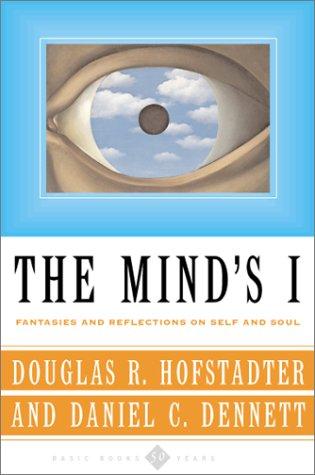
Daniel Dennett & Douglas Hofstadter · Buy on Amazon
"When you asked earlier if I would recommend William James to the modern reader and I said what I did and offered my hesitations, I have no hesitation at all about this book because it’s got so many absolutely classic papers in it. It’s edited and introduced by [Douglas] Hofstadter and Dennett and each chapter – whether it’s written for the book or composed of excerpts or a whole paper taken from elsewhere – has a thing called ‘reflections’ at the end. Some of them are absolutely bizarre. But, again, they show people really struggling and thinking about the problems they’re dealing with, like the nature of the mind and the ‘I.’ There are such classics in here. There is John Searle’s ‘Minds, Brains, and Programs’ paper, where he gives the famous Chinese Room argument . There’s also ‘What Is It Like to Be a Bat?’ by Thomas Nagel. Any student interested in consciousness has to read ‘What Is It Like to Be a Bat?’. That’s such a fascinating paper because Nagel thought at the time – in 1974 – that he had defeated materialism forever. He’s still more or less trying to do that today. And nobody remembers that paper for its attack on materialism. What it’s remembered for is two things. One is saying that you can never know what it’s like to be a bat. If you became a bat, you would lose all language and wouldn’t be able to tell us what it was like. Forget bats for a moment, this is one of the fundamental problems of consciousness: I can’t know what it’s like to be you, and you can’t know what it’s like to be me. Yes, and we speak the same language, so we imagine we have an idea what it’s like. That’s why he chose a bat, because of course it doesn’t use vision, it uses sonar, and it’s so different from us. But the second point that people remember from this essay is the importance of thinking about what it’s like to be whatever you are. What is it like to be Nigel Warburton right now? That’s what we mean by consciousness. If there’s something that it is like for the bat to be a bat, then that’s what we mean by being conscious. If there’s nothing that it’s like to be a bat, then that’s what we mean by not being conscious. If I said ‘what is it like to be this cup?’, I hope you’d say it’s not like anything at all. And we work up from there. So, that’s a very important paper. Then, we have ‘Selfish Genes and Selfish Memes’ by Richard Dawkins. I became obsessed with memes when I re-read his The Selfish Gene when I had chronic fatigue and was in bed for a year back in 1995. To some extent I still am obsessed with them; I go backwards and forwards between consciousness and memes. That is an absolutely classic paper. Yes, there’s ‘Where Am I?’ by Daniel Dennett and then there’s ‘Where Was I?’ by David Hawley Sandford; both are followed by Dennett’s reflections. There’s also ‘Ant Fugue’ by Hofstadter which is wonderful. There’s also lots by Borges himself. The first chapter in there is his ‘Borges and I.’ Yes. And if he were around today he’d have all the questions that I started asking myself when I built my first website back in the late 1990s. Who is this person that I’m putting out there? And now, when you’ve got all these social media, you feel like a different person in these different contexts. Kids nowadays are so used to that. One more chapter is ‘On Having No Head’ by Douglas Harding. The headless way is just fantastic. After all these years of meditation, I find it very easy now to flip into the headless way. It’s another way of seeing that I am not separate from the world. I’m delighted that that article is in here, and Harding writes very succinctly and clearly about it. And then there’s Turing’s famous 1950 paper that started the Turing Test. It was called ‘Computing Machinery and Intelligence’ but it begins with ‘I propose to consider the question, “Can machines think?”’ That is such a classic paper. We’re still struggling with the Turing Test now and the question is ever more pertinent. Many people think that he might equally have asked not ‘can a machine think?’ but ‘can a machine be conscious?’. The question of what the relationship is between intelligence and consciousness is so hard, but nevertheless a lot of ideas about the Turing Test are used by modern people to ask whether the computer that you’re comparing to a person is conscious or not. Those are just a few of the classics. Support Five Books Five Books interviews are expensive to produce. If you're enjoying this interview, please support us by donating a small amount . My favourite, or at least one that really stuck with me, is by Stanisław Lem, called ‘The Seventh Sally or How Trurl’s Own Perfection Led to No Good.’ Trurl lives in this mythical kingdom ruled by a terrible tyrant who wants to murder everybody and do terrible things. Trurl is so brilliant at making tiny little machines that he makes an entire kingdom that can fit inside a case that the nasty tyrant can carry around. It had thousands of people and had fields and farms and towns and villages and uprisings and wars. It had everything all on this minute scale. Trurl says to the king, ‘isn’t this wonderful? I can give you this tiny kingdom and you can pull levers or turn knobs to wage wars and torture people whenever you like and yet these are all just tiny mechanisms inside a box’. The question raised at the end of the story is this: Are these tiny little insignificant people in there suffering just as the real people did? Has Trurl done a good thing or an absolutely terrible thing in creating yet another kingdom full of suffering? I love that story and the question it raises, which is not answered, of course, in the story. I’ve put it in my consciousness textbook in all three editions, and I used it every year in my consciousness course. I would read the story to the students and ask them to write an essay or come and give a talk on whether they think that Trurl had done something really clever in stopping the suffering of the real world, or has he just created another world full of suffering? That has become more and more pertinent as AI and robots get better and better and cyberspace becomes more and more full of clever stuff. So The Mind’s I is an absolute goldmine. I would definitely recommend anyone who cares about consciousness to pick some chapters out of there or, preferably, read them all."

Peter Godfrey-Smith · Buy on Amazon
"Nor on consciousness. I should say he is a little naïve about consciousness but I think he’s a brilliant philosopher. I met him at a two-week working party at the Santa Fe Institute organised by Dennett a few years ago. He is brilliant and has the most fantastic ideas. I say that to begin with because I still want to say that I think he’s naïve about consciousness. Even so, this book is highly relevant to consciousness and that’s why I chose it – partly too because I’ve only just read it and it’s a thrilling book to read. Again and again it makes you wonder what is it like to be an octopus ? OK, a bat is pretty different from us, but a bat is a mammal. If you think about what it’s like to be a bat, you can imagine that you have wings and your little heart is beating and you have your little legs. This is because you have the same body structure as every other mammal. You have a spine and four limbs and a head. If you think about the intelligence of all other mammals, we all emerged somewhere after the dinosaurs became extinct around 65 million years ago. But the last common ancestor between us and an octopus is way back, possibly 600 million years ago. It would have been some kind of little wormy thing. The intelligence that we have must have evolved entirely separately in us, bats, whales, pussycats, and all of that, as opposed to the octopus. And there are many consequences of this for thinking about the nature of its consciousness. “If you ask what it is like to be a certain creature, then that’s a question about consciousness” If you ask what it is like to be a certain kind of creature, then that’s a question about consciousness. But then you try to imagine it. I cannot imagine having eight limbs, all of which are semi-autonomous. Godfrey-Smith goes into wonderful detail about how the system works. If you chop one of the tentacles off, it can still carry out meaningful movements and actions. I cannot imagine this and I cannot imagine not having a skeleton and being able to squeeze myself through the tiniest little gap and my limbs going through and then reaching out and grabbing eight things at once and doing different things with them all. It’s so hard to imagine. That’s what I loved about the book: the intricate details that he gives on octopus behaviour and on octopus evolution. This question came to my mind – if not to his – over and over again: What is it like to be an octopus? Yes, only in the way that he tackles the very important and difficult question of the evolution of consciousness. In writing my textbook – in the three times I’ve done it in different editions – I’ve found it the hardest chapter to deal with. Some people, like Nicholas Humphrey, for example, start by saying that obviously we are conscious and therefore consciousness must have evolved for a function because nothing evolves that doesn’t have some kind of a function. But I don’t think that is necessarily true. To me, the big dichotomy is this: is consciousness an added extra that appears at some stage during evolution (in which case we can ask when this happened) or is it intrinsic to being alive, or something very fundamental like that, (in which case we don’t have to ask when it evolved). For example, I could take the view that as soon as anything has a representation of itself in the world or makes any kind of distinction between inside and outside – this is me and this is the outside world – then ‘what it is like to be’ it would be whatever that distinction describes. In that case, a bacterium which has a membrane and chemical sensors and goes towards some chemicals and away from others, has got some kind of very basic representation of this and that . If you ask ‘what is it like to be’ that bacterium, then I would say it’s what it is like to be that representation. This is an idea that I have toyed with for a long time in different versions. If we take it up to cats and dogs, then this is very complex thinking. It gets even more complicated with humans, with all their delusions and their illusion of self and so on. With any view of that kind – and there are plenty of related views of this kind – you don’t need to ask when consciousness arose. You don’t ask when it emerged, because it is absolutely intrinsic to everything else that is going on. But Godfrey-Smith doesn’t raise that problem at all. He just asks when it arose and tries to find out by looking at the different things that different organisms do. The book’s not all about consciousness, but the chapter he has on the evolution of consciousness doesn’t really engage well with the current arguments that are very deep and very difficult about what we mean by the evolution of consciousness. Nevertheless, running through that book all the time is this question of what it is like to be an octopus. It is a brilliantly written book and absolutely gripping (and, as I mentioned, I find it hard to be gripped by a book.) So, I’ve included it among my five choices as a much more light-hearted option– something that’s an enjoyable read that will also make you think."