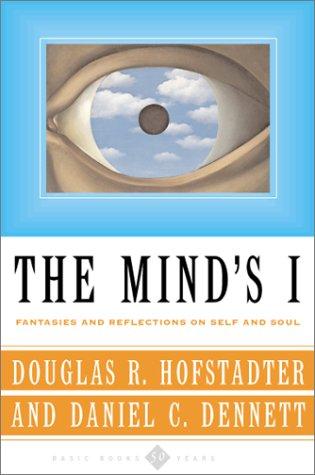
The Mind's I: Fantasies And Reflections On Self & Soul
by Daniel Dennett & Douglas Hofstadter
Buy on AmazonWhen you asked earlier if I would recommend William James to the modern reader and I said what I did and offered my hesitations, I have no hesitation at all about this book because it’s got so many absolutely classic papers in it. It’s edited and introduced by [Douglas] Hofstadter and Dennett and each chapter – whether it’s written for the book or composed of excerpts or a whole paper taken from elsewhere – has a thing called ‘reflections’ at the end. Some of them are absolutely bizarre. But, again, they show people really struggling and thinking about the problems they’re dealing with, like the nature of the mind and the ‘I.’ There are such classics in here. There is John Searle’s ‘Minds, Brains, and Programs’ paper, where he gives the famous Chinese Room argument . There’s also ‘What Is It Like to Be a Bat?’ by Thomas Nagel. Any student interested in consciousness has to read ‘What Is It Like to Be a Bat?’. That’s such a fascinating paper because Nagel thought at the time – in 1974 – that he had defeated materialism forever. He’s still more or less trying to do that today. And nobody remembers that paper for its attack on materialism. What it’s remembered for is two things. One is saying that you can never know what it’s like to be a bat. If you became a bat, you would lose all language and wouldn’t be able to tell us what it was like. Forget bats for a moment, this is one of the fundamental problems of consciousness: I can’t know what it’s like to be you, and you can’t know what it’s like to be me. Yes, and we speak the same language, so we imagine we have an idea what it’s like. That’s why he chose a bat, because of course it doesn’t use vision, it uses sonar, and it’s so different from us. But the second point that people remember from this essay is the importance of thinking about what it’s like to be whatever you are. What is it like to be Nigel Warburton right now? That’s what we mean by consciousness. If there’s something that it is like for the bat to be a bat, then that’s what we mean by being conscious. If there’s nothing that it’s like to be a bat, then that’s what we mean by not being conscious. If I said ‘what is it like to be this cup?’, I hope you’d say it’s not like anything at all. And we work up from there. So, that’s a very important paper. Then, we have ‘Selfish Genes and Selfish Memes’ by Richard Dawkins. I became obsessed with memes when I re-read his The Selfish Gene when I had chronic fatigue and was in bed for a year back in 1995. To some extent I still am obsessed with them; I go backwards and forwards between consciousness and memes. That is an absolutely classic paper. Yes, there’s ‘Where Am I?’ by Daniel Dennett and then there’s ‘Where Was I?’ by David Hawley Sandford; both are followed by Dennett’s reflections. There’s also ‘Ant Fugue’ by Hofstadter which is wonderful. There’s also lots by Borges himself. The first chapter in there is his ‘Borges and I.’ Yes. And if he were around today he’d have all the questions that I started asking myself when I built my first website back in the late 1990s. Who is this person that I’m putting out there? And now, when you’ve got all these social media, you feel like a different person in these different contexts. Kids nowadays are so used to that. One more chapter is ‘On Having No Head’ by Douglas Harding. The headless way is just fantastic. After all these years of meditation, I find it very easy now to flip into the headless way. It’s another way of seeing that I am not separate from the world. I’m delighted that that article is in here, and Harding writes very succinctly and clearly about it. And then there’s Turing’s famous 1950 paper that started the Turing Test. It was called ‘Computing Machinery and Intelligence’ but it begins with ‘I propose to consider the question, “Can machines think?”’ That is such a classic paper. We’re still struggling with the Turing Test now and the question is ever more pertinent. Many people think that he might equally have asked not ‘can a machine think?’ but ‘can a machine be conscious?’. The question of what the relationship is between intelligence and consciousness is so hard, but nevertheless a lot of ideas about the Turing Test are used by modern people to ask whether the computer that you’re comparing to a person is conscious or not. Those are just a few of the classics. Support Five Books Five Books interviews are expensive to produce. If you're enjoying this interview, please support us by donating a small amount . My favourite, or at least one that really stuck with me, is by Stanisław Lem, called ‘The Seventh Sally or How Trurl’s Own Perfection Led to No Good.’ Trurl lives in this mythical kingdom ruled by a terrible tyrant who wants to murder everybody and do terrible things. Trurl is so brilliant at making tiny little machines that he makes an entire kingdom that can fit inside a case that the nasty tyrant can carry around. It had thousands of people and had fields and farms and towns and villages and uprisings and wars. It had everything all on this minute scale. Trurl says to the king, ‘isn’t this wonderful? I can give you this tiny kingdom and you can pull levers or turn knobs to wage wars and torture people whenever you like and yet these are all just tiny mechanisms inside a box’. The question raised at the end of the story is this: Are these tiny little insignificant people in there suffering just as the real people did? Has Trurl done a good thing or an absolutely terrible thing in creating yet another kingdom full of suffering? I love that story and the question it raises, which is not answered, of course, in the story. I’ve put it in my consciousness textbook in all three editions, and I used it every year in my consciousness course. I would read the story to the students and ask them to write an essay or come and give a talk on whether they think that Trurl had done something really clever in stopping the suffering of the real world, or has he just created another world full of suffering? That has become more and more pertinent as AI and robots get better and better and cyberspace becomes more and more full of clever stuff. So The Mind’s I is an absolute goldmine. I would definitely recommend anyone who cares about consciousness to pick some chapters out of there or, preferably, read them all.