Stanley Wells's Reading List
Sir Stanley Wells is a Shakespearean scholar, writer, professor and editor. He is honorary president of the Shakespeare Birthplace Trust, emeritus professor at the University of Birmingham, and honorary emeritus governor of the Royal Shakespeare Theatre. He was knighted in 2016 for services to scholarship.
Open in WellRead Daily app →Shakespeare's Plays (2016)
Scraped from fivebooks.com (2016-09-19).
Source: fivebooks.com
William Shakespeare · Buy on Amazon
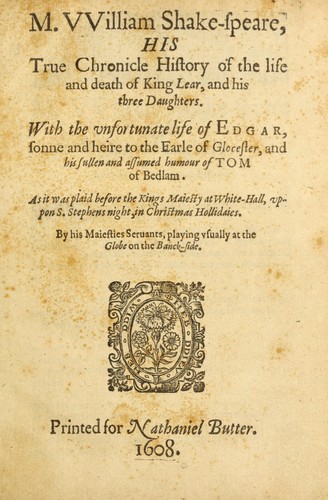
"The Times has just been doing a feature on Shakespeare’s plays, ranking them, and they quoted me saying I chose it as my number one and called it “the Mount Everest of plays.” It’s a play I’ve been deeply connected with over many years. I edited it for the Oxford Shakespeare edition, which I’m general editor for, and for the multivolume Oxford World Classics plays. I’ve seen it a great many times, right from 1949. I’ve seen Paul Scofield. I’ve seen it performed by a 17-year-old boy. Jonathan Pryce, recently, was a very fine Lear. I’m looking forward to seeing Antony Sher play it later this year. I think it’s the most profound of the plays. It’s not one you go to for a jolly night out, Shakespeare was deeply serious in writing this play. It does have its comic aspects, but it’s easily the most profound examination of what it means to be human of anything that I know. It’s wonderful to me that such a profound and serious play was popular in its own time. We know it was performed in Court—Jim Shapiro has recently written a great bestseller about it called The Year of Lear . It was performed for King James. It’s a great tribute to the Elizabethan and Jacobean audience that they made popular a play as demanding as this, which made such a fundamental examination of man’s relationship to the universe. “King Lear is easily the most profound examination of what it means to be human of anything that I know” It’s not a poetical play, in the most obvious sense of the word. It’s not poetical in the sense that Romeo and Juliet is, for example. The greatest lines in King Lear are not long passages of verse but aphorisms, almost, or lines like, “Why should a dog, a horse, a rat have life, | And thou no breath at all?” It speaks for all of us in the situation of mourning and grief over a loved one. And “a man more sinned against than sinning”—these are the sort of things we remember from King Lear, not: “But soft, what light through yonder window breaks?” as from Romeo and Juliet. To me, it’s a philosophical document. It’s also a great play; it’s a great acting play. I’ve seen wonderful performances of it. The most radical one was certainly Paul Scofield. My most recent book is called Great Shakespeare Actors and, in that book, I write about actors from Shakespeare’s own time right up to Simon Russell Beale who himself played Lear not long ago. I have essays in that book about many of the great Lears over the years: David Garrick, Scofield, Olivier who made a television film of it in his own life, and Derek Jacobi. It is a great acting role. As well as a philosophical play, it’s also a very theatrical play as Peter Brook and Paul Scofield showed very successfully. It is also the basis of a very good film, which was Peter Brook’s film with Paul Scofield; and a very fine Russian film directed by Kozintsev. That’s a very interesting question. It’s partly because it was an age when neoclassical rules were more easily applied to drama. They couldn’t take the variety of Shakespeare plays. There was a desire to cut them down to size, to make them more like the plays of Dryden, for example, or French neoclassical drama. Voltaire, for example, the great 18th century philosopher, couldn’t take Hamlet at all because it did not conform to the neoclassical model. And, even in Shakespeare’s own time, there was something of that feeling. Ben Jonson, who was much more classically orientated in his dramatic attitude, made fun of some of Shakespeare’s romantic dramatic devices. The Nahum Tate Lear is an evasion of the tragic issues of the play. Nowadays, we are, perhaps, more inclined to allow that theatre can be a very serious matter, that it can deal with matters of life and death. Also, we tend, nowadays, easily to accept the fact that Shakespeare can be adapted and made relevant to different situations by devices which bring the plays more into line with our own preoccupations, with our own society. Deborah Warner, for example, set the play’s opening scene in an old people’s home. Brian Cox, playing Lear, came on stage in a wheelchair blowing a party popper. It must have been his 80th birthday. And that’s a fair enough way to help modern people relate to the enduring issues that Shakespeare is concerned with in the play: the problem of old age and the prospect of giving up authority that old age necessitates."
William Shakespeare · Buy on Amazon
"A Midsummer Night’s Dream has always been a great favourite of mine, ever since my school days. I was introduced to it at school when I was about 11 or 12. I’ve seen many productions of it. It’s the first play I edited, for the New Penguin Shakespeare, in 1967. I very much enjoyed writing about it then. It’s a play about imagination, about Shakespeare’s own heart, in many ways. The Mechanicals’ scenes, as they’re called, in which Shakespeare portrays amateur actors putting on the play of Pyramus and Thisbe, actually tell us an awful lot about Shakespeare’s attitude towards the theatre and the acting profession. They’re also wonderfully playable. It’s a play that appeals very much to young people. I’m speaking now from the Shakespeare Birthplace Trust at Stratford-Upon-Avon and we have what’s called ‘Shakespeare Week,’ when we engage with over 10,000 primary schools. The Royal Shakespeare Company put on a production of A Midsummer Night’s Dream which uses amateur actors, including schoolchildren. It’s also a play about Shakespeare’s own art. He is writing about the art of theatre and, more generally, about the imagination. He has a wonderful speech in the play about poets. It’s a very funny play, it’s a very beautiful play, it’s got some lovely verse and some very fine prose. It’s, again, a very actable play. I’ve seen lovely productions of this over the years since 1962, when Peter Hall directed it with a lovely cast including Ian Richardson as Oberon and Judi Dench as Titania. Judi Dench went on to play the role again when she was seventy-five years old, a few years ago, in Richmond, and very successfully because it’s an ageless sort of part. It’s a part that gives amazing opportunity for beautiful verse-speaking because of the way in which the fairy world speaks. It’s an all-encompassing play. It’s delicate, it’s charming, but also a deeply serious play because Shakespeare is concerned as much with the art of theatre, as with the work of the imaginative artist: whether the artist is a writer or an actor."
William Shakespeare · Buy on Amazon
"The Winter’s Tale , again, is a play that I’ve been associated with for a long time. I edited the text for my Oxford Complete Works edition. The Winter’s Tale is complex. I saw it long ago when John Gielgud was in it as was Sybil Thorndike’s husband, Lewis Casson. It’s a great acting play. I’ve just seen it again recently with Ken Branagh. I saw it earlier in the 70s when Judi Dench played both Hermione and Perdita—she doubled as both mother and daughter. I remember her saying that when Trevor Nunn asked her to play Hermione, the mother of Perdita, she said, ‘Oh dear, is it mums’ parts already?” He then asked her to play Perdita too. She did double those parts very beautifully, though it was a bit awkward in the final scene where she has to talk to herself, as it were. They had to use a double for that and it was a bit tricky. Much more recently, in Ken Branagh’s production at the Garrick Theatre, which I saw in London, Branagh played Leontes very well and Judi played the older woman’s part of Paulina. She also spoke the chorus part, and I must say, spoke it with an authority and beauty of line that was an absolute model of verse-speaking in Shakespearean drama. “Shakespeare was a great user of silence in his plays” The greatest of all the scenes in the play is the one before the ending. [Spoiler alert!] This is the climactic scene where Hermione, who was thought to be dead for 16 years, is depicted in a statue and she miraculously comes to life. It’s absurd, if you think of it in rational terms, but it is literally miraculous in the theatre. It’s a moment that causes profound emotion in many people who see it. That’s sort of a spoiler: if possible, it’s better to go and see it without knowing what happens at the end. But it works, even if you do know what happens, time and time again because Shakespeare’s drama is such that it can make the situation imaginatively vivid for you. Even though you know what’s going to happen, you can be still be moved because of the writing, not only the verse writing but also the dramatic writing—the writing for the stage. This includes great moments of silence. Shakespeare was a great user of silence in his plays. There are some wonderful silences in The Winter’s Tale, for example when Leontes stands in awe before this big statue and then says “O, she’s warm!” as the statue begins to move. It’s not entirely easy to deduce Shakespeare’s views from his plays. It’s also important to remember that Shakespeare was an evolving person. People sometimes talk about Shakespeare as if there was only one moment in his lifetime, but the plays cover a period of 25 or so years. It’s a period during which he develops; and his attitudes change. One of my books is called Shakespeare, Sex, and Love . When I was writing that book, I felt I could discern a shift in Shakespeare’s imagination and his intellectual attitudes towards sex and love. With the earlier plays, he often made comedy out of people’s sexual attitudes. But as time goes on, he treats it much more seriously and more profoundly. He becomes concerned not only with the sexual aspects of love but with its spiritual aspects. This is also reflected in the sonnets, which are profound but impersonal love poems. But some of them, I think, are about his own love life and his own conflicted attitudes towards love. Some of them are very concerned with sex. They are some of the sexiest poems in the English language. A couplet in one of the sonnets could be spoken by the poet’s penis: it talks about being a drudge, rising and falling at the beloved’s request. It’s a very open and modern poem, in some ways. It breaks taboos. Shakespeare observed the taboos quite a lot in the plays written for the public theatres, but in the private world of some of the sonnets, he faces up to them square on."
William Shakespeare · Buy on Amazon
"Antony and Cleopatra is, in some ways, the most romantic of Shakespeare’s plays. It takes over, in a way, from Romeo and Juliet. Romeo and Juliet gives a wonderful exploration of young love, of first love, of romantic attitudes to love. Antony and Cleopatra are mature lovers. They are seasoned. They are disillusioned. It’s an extraordinarily rich play, poetically—as Romeo and Juliet is—but the poetry of Antony and Cleopatra is that of a mature person who has gone through a lot of experiences himself and is capable of expressing the disillusionment of middle-aged love as well as the raptures of it. And, also, the sadness lying behind people who know their lives are coming to an end. “Antony and Cleopatra are mature lovers. They are seasoned. They are disillusioned” It’s a vast play, imaginatively and geographically—it takes place over a couple of continents between Rome and Egypt. It portrays different attitudes relating to those places. It’s also, again, a wonderfully comic play. When Judi Dench played Cleopatra, she brought out a lot of comedy in the role: a sort of self-knowing ironical comedy of Cleopatra who knows that she’s funny, in some ways, but then, of course, becomes transcendent in her acceptance of the need to die at Antony’s side. There’s wonderful poetry infused with comedy because Shakespeare brings on the clown to bring Cleopatra the means of death: the asp with which she is poisoned. Cleopatra is transcendent in her reaction to that and her acceptance of the fact that she’s about to die. It’s a wonderful poetic scene and a wonderful acting scene too. He’s not a scholar. He’s not trying to probe into the truth about the past. He’s not particularly interested in historical truth or accuracy. He’s using the past for his own dramatic means and he’s quite happy about altering historical fact in order to achieve dramatic effects. He’s someone who makes use of the classics imaginatively. He was a great reader throughout his life, and most of the plays are based on other books. For the classics, his main source is Plutarch’s Lives of the Roman Emperors, which he used extensively for Julius Caesar and Antony and Cleopatra and indeed for Coriolanus too. Sometimes he even takes over its wording. I think he does have insights into the classical world but that was derived from the writings that he used. Plutarch was a great user of anecdote and that, I think, was one of the things that appealed to Shakespeare. I don’t think Shakespeare was a classical scholar at all but he’s a wonderful user of the stories that classical literature tells for dramatic ends. The play is the thing for him."
William Shakespeare · Buy on Amazon
"Twelfth Night is a lovely mellow play. A play which has more comedy in it, in the scenes involving Malvolio. Donald Sinden was a wonderful Malvolio and he has a marvellous essay about it, which I talk about in my book about great Shakespeare actors. He’s very good at describing the self-consciousness of the actor in manipulating his audience as Malvolio. “Shakespeare was quite happy about altering historical fact in order to achieve dramatic effects” At the same time, it’s a maturely romantic play. Take the lover Orsino, his opening scene, “If music be the food of love, play on” is one of the best known lines in Shakespeare. It’s a play that rises to a great climax of reunion. Again, it looks forward to the late plays like The Winter’s Tale in the almost miraculous sense you get in the final scene when Viola is reunited with her brother she believed to be dead. It’s a very beautiful and very moving scene. It covers a wide range of comedy and romance. It’s very entertaining in the scenes with Sir Toby Belch. Again, I saw a great production by John Barton with the Royal Shakespeare Company which was the one in which Donald Sinden played Malvolio and Judi Dench was a great Viola. It’s a very musical play too. The clown has a number of songs which give us a framework for the action. Hardly any of the music originally written for Shakespeare’s plays has survived. But people have been able to use the lyrics of Shakespeare to create their own songs through the ages, all the way up to modern composers. There are some great compositions for the Royal Shakespeare productions. With all the sittings there would have been a great range of people, including some Puritans. Some refused to go to the theatre but no doubt some of them did, even if it didn’t square easily with their principles. So, some people, no doubt, were shocked by the play. The play is one which toys, as does Shakespeare in other plays, with homoerotic themes: for example the relationship between Orsino and Viola disguised as a boy. The relationship between Sebastian and Antonio is particularly capable of homoerotic interpretation: when Antonio talks about his desire for the boy Sebastian being “more sharp than filed steel”; I can’t help but regard that as a suggestion of homoerotic desire. Shakespeare invites the possibility of same sex desire in a number of places. I doubt that members of the audience were particularly worried about it. I don’t think they cared all that much. I think it’s we, in modern times, who have been more inclined to worry about the homoerotic aspects behind some of the plays. Again, it’s something I write about in my book Shakespeare, Sex, and Love . I write at some length about this topic. I write about the attitudes towards same-sex desire in Shakespeare’s plays and in Shakespeare’s time. My feeling is that one of the reasons why we don’t see it spoken about very explicitly in the plays or in other writings in the period is because they didn’t think it was all that important. They were pre-Freud and didn’t have great complexes about what people did with each other’s bodies. I think they accepted these things more easily and in a more relaxed fashion than later ages have tended to do. Indeed, it would. I have taught Shakespeare, I’ve lectured about Shakespeare, I’ve been chairman of the Shakespeare Birthplace Trust, I’ve been director of the Shakespeare Institute, I’ve been professor of Shakespeare Studies, I’m general editor of the Oxford Shakespeare, I’m general editor of the Penguin Shakespeare, I’ve lectured about Shakespeare all over the northern hemisphere. And still, at the age of eighty-five, I’m doing that. I’m going to Romania and Italy and taking part in conferences and I’m writing another book about Shakespeare’s Tragedies. So I am a fairly comprehensive Shakespearian, I think it’s fair to say. It’s difficult to put anything like that in a nutshell but I suppose, ultimately, it has to be his great humanity. It’s his concern with what it is to be a human being, in the sense of the fun that human beings can have out of life but also the sense of the mysteries of human life. It’s his consciousness of the heights to which human beings can rise in heroism—for example with characters like Henry V and Coriolanus—but also the sense of suffering that people can undergo. And also his great sense of fun. He’s a comprehensive writer. I would come back to the fact that ‘Shakespeare’ is not just one play, but that ‘Shakespeare’ is a great body of evolving work. We get a sense of a man who was himself evolving over that period and whose response to life is always alert and always deepening and becoming more and more aware of the complexities of what it is to be a human being."