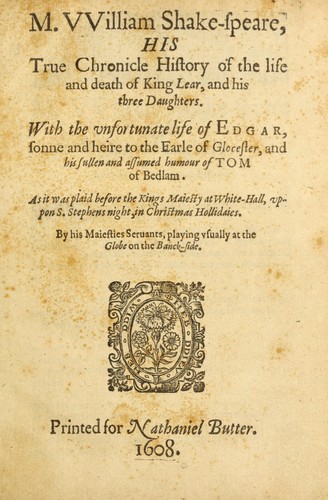
King Lear
by William Shakespeare
Buy on AmazonKing Lear divides his kingdom among the two daughters who flatter him and banishes the third one who loves him. His eldest daughters both then reject him at their homes, so Lear goes mad and wanders through a storm. His banished daughter returns with an army, but they lose the battle and Lear, all his daughters and more, die. (source)
Recommended by
"You see the same dichotomies, and beginnings of discomfort with prudence, in Shakespeare that you see throughout our culture ever since. Edmund is prudent – evil and calculating. That is the danger we think we face. And on the other hand we worship Cordelia, but she is an utter fool. She is absolutely sincere, horrified by the phoniness of her sisters, only tells Lear “I love you according to my bond” and is cast out by him as a result. She could have been true instead of being silly. Tragically, she was both true and silly. But let’s not forget that the mainspring of the tragedy was Lear’s imprudence in giving away his kingdom without, at a minimum, thinking to whom he was giving it. How could he have been so blind as to who his daughters were? But this is evidently not their first experience of his imprudence. Regan says: “He has ever but slenderly known himself.” That lack of self-knowledge runs through the history of imprudence. Psychologists ask the same question: Do we learn from our mistakes? Or in other words: Do we get wiser as we grow older? Perhaps not on a Learian scale but on a more mundane scale, do we learn from our imprudence? And the answer is no. The answer is people do not get wiser as they grow older, rather they become more entrenched in the attitudes they started out with. Because you can only learn from experience with the mental furniture you have at the moment. And that mental furniture consists too often of those attitudes you began with. So a lot of what people “learn” is just a confirmation of their attitudes. Contemporary psychology is filled with lessons like that, where people at the end of the journey get what they started with. Life, instead of being filled with lessons, is too often a cracked mirror reflecting us back to ourselves. If Lear learns, he learns because Shakespeare wanted him to. And he learns because he had therapists along with him, in Edgar and the Fool, and later Cordelia. You have three to one therapist-patient ratio, so how could he not have learned?! I’m not trying to re-write Shakespeare, but a prudent version of Cordelia could have said: My Lord, you asked me to describe how much I love you. Let’s talk about all the times we’ve had together, all the moments we’ve shared, the conversations we’ve had and the ways I’ve accompanied you. When have I ever been anything other than a devoted and loving daughter? She stabbed herself in the heart, and she’s not the only Shakespearian heroine to have done that – only she did it with her words. Hamlet is conceived of as the poster child for indecision. I think that’s a bad rap. He is faced with the difficult question of what the best thing to do is. It’s easy to make fun of him for thinking about it so carefully because he’s a graduate student in philosophy – so he was always going to be wrapped up in the coils of thought. But his dilemma is really a practical one: Can I trust the ghost of my father? Should I kill my uncle and take vengeance and the consequences of vengeance? If I do kill him, what is the best moment to do it? Do I really want revenge if he confesses, and so I end up sending him straight to heaven? Hamlet struggles with all of that. More than indecision, he really represents someone who is trying to be prudent, as best he can. Like Antigone. He is certainly contrasted with Ophelia, who deals with overwhelming difficulty by throwing herself in a river – the height of imprudence. Ophelia is Lear without his team of therapists. Hamlet is simply trying to be as thoughtful as possible about what the best thing to do is under incredibly difficult circumstances. And we know, for example from the World War II literature of people in the resistance, that sometimes in difficult circumstances you can be boundlessly prudent but in the end you’re still dragged under."
Living Prudently · fivebooks.com
"It is one of the great representations of old age and another fine example of intergenerational conflict. Lear is about all sorts of things but one of the things it’s about is people getting old and not ceding what their kids think they should to them and the kids trying to bully them. Interestingly, the last line in the Gilead book is a quote from Lear : “I’ll pray, and then I’ll sleep.” So, there are connections between all five of these books. They all pull on the same things. “There are an awful lot of people sitting in care homes on their own never being visited. ” Lear is interesting because, for example, there’s a point where one of the daughters says he’s so unmanageable but then he always was. So there’s this idea that, yes, Lear is becoming wayward and impetuous but, in a sense, he’s not because he was always like that. Now he’s old, it’s more unrestrained than it was before. Again, you have this sense of pre-existing personality and how that contributes. For personality, of course, you just read genes because that’s the link between the innate forces that make you who you are versus the environment that acts on you. You have the same things coming back again and again. They’re there in Shakespeare like they’re there in Cicero. Abandonment is one of the huge fears of old age. I oscillated between choosing Lear and Shakespeare’s other great late play, The Tempest. Both of them are about older people dealing with power and how to hand it on. And that’s very difficult. Prospero too has the power and he doesn’t know how to shed it gracefully. With that comes the feeling that, as you lose not only physical but also social power, you do feel abandoned. When you’re suffering from dementia, you are losing not only your physical faculties but your mental ones as well and that includes your social faculties. There are an awful lot of people sitting in care homes on their own never being visited. I know that because when I go to care homes to visit my elderly relatives, there are a lot of people there who never get visitors. So maybe that fear of abandonment isn’t just a crazy old age thing, it’s quite a real fear. Dementia, in a sense, makes it worse because you’re not just being abandoned but you’re actually losing yourself and that’s worst of all because there is nothing there for people to relate to anymore. That’s what people are really afraid of, that they’re losing themselves. It’s hard. It’s not a good place to be when you’re lonely and you’re old. Well, literature is usually based on a certain amount of experience and there are only so many ways that people can do things. So, why not use the guide? We all do. We all rely on it, whether we acknowledge it or not. I don’t think that literature isn’t a valid way to understand something. And I have had people say to me , ‘Knowing that amyloid protein does XYZ is all very interesting but how’s that going to help?’ Well, indeed. Given how complicated an issue it is, I think, yes, it’s progressing at a very decent rate. This is really, really hard stuff and that’s what I think most people don’t understand about dementia research. Fixing a broken leg or even a broken heart is easy compared to when you’re dealing with the brain. Also, dementia is one of those things where you can’t just go ‘ah, great, there’s the gene! Hurray! We’ll fix the gene and we’ll fix the problem.’ It doesn’t work like that. There’s an awful lot of complicated factors. And the truth of it is that, I’m afraid, a lot of them are going to be really hard to change. Some of them are going to be easy but a lot of them are going to be very difficult and that’s because our societies are built in ways that do us harm. So, we’re going to have to change our societies and that makes it difficult. Air pollution, poverty, domestic violence, for example. All of these are stresses, they stress the brain, they create trauma, they damage things, and they possibly age people. That’s what the evidence is suggesting. Again, it’s not conclusive but the evidence suggests that these traumas affect the brain as they affect the body and the person. If that’s the case, then reducing those traumas is going to be difficult, but essential."
Ageing · fivebooks.com
"The textual history of the play is very, very contested. It started with the really famous Oxford Shakespeare in 1986 or ’87 when the editors argued very persuasively that Shakespeare wrote the work twice. He wrote it once, published in quarto, then a second time, which is the text preserved in folio. I was asked to do a parallel text showing the quarto and folio of King Lear on facing pages. There is a book coming out very shortly which is going to argue—I suspect, fairly persuasively—that Shakespeare did not re-write and the jury is out. The fact is that even if there are or were two different versions of the play, they are both in their own right probably equally wonderful. One would have to say the First Folio of 1623 exported Shakespeare into England and then into the world. In a strange way, this most brilliant of dramatists is really a creature of the book. Having said that, the plays—not only through subsequent editions—have lasted the course and have done so sometimes in spite of all the academic work done on them. They are alive, they are buoyant. “This was the son of a glover, and he was a brilliant son of a glover, undoubtedly, the most brilliant person who’s ever lived, perhaps.” Very recently, in the last year and a half, a number of books have appeared which demonstrate that Shakespeare is the primary literary export from this country. In fact, he is the world’s favourite author by a long way: in China, in India, in Africa. A book has just come out about Shakespeare in Swahililand , a brilliant book—and so Shakespeare is everywhere. It is unforgiving, it’s a very, very bleak work. It’s a work about nothingness. The words ‘nothing’ and ‘zero’ are everywhere in the play. They are ultimately the reason why we think it is so, Beckettian, so absurdist, so modern. But those are ultimately solecisms, anachronisms. At the end of the King Lear , there are no women, so it is a play of complete desolation and deadness. But because of this magnificent rhetoric, because of the sheer brilliance and passion of the insights in the play into our human condition, it has lasted. “ King Lear is a play that changes your life. How could it not?” The very first line of the play is ‘I thought the king had more affected the Duke of Albany than Cornwall’, and that word ‘affected’, affection, becomes everything this play is about. It is about the human soul, about instincts, about how it is important that royalty, for example, has to be earned through decency. It’s a very powerful and very engaged, committed work."
The Best Plays of Shakespeare · fivebooks.com
"The Times has just been doing a feature on Shakespeare’s plays, ranking them, and they quoted me saying I chose it as my number one and called it “the Mount Everest of plays.” It’s a play I’ve been deeply connected with over many years. I edited it for the Oxford Shakespeare edition, which I’m general editor for, and for the multivolume Oxford World Classics plays. I’ve seen it a great many times, right from 1949. I’ve seen Paul Scofield. I’ve seen it performed by a 17-year-old boy. Jonathan Pryce, recently, was a very fine Lear. I’m looking forward to seeing Antony Sher play it later this year. I think it’s the most profound of the plays. It’s not one you go to for a jolly night out, Shakespeare was deeply serious in writing this play. It does have its comic aspects, but it’s easily the most profound examination of what it means to be human of anything that I know. It’s wonderful to me that such a profound and serious play was popular in its own time. We know it was performed in Court—Jim Shapiro has recently written a great bestseller about it called The Year of Lear . It was performed for King James. It’s a great tribute to the Elizabethan and Jacobean audience that they made popular a play as demanding as this, which made such a fundamental examination of man’s relationship to the universe. “King Lear is easily the most profound examination of what it means to be human of anything that I know” It’s not a poetical play, in the most obvious sense of the word. It’s not poetical in the sense that Romeo and Juliet is, for example. The greatest lines in King Lear are not long passages of verse but aphorisms, almost, or lines like, “Why should a dog, a horse, a rat have life, | And thou no breath at all?” It speaks for all of us in the situation of mourning and grief over a loved one. And “a man more sinned against than sinning”—these are the sort of things we remember from King Lear, not: “But soft, what light through yonder window breaks?” as from Romeo and Juliet. To me, it’s a philosophical document. It’s also a great play; it’s a great acting play. I’ve seen wonderful performances of it. The most radical one was certainly Paul Scofield. My most recent book is called Great Shakespeare Actors and, in that book, I write about actors from Shakespeare’s own time right up to Simon Russell Beale who himself played Lear not long ago. I have essays in that book about many of the great Lears over the years: David Garrick, Scofield, Olivier who made a television film of it in his own life, and Derek Jacobi. It is a great acting role. As well as a philosophical play, it’s also a very theatrical play as Peter Brook and Paul Scofield showed very successfully. It is also the basis of a very good film, which was Peter Brook’s film with Paul Scofield; and a very fine Russian film directed by Kozintsev. That’s a very interesting question. It’s partly because it was an age when neoclassical rules were more easily applied to drama. They couldn’t take the variety of Shakespeare plays. There was a desire to cut them down to size, to make them more like the plays of Dryden, for example, or French neoclassical drama. Voltaire, for example, the great 18th century philosopher, couldn’t take Hamlet at all because it did not conform to the neoclassical model. And, even in Shakespeare’s own time, there was something of that feeling. Ben Jonson, who was much more classically orientated in his dramatic attitude, made fun of some of Shakespeare’s romantic dramatic devices. The Nahum Tate Lear is an evasion of the tragic issues of the play. Nowadays, we are, perhaps, more inclined to allow that theatre can be a very serious matter, that it can deal with matters of life and death. Also, we tend, nowadays, easily to accept the fact that Shakespeare can be adapted and made relevant to different situations by devices which bring the plays more into line with our own preoccupations, with our own society. Deborah Warner, for example, set the play’s opening scene in an old people’s home. Brian Cox, playing Lear, came on stage in a wheelchair blowing a party popper. It must have been his 80th birthday. And that’s a fair enough way to help modern people relate to the enduring issues that Shakespeare is concerned with in the play: the problem of old age and the prospect of giving up authority that old age necessitates."
Shakespeare's Plays · fivebooks.com
"“King Lear.” The most humane portrait of the human condition I know."
By the Book: Emma Thompson · nytimes.com
"poetry by Yeats and T. S. Eliot; and “King Lear” were my set books for English."
By the Book: Edward St. Aubyn · nytimes.com
Favorite books · radicalreads.com