Simon Brett's Reading List
Simon Brett has written more than 100 books, including the Charles Paris, Mrs Pargeter and Fethering series of crime novels. Blotto and Twinks are his most recent creations. He was awarded an OBE in 2016 and is a Fellow of the Royal Society of Literature.
Open in WellRead Daily app →The Best Whodunnits (2010)
Scraped from fivebooks.com (2010-12-30).
Source: fivebooks.com

Barbara Vine · Buy on Amazon
"Yes. There were two I liked. A Dark-Adapted Eye was the first one, and the second one was called A Fatal Inversion. I like Ruth Rendell very much as a writer, and I just found it amazing when she suddenly started writing under this new persona. And I thought the books had another level: it was as if she’d been holding back this extra skill. They were very different from the Ruth Rendells – and I just thought those first two were amazing… A greater depth. Because her early books – the early Wexford books – were very good, but fairly traditional police procedural whodunnits. Then some of the psycho-pathological ones like A Judgement in Stone were also very good and very creepy. But this seemed somehow a broader canvas, it seemed to involve more depth of character, and I thought it was remarkable that a good writer could suddenly get so much better."

Patrick Hamilton · Buy on Amazon
"Yes. It’s a study of schizophrenia, in a way. The main character, George Harvey Bone, goes into these strange trance states. Like a lot of Patrick Hamilton’s characters, he is devoted to a woman who is not worthy of him, who is one step up from a prostitute. He’s obsessed with her, and eventually ends up murdering her. It’s just an incredibly written, claustrophobic book that would be in my top five almost any day you rang me. Patrick Hamilton goes in and out of fashion – and I’m not sure he’s ever been as popular in the States as he is in the UK – but a lot of crime writers like him because he has this strange claustrophobia. And he can be funny too, about fairly nasty things. There is a kind of black humour that comes through it – this central character who is so hopeless and is being exploited by his friends, and particularly by this woman. And you just know it’s going to end badly. A lot of it goes on inside his head. There’s one particular bit where he’s walking along in Brighton. Brighton figures a lot in the book. It’s actually set in Earl’s Court in London, but he goes down to Brighton, and Brighton carries a meaning for him. But there’s a very good description as he’s just walking along and his mood is changing, and there are things clicking in his mind and you can feel the threat of the mental illness about to take him over…"
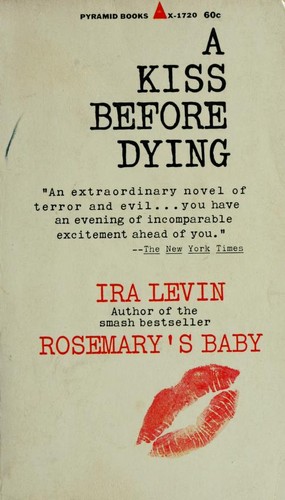
Ira Levin · Buy on Amazon
"He wrote A Kiss Before Dying very young: I think it was his first book. If you look at the history of the crime novel , the whodunits, where there was a puzzle and a device, were very popular in the 1920s and 1930s. But since World War II there have been very few books which rely on a trick – like, famously, the Agatha Christie where the narrator turns out to be the murderer. One would have thought that at the end of the so-called golden age, at the end of the 1930s, that all those tricks had been done. But in A Kiss Before Dying, there is such a device. I won’t describe it, because I don’t want to give it away, but it is a kind of verbal trick. And it’s one of those books where you get halfway through and you actually go back through the book and think, I know this, there’s a piece of information that has been kept from me… It’s also a very tense novel, again, about a murderer. But there is this central device that is so clever, that at the end you both hug yourself with glee at how good it is and kick yourself because you didn’t get it. Like any good novel it creates a world of its own, and at the end of the book you know more about that world. In a crime novel it’s done through an investigation, normally a murder, but at the end you know not only who committed the crime, but you also know a lot about the environment that gave rise to this kind of pressure, the boil that was lanced by the murder. You’ve got to know the characters a lot better, and you know what pressures they were under. Also, I think increasingly in crime novels, you know that crime is not without consequence. Because I think there was a danger with the golden age ones that they were nice little puzzles really. Murder was just a device to turn a key in an investigation, whereas now, in contemporary crime fiction, you’re much more aware of the consequences. I think it’s partly because we’ve lost the death penalty in England. In the golden age, it was wonderful: Hercule Poirot would get them all in the library and point at one person and say, ‘For zees reazons you deed it…’ and they’d go off and be hanged, end of story. But now, of course, the ramifications of crime and punishment are gone into more and there’s much more questioning of how close the criminal is to the investigation. Which was there from the start – look at Sherlock Holmes with Moriarty. It’s a very broad church now, crime fiction, and all kinds of things can fit into it. It’s where I live, really. There are a lot of villages near Worthing in West Sussex – there’s Goring and Ferring and there’s one called Tarring. I thought Tarring and Fethering was a nice little private joke so I invented this village. Yes, when I was a radio and television producer I was working with lots of actors – which actually I still do now as a writer. So I invented this antihero, who was about 20 years older than I was when I started writing. But then in about the tenth book I sort of froze him in the amber of his late 50s and I’m now rather older than he is. I’m contemplating writing another one at the moment. Well, I’m very chuffed. I think they’ve been out of print in the States for a long time, but who knows, maybe he’ll come back. He’s having a life here on radio: Bill Nighy is playing the part on Radio 4. It’s rather good casting . I remember once hearing someone say that if you are writing a book or doing some research about some time in the last 100 years or so, you should read the contemporary crime fiction. Not for your deep research of course. But it will give you a flavour of what people’s preoccupations were and what their entertainments were, and would be, I think, quite a painless way of starting research."
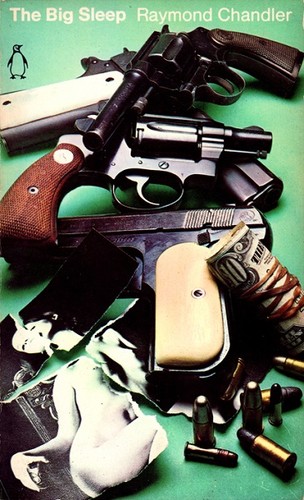
Raymond Chandler · Buy on Amazon
"I think the writing is just so beautiful. Raymond Chandler’s hopeless at plots, as we know. He said himself, if he couldn’t think of what to do, he brought in a man with a gun. But the language… I remember some years ago an American publisher got the rights to do a book called Raymond Chandler’s Philip Marlowe and got various contemporary crime writers to write a Philip Marlowe story . I was asked to do one – it was great fun. I was very excited, because it meant rereading all the books again. I found I could do the wisecracks, but I couldn’t do them as economically as he could. I think that’s what I admire in Chandler; he’s very economical with his words. And also he can do something that very few writers can do, he can actually use a joke to increase tension rather than release tension. Normally we think of comic relief: you build up the tension and then you break it with a joke. But Chandler could actually make the tension tighter with a joke, which I think is a great achievement. Support Five Books Five Books interviews are expensive to produce. If you're enjoying this interview, please support us by donating a small amount . I don’t think so. He’s an icon really; I don’t think he’s a real person. It’s just the quality of writing that keeps me going. And actually it was very influential. It’s interesting that Agatha Christie and Raymond Chandler were both British. Agatha Christie was the godmother of the whodunnit tradition and Raymond Chandler was the godfather of the hard-boiled tradition – and I think very few people did it as well as he did. No. There could have been. I’m not anti-Agatha. A lot of contemporary crime writers are very anti-her. A lot of people criticise her, and say there’s no psychological depth. But that wasn’t what she was trying to do. She was producing these wonderful little clockwork toys which actually worked very well. The mechanism worked perfectly. The fact that she didn’t deal with the underbelly of society and deprivation in inner cities is neither here nor there. Yes, reputedly, towards the end. And she did create this Ariadne Oliver in some of her stories who was a version of herself, this crime writer who was saddled with this detective she was bored to tears by. Also, someone once worked out that Hercule Poirot, since he didn’t start investigating till he had retired from the Belgian police force, was 136 when he solved his last case."

Patricia Highsmith · Buy on Amazon
"Again, I think Patricia Highsmith, at one stage, was much more appreciated in Europe than she was in America, even though she was American by birth. I think Ripley just set so many characters in motion because he was one of the first entirely amoral central figures, someone who commits appalling crimes and murders but you actually feel a kind of sympathy for. Well, if not a sympathy, you’re intrigued by the character. It’s also fascinating because he’s a kind of blank canvas. So in The Talented Mr Ripley – which was made into a movie not that long ago – he’s got this friend who he rather sucks up to called Dickie Greenleaf. When he murders Dickie and takes on his persona, it’s almost as if he becomes more real to himself as a person, because he’s being someone else. Which I think is fascinating – and goes back to actors and Charles Paris. This idea of the criminal who does it almost from lack of his own personality rather than the power of his personality. It’s a very interesting area, which has been explored a lot more since, but I think Patricia Highsmith was the first to do it. I’m not sure we could have had Hannibal Lecter without Patricia Highsmith. It’s very much the same thing. Obviously he is more extreme, but here is a character doing appalling things who gets all the best lines. It’s a very different kind of writing, a very different kind of book, but yes, Hannibal Lecter is, I think, in a direct line from Tom Ripley, the amoral killer. Very intriguing, and these days not unusual. But when Patricia Highsmith was writing, I don’t think the concept of the serial killer existed. She was ahead of her time I think. No, it’s a very clever trick, because she doesn’t sentimentalise him or anything. The telling of the story is very even-handed, really. But we kind of get inside his head, and what he does has a kind of logic to it."