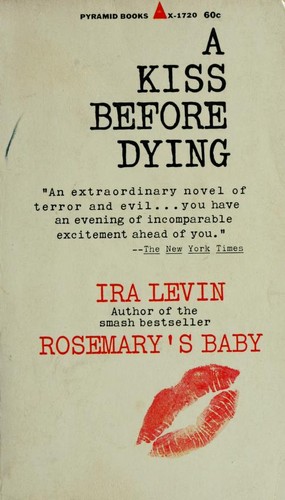
A Kiss Before Dying is the story of young man who has just come out of the horror of World War II and is loath to return to the quieter horror of the manufacturing town he grew up in. These two backgrounds have made him what he is: a young man on the make possessing a complete immorality in the ways he makes it. When he meets Dorothy Kingship, who loves him deeply and whose father just happens to be the copper king of America, he has it made. But so devious is his brilliant mind and so strange is fate that it is only with her murder that he is able to reach the pinnacle in Kingship Copper. From the first page, this novel has the kind of emotional pull that good storytellers have always evoked, You will not be able to abandon this ruthless young man.…
"He wrote A Kiss Before Dying very young: I think it was his first book. If you look at the history of the crime novel , the whodunits, where there was a puzzle and a device, were very popular in the 1920s and 1930s. But since World War II there have been very few books which rely on a trick – like, famously, the Agatha Christie where the narrator turns out to be the murderer. One would have thought that at the end of the so-called golden age, at the end of the 1930s, that all those tricks had been done. But in A Kiss Before Dying, there is such a device. I won’t describe it, because I don’t want to give it away, but it is a kind of verbal trick. And it’s one of those books where you get halfway through and you actually go back through the book and think, I know this, there’s a piece of information that has been kept from me… It’s also a very tense novel, again, about a murderer. But there is this central device that is so clever, that at the end you both hug yourself with glee at how good it is and kick yourself because you didn’t get it. Like any good novel it creates a world of its own, and at the end of the book you know more about that world. In a crime novel it’s done through an investigation, normally a murder, but at the end you know not only who committed the crime, but you also know a lot about the environment that gave rise to this kind of pressure, the boil that was lanced by the murder. You’ve got to know the characters a lot better, and you know what pressures they were under. Also, I think increasingly in crime novels, you know that crime is not without consequence. Because I think there was a danger with the golden age ones that they were nice little puzzles really. Murder was just a device to turn a key in an investigation, whereas now, in contemporary crime fiction, you’re much more aware of the consequences. I think it’s partly because we’ve lost the death penalty in England. In the golden age, it was wonderful: Hercule Poirot would get them all in the library and point at one person and say, ‘For zees reazons you deed it…’ and they’d go off and be hanged, end of story. But now, of course, the ramifications of crime and punishment are gone into more and there’s much more questioning of how close the criminal is to the investigation. Which was there from the start – look at Sherlock Holmes with Moriarty. It’s a very broad church now, crime fiction, and all kinds of things can fit into it. It’s where I live, really. There are a lot of villages near Worthing in West Sussex – there’s Goring and Ferring and there’s one called Tarring. I thought Tarring and Fethering was a nice little private joke so I invented this village. Yes, when I was a radio and television producer I was working with lots of actors – which actually I still do now as a writer. So I invented this antihero, who was about 20 years older than I was when I started writing. But then in about the tenth book I sort of froze him in the amber of his late 50s and I’m now rather older than he is. I’m contemplating writing another one at the moment. Well, I’m very chuffed. I think they’ve been out of print in the States for a long time, but who knows, maybe he’ll come back. He’s having a life here on radio: Bill Nighy is playing the part on Radio 4. It’s rather good casting . I remember once hearing someone say that if you are writing a book or doing some research about some time in the last 100 years or so, you should read the contemporary crime fiction. Not for your deep research of course. But it will give you a flavour of what people’s preoccupations were and what their entertainments were, and would be, I think, quite a painless way of starting research."