Robert Poole's Reading List
Robert Poole is Professor of History at the University of Central Lancashire. He is also historical consultant to the Peterloo commemoration programme .
Open in WellRead Daily app →Popular Uprisings (2019)
Scraped from fivebooks.com (2019-04-18).
Source: fivebooks.com

Kim Wagner · Buy on Amazon
"The famous depiction of Amritsar is in the film Gandhi, where you have Colonel Dyer simply coming into Jallianwala Bagh, the park at Amritsar, taking a brief look, and then opening fire on what’s clearly a peaceful crowd for no apparent reason. The British then icily carry on killing people, long after there could be any possible threat, and many people were shot in the back. “You get massacres when a colonial mentality develops or the authorities simply refuse to believe that the protesters are about what they claim to be about.” That contains an important element of truth, something like that did happen. But what Wagner points out is that this was not just some incomprehensible atrocity. He demonstrates that Colonel Dyer, as well as the governor and those around him, all had a profound fear of Indian uprisings, dating back to the Indian Mutiny of 1857. This was a view of the Indians as natives, an uncontrollable mob. The only thing they could understand was firepower, fear and terror—and you just had to use enough of it, quickly enough, to stop the whole thing in its tracks. Wagner demonstrates in great detail how this appalling, imperial mentality operated in 1919. Wagner also shows that this isn’t just something that happens in one day. The unrest in Amritsar was related to Gandhi’s campaign against British rule. The protesters wanted to stage a shutdown of the city in protest against restrictions on the ordinary lives of Indians. There was a peaceful protest campaign going on, because of the restrictions on movement and on trade and so on. The British were making life intolerable for people who were working inside the walled city of Amritsar. Gandhi ’s supporters were developing his methods of peaceful, nonviolent resistance. So people in Amritsar had declared a day when factories would close down, when nobody would work, when shops would be closed and so on, in protest, just to show that the effect of these British regulations would be to make business and trade unworkable. As part of that protest, there was a march. The march was fired on by the British when it reached a bridge, because the British had this idea that the natives were dangerous and just need to be taught a lesson with gunfire. Then there were Indian retaliations because of that, one of which involved the ill treatment and near murder of a white woman. That really did press British colonial buttons, because of its similarity to some of the atrocities of the Indian Mutiny. From that point onwards, the British simply perceived it as the beginnings of another Indian Mutiny, another 1857 Rebellion, which could only be dealt with by firepower. There was a festival going on, there were gatherings going on. But as part of their security measures in response to the events of a few days before, the British had banned people from travelling, from moving in and out of the city and they had banned all gatherings. But the gathering for the religious festival carried on, because to the people in Amritsar it made no sense at all. They couldn’t understand it. And they simply didn’t believe they would actually be fired on. It just seemed so fantastic. And that’s why there was so much shock when it happened. Yes, I think it is. You certainly get that at Peterloo. The protesters are trying to demonstrate that they are peaceful, that they are citizens with families, that they are a community, but the authorities simply read the opposite into it and use force. Yes. In Amritsar the death toll was something approaching 400, it could be 600, and figures of a thousand might be credible. But it’s not the exact numbers that matter so much, it’s what Amritsar stands for: pointless, intolerable, imperial atrocities. As Wagner points out, extra myths then get added to it: that a hundred people died in a well, for example—that’s still commemorated on the site—and that the British opened fire with machine guns. Neither is actually true. The atrocity was bad enough , but those myths play to Amritsar as a symbol of the violent exercise of imperial power, which was certainly very widespread. People fasten on this particular incident and it then gets invested with all the qualities of imperial power generally. Support Five Books Five Books interviews are expensive to produce. If you're enjoying this interview, please support us by donating a small amount . I don’t think it’s wrong that that one set of atrocities comes to stand for all. In fact, it’s probably the only way we will ever, on a large scale, understand and be able to remember these things. But I do think it’s important to understand what the event really was and why it happened, without excusing it. The People’s Army turned on the people that day, that was the symbolism there. But perhaps the Chinese government wants people to remember that, to discourage similar protests in Hong Kong and elsewhere. Is memory always on the side of democracy? We’ll probably find out soon."
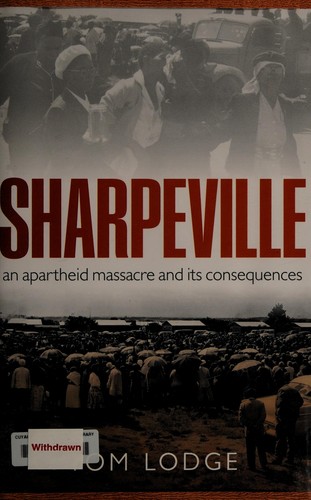
Tom Lodge · Buy on Amazon
"When I was writing about Peterloo, I wanted to look at other instances of massacres. Sharpeville was the obvious one. The Soweto uprising in 1976 is probably more famous now, but the Sharpeville massacre was at an earlier stage, when new apartheid policies were being brought in after 1958. There were protests in many parts of South Africa. Sharpeville was a township some distance south of Johannesburg, not too far from Soweto. There was a protest that was essentially against apartheid, but more immediately about freedom of movement and the new pass laws. As in Amritsar, the authorities had banned political gatherings and what was happening on the day of the Sharpeville massacre was that pan-Africanist leaders, who were a part of the resistance movement, were marching to the police station—without weapons and completely peacefully, with nothing more than umbrellas—in order to surrender themselves for arrest. “In democracies, you get heavy security, you get repression, but you don’t normally get outright massacres except as some kind of freak event.” They were doing that because, as at Amritsar, they wanted to bring the economy to a halt. Following Gandhi ’s ideas, they wanted mass arrests which would then mean that people couldn’t work, and that the economy would grind to a halt, demonstrating how the pass laws made ordinary life impossible. The authorities at Sharpeville opened fire on people as they were coming peacefully to surrender themselves, because they didn’t know how to handle the situation. Authorities have a mentality that it’s either obedience or it’s rebellion. It’s actually extraordinarily difficult for them to cope with non-violent resistance, where resistors are willing to break the law and suffer the consequences peacefully, but refuse to rebel or do any of the things that rebellious natives are supposed to do. So not consciously, but in effect, the authorities had to fire on the gathering, to turn it into the sort of angry mob which they then knew how to police. It’s always extremely difficult when people resist peacefully and non-violently and when they are clearly the people of the area, the citizens, and not outside agitators. It makes it hard for the authorities to use the usual weapons of force or of isolating or demonizing or caricaturing people. We’ve got that in Hong Kong now. There are vast numbers of people protesting week after week, month after month, on an absolutely huge scale. They are demonstrating that the Chinese government doesn’t have any real moral authority in Hong Kong. The Chinese authorities constantly home in on the violence, because they simply don’t know how to cope with a large, open, mass movement. And if the protestors can manage to continue a broad-based movement that avoids at least violence against people, it’s going to be very difficult for the authorities to regain any genuine control of Hong Kong in the long-term. I’m a strong believer in the power of non-violence. Any gains that violence makes tend to be short-term and illusory. The gains of non-violence, of mass movements, may not be so visible at the time, but they are more enduring. Protestors can very rarely outfight armed and organized authorities, but large numbers of people can outmanoeuvre small numbers of people in power. Violence tends to play into the hands of authorities, whereas mass, peaceful, sustained resistance is usually met by concessions sooner or later. Yes, in the short-term it was a defeat for the protestors. People on the left have said it demonstrated that the workers should have been better organized, they should have been armed, that they should have fought back. On the other hand, if you look at how impossible the demand for any kind of democracy was in 1819, they were never going to get what they wanted. The really significant thing is what happened a political generation later. When, in 1832, there was another mass movement for the vote—okay, it was middle class-led and the bill they eventually gained was only a very modest increase in the vote for propertied people—but it was the foot in the door that, in turn, made later changes possible. In my view, the 1832 Reform Act went through because the authorities knew they could not risk another Peterloo. They could not again use armed troops on unarmed crowds. In the end the House of Lords backed down and the first Great Reform Act went through. It was overwhelming and very general—from radicals through Whigs to what we might now call moderate or one-nation Tories. Essentially the government and its loyalist supporters—who were quite numerous but quite hard-line—were on one side and everybody else was on the other. The outrage over Peterloo played to a far bigger political constituency than the movement for radical reform. So that was the long-term effect of it."

Simon Schama · Buy on Amazon
"Citizens is the work that spoiled the party in 1989, the Bicentennial of the French Revolution. In it, Schama argued that the French Revolution was not the great festival of human liberty that everybody was celebrating. He got a huge amount of stick. In fact, tucked into the back of my copy of Citizens, I have an article by Schama from the Sunday Times , written at the end of the year, where he describes the reaction to his book. It begins with, “If I wanted a quiet life, obviously I shouldn’t have written Citizens . A book tactless enough to offer a critical view of the French Revolution in the year of the Bicentennial was bound to attract its fair share of criticism, but I was taken aback by the eagerness with which it was seized as a bludgeon by the warring parties of revolutionary history to beat each other (and me) over the head…History isn’t just a stroll down memory lane.” And that was a risk, that the Bicentennial would be a stroll down memory lane, celebrating all the values that people wanted to celebrate and reading them back into the French Revolution. “Authorities have a mentality that it’s either obedience or it’s rebellion. It’s actually extraordinarily difficult for them to cope with nonviolent resistance” What Schama demonstrates is that while the French Revolution was supposed to be about the rise of the bourgeoisie, of what was rational, what was democratic, what was modern, it was actually the monarchy that was modernising in the 1770s and 80s. It was the French monarchy that was attempting to reform its tax system, its revenue, its government, trying to create a modern bourgeois state, to tap into the wealth of the economy in a much more rational way. But the political price and the taxes that people had to pay were simply intolerable. In a way, the French Revolution can be seen as an idealistic, nationalistic, romantic reaction against a modernizing project from above. It’s not just out of control, sometimes it’s in the control of people who want bloodbaths and massacres and civil wars. That’s the irony of it. The way I was taught French Revolutionary history was essentially that it was about modernizing, it was about the working class, it was about progress and rationalism and democracy and so forth. There were, understandably, excesses, but they had a lot to contend with. There was a certain amount of over-enthusiasm, and one or two wrong political lines taken, but that was understandable. That whole narrative is exposed by Schama as a fantasy. He shows that the dramas, the murders, the civil wars, the bloodbaths were actually central to the drama. When, for example, Charlotte Corday stabs Marat, the Jacobin leader, in his bath, it’s been portrayed as a betrayal of the Revolution by an angry woman with an axe of some sort to grind. In fact, she reads a list to him, while he’s in the bath, of yet another list of plotters against the regime of the Terror that he stands for. He simply says, ‘Yes, I’ll have them up on the guillotine in a few days’ time’ and then she stabs him to death. The right of government to practise terror is absolutely central to what the Revolution is about. In his conclusion, Schama talks about how the bourgeoisie were actually the principal victims of the French Revolution. The Atlantic economy, the textile districts, the ports, the economy of Lyon were all devastated by what happened. He says the Revolution created the judicial entity of a free citizen, some idealized person who ought to exist but didn’t. No sooner had this hypothetical free person been invented than his liberty was circumscribed by the police power of the state, and this in turn created the militarized nationalism that gave you Napoleon and dictatorship, the war against all Europe and so forth. It was this romantic, militarized nationalism that was the legacy of the French Revolution. It was not an unintended consequence. It was the heart and soul of the Revolution. Schama sees the French Revolution as a kind of leftist populism. These days reading Slavoj Žižek, the Marxist writer, resurrecting the old, repulsive apologies for revolutionary violence is quite extraordinary. I don’t know how somebody, in this day and age, can see the massacres, the murders, the civil wars of the French Revolution as some regrettable but necessary stage in a path to order and progress. It’s completely beyond me. We need to be on our guard against that kind of thing and I think Schama is on the side of citizenship and democracy, not Žižek. Obviously all major historical changes and upheavals are going to involve conflict and protest and repression and struggle and there will probably be violence somewhere along the way. But I think what is achieved will always be achieved in spite of the violence and not because of it. If anybody is telling you that in order to achieve something good and democratic you have to use means which are evil and undemocratic, I would just stop and pause for a very, very long time. I think the idea that one person’s violence is somehow necessary to everybody is extremely dangerous. I can’t think of a single instance, actually, where I would go along with that other than, perhaps, resistance to enemy occupation. Maybe in utterly impossible conditions like that."

Émile Zola · Buy on Amazon
"Novels are important, and I’ve been a bit too academic in my choices so far. I went for Germinal , by Émile Zola. During the Third Republic, Zola wrote a 20-novel cycle about the French Second Empire, so he’s looking back a generation. It’s called the Rougon-Macquart cycle and Germinal is the most famous. It was an Open University set text for decades. It’s about a miners’ rebellion in the 1880s in France. It’s an amazing novel because Zola pulls absolutely no punches at all. He looks from the mine owners, to the more privileged miners, right down to the children working in the mines who are abused by people who might be trade unionists. It gives an extraordinary picture of the mine as this almost inhuman, machine-like development devouring the souls of everybody who works in it. We know from Orwell’s descriptions what a completely different world mining is. Zola went to the coalfields in northeast France and went down a mine. He experienced a miner’s strike. So when he’s writing about it, it has the fine-grained feel of ordinary life, which is very far from the historical generalities that historians tend to talk about. I’ve tried to recapture some of that in writing about Peterloo, the small detail of the bottom of the heap, as well as the grand generalizations. Some of his portraits of individuals, of the workers, of the experience of going down a mine are quite vivid and extraordinary. “I’m a strong believer in the power of non-violence. Any gains that violence makes tend to be short-term and illusory” It’s called Germinal from the month of ‘Germinal’ in the French Revolutionary calendar. It’s the spring, the sowing, but he turns that around. The workers are appallingly badly treated. They behave with great resentment and violence as a result, and the entire strike [SPOILER ALERT] ends in disaster. An anarchist saboteur, a nihilist, sets charges and blows up the mine and it collapses into a huge hole. At the end of it the original character who is our eyes and ears—the person who walks into the area and gets the job in the mine and finds out about it—is almost the only person to survive. And yet Germinal has been interpreted as a politically optimistic novel. Towards the end of it Zola writes that the miners, ‘passed by in a constant stream like a routed army forced to march and retreat, moving ceaselessly onwards with their heads hung low, filled with a quiet but furious rage at the thought of needing to start struggling all over again, and seek revenge.’ Well, you can read revolutionary pessimism, human pessimism or perhaps revolutionary optimism into that. The final image is the following spring, when flowers spring up in the meadow where the mine has collapsed, to symbolize the endless renewal of the human spirit and the possibility of doing better next time. Again, towards the end, Zola writes, ‘their crumbling society had received another body blow, they’d heard the foundations cracking beneath their feet and felt the first shockwaves of tremors to come, which would grow in number until the whole rotten tottering edifice would come crashing down and disappear into the abyss like La Voreux’ (the mine, ‘the voracious one’.) You can read what you want into that, but it’s an absolutely fantastic portrait of a strike and of a whole society at war with itself. Apart from anything else, Germinal is a great read. What all the books I’ve chosen have in common is that they all spend a lot of time looking at the very significant details. They don’t generalize or theorize. They do have broad visions, they do make broad points, but they do it on the basis of insights into all sorts of tiny, significant, little things that are happening, the human details, the significant details, the images, the pictures. They look at life on a human scale. They look at real things. That’s true of all five of them. Get the weekly Five Books newsletter Four out of the five—with the exception of The Making of the English Working Class— also make a point of looking at the authorities pretty much equally. They analyze the whole thing in terms of the interplay between authority and power and protest and people. It’s the interplay between the two and the detail that makes gripping history and that’s what I’ve tried to do in Peterloo . It’s a very dangerous thing to offer tactical or strategic advice to protesters, not least because the message received would likely be very different from what was sent, even if it was ever heeded. But in all things, it’s important to think of the longer-term, of how this will pan out, of what eventually will provide a solution. What, realistically, will success look like? And then aim for that, thinking long term, doing as little human damage as possible. One massacre, or one episode of unjustifiable violence, might work in the one instance, but it will come back to you 10, 20 times over and hamper whatever it is you’re trying to do in the future. That’s true of authorities or, for that matter, of revolutionary massacres and violence from the bottom. The consequences will be visited on you not just once, but many times over. I think I draw a distinction between conflicts within a state and the use of military force in war or under a military occupation. That’s a different situation. But if you are talking about using violence within a state to achieve long-term political ends, then the long-term damage that does is much greater than the short-term benefits that it brings. Yes, the concentration camps needed to be captured by force, but to slide between things like that and the notion of revolutionary violence is very dangerous. As an anti-nuclear campaigner in the 1970s and 1980s I was influenced by Gene Sharp’s The Politics of Nonviolent Action . It’s an encyclopaedia of historical examples where he argues that it’s essentially the exercise of citizenship and things other than violence that tend to bring about enduring change."