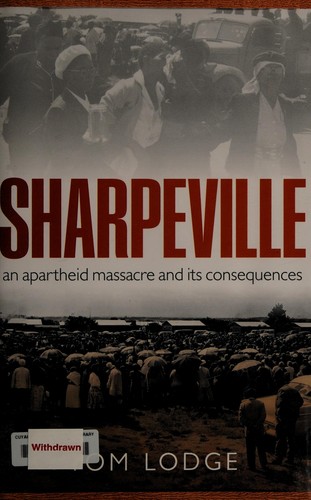
Sharpeville: An Apartheid Massacre and its Consequences
by Tom Lodge
Buy on AmazonA new account of the social and political background to the notorious Sharpeville Massacre of March 1960, which looks both at the sequence of events that prompted the shootings and also their long-term consequences for South African politics, both domestically and in the country's relationship with the rest of the world.
Recommended by
"When I was writing about Peterloo, I wanted to look at other instances of massacres. Sharpeville was the obvious one. The Soweto uprising in 1976 is probably more famous now, but the Sharpeville massacre was at an earlier stage, when new apartheid policies were being brought in after 1958. There were protests in many parts of South Africa. Sharpeville was a township some distance south of Johannesburg, not too far from Soweto. There was a protest that was essentially against apartheid, but more immediately about freedom of movement and the new pass laws. As in Amritsar, the authorities had banned political gatherings and what was happening on the day of the Sharpeville massacre was that pan-Africanist leaders, who were a part of the resistance movement, were marching to the police station—without weapons and completely peacefully, with nothing more than umbrellas—in order to surrender themselves for arrest. “In democracies, you get heavy security, you get repression, but you don’t normally get outright massacres except as some kind of freak event.” They were doing that because, as at Amritsar, they wanted to bring the economy to a halt. Following Gandhi ’s ideas, they wanted mass arrests which would then mean that people couldn’t work, and that the economy would grind to a halt, demonstrating how the pass laws made ordinary life impossible. The authorities at Sharpeville opened fire on people as they were coming peacefully to surrender themselves, because they didn’t know how to handle the situation. Authorities have a mentality that it’s either obedience or it’s rebellion. It’s actually extraordinarily difficult for them to cope with non-violent resistance, where resistors are willing to break the law and suffer the consequences peacefully, but refuse to rebel or do any of the things that rebellious natives are supposed to do. So not consciously, but in effect, the authorities had to fire on the gathering, to turn it into the sort of angry mob which they then knew how to police. It’s always extremely difficult when people resist peacefully and non-violently and when they are clearly the people of the area, the citizens, and not outside agitators. It makes it hard for the authorities to use the usual weapons of force or of isolating or demonizing or caricaturing people. We’ve got that in Hong Kong now. There are vast numbers of people protesting week after week, month after month, on an absolutely huge scale. They are demonstrating that the Chinese government doesn’t have any real moral authority in Hong Kong. The Chinese authorities constantly home in on the violence, because they simply don’t know how to cope with a large, open, mass movement. And if the protestors can manage to continue a broad-based movement that avoids at least violence against people, it’s going to be very difficult for the authorities to regain any genuine control of Hong Kong in the long-term. I’m a strong believer in the power of non-violence. Any gains that violence makes tend to be short-term and illusory. The gains of non-violence, of mass movements, may not be so visible at the time, but they are more enduring. Protestors can very rarely outfight armed and organized authorities, but large numbers of people can outmanoeuvre small numbers of people in power. Violence tends to play into the hands of authorities, whereas mass, peaceful, sustained resistance is usually met by concessions sooner or later. Yes, in the short-term it was a defeat for the protestors. People on the left have said it demonstrated that the workers should have been better organized, they should have been armed, that they should have fought back. On the other hand, if you look at how impossible the demand for any kind of democracy was in 1819, they were never going to get what they wanted. The really significant thing is what happened a political generation later. When, in 1832, there was another mass movement for the vote—okay, it was middle class-led and the bill they eventually gained was only a very modest increase in the vote for propertied people—but it was the foot in the door that, in turn, made later changes possible. In my view, the 1832 Reform Act went through because the authorities knew they could not risk another Peterloo. They could not again use armed troops on unarmed crowds. In the end the House of Lords backed down and the first Great Reform Act went through. It was overwhelming and very general—from radicals through Whigs to what we might now call moderate or one-nation Tories. Essentially the government and its loyalist supporters—who were quite numerous but quite hard-line—were on one side and everybody else was on the other. The outrage over Peterloo played to a far bigger political constituency than the movement for radical reform. So that was the long-term effect of it."
Popular Uprisings · fivebooks.com