Rebecca Watson's Reading List
Rebecca Watson is the author of little scratch , which is published by Faber in the UK and Doubleday in the US. She was picked as one of The Observer 's ten best debut novelists of 2021. Her work has been published in The TLS, The Guardian, Granta and elsewhere. In 2018, she was shortlisted for the White Review Short Story Prize. She works part-time as assistant arts editor at the Financial Times and lives in London.
Open in WellRead Daily app →The Best Experimental Fiction (2021)
Scraped from fivebooks.com (2021-04-12).
Source: fivebooks.com

Meena Kandasamy · Buy on Amazon
"Um, actually I think you can use the word play. It’s uncomfortable, but the beauty of what she does is that she takes an incredibly disturbing centrepiece—this abusive marriage—and turns it into a creative challenge, and a performance. It’s fiction, with an unnamed first-person narrator, and the narrator is telling the story retrospectively, about five years after these few months of marriage. It’s about how to tell the story: how do you go back and look at something so invasive, so encompassing, while reclaiming, or asserting, your sense of self. “Experimental writing needs an openness and willingness from a reader, to go beyond what you might be used to” What is the centre of the book is a playfulness about what it is to be a writer, and what it is to live a life—how we write narratives. And she has this very playful voice that shifts and flirts and diverts. It moves in lots of different registers. I don’t think it looks experimental on the page. It’s the shifting register that makes it feel really, really new. Kandasamy studies the different vehicles of how to tell a story. The novel moves between prose poetry, to bits where it’s like a Q&A. The narrator is simultaneously the actor who breaks the fourth wall, and the writer dictating the stage directions. So even though we’re looking at this abusive marriage, most of the time this person is almost testing you to see if she can make you laugh, think, shift your expectations of a ‘victim’. I think we act like there’s more we need from the reader than we actually do. That’s the barrier for people getting into this kind of writing. I think often experimental fiction is used as a warning term rather than as a way of elaborating what the writing is. There is a cost of admission, but maybe that’s only focusing for the first few pages. It’s not yet familiar to you. But each of these books is introducing a world that becomes familiar, and in which you can trust – they have a sound vision. So I think what we’re really talking about is just making the reader spend five minutes getting inside the world, and once you’re inside the world you’re sorted."

Eimear McBride · Buy on Amazon
"I had to look at this again yesterday, because although I have such a vivid recollection of the feeling of reading it, I couldn’t remember anything about it on a line level! I opened it and thought, ‘wow, so this is what it looks like.’ I guess because it’s so voice-led, you completely enter that head. It’s true consciousness. McBride’s really good at, like, skipping to the image of the association—the kind of narrative preamble, or narrative signposting, that writers often give she will skip, not because she’s trying to be cryptic, but because in real consciousness none of those things exist. You’ve instantly leapt to the next thought or sensation. It’s a love story between an 18-year-old girl who just moved from Ireland to London to attend drama school, and the older actor she meets in a pub. They slowly unveil their stories to each other, but both are hiding parts of themselves. Partly it’s about the unknowability of the other, but also the ability to learn so much through love. The lyricism of it is just something else. There’s such a music, such a lilt to it. There’s rhythm and movement to how you read it, any reader would get that. And that’s something incredible to establish. Experimental fiction both points forward and back. We often describe things as new, when they are speaking as part of a tradition. But there is a noticeable newness to this book, and it’s in the deftness of language and the immersion—you feel so entirely in this person’s head whilst also being so clearly told a story. The way she gets inside people’s bodies, and writes sex in such a brilliant, honest and felt way. I think that is genuinely new. And if sex is something that is more instinctive, relies more on sensation and the unifying of desire and the body, then yes, surely experimental fiction serves that best: like sex, it defies a linear, straightforward recounting. I actually prefer The Lesser Bohemians , although I’m not sure why. A Girl is a Half-Formed Thing is darker in some ways. But I found that the music of The Lesser Bohemians worked best for me. I mean, they’re both brilliant, but I felt that the emotion and music was more intense in this."

Virginia Woolf · Buy on Amazon
"Yes, there’s a split over whether it was finished or not. She never did her final revise of it, and often she did do quite a lot of work in that act of revision. But it doesn’t read like something unfinished. It’s very, very accomplished, and one of my favourite of Woolf’s books. It takes place at a village pageant in the summer preceding World War Two. I read it as a teenager and was so obsessed with it. I remember getting into an argument with a literature professor at an interview for a university that I very much got rejected from. It was so weird. We both loved Virginia Woolf, but both had very different visions of what that book was. I was young, so sure! I was the naïve one, more likely to be wrong but, at the same time, I remember this man puffing out—because I disagreed with him. What I was making the case for—and what I still agree with—is how obsessed that book is with the idea of individualism versus society, the exhausting nature of being one person whilst also being so recognisably within the midst of a group, connected to other people. Support Five Books Five Books interviews are expensive to produce. If you're enjoying this interview, please support us by donating a small amount . I remember him being like, ‘it’s about the war!’ And I was like, I get that it’s about the war, but it’s also about these other things. We just couldn’t connect. I mean, it is about the war, to be fair—so much of it is about the burden of retrospect. It’s just before the war arrives, but they know the war is coming. Another war’s happened already. And so everything’s laced with this very aggressive, violent imagery. There’s something simmering. It’s all about living in what seems a simple present tense that’s about to combust into historical significance. So there’s this village pageant, and there are loads of silly characters who obsess with their hats and all these stupid everyday societal hang-ups. And they sit in an audience and watch a play. So this play comes into the text and you read the script as it’s being performed and get the audience’s reaction. We see the different levels of performance, and how existing in society is, on one level, feeling watched and scrutinised."
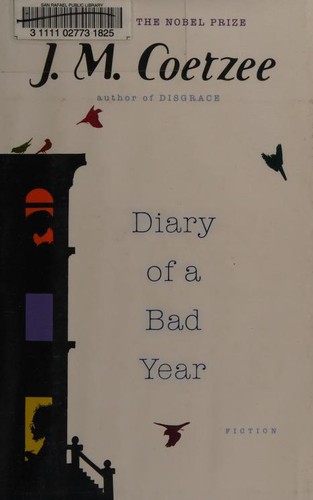
J M Coetzee · Buy on Amazon
"It begins with the page split into two, horizontally. We have on the top an extract from a book by an old Australian writer, called Strong Opinions . It’s political essays, stuff like that. That’s the top narrative, and initially the bottom narrative is him, first-person, his life as he’s writing the manuscript. Quickly he meets a woman called Anya, in the laundry room of his apartment building. He’s very struck by her, she’s very attractive, she’s a lot younger… there’s something about her that intrigues him. So he asks her to start typing up his manuscript for the book, the first narrative. Suddenly she appears as a third column, or rather a horizontal division. So now you have the book, his first-person, her first-person. And each informs the others. So you see two perspectives – how she sees him, and how he sees her. He embroils her in his life, but she also embroils herself, because she and her boyfriend start to plot how to insinuate themselves. He’s got a lot of money—maybe they could get some of his cash. “It sounds very complicated, but it’s incredibly easy to read, and it’s very profound” You have these interfering narratives, and you can read across the double spread of the page, or down each page. Depending on which way you do it, you learn different things about each of the segments. That sounds very complicated, but it’s incredibly easy to read, and it’s very profound. This guy’s dying, so it’s about being a writer, how to make meaning, and the difference between the creator and the product—seeing this fallible human being behind the authoritative essay. It does also have a very propulsive story. A classic narrative, of someone thinking they are intentionally bringing someone into their life, and at the same time they are being undone. Who has the power? I think that is often the reader’s fear. I always want to say to people: ‘Hey, don’t worry. Just trust yourself.’ That’s what I say to myself, sometimes. Readers often fear they don’t have the authority to tackle a text. Or just see it as something they have to ‘tackle.’ But a writer doesn’t write something with an authoritative insistence of how it should be read. They lay out a path of how to read it, and you as a reader will follow that – or make your own. little scratch , particularly, exists to be read in different ways, and the reader is meant to make their own choices. Depending on what choice they make, they get different things. That’s the same for Diary of a Bad Year ; those decisions are important, but they’re meant to be fun. They’re not meant to be a stress. The reader should remember that once the book is in their hands, they’re the authority. It’s their reading experience, they’re in control. I don’t know. I didn’t think it was strange. I mean maybe, in as much that it’s kind of crazy that it came out of someone’s head. But who are we to say what a writer will write next? And why would we want that to be predictable? The novel is exciting in its formal invention, but as a story in its own right, it’s interesting. The form is a way of getting you closer to the story. It’s not an indulgent thing. I don’t know who wrote that, but I do think reviewers can be very interested in separating the form from the rest of the book, when in any successful piece of experimental writing the form is completely engaged in the story. It has purpose."

Jenny Offill · Buy on Amazon
"It’s quite a hard book to summarise, because it’s so much about those myriad moments that make up a life, or relationship, or anything. Firstly, it’s really funny. People don’t talk directly enough about how funny Jenny Offill is. It’s essentially about a test of marriage, a kind of imperfect love story. Right? It’s both very sad and very funny. You have these moments between the fragments to take a break, just to laugh, or absorb it. She takes the ordinariness of life and she makes it mean something. I think she proves why every moment of life can have significance, and how the quiet moments of existence contribute to our sense of self. Last year, when her new book Weather came out, there was a picture of the fragments of Weather , how she’d rearrange them. Seeing that patchwork was amazing, because you can forget when a product is complete that so much work goes into the order of these things. Even just choosing the right ones… there will be so many rejected fragments. It affirmed the level of precision with which she works in order to create these novels. Get the weekly Five Books newsletter She’s said that the gaps are moments for the reader to have an imagination. She doesn’t want to fill in the gaps. Because in doing so you eliminate or pin the story down. By fragmenting you allow the reader to immerse themselves in, be part of the world in a more intense way. The absences give the created world a greater imaginative potential. I don’t know. I think that the fact that little scratch was published and accepted and treated as a novel speaks to a healthy publishing culture. Certainly there’s more space for it and, I think, more commercial viability, which is the key sign that people are open to it. There’s still a lot of pushback. There’s still a strange treatment of experimental writing. And, you know, when I see people talking about my book, it’s the first thing they do, right? They say, ‘okay, guys, this looks weird, but don’t worry, you’re going to be able to get into it.’ There’s an apology at the beginning. I find that strange. ‘Experimental’ has taken on this negative association. It’s something that we have to forgive, that you can get something from despite it. I think that kind of negates the whole purpose of this type of writing, which is to help immerse the reader further in the story. It serves a purpose. It’s there to do something beyond looking funny. It’s meant to open up new possibilities. I find it sad that it is often seen as a boundary. We are still very obsessed with keeping that boundary, putting the signpost up. I think we need to work on that. Maybe? I think some readers fear they are being pushed away, or that it’s coded for a certain level of education, rather than for a general reader—which I don’t think is true. But I think what you were saying earlier about being scared of not approaching the text ‘right’—those kind of insecurities, it’s not that formal or informal education helps you read better, but that maybe it gives you a level of self-trust. Sometimes we need an ego to trust ourselves as a reader. But it’s too complicated to make generalisations. Some think ‘experimental’ fiction is elitist, like it’s trying to shut out a certain reader. But all I can say for myself is that I’m writing for all readers. And I hope little scratch will show some readers who might feel hesitant over formally inventive writing, that shaking up the page can sometimes be a more natural way to read. It might bring you closer, rather than push you away."