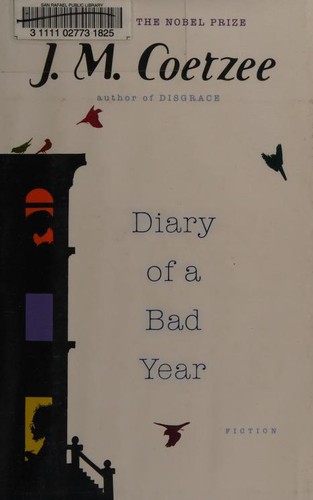
An utterly contemporary and deeply thought-provoking novel which addresses the profound unease of countless people in modern democracies around the world. An eminent, seventy-two-year-old Australian writer is invited to contribute to a book entitled Strong Opinions. It is a chance to air some urgent concerns. He writes short essays on the origins of the state, on Machiavelli, on anarchism, on Al-Qaida, on intelligent design, on music. What, he asks, is the origin of the state and the nature of the relationship between citizen and state? How should the citizen of a modern democracy react to the state’s willingness to set aside moral considerations and civil liberties in its war on terror, a war that includes the use of torture? How does the state handle outsiders?…
"It begins with the page split into two, horizontally. We have on the top an extract from a book by an old Australian writer, called Strong Opinions . It’s political essays, stuff like that. That’s the top narrative, and initially the bottom narrative is him, first-person, his life as he’s writing the manuscript. Quickly he meets a woman called Anya, in the laundry room of his apartment building. He’s very struck by her, she’s very attractive, she’s a lot younger… there’s something about her that intrigues him. So he asks her to start typing up his manuscript for the book, the first narrative. Suddenly she appears as a third column, or rather a horizontal division. So now you have the book, his first-person, her first-person. And each informs the others. So you see two perspectives – how she sees him, and how he sees her. He embroils her in his life, but she also embroils herself, because she and her boyfriend start to plot how to insinuate themselves. He’s got a lot of money—maybe they could get some of his cash. “It sounds very complicated, but it’s incredibly easy to read, and it’s very profound” You have these interfering narratives, and you can read across the double spread of the page, or down each page. Depending on which way you do it, you learn different things about each of the segments. That sounds very complicated, but it’s incredibly easy to read, and it’s very profound. This guy’s dying, so it’s about being a writer, how to make meaning, and the difference between the creator and the product—seeing this fallible human being behind the authoritative essay. It does also have a very propulsive story. A classic narrative, of someone thinking they are intentionally bringing someone into their life, and at the same time they are being undone. Who has the power? I think that is often the reader’s fear. I always want to say to people: ‘Hey, don’t worry. Just trust yourself.’ That’s what I say to myself, sometimes. Readers often fear they don’t have the authority to tackle a text. Or just see it as something they have to ‘tackle.’ But a writer doesn’t write something with an authoritative insistence of how it should be read. They lay out a path of how to read it, and you as a reader will follow that – or make your own. little scratch , particularly, exists to be read in different ways, and the reader is meant to make their own choices. Depending on what choice they make, they get different things. That’s the same for Diary of a Bad Year ; those decisions are important, but they’re meant to be fun. They’re not meant to be a stress. The reader should remember that once the book is in their hands, they’re the authority. It’s their reading experience, they’re in control. I don’t know. I didn’t think it was strange. I mean maybe, in as much that it’s kind of crazy that it came out of someone’s head. But who are we to say what a writer will write next? And why would we want that to be predictable? The novel is exciting in its formal invention, but as a story in its own right, it’s interesting. The form is a way of getting you closer to the story. It’s not an indulgent thing. I don’t know who wrote that, but I do think reviewers can be very interested in separating the form from the rest of the book, when in any successful piece of experimental writing the form is completely engaged in the story. It has purpose."