Mphuthumi Ntabeni's Reading List
Mphuthumi Ntabeni is a South African novelist and book critic, author of The Broken River Tent (2018) and The Wanderers (2021).
Open in WellRead Daily app →The Best African Contemporary Writing (2023)
Scraped from fivebooks.com (2023-12-19).
Source: fivebooks.com

Tayeb Salih and Denys Johnson-Davies (translator) · Buy on Amazon
"As I mentioned, I chose that book because I feel that African contemporary writing is in an age of restless migration to the North. You know, those stories of how people go to the North for different reasons: economic, political upheavals, all those things, and the issues migrants to the West are confronted by. Almost all the themes that he put there are what most writers at this particular moment are talking about. You can read Abdulrazak Gurnah , who won the Nobel Prize in Literature : Most of his themes are based on that. It’s as if he is haunted by the ghost of Salih. Then you can go to Chimamanda Ngozi Adichie , from Nigeria. It’s a very popular genre now, but I found that Tayeb Salih was the one who established it, especially from the African perspective. Oh, it’s a very beautiful book because it’s poetic also. Another thing that I complain about most of the time, because I read a lot of African writing, is that most writers don’t pay enough attention to the language. He does. He pays a lot of attention. His prose has a quiet wisdom with tinges of poetic lyricism. I love that about his writing. Mustafa, yes! I think there was an element of autofiction to the book because Salih himself worked in the UK for the BBC for some time. He always felt he lent his experiences to his protagonists. When the narrator comes back home, he finds that as much as he misses his culture, he can see how much he doesn’t fit into that culture anymore because he stayed too long in the West. But then, when he goes to the West, he finds that culturally and religiously he doesn’t fit there, either. There are also the elements of xenophobia and so much difficulty. Initially, when he’s undocumented, he can’t get a job. It’s all the things that we’re experiencing most of the time, as Africans, when we go to Western countries. I mentioned Paperless , by Buntu Siwisa: it goes into depth on that topic."

Tembeka Ngcukaitobi · Buy on Amazon
"I don’t want to call them biographies because they are too short. Let’s call them ‘personalised histories.’ He writes the personalised histories of the first Black lawyers, who he claims were founders of constitutionalism and the universal Bill of Rights in South Africa. He showcases how they were affected by their naivety of thinking this would deliver universal justice, political and otherwise during the British colonial era of our history. They were trained overseas in the West, and they came back with the notion that they were going to change things because of their misconception, despite everything, that the British Empire had respect for the law. They had a rude awakening. They came to understand that not only did the British not respect the law when it came to people of colour, they manipulated it. They only respected it when it supported their purposes. So they were always kicking the can down the road. It’s so painful when you read about their personal histories because most of them died in shame. Out of the six of them, five died as alcoholics because they couldn’t even make money as lawyers. There was just no space for them as Black people in the system. The system just couldn’t accommodate them. As a result, one of them, Henry Sylvester Williams, who was Caribbean, chose to go back to England rather than stay in South Africa because he could see that there was no way he could practise law and pursue justice. In the end, all of them came to the realisation that practising law where there’s no justice is pointless. This fight has to be political rather than legal. This is why they became foundational members of what became known as the ANC, the African National Congress, the current rulers of South Africa. Yes, for me, historically, it is relevant. I suppose it is also relevant, even today, because Tembeka Ngcukaitobi is, I think, the youngest senior counsel in the land. His success has been prominent, but he himself is an exception to the rule. For most of these professions, the culture is still not accommodative to the Black people. But I think most people will argue that things are much, much better than they were in the late 19th and early 20th century. I hear the book is being turned into a TV series. It’s going to be interesting to watch that."

Etienne van Heerden · Buy on Amazon
"Yes, it was translated into English last year. There is something that we call here the UJ Prize for Translation, which is awarded by the University of Johannesburg. The translator, Henrietta Rose-Innes, won that prize this year. It’s quite exciting. The genre of this book is the most popular one at the moment. Now, let me first make you understand what kind of a genre it is. There is this thing that is happening now, especially in South Africa, whereby stories are also set in some global cities outside of South Africa. And we’re no longer only looking west; apparently, we’re also looking east, so there are a lot of stories now that are set in China. This one is part of that movement: It’s partly set in China, and generally set in South Africa. The most popular one in this genre at this particular moment is C. A. Davids’s How to Be a Revolutionary . I’m sure you would have heard of it because it’s published in the UK by Verso. It has won quite a lot of prizes in South Africa: the Sunday Times Literary Award and the UJ Prize for Writing in English. But what I like more about Etienne Van Heerden’s one, A Library to Flee , is that I find it’s a little bit more nuanced and the prose has got more finesse to it. It follows a Black woman who comes across some kind of data harvesting business. She realises that her father is involved in this, and there’s some corruption because it involves the government during the Zuma years of our presidency. It follows the sniff of this corruption to China, and that’s where tragedy strikes. What I love most about it also is that it’s got a lot of diverse characters: a Xhosa woman, an Afrikaner man, an English man. It mixes and intermixes these characters together and it all comes to a very beautiful ending – I can’t mention it, but it’s plotted very well. It’s got a very surprising ending. It’s a thick book, but actually, by the end, it rewards your patience. Yes, it’s a very long book. It helps that the prose is written in pleasing poetic flashes, so you hang in there. I can understand how readers might be discouraged because it’s got a lot going on initially, but if you have patience, the plot has got a very pleasing, rewarding end, where it brings everything together. It mixes a lot of genres. It’s a spy novel also; it eavesdrops on history. It’s got a lot of things going on. And then, it’s contemporary in the sense that it interrogates how AI will affect us, especially security clusters because of the cameras on the streets, the cameras in shopping malls. Also, it showcases – it’s almost a legal drama in itself – arguments about how ethical data harvesting itself is."
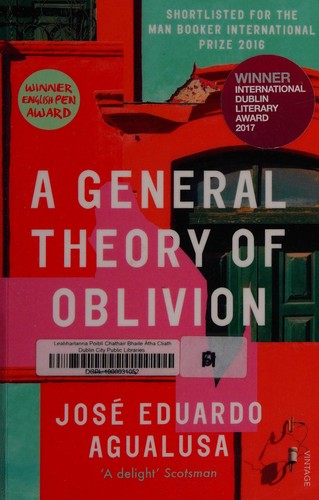
Daniel Hahn (translator) & José Eduardo Agualusa · Buy on Amazon
"Yes, and it also won the International Dublin Literary Award in 2017. This book is brilliant. It’s set during the time when Angola was getting its independence. One woman locks herself in a room and then she looks outside at the world as she meditates on the past, on the present, and on the future. That’s the plot, but the way it is written, in a wonderful stream of consciousness, you will not believe. And what she does is she plants vegetables on the balcony. She never goes out of the room. She never goes anywhere. She’s just waiting for everything to subside. Coming from the years of lockdowns due to the pandemic we relate very easily to her condition. Initially, why I chose the book is because I wanted to introduce your readers, and even South African readers, to Lusophone literature because it’s not very popular here. Most people don’t know Portuguese literature and I think it’s one of the best books of Luso literature. And then, the writing style of it – it’s so varied. Sometimes she writes journals; sometimes she writes letters. Sometimes it’s written in the first person; sometimes in the third person. I love the third person more because of the beautiful remove on it. She suspects she’s not going to make it. You are rooting for her, but she does not care if she’s going to make it or not. She’s okay with whatever happens, which is where the ‘oblivion’ in the title comes from, I think. Oh yes, and not just Angolan history, also Portuguese history. She tries to show how the mess she’s trying to avoid came through the colonial history itself. But she also does not absolve the cruel actions of Angolan comrades who worked for the liberation, when they betrayed the people as they started to imitate their colonial masters. It’s a beautiful book. It’s what I would call apocalyptic literature, about the end of the world. It’s got a surprising ending, also, that has a metafictional twist to it. I was trying to find a way of mentioning it without spoiling it. I decided that if I mention it, it will spoil it, but throughout the book, that is the thread that the book is pulling on. It gets tighter with every chapter, and it’s just so surprising at the end. It’s funny because I usually don’t care about plots, but the books I’ve chosen for you are all very plot-driven. They’re also written in beautiful prose, which is my minimum requirement for enjoying a book. Ngcukayitobi, for instance, especially in his latest book, The Land Matters, comes close to the demands of James Baldwin that the prose must be clean as a bone. His thinking is very clear, which must be why he’s so successful as a lawyer."