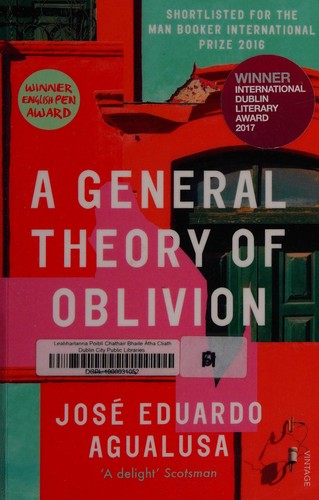
A General Theory of Oblivion
by Daniel Hahn (translator) & José Eduardo Agualusa
Buy on AmazonThis is the brilliant new novel from the winner of the Independent Foreign Fiction Prize. On the eve of Angolan independence, Ludo bricks herself into her apartment, where she will remain for the next thirty years. She lives off vegetables and pigeons, burns her furniture and books to stay alive and keeps herself busy by writing her story on the walls of her home. The outside world slowly seeps into Ludo's life through snippets on the radio, voices from next door, glimpses of a man fleeing his pursuers and a note attached to a bird's foot. Until one day she meets Sabalu, a young boy from the street who climbs up to her terrace.…
Recommended by
"Yes, and it also won the International Dublin Literary Award in 2017. This book is brilliant. It’s set during the time when Angola was getting its independence. One woman locks herself in a room and then she looks outside at the world as she meditates on the past, on the present, and on the future. That’s the plot, but the way it is written, in a wonderful stream of consciousness, you will not believe. And what she does is she plants vegetables on the balcony. She never goes out of the room. She never goes anywhere. She’s just waiting for everything to subside. Coming from the years of lockdowns due to the pandemic we relate very easily to her condition. Initially, why I chose the book is because I wanted to introduce your readers, and even South African readers, to Lusophone literature because it’s not very popular here. Most people don’t know Portuguese literature and I think it’s one of the best books of Luso literature. And then, the writing style of it – it’s so varied. Sometimes she writes journals; sometimes she writes letters. Sometimes it’s written in the first person; sometimes in the third person. I love the third person more because of the beautiful remove on it. She suspects she’s not going to make it. You are rooting for her, but she does not care if she’s going to make it or not. She’s okay with whatever happens, which is where the ‘oblivion’ in the title comes from, I think. Oh yes, and not just Angolan history, also Portuguese history. She tries to show how the mess she’s trying to avoid came through the colonial history itself. But she also does not absolve the cruel actions of Angolan comrades who worked for the liberation, when they betrayed the people as they started to imitate their colonial masters. It’s a beautiful book. It’s what I would call apocalyptic literature, about the end of the world. It’s got a surprising ending, also, that has a metafictional twist to it. I was trying to find a way of mentioning it without spoiling it. I decided that if I mention it, it will spoil it, but throughout the book, that is the thread that the book is pulling on. It gets tighter with every chapter, and it’s just so surprising at the end. It’s funny because I usually don’t care about plots, but the books I’ve chosen for you are all very plot-driven. They’re also written in beautiful prose, which is my minimum requirement for enjoying a book. Ngcukayitobi, for instance, especially in his latest book, The Land Matters, comes close to the demands of James Baldwin that the prose must be clean as a bone. His thinking is very clear, which must be why he’s so successful as a lawyer."
The Best African Contemporary Writing · fivebooks.com