Mark Wolverton's Reading List
Mark Wolverton is an American science writer. He is the author of Nuclear Weapons ; Burning the Sky: Operation Argus and the Untold Story of the Cold War Nuclear Tests in Outer Space ; A Life in Twilight: The Final Years of J. Robert Oppenheimer ; The Depths of Space: The Story of the Pioneer Planetary Probes ; and The Science of Superman . He also writes widely on the history of science and technology for a variety of magazines.
Open in WellRead Daily app →Books about J Robert Oppenheimer (to Read After the Movie) (2024)
Scraped from fivebooks.com (2024-08-11).
Source: fivebooks.com
Kai Bird & Martin Sherwin · Buy on Amazon
"My first thought when I heard that Christopher Nolan was doing a movie about Oppenheimer was, ‘Wait a minute, Chris! You didn’t call me? What is this? You’re not using my book?’ But yes. American Prometheus by Bird and Sherwin is the gold standard for books about Oppenheimer. It’s the definitive Oppenheimer biography—and I say that as the author of one myself."
Mark Wolverton · Buy on Amazon
"He basically stayed at the Institute for Advanced Study in Princeton and did a lot of speaking around the world. He was sort of an elder statesman of science but he also was very careful not to get too publicly involved with policy. He would be asked sometimes by reporters, ‘What do you think about this latest thing with the hydrogen bomb or these disarmament talks?’ And even though he would definitely have opinions on it, he would say, ‘I can’t really comment on that, because I’m too far from the center of events now.’ He just lay low and lived out his life. He was destroyed by the security hearing, as we see in the movie, but maybe not quite as much as some people thought. One thing I think comes out in the movie is that he did have something of a martyr complex. That was also there in his later life. I think Einstein just had such a special status—and had had it for so long. In some ways, he was immune from being canceled (as we’d say nowadays) like Oppenheimer was. One thing that’s tragic about his later years is that Oppenheimer was doing really interesting, valuable research before the Manhattan Project. On black holes, and so forth, as you see in the movie. He dropped all of that for the Manhattan Project. He could have picked that up after, especially after he was out of government and he no longer had those responsibilities. But he never did. When I was researching my book, I talked to people like Freeman Dyson, who knew him. Dyson once asked Oppenheimer, ‘You did all this great stuff. Why don’t you get back into it? Why don’t you do more of that?’ But he just didn’t seem interested in doing it anymore. Maybe because he was just so demoralized. But he could have. He could maybe have won the Nobel Prize if he had."
Robert J. Sawyer · Buy on Amazon
"Robert Sawyer is a very well-known science fiction writer. This book came out a few years ago and it traces Oppenheimer’s history. For a lot of it, it’s almost straight history, although dramatized, because it’s a novel. But then, after the war and the atomic bomb, it takes a left turn into an alternate path that might have occurred, building on some things that they had discovered during the Manhattan Project. Because a lot of the research that had been done leading up to the atomic bomb, and that Oppenheimer had been working on, and Enrico Fermi and so forth, was about solar and stellar physics. And without giving too much away, they discover some disturbing things that are going on…and the course of Oppenheimer’s life takes a different turn. It’s extremely well researched and very accurate scientifically. It’s just a great book for anyone interested in Oppenheimer. In an alternate universe, this is maybe how Oppenheimer turned out."
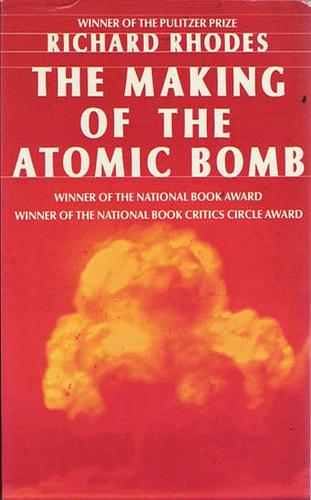
Richard Rhodes · Buy on Amazon
Richard Rhodes · Buy on Amazon
"Yes, I’m cheating a little with the dual choice, but I think it’s appropriate because these are really two volumes of a larger work. It’s the seminal history of nuclear weapons from their beginnings in early 20th-century physics through the development of the hydrogen bomb and beyond."
William Lanouette & with Bela Silard · Buy on Amazon
"He’s a minor character in the movie but a major force in starting the whole atomic bomb effort. He was really instigator of the letter that was sent to Roosevelt, that started the Manhattan Project. He and Edward Teller went to Einstein and convinced him to put his name on this letter. He was such an interesting and eccentric character. He did not have a conventional career, like scientists usually do. He never really had a particular place that he settled. He was always very peripatetic. The legend about him is that he always kept two packed suitcases. He was a refugee from Europe, so that experience, I think, affected him. Genius in the Shadows is really the first full biography of him that I had encountered. Szilard was very politically active. We see this in the Oppenheimer movie: he’s the one with the petition, trying to get the demonstration of the bomb. He was a gadfly. He was somebody who was always going against the grain, annoying people, but also making them think about things. He always had out-of-left-field ideas, but very interesting ones. Szilard was distraught by nuclear weapons. He fought to stop the use of the atomic bomb on Japan. He became very, very involved in the anti-nukes movement. Probably more than anyone else, he was the one who saw the definite damaging potential of them and what could happen. He predicted that there would be an arms race—many of the things that he predicted have come true. And he was so disillusioned by it all that in his later years, he switched from physics to molecular biology. I think it would have, but maybe a little bit later. After fission was discovered, everyone in the physics community knew was going on, and knew the potential of it. And of course, since that happened in Germany, everyone was worried about the Germans getting the bomb first. So I think even without Szilard pushing for it, it would have would have gotten done. Maybe a little bit later, maybe too late for us. And of course, Szilard really regretted his role in that, in getting it started. That led, in later life, not so much to guilt, but feeling responsibility for it—he was trying to offset that."
The History of Physics (2024)
Scraped from fivebooks.com (2024-05-14).
Source: fivebooks.com
Marcia Bartusiak · Buy on Amazon
"This book covers a lot of ground. It’s about early 20th-century astronomy, mostly in America, and Edwin Hubble and how he discovered the expanding universe. She also traces everything leading up to that discovery. There was a big debate in the 1920s about whether galaxies were just nebulae, and part of our own galaxy, or if they were actually completely separate, which is what they turned out to be. She describes this in her book, and I also mention it mine. There was a ‘Great Debate,’ as they called it, between Harlow Shapley and Heber Curtis about this issue. It was like a softer, less hostile version of the debate that I describe in my book . “I’m very drawn to books with strong narratives and strong characters” The thing that I like about this book is that she really humanizes all the scientists, and the research too. By doing that, she provides a fascinating insight into how the scientific process works. She shows how pioneering it all was at the time, because they just had basic tools. They had telescopes and spectrographs, but nowhere near what we have now. The fact that they were able to gather so much information and come to all these conclusions is a fascinating story. I love her writing, too. There’s a very humanistic quality to it, I would say. There’s a humor to it. It’s not dry at all. You always get the feeling she’s talking about real people who have real problems like the rest of us and yet they persevered and accomplished these amazing things. When you read a book sometimes, you think, ‘Wow, this is so good. I wish I’d written it.’ I had that feeling with this book. I knew I couldn’t write something as good, but at least I could try. The stories are different in a lot of ways, but it was an inspiration for Splinters of Infinity . A bit of both. Originally, I had the idea of doing a book on cosmic rays in general, and the history of cosmic ray research, which is a big subject. It’s been going on for over a century and is still ongoing. But I realized that was going to be a huge project that was going to take a long time. Then the pandemic hit, and everything closed down. I thought, ‘Well, if I’m going to do this, I need to scale it down somewhat.’ And the conflict between Robert Millikan (1868–1953) and Arthur Compton (1892–1962) turned out to be the perfect way into the subject. Just the idea of cosmic rays had a sort of romance and wonder to it. These mysterious things coming from outer space. A century ago, people were wondering, ‘What are these things?’ In many ways, it’s like the way we think about dark matter or dark energy now. We know there’s something there. We don’t quite understand it, but we know that it’s very important. That’s what cosmic rays were 100 years ago. A cosmic ray is basically a high energy particle coming from space. The term cosmic ray is really a misnomer because it implies it’s like a ray of light. This was the core of the argument between Millikan and Compton. Are they rays like photons or light, just energy waves? Or are they actually subatomic particles? They turned out to be particles, which—not to give any spoilers—was Compton’s argument. But when they were first discovered and publicized ‘cosmic ray’ was the term that somebody came up with. It’s been credited to Robert Millikan but other people say, ‘No, Millikan didn’t come up with that word, he was just the first one to really use it widely.’ Whoever coined it, it’s stuck all this time. They’re particles that are always coming in from all different directions and are passing through your body right now. They’re very high energy, but most of the time they don’t do anything. Once in a while they’ll flip a byte inside a chip in your computer, causing glitches. But that’s rare. We still don’t know exactly where they all come from. Which is another thing that drew me to this subject because after all this time, it’s still a mystery. At that time (not so much now), they were really thought to be the key to everything: ‘If we can figure this out, we will know the origins of the universe and its ultimate fate!’ There’s something to that, but it’s a lot more complicated, as we now know. I debated whether to start with that. I wanted something to get my readers into this and also to show the importance of the international nature of science, and how that can be deeply affected by other things going on, like the politics. I also thought that line that Pauli wrote in his letter—’Oh, my God, I had to shake hands with this guy’—was kind of funny. It was a big factor. World War One disrupted a lot of the relationships between scientists. The ideal is that science is a universal thing and doesn’t pay attention to national boundaries. Of course, it doesn’t work that way. From right after the war through the 1920s the Germans were kind of ostracized. Some of them had done war research, but it affected even those physicists who had nothing to do with it. The US also started to have scientists like Millikan and Compton, who were prominent, did important work, and won Nobel prizes . But Europe was still very important, because of quantum physics. You had Einstein , Niels Bohr and all those folks. I think it was in the 1930s that things really began to shift to the United States. We had the Great Depression , but we were still relatively unscathed from the war. We didn’t have Hitler or Mussolini. This is one of the reasons I liked The Physicists, which goes into a lot of detail on this."
Daniel Kevles · Buy on Amazon
"It’s a history book—by a physicist who shifted to doing history. It goes from the early 19th century up to the present (when it was published). It covers how the world wars, especially World War One, affected scientific research and looks at why the centre, especially of experimental physics, shifted to the United States. The book traces all the different threads—social, political, and, of course, scientific—of how physics went from being an outré subject in the 19th century, with only a few fairly eccentric people doing it, to people like James Maxwell, who were really getting into the nuts and bolts of things. Then, in the 20th century, it started getting a lot of support from people like Rockefeller, who were funding research. Now, of course, scientific research is largely funded by governments—the National Science Foundation, and so forth. But 100 years ago, the government was not involved at all in it. There was actually a lot of controversy about whether the government should be involved in funding scientific research. The book traces that but also just the whole social phenomena that were going on. It’s very engagingly written, it’s very entertaining. You would think it would be a fairly dry book, it could even be an academic book, but it’s not at all, it’s very readable. I learned a lot from it that I did not know before, about the background of physics in America. And just science in America too."
Richard Rhodes · Buy on Amazon
"This is, of course, the gold standard for that story. It won a Pulitzer Prize, a National Book Award and a whole bunch of other awards. And even though it was published in 1986, it still holds up. I’ve written a lot about nuclear weapons and atomic bombs, so I’ve read basically every book that’s available on it—from the earliest postwar stuff to the present—and Rhodes is just the master at putting it all together. He tells the entire story, from its very beginnings in quantum physics in the early 20th century, and even before that, and how it developed into the atomic bomb. All the figures are in there, all the important physicists. He’s also masterful at explaining the science. He’s something of a role model in that for me, because he’s not a scientist either, but he talked to enough people. And because he was doing this in the late 1970s and early 1980s, a lot of the people who worked on the Manhattan Project were still around for him to interview and talk to. That’s really important. When I was writing my Oppenheimer book ten years ago, most of the folks that were involved had passed away. Rhodes also writes with a keen awareness of not just the science, not just the human element, but also why this was such a monumental event in human history and something that touches all of us even to this day. If you’re going to read one book on the atomic bomb, that’s the book to read."
David Kaiser · Buy on Amazon
"This is by David Kaiser, who is a physicist. When I was on my fellowship at MIT a few years ago, I took his course on the history of 20th-century physics, which was right up my alley. He’s a great teacher, very entertaining. That comes through in this book, because he takes something that you don’t think would have anything to do with physics—the 60s, hippies and all these fringe movements in California—and shows how, by the 1960s, physics had become hidebound. It was stuck intellectually in some ways. They would just say, ‘Don’t worry about why this works, don’t ask any questions, just shut up and calculate.’ But there was this group of physicists, mostly in California, who had these unconventional ways of looking at things, especially quantum physics. This unconventional approach really led to some breakthroughs in theoretical physics that we’re still exploring. David Kaiser is of that generation himself, so he’s very tuned in to the cultural and social aspects. It’s a very entertaining read and he explains everything quite well. It’s a great book."
Paul Halpern · Buy on Amazon
"This is one of those cases where I had to narrow it down because Paul Halpern has written a lot of great books about physics and the history of physics. He’s a physicist himself. This is one I really liked, and one of his more recent books. It’s taking two figures who were very different in a lot of ways, but came together intellectually, and really complemented each other as scientists. There’s a strong narrative to the book too. I’m very drawn to books with strong narratives and strong characters. I think that’s because I started out as a fiction writer. In my own books, I always try to tell a story. Feynman himself was a fascinating character. And so was Wheeler. He really shows how they both just came together to—as the subtitle says—revolutionize time and reality. They’re not always real quotes, like Einstein. Einstein , I think, has more quotes and more memes attributed to him than anyone else and a lot of them are things that he never actually said. Yes, they seem to be tied into the truth somehow. They’re oracles or modern-day priests that tell us the mysteries of God or something."