← All books
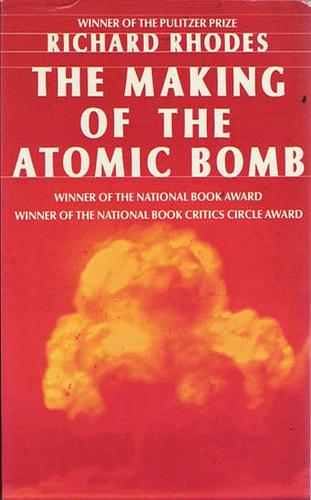
The Making of the Atomic Bomb
by Richard Rhodes
Buy on Amazon
Here for the first time, in rich, human, political, and scientific detail, is the complete story of how the bomb was developed, from the turn-of-the-century discovery of the vast energy locked inside the atom to the dropping of the first bombs on Japan. Few great discoveries have evolved so swiftly -- or have been so misunderstood. From the theoretical discussions of nuclear energy to the bright glare of Trinity there was a span of hardly more than twenty-five years. What began as merely an interesting speculative problem in physics grew into the Manhattan Project, and then into the Bomb with frightening rapidity, while scientists known only to their peers -- Szilard, Teller, Oppenheimer, Bohr, Meitner, Fermi, Lawrence, and Von Neumann -- stepped from their ivory towers into the limelight.…
Recommended by
"This is, of course, the gold standard for that story. It won a Pulitzer Prize, a National Book Award and a whole bunch of other awards. And even though it was published in 1986, it still holds up. I’ve written a lot about nuclear weapons and atomic bombs, so I’ve read basically every book that’s available on it—from the earliest postwar stuff to the present—and Rhodes is just the master at putting it all together. He tells the entire story, from its very beginnings in quantum physics in the early 20th century, and even before that, and how it developed into the atomic bomb. All the figures are in there, all the important physicists. He’s also masterful at explaining the science. He’s something of a role model in that for me, because he’s not a scientist either, but he talked to enough people. And because he was doing this in the late 1970s and early 1980s, a lot of the people who worked on the Manhattan Project were still around for him to interview and talk to. That’s really important. When I was writing my Oppenheimer book ten years ago, most of the folks that were involved had passed away. Rhodes also writes with a keen awareness of not just the science, not just the human element, but also why this was such a monumental event in human history and something that touches all of us even to this day. If you’re going to read one book on the atomic bomb, that’s the book to read."
"This is journalism about science. It’s a history of the Manhattan Project, the US effort to build an atomic bomb to defeat Nazi Germany. This is the best history of the greatest minds in science alive at the time, or maybe ever, and how they were brought together to build this bomb. I hope humanity can come together again in the same way but with a more positive goal. It’s incredible how little they knew in 1929 and what they then did in 1945. The book takes us through the earliest theories in atomic physics, from Ernest Rutherford and Einstein, to actually detonating the device that harnessed the power of the atom – it was an astonishing rate of progress. It shows the power and the weakness of science. Rhodes reminds us of this guy, Leo Szilard, a Hungarian physicist, a good but not the greatest atomic physicist, who had an epiphany crossing the road through London traffic in 1933, and realized you could split the atom, that you could tear it apart and release all the energy at once in a huge chain reaction. He realized you could make a bomb. The thought that this was already going through people’s minds in such a crucial time as 1933 makes the reality of nuclear war seem almost like an inevitability. Then you’ve got Niels Bohr, a Dane and one of the greatest theoretical physicists, who was a pacifist helping Jews escape the Nazis through Denmark, who wanted to make nuclear reactors not bombs. But, in the end, his knowledge was harnessed too. These were theorists – the geekiest, nerdiest mathematicians you can imagine – but some of them had political motivations, some had philosophical motivations, some wanted to punish the Nazis. In a weird way this explains the modern day fear of science, of madmen in white coats. That fear was born of these men and some of them really were crazy scientists. This books describes the drama played out between them and then, once the military machine got involved, the story of the militarization of science. The book has espionage too – the story of Klaus Fuchs, a brilliant British physicist who, after the Manhattan Project was concluded, leaked a lot of what he’d learned to the Soviets. Finally tracked down by the FBI and British intelligence, he spent 14 years in Wormwood Scrubs before fleeing to East Germany. This, in a way, was the crowning achievement of America’s political understanding of the power of science. In films from then on there were always these scientists saving the day when there was an alien invasion or whatever, and they did. They won the war. I know. Look at the incredible amount of money and the destruction that went into achieving that. There is a lengthy chapter that moved me to tears about the impact of the bombs on Hiroshima and Nagasaki. Somehow, when you have been on this journey through the minds of the scientists and of Oppenheimer, the scientist-bureaucrat who ran the project with this blank cheque from the government, it makes it even more tragic. It was a mammoth enterprise, the greatest example ever of human cooperation and such an evil end. I often have conversations about climate change where people say we would need a Manhattan Project level of financing, enthusiasm and cooperation – a blank cheque and the best minds in the world – to make anything like an impact. Yes, an identifiable common enemy. But it was also a race. The Germans were on to it; the Russians weren’t so far behind. It was a race of science. This is one of the best examples of how pure science – like atomic physics or even Darwinian evolution – becomes a functioning technology. I mean, the Americans were fiddling around with centrifuges, like the Iranians are doing now, in the 1940s. They are still clearing up some of the contaminated secret locations today. The saddest thing was the outcome."
Books about J Robert Oppenheimer (to Read After the Movie) ·
fivebooks.com
"an epic account of the Manhattan Project. I cannot think of another book that makes scientific history more riveting."