Marina Warner's Reading List
Marina Warner writes fiction and cultural history. Her books include From the Beast to the Blonde (l994), the novels Indigo (l992) and The Leto Bundle (2000), and Stranger Magic: Charmed States and The Arabian Nights (2011). She has curated exhibitions, including The Inner Eye (l996), Metamorphing (2002-3) and Only Make-Believe: Ways of Playing (2005). Her essays on art will be collected in Art & Enchantment (forthcoming). In 2015, she was awarded the Holberg Prize in the Arts and Humanities. She is Professor of English and Creative Writing at Birkbeck College, a Fellow of the British Academy
Open in WellRead Daily app →Fairy Tales (2017)
Scraped from fivebooks.com (2017-07-27).
Source: fivebooks.com

George Martin (translator) & Italo Calvino · Buy on Amazon
"As a communist, Calvino himself realised I think that the kind of realist literature he had been writing didn’t really appeal very much to the people he wanted to reach – Pier Paolo Pasolino made the same move in his trilogy of films that included one on the Canterbury Tales . The literature of working people, the people who the communists wanted to include in culture rather than separate from it, was steeped in the exuberant fairy tale, and Calvino wanted to see that culture recognised. But when he looked around he couldn’t see a book that did that and so he decided to do it himself. He writes in his introduction about how he became so completely and deeply absorbed by it all – he says at one point that he would have given the whole of Proust just to find another variation on the tale of the donkey that shat gold. He collected the tales from the ethnographers around the country, who had already gathered them up – including a brilliant Sicilian, Giuseppe Pitrè, who was a doctor in Palermo in the nineteenth-century, who collected them from his patients. He’s a very important figure in all of this. In Italy the ethnographers had been very, very busy right through the 18th and 19th centuries, gathering up these fragments in pursuit of the idea of italianità . They were finding out about the many streams feeding this extraordinarily rich and varied culture. And so Calvino went to all the local libraries collecting them, and one of the reasons he decided to translate them all into his own prose was because there were just so many of them. This has all been very much in my mind because I’ve been involved in this project in Palermo – a refugee storytelling project for ‘minorenni’, aged l8 and under. We’ve been trying to create a space for refugees to tell stories from their own culture, or to invent stories out of their own culture rather than tell stories of their own often tragic circumstances. It is called Stories in Transit and we are currently building the website, www.storiesintransit.com , where we’ll archive the work – the plays and songs etc of the young people. I see the telling of stories as an opportunity for mischief and defiance, dreams and laughter – hope against hope."

Robert Chandler · Buy on Amazon
"Oh, the Chandler volume is simply wonderful. The Russian tradition is very interesting because some of the things I was saying before don’t quite apply – the tradition does seem to be sui generis in some respects. I remember reading somewhere that there are more unique fairytales in Alexander Afanasyev’s collection, published in Russian in the 19th century, than there are in any of the other comparable collections. Some scholars do this “tale type” classification – which I’m not too keen on – by which, for example, “Sleeping Beauty” is listed as “AT-134”, but what this work does build to show is thatb the Russians have the most single stories of any of the cultures studied. That’s partly to do, probably, with the isolation of certain districts. Around the Pole, you get a lot of similar tales circulating – from the Finns, the Lapps, and the Japanese – there are echoes across the Polar region; but there are still some truly isolated pockets in Russia, with tales that are found nowhere else. You also get some very, very, very unusual ones in Iceland. Oh, there are some very strange tales indeed in Iceland. There’s one that, in fact, Angela Carter included in her Virago Book of Fairytales (1992), and it features a relationship that to my knowledge is unique: an Eskimo hunter goes off hunting, leaving behind his new bride with his mother. The two women are alone and so isolated that, after a while, the mother-in-law starts to look at her charge differently. She’s very pretty, she finds…. She falls in love with her. I think not even the Greek myths got round to that one. One of the things I like about the genre is that it is a common language so that people can pick it up and use it – it’s like a tune, like “Greensleeves”; you may recognize it as “Greensleeves” at the same time as recognizing that it’s a completely different, new way of doing “Greensleeves” – one with a jazz riff, or something. Some of the classic jazz numbers are really in themselves something that surpasses the original, in a way. I’d put Carter’s “The Werewolf”, based on “Little Red Riding Hood”, in that category. The same with her “Beauty and the Beast” – she’s created unsurpassed variations that have become standards in their own right. Yes, and interestingly she changed a lot in her career. She moved away from subversion. Some of the tales in The Bloody Chamber are just full of an absolute spit-in-your-eye kind of rebel tough-talk as well as sexual delinquency with a very specific feminist agenda, and I wonder what she would have made of that herself now. What has happened to sexuality and to young women, and attitudes around pornography and how one might use it in this way or that, is considerable and one wonders what she would have thought of it all. I would love to know, for instance, what she thought of Fifty Shades of Grey – for her it would have been like looking in a horribly distorted mirror. Quite apart from the fact that the writing in that book is terrible, the S & M relationship is one that Carter had herself investigated a lot. She does stage escapes, of course, so that Carter’s relationships never resolve into submission. That’s an important point. “There are still some truly isolated pockets in Russia, with tales that are found nowhere else – and you get some very, very, very unusual ones in Iceland” But, as I said, she moved away from subversion and over the arc of her writing life she moved on to the idea that you could mobilize a story to create something more than that. Certainly her last two novels, Nights at the Circus (1984) and Wise Children (1991), use folk motifs to talk about common culture, tolerance, the new multiculturalism, and the new multi-ethnic culture. There is humour in them, too, but the resolve at the end of Nights at the Circus, in which there is this emphatic resolution of love between the heroine, “Fevvers” and the journalist Jack Walser – that’s not the old subversive Carter."

Angela Carter · Buy on Amazon
"I absolutely love her last “Cinderella” – “Ashputtle or The Mother’s Ghost” [which first appeared in 1993, in American Ghosts and Old World Wonders ] – in which she takes the Grimms’ motif of the mother returning to help her daughter. She combs her hair and says ‘you’ve worn out my nails’ and says to her ‘now you’re strong and ready to go out into the world on your own’. And so she sends her into the world strong and happy. I think that’s a really beautiful story. Japan certainly did. She went there because she liked Japanese cinema. She liked the films of Akira Kurosawa, which were a blend of realism and fantasy and fairytale – so that was a strong pull on her. And she liked Japanese ghosts stories. In the 1960s there were more of those around – now they have the Studio Ghibli, of course, which is wonderful, but there was a rich scene in Carter’s time too. That’s what drew her there. And she loved Yukio Mishima, too. Someone told me that Carter did know “The Debutante” [ Carrington’s most famous short story; re-published in a new edition earlier this year]. It was discovered in her library. Carter came across Carrington through Surrealism, which was an important influence on her – French Surrealism was very much the milieu of her earlier work especially. It wasn’t so much the fairytale aspects of Carrington that drew Carter to her; I think it was the Surrealist coordinates of communism, sexual liberation, delinquency, foul-mouthedness, blasphemy. She was very interested in blasphemy as a method of shaking up thought. Support Five Books Five Books interviews are expensive to produce. If you're enjoying this interview, please support us by donating a small amount . Fairytale is good at that, too, because it’s part of looking at the unspeakable things that people do, perhaps using blasphemy to challenge and take down tyrants. I don’t think she was interested by Australia particularly, although she loved the birds – the parrots! The US, she went to to teach. At the time she was lucky enough to go there it was a different place. The Americans have always had a great cult of literature and specifically of the short story. That was important. There was a great interest in her work over there, which hadn’t yet happened in the UK. She never had an easy time in the UK. She never won a prize, or anything. Hugely renewed interest, yes, and very much in academe, too. It’s because she’s an absolutely extraordinarily good writer. People are recognizing it – her writing is just astonishingly lively, and rich, and her thought hasn’t aged. She’s very fresh and agile in her thinking. She was a tremendous freethinker in the best possible way. Logan is very imaginative and very fertile. She’s the kind of congenial spirit that one likes to be with as a reader. But her work is much gentler than Carter’s, much more tender and touching and poignant. Because she is a lesbian and many of her stories are allegories of lesbian love, she is very much what I was saying earlier: this is literature that creates a realm of understanding and mutual feeling that can build something. This may not explicitly be Logan’s intention – although I expect it is. A Portable Shelter is not a collection of fairytales but a novel with fairytales interpolated. It’s actually about telling fairytales to a baby, and creating a safe place for the baby in the process. There’s a kind of dystopian vision hanging over it, some kind of apocalypse coming. There’s a Noah’s Ark feel to it. And this couple has a baby and they are keeping it safe by telling these stories. Mitchison is a bit of a forgotten figure and yet she had a great spirit and led an amazing life. The best place to start with her is her play Kate Crackernuts , which she wrote for children to perform. It’s a traditional fairy tale – its name comes from the Scottish tradition. It’s the same story as Christina Rossetti’s “Goblin Market”, except here it is a man who is saved from the goblins who would steal him away into the underworld. And although he loves being there with the fairies and the fairy queen, the woman who loves him back on earth fights, fights, fights the goblins and fairies to bring the earthling back to safety. Mitchison married a Scotsman and they lived on the beautiful Mull of Kintyre. And she had a Scottish nationalist period in her life and she fought for fishing rights and all manner of things. She came from the Oxford intelligentsia-aristocracy. Yes, I do, but the person who really thinks highly of Mitchison is Ali Smith. So I think in Scotland she does have a kind of aura, which she doesn’t have down South."
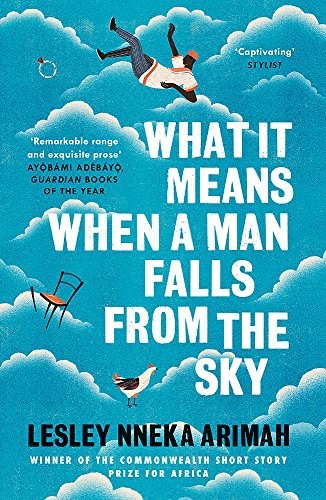
Lesley Nneka Arimah · Buy on Amazon
"I really think very, very highly of it. That’s a really brilliant story. Something we should touch on which we haven’t yet is that the idea of projecting into another time or space belongs to science fiction or to utopian fiction, too. That’s why, when Angela Carter was first published, she was classified under science fiction, which wasn’t strictly correct. Now, What It Means When a Man Falls from The Sky brings up the same difficulties around classification. There are some rather good realist stories in this collection, but I’m most interested in where she uses fantasy in order to edge towards apocalypse and dystopia. That’s what we see her doing in “Who Will Greet You at Home”, where we find a world of designer babies in a nightmare form. “The story is a poignant nightmare. It’s a horrendous story. I had terrible dreams after reading it, all about babies and death. She got very deep down into my psyche” It’s also a critique of the pressures on women to be fertile and to be mothers. Apparently this is very strong in Nigeria where she has roots. She seems to know the culture very well although she now lives in the US. She was born in the UK, though. The story is a poignant nightmare. It’s a horrendous story. I had terrible dreams after reading it, all about babies and death. She got very deep down into my psyche. It’s a very interesting reflection on the inability of systems to crush human emotion, which, I think, literature expresses. So one of the important things about making up stories and writing things down is that you create a record of all the possible human expressions and emotions and you understand their calibrations and subtleties and their complexities. I wouldn’t know half of what I know if I didn’t read about it – I’m not that good at noticing myself. I need other people to notice for me. Fiction can do that. It’s an amazing seismograph. When I first started reading the Brontës or George Eliot, for instance, I learnt so much about how people interact. Absolutely. We have this shiny and horrible sort of brave new world, with mathematicians having found this code – “the equation of a person” – that runs everything perfectly. But of course it doesn’t run everything perfectly and passion breaks though. In this world, the narrator’s role is to be a Grief Eater. These particular gifted children – gifted because they have the right mathematical code –are seemingly capable of absorbing or removing grief from the world. But it turns out that that doesn’t add up. Grief is overwhelming. Grief can’t be “eaten” by a code; computers can’t process grief. Yes, and it’s also the case in the visual arts – Paula Rego and Kiki Smith. A lot of women artists are drawing on fairy-tale. I think its partly to do with this idea of a common language, a way of looking through a lens that will be shared by someone else so that one can have a shared joke, one can have a shared transgression. It’s a way of reaching out through a common vernacular, tapping the reader or the viewer and letting them feel they’re in on the game. There’s a very good collection we haven’t had time to discuss called Caught in a Story: Contemporary Fairytales and Fables [1992; edited by Caroline Heaton and Christine Park]. It has a number of these witchy reversals of well-known fairy tales. There’s a particularly good one – with a very 1960s feel of asserting independence – by Ruth Fainlight, which I’ll leave your readers to discover for themselves if they don’t already know it. They are, yes, and I think that’s a case of the genre keeping in step with the rest of the world. It’s a long time since ogres have seemed so absolutely real. That’s the thing: ogres often come across as a little bit foolish but they are very, very dangerous."