← All books
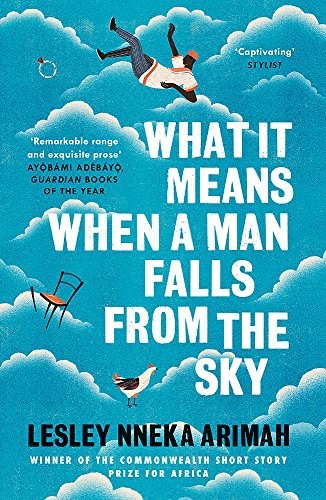
What It Means When a Man Falls from the Sky
by Lesley Nneka Arimah
Buy on Amazon
"A dazzlingly accomplished debut collection explores the ties that bind parents and children, husbands and wives, lovers and friends to one another and to the places they call home. In "Who Will Greet You at Home," a National Magazine Award finalist for The New Yorker, A woman desperate for a child weaves one out of hair, with unsettling results. In "Wild," a disastrous night out shifts a teenager and her Nigerian cousin onto uneasy common ground. In "The Future Looks Good," three generations of women are haunted by the ghosts of war, while in "Light," a father struggles to protect and empower the daughter he loves. And in the title story, in a world ravaged by flood and riven by class, experts have discovered how to "fix the equation of a person" - with rippling, unforeseen repercussions.…
Recommended by
"I really think very, very highly of it. That’s a really brilliant story. Something we should touch on which we haven’t yet is that the idea of projecting into another time or space belongs to science fiction or to utopian fiction, too. That’s why, when Angela Carter was first published, she was classified under science fiction, which wasn’t strictly correct. Now, What It Means When a Man Falls from The Sky brings up the same difficulties around classification. There are some rather good realist stories in this collection, but I’m most interested in where she uses fantasy in order to edge towards apocalypse and dystopia. That’s what we see her doing in “Who Will Greet You at Home”, where we find a world of designer babies in a nightmare form. “The story is a poignant nightmare. It’s a horrendous story. I had terrible dreams after reading it, all about babies and death. She got very deep down into my psyche” It’s also a critique of the pressures on women to be fertile and to be mothers. Apparently this is very strong in Nigeria where she has roots. She seems to know the culture very well although she now lives in the US. She was born in the UK, though. The story is a poignant nightmare. It’s a horrendous story. I had terrible dreams after reading it, all about babies and death. She got very deep down into my psyche. It’s a very interesting reflection on the inability of systems to crush human emotion, which, I think, literature expresses. So one of the important things about making up stories and writing things down is that you create a record of all the possible human expressions and emotions and you understand their calibrations and subtleties and their complexities. I wouldn’t know half of what I know if I didn’t read about it – I’m not that good at noticing myself. I need other people to notice for me. Fiction can do that. It’s an amazing seismograph. When I first started reading the Brontës or George Eliot, for instance, I learnt so much about how people interact. Absolutely. We have this shiny and horrible sort of brave new world, with mathematicians having found this code – “the equation of a person” – that runs everything perfectly. But of course it doesn’t run everything perfectly and passion breaks though. In this world, the narrator’s role is to be a Grief Eater. These particular gifted children – gifted because they have the right mathematical code –are seemingly capable of absorbing or removing grief from the world. But it turns out that that doesn’t add up. Grief is overwhelming. Grief can’t be “eaten” by a code; computers can’t process grief. Yes, and it’s also the case in the visual arts – Paula Rego and Kiki Smith. A lot of women artists are drawing on fairy-tale. I think its partly to do with this idea of a common language, a way of looking through a lens that will be shared by someone else so that one can have a shared joke, one can have a shared transgression. It’s a way of reaching out through a common vernacular, tapping the reader or the viewer and letting them feel they’re in on the game. There’s a very good collection we haven’t had time to discuss called Caught in a Story: Contemporary Fairytales and Fables [1992; edited by Caroline Heaton and Christine Park]. It has a number of these witchy reversals of well-known fairy tales. There’s a particularly good one – with a very 1960s feel of asserting independence – by Ruth Fainlight, which I’ll leave your readers to discover for themselves if they don’t already know it. They are, yes, and I think that’s a case of the genre keeping in step with the rest of the world. It’s a long time since ogres have seemed so absolutely real. That’s the thing: ogres often come across as a little bit foolish but they are very, very dangerous."
"Fans of Roxane Gay’s short fiction shouldn’t miss this debut collection, a magical-realist anthology focused on fierce black women who break the rules and awkward black girls fumbling toward becoming fierce women. Some of these stories are strange, fantastical metaphors, like the one about a world where babies are constructed of scrap materials, then breathed into life. In other, more down-to-earth settings, teenage girls joust for attention and a sense of their own identities. Lesley Nneka Arimah handles fables and rich family drama with equally confident ease, and the wide variety of tones and genres makes this a compulsive, satisfyingly diverse read."