Lloyd Gardner's Reading List
Lloyd C Gardner is a diplomatic historian and specialist in 20th century foreign policy. He is professor of history at Rutgers University and the author or editor of 16 books, including The Long Road to Baghdad and Three Kings . His latest book is The Road to Tahrir Square
Open in WellRead Daily app →Egypt and America (2011)
Scraped from fivebooks.com (2011-09-04).
Source: fivebooks.com
Douglas Little · Buy on Amazon
"We should say it right out: Americans, including academics, are behind in terms of the Middle East. And that is because when Americans studied the rest of the world before all the trouble began in the Middle East, basically we studied Europe. We studied Asia and Latin America as a deep second to Europe, but the Middle East was almost completely ignored. The only interest that the United States had in the Middle East was oil and protecting the new state of Israel. So very little time was spent in history courses or political science courses in the United States on the Middle East as an area. Hence when Doug Little’s book came along it was a real pioneering effort in many ways to talk about America’s attitude to the Middle East. There is something else to say on this point – even when Americans write books about the Middle East and Egypt, they are less aware of the internal history of those countries than they are of the history of any of the European powers, and that leads to oversimplification. Now there are other books around, but it seems to me that the worth of this book has already been illustrated by the fact that it is in its third edition now. And it keeps expanding and covers the area all the way back to Mark Twain and up to the present, so I think it is a wonderful survey. He doesn’t single out Egypt as much as I do in terms of seeing it as the key area for American influence. But he fits it into the problems of dealing with nationalism from Nasser on, and trying to satisfy both the Egyptian desire for self-determination and American desire to keep a strong hegemonic influence in the area."
Geoffrey Wawro · Buy on Amazon
"Yes, and it is a much newer book. The more I read about it the more I knew I would have to look at this book. He comes at it from the tradition of a European political historian and therefore his book is filled with comparisons between American policy now and previous policies by the Europeans. He also, very effectively I think, discusses the problems with America’s policies towards Israel in a very dispassionate fashion. And this is something which is quite difficult, in the United States especially, and yet I think he pulls it off very well and, without being overly critical of American policy, he points out the problems we have had in satisfying all the sides in the Arab-Israeli dispute. I talk about this a lot in my book and I think it really owes as much to Egyptian leaders as it does to the United States, particularly Anwar al-Sadat who broke completely with Nasser’s policies and announced this, in a way, when he talked about how his major interest was going to be “Nile Nationalism” not “Arab Nationalism”. In the process, he paved the way for greater American military support to Egypt, which was always on the basis of quid pro quo – that is, we would give Egypt military support in exchange for Cairo’s maintaining peace with Israel. And up until the fall of Mubarak, our military support to Egypt was second only in the world to our military support to Israel. Yes, I think that is true, and in many respects Sadat angered the rest of the Arab world by doing this. In fact, when he went to Israel to speak and when he made his deal with Israel, the angry Arab countries pulled the Arab League offices out of Cairo for a time. In many ways Sadat triggered the whole beginning of what we face today. The number one man in Al-Qaeda now is, of course, Egyptian. Ayman al-Zawahiri began in Egypt by opposing Sadat."
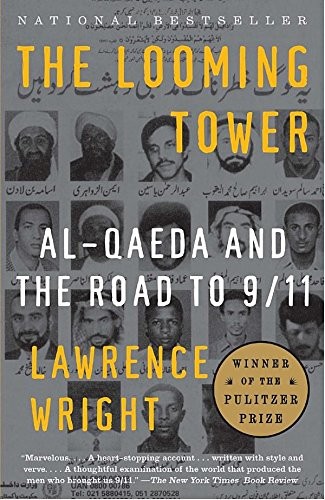
Lawrence Wright · 2006 · Buy on Amazon
"Lawrence Wright ’s book is a marvellous study. It begins with the American education of this very famous Egyptian writer, who became the inspiration of the jihadists in Egypt. This was Sayyid Qutb, who was made a martyr by Nasser. Lawrence Wright goes right through the trial of the people who were accused of the assassination of Sadat, including al-Zawahiri, and then looks at the linkage between the Egyptian Jihad and Al-Qaeda. It is a very worthwhile book to read to try to understand the whole problem. That’s a good question. Of course we supported Mubarak and we turned a blind eye to many of the repressions that he carried out, because it was the feeling at the time that he was helping to keep potential Al-Qaeda people in check. Egypt became used in a very infamous way as a spot for rendition for suspected terrorists sent there by the CIA, because of concern that the same interrogation techniques Mubarak employed would not be legal in the United States. It is a very controversial episode."
Fawaz A. Gerges · Buy on Amazon
"This book by Gerges is important because I don’t think many people really understand that much of this turmoil began in ferment against the local governments and that it was the persistence of American military support for governments in power that led Al-Qaeda to turn against America. And of course one of the key people in this was Osama bin Laden, who, according to what Gerges and others say, was heavily influenced by the Egyptians. Get the weekly Five Books newsletter It was Ayman al-Zawahiri who persuaded Osama bin Laden that one had to go after the “far enemy” first. That can be disputed but still it opens a very important insight into how what started as a struggle against the local governments became a struggle against the West, and the United States in particular."
Saïd K Aburish · Buy on Amazon
"There are a lot of books out there about Nasser. Some of the books by local authors like Mohamed Heikal are very important as semi-memoirs. Aburish, it seems to me, gives a very fair and balanced picture of Nasser’s ambitions. He wanted to be the leader of an Arab renaissance. Ironically this is what the US Secretary of State John Foster Dulles hoped in 1953, when he first visited the revolutionaries in Egypt. He promised them that he would make Egypt a major regional military power if the Egyptians tried to make peace with Israel and if they joined into a Middle Eastern pact much like NATO. In other words, if they played their assigned role in the Cold War they could become a regional leader. Through such a pact, it was hoped, the countries of the Middle East would focus on cooperation. Nasser balked at such a limited role, and proved to be a great problem for Washington, taking aid from the Russians and nationalising the Suez Canal. Ironically, the policy that both Richard Nixon and Jimmy Carter tried to pursue towards Iran when they tried to make the Shah into the leader of the Middle East was what Dulles had once tried to do with Egypt. And therefore this book is very good at helping us understand how Nasser’s ambitions were more than that and yet how the United States and others hoped to use those ambitions to mold a pro-Western Egypt. To the end with Mubarak. The progression is obvious. Sadat, in his autobiography, says that in Nasser’s last days he had warned that everything an Egyptian leader tried was going to be very chancy because the United States called 99% of the shots in the Middle East. Sadat kept repeating that and in 1973, when he launched the October War [against Israel], he very self-consciously did this, not in the expectation of military victory, but in terms of getting the United States involved, on the grounds that if the United States did not get more involved a few things would happen. One, the Russians would continue their influence in Egypt, and two, there would be permanent instability and potential for war in the Middle East. That was Sadat’s message to the United States and it worked. If you look at Kissinger’s memoirs he talks about Sadat as a modern Bismarck. I think that is going a bit far but still Kissinger realised exactly what was up. Get the weekly Five Books newsletter And the most amazing thing to me, which comes out of all the documents that were made available, was on Kissinger’s first visit in shuttle diplomacy at the end of the October War, Sadat asks him to provide him with CIA protection. This is just like one of the Indian princes inviting the British in the 18th and 19th centuries to protect them in exchange for being protected. It has changed quite a bit. Towards the end of the Mubarak days there was very heavy traffic between the Pentagon and the Egyptian military. When it became clear that Mubarak was not going to survive in any form, the Americans were very anxious to make sure that in the future the contacts in the military were not disturbed. And I think the question will be just how much the United States will be able to influence the Egyptian military and in turn how much the military will be able to keep control of the situation. Admiral Mullen [the US chairman of the joint chiefs of staff] who is about to retire, keeps talking about what a wonderful worthwhile investment our military aid has been over the years. The $50bn we invested in Egypt has paid great dividends. I think we are very concerned about whether we will be able to keep that investment up. From what I am reading, and of course here we are projecting into the future, I am not sure the relationship will ever be quite the same, and I think that the new government that emerges in Egypt, whatever it is, will try to have more determination of its own history. And that is no bad thing. If you say that America stepped in at the end of the colonial era to re-order the world, you might say we are now witnessing the end of the neo-colonial era with the events of the Arab Spring that began in Tunisia and received a great impetus from the events in Tahrir Square."