Lewis Wolpert's Reading List
Lewis Wolpert is Emeritus Professor of Biology as Applied to Medicine at University College, London. His research interests are in the mechanisms involved in the development of the embryo. He was made a Fellow of the Royal Society in 1980 and awarded the CBE in 1990. He was made a Fellow of the Royal Society of Literature in 1999. His books include “ Malignant Sadness - The Anatomy of Depression ”; “ The Unnatural Nature of Science ”; “ Six Impossible Things Before Breakfast – The evolutionary origins of belief ”; and most recently, “ How We Live, and Why We Die - the secret life of cells”.
Open in WellRead Daily app →Science (2009)
Scraped from fivebooks.com (2009-07-21).
Source: fivebooks.com

William James · 1902 · Buy on Amazon
"I suppose that’s true. It’s not precisely a science book, but James is trying to understand religion in a scientific sort of way. He tries to give some insight into it. I became interested in religious experience myself and I found it a wonderful book. Although it was written over a hundred years ago, it could have been written yesterday. I doubt it. I think I partly got involved with religious experience because my youngest child became very religious at one stage. He was evangelized and became a fundamentalist Christian, and people thought that I – a bad Jewish boy from South Africa – would be upset. I never was for a single moment. I never ever tried to persuade him not to be. Instead, I began thinking about why people were religious and I even wrote a book about it, Six Impossible Things Before Breakfast , which is really about the evolution of religion. So the William James book is important to me. I think that one of the most important things that he says is that when people do have a religious experience, it’s as real to them as anything that goes on in their day-to-day lives and I think that’s very important to understand. He also says that a truth experienced in the extreme of a fever is no less authentic because of the fever. Why shouldn’t fever be a state in which truth is experienced?"

John Adams · Buy on Amazon
"John Adams is actually a colleague of mine, and when I read his book it completely changed my image of risk. For example, Adams discusses at great length whether seat belts actually have reduced the number of accidents, and his point is that when you have a seatbelt on, you might drive more dangerously, because you feel more secure. In other words, he’s saying risk is not a simple, straightforward thing. He has this brilliant idea which I always quote. If you want to get people to drive more carefully, have a spike set in the steering wheel, pointing towards the driver’s heart. Isn’t that wonderful? It’s about compensation and how you adjust for risk. I’m a cyclist. Adams asks, how wise is it to wear a cycling helmet? Perhaps it makes you cycle more dangerously. I do wear a helmet, I must admit."

Daniel J. Povinelli · Buy on Amazon
"Povinelli’s Folk Physics for Apes . I was interested in people’s beliefs and the origins of religion, and somebody recommended this book. What Povinelli looks at is that humans, as distinct from animals, have a set of causal beliefs about the physical world. Animals don’t have a concept of cause and effect. It’s a somewhat controversial book and many of the animal behaviouralists don’t like it, but it had an enormous influence on me. Toolmaking drove human evolution, and in order to make tools, you had to have a concept of physical cause and effect. If you show an ape an array of tools to get a banana, the ape will frequently choose the wrong thing because it doesn’t have a concept of cause and effect that any human child would have. It’s a very important book for me. Yes. One of the evolutionary advantages of having a concept of physical cause and effect is that you can make tools. That’s what drove evolution. But my theory, which nobody takes seriously, is that once you have a concept of cause and effect, you want to explain everything that has happened to you. And that’s where God comes from. Well, in the literature on religion nobody ever mentions it. But I do think that’s the origin of mysticism and all sorts of things like that. Apes can break nuts with a stone, get insects with a stick, but they don’t really have a sense of cause and effect, and so no physics and certainly no metaphysics whatsoever. Well, I don’t think they’d be able to drive a ca,r frankly."

William Styron · Buy on Amazon
"I had a very bad attack of depression about fourteen years ago. Yes, and I challenged people to find a novel that contains a good description of depression. There’s a joke about depression that if you describe it, you haven’t had one. But the difficulty in describing depression is exactly why Styron’s Darkness Visible is such a masterpiece. It’s not a novel. It’s about his own depression, and it’s extraordinary – one of the best. No, none at all. I had a minor problem with my heart. But really minor. I was happily married, I had a nice job at the university, but I went down very badly. You can’t describe it, it’s an absolute bloody nightmare. But that’s why Stryon’s the one I quote – he really is very, very important. For example, he thinks that the word “depression” is the most depressive, miserable, lousy word you could possibly use to describe the disease. To put it mildly. But he really speaks out. He’s totally unconstrained in his descriptions. He’s entirely frank about his own experiences."
V. S. Ramachandran, Sandra Blakeslee · Buy on Amazon
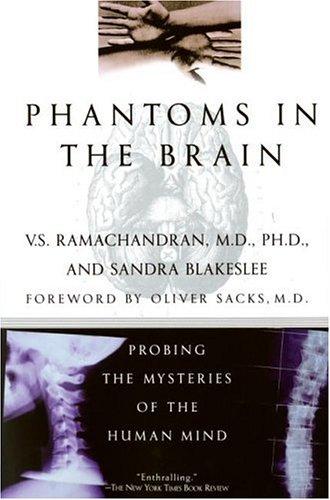
"I just couldn’t get over this book. The description of people with only one arm who believed they could clap. It’s just wonderful. It’s really about how people who have some physical injury to their brain can have fantasies that bear no relationship to reality whatsoever. No, not at all. He’s really a serious neuropsychiatrist. I’m very impressed by him. I do think there’s a connection, and in my book, I argue that we have religious beliefs, mystical beliefs, embedded in our brain. One of the arguments is that if you take LSD, a boring bloody molecule, how could you possibly have these extraordinary experiences unless the experiences were already there? Well, that’s my story, but Phantoms in the Brain is a wonderful book. A really marvellous book. Yes, The Revolution of Wisdom . I’m interested in the origin of science, and Sir George Lloyd is the best writer on that. You see, all science – people don’t like this – but all science as we know it began with the Greeks. They were the first society to think in that way and a lot of my ideas on this come from Lloyd. I am a scientist and I care about science, and Lloyd just writes so well about it. So the first scientist we know about is Thales [sixth century BC] who said that everything in the world was made out of water. It wasn’t a mystical thing. He was really trying to understand the world. One of my heroes of course is Archimedes, who I think is one of the greatest scientists who ever lived. Because he had nobody else’s shoulders to stand on, and I want to tell you that working out buoyancy and specific gravity, quite apart from all his mathematical things, was just absolutely brilliant. Greek science is so important. Not that people didn’t make enormous contributions later, but it all started with the Greeks. The Chinese had no science at all. They had wonderful technology but understood nothing. Technology is about building things. The elephant, for example, is wonderful technology, yes? But evolution knows no science. It just selected those things that work. Yes, the difference between science and technology is absolutely fundamental. If you want to understand why the sun goes round the earth and things like that – that’s not technology."

Randolph M. Nesse, George C. Williams · Buy on Amazon
"I was introduced to the book by Randolph Nesse, who is one of its authors, and I even taught it at University College London. It’s really thinking about medical issues in evolutionary terms. So for example, if you have a gene for sickle cell anemia, it prevents you from having malaria, and so there are lots of people with sickle cell anemia in areas afflicted with malaria. But there are all sorts of evolutionary aspects to do with why one gets fat, mental illness, cancer and so on. It’s a very interesting book and a very important book, I think. But it’s not a subject sufficiently taught in this country. You treat the patients the same way, but on the basis of a different understanding. You can begin to understand why things have gone wrong in evolutionary terms. You can only understand aging, for example, in evolutionary terms. Because evolution doesn’t bother with the damage we do to ourselves once we’ve reproduced. No, no. If you didn’t die and were still reproducing well, things would be fine. Because the cells get damaged as we age. They accumulate damage. But evolution is useful for understanding a variety of medical problems. You can think about different illnesses and understand them better in evolutionary terms. One unsolved problem, which I simply don’t understand, is what the advantage is of having a fever when you get ill? Oh rubbish! But why? Why should raising the temperature make any difference? I think that’s all crap. I just don’t think the problem’s solved. Or perhaps it’s because the things that are helping you recover work better at a higher temperature, or are working harder. No, because it’s energy-consuming. But that’s only a thought. It’s not a solved problem."