La Carmina's Reading List
La Carmina is an award-winning alternative culture journalist and TV host. A graduate of Columbia University and Yale Law School, she blogs about Goth travel and fashion and is the author of four books.
Open in WellRead Daily app →Satanism (2022)
Scraped from fivebooks.com (2022-10-11).
Source: fivebooks.com
Ruben van Luijk · Buy on Amazon
"Yes, absolutely. There’s this one and also Satanism: A Social History , but that’s a bit harder to get hold of. My book is A Little Book of Satanism . It’s a primer, an introduction for a general audience. As I say in the introduction, I always encourage people to dive deeper into the academic sources if they’re interested in learning more. I know that these academic sources are not for everyone. They’re big. They’re expensive. And they’re very dense. But this is one of the best books out there for the origins of modern religious Satanism. Get the weekly Five Books newsletter It traces where Satanism came from, from the concept of anti-Satanism—where the Christians were trying to use this label to demonize who they considered their enemies, like the Knights Templar, or the women who were accused of being witches in the witch trials—up to the how the label was embraced by people in the West, and how it developed into modern Satanism, like the Church of Satan and the Satanic Temple today. Yes, from the Greek. My book isn’t only for people who are already knowledgeable about Satanism, so I tried to include some commonly asked questions. I thought people might wonder where these names came from. Who is Mephistopheles? Who is Beelzebub? How does that all fit in?"
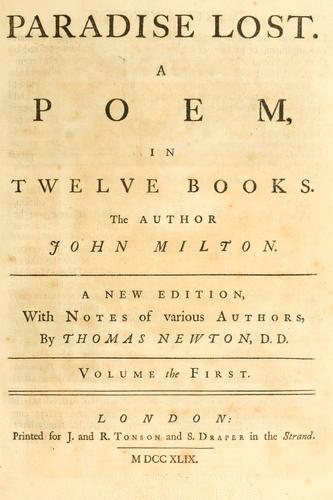
John Milton · Buy on Amazon
"Paradise Lost had an enormous impact on Satanism. Ironically so, because John Milton was a Christian, and he did not write Paradise Lost in any way to honor the Devil. But because he’s such a tremendous writer, he ends up making Satan, for the first time, a nuanced and compassionate character. Before that, in medieval works, Satan is pretty one-dimensional. He’s just the bad guy and that’s it. But then, in Paradise Lost , you see his motivations. You start to feel sympathy for the Devil. It talks about how he’s cast out of heaven, and you hear about his struggles. You end up rooting for him. There’s the great quote, “Better to reign in Hell than//serve in Heaven.” Milton ended up making the Devil seem like a very appealing character. Later on, during the Romantic era, writers started reading Paradise Lost again. It was republished and became very popular. Poets were inspired by it and Satan was held up as an antihero. For the first time, Satan was depicted in art as this classical, muscular and beautiful Greek god-type character. Baudelaire and others wrote these tremendous odes to Lucifer and how he was courageous for standing up against tyranny, how he was to be honored for being a rebel who questioned arbitrary dogma. So Paradise Lost really influenced the way Satan is seen today as this rebel, the underdog who stands up, a heroic figure rather than this figure of evil. That’s the thing that gets confusing to people. There isn’t one definition of who these characters are and how they relate to each other. It’s very fluid and changes over the centuries. Sometimes Lucifer is seen as the same as the Devil/Satan. Sometimes he’s seen as a separate entity. But, generally, Satan, the Devil and Lucifer are seen as the same—the angel that was cast out of heaven. Then demons like Mephistopheles, Beelzebub and Belial are seen as his demonic agents, his helpers, though sometimes they’re conflated with Satan."
Johann Wolfgang von Goethe · Buy on Amazon
"Faust is a play from the 19th century and it’s not the first variation of the Faust story. It actually began during the Middle Ages, about this possibly real-life magician called Faust, who supposedly sold his soul to the Devil. That led to a lot of stories about him developing over the centuries. It’s so interesting to trace these tropes that we have—like selling your soul to the Devil—and see where they came from. Goethe’s Faust is one of the most important and popular and influential of these works and, again, really humanizes both Faust and Mephistopheles. So Dr. Faustus is a scholar. He’s not an evil guy; he’s someone who wants to pursue knowledge. That’s another element that’s important in Satanism: seeking scientific knowledge, questioning and trying to find out the facts for yourself rather than believing in superstition. Dr. Faustus is very much that type of scholarly, curious character, who because he wants knowledge signs away his soul, in blood, to Mephistopheles. Mephistopheles then takes him around on these great adventures throughout the world. He has all these incredible experiences. What’s interesting is that in earlier works about Faust, the Devil ends up dragging Faust to hell at the end. Faust is doomed. But, in Goethe’s version, because it’s later, Faustus actually still ends up in heaven. It’s an interesting take. A person can sign their soul away to the Devil and have all these great adventures and seek knowledge but still end up in heaven. It goes with what we were saying earlier, about how Satan came to be seen as more of a sympathetic character. If you represent someone who rebels and seeks knowledge and questions what’s imposed upon them, it can lead to good things."
Ira Levin · Buy on Amazon
"We’ve been discussing works of fiction that had a big impact over time in how people perceived of Satanism and the Devil. Rosemary’s Baby is a bestselling novel from the 1960s, very influential in terms of pop culture and horror movies. It introduced the idea of how your seemingly benign elderly neighbors next door could be Satanic leaders out to get your baby. That’s the plot of Rosemary’s Baby . Rosemary and her husband move into a new apartment and befriend the neighbors who end up impregnating her with the Devil’s baby and the story goes from there. It became a movie as well, starring Mia Farrow, and it had a huge impact on how people perceived Satanists because of the visuals of these Satanists yelling, “Hail Satan!” and doing rituals on women and getting the baby. It made people have this negative conception of Satanists as engaging in evil behavior and in conspiracy. You could argue that that fed into the Satanic Panic later in the 1980s and 90s, when people were accused of engaging in Satanic practices and abusing children when there was no basis whatsoever in the accusations. Yes, and it’s ongoing today with QAnon. People’s lives and reputations are still being ruined because of false associations and rumors about them being associated with the Devil. Yes, over the centuries and even now, people have been accused of being Satanists and they’ve been put on trial, they’ve been executed or just rubbed out. That’s very much part of the history. That’s why people who adopt the label today are standing up for those persecuted in the past and present"
Joseph Laycock · Buy on Amazon
"So this book takes us up to the present day and today’s take on Satanism. In my book, I do talk about some earlier Satanists, but most scholars think that the Church of Satan, which was founded in 1966, was really the first full-fledged, modern Satanic religion. Then, later on, in 2013, the Satanic Temple was founded. There are also individual Satanists who don’t associate with any particular type of Satanism, they do their own practice, but those are the two main organizations today. Both are non-theistic and nonviolent. They have similarities in that they stand up for individuality and non-conformity and for scientific, critical thinking . But there are also differences. The Satanic Temple has political and social engagement. That’s quite a new element in Satanism, engaging in activism—campaigns for separation of church and state, advocating for reproductive and LGBTQ rights—or even community good works like clothing drives. That’s all discussed in Speak of the Devil , which is a book that follows the founding of the Satanic Temple and how it led to what they do today. Certainly not commandments, because it’s always about thinking for yourself. But Anton LaVey, who founded the Church of Satan, did release certain—I guess you could call them—central convictions. In his The Satanic Bible (1969) he has Nine Satanic Statements, and there are also the Eleven Satanic Rules of the Earth. The Satanic Temple has Seven Tenets, which I included in my book. They’re quite democratic, humanistic values, there are no ‘thou shalt’ or ‘thou shalt nots.’ When people read them, they often realize, ‘Oh, actually, I agree with this.’ They’re about respecting bodily autonomy and making sure your beliefs conform with the best available science. So this book, Speak of the Devil , goes through that. It’s just so interesting to see how a religion is founded and how it evolves. Absolutely. They really pointed out the hypocrisy out there. A lot of the times, people don’t even question it. We’re ‘one Nation under God.’ People assume the United States is a Christian nation but that’s not the case. If you look at the Constitution, there should be equal representation in public spaces for all religions. We’re not just talking about Satanists but Hindus, Buddhists, everyone should be able to have their monuments outside in the grounds of courts or Capitols or public memorials. But often it’s the Christians who put up a Ten Commandments tablet or a cross and no other religion can have their own symbols there. The Satanic Temple has succeeded in really pointing out that hypocrisy saying, ‘Well, if you can do this under the law, then so can we.’ Then, when they’re told they can’t, doesn’t that point out that there’s something wrong there? That’s a very important part of it too. There are all these elements that, ironically, you might expect of a Christian organization: there are community gatherings and celebrations of Satanic holidays throughout the year. There’s community good work—people getting together to do beach cleanups or clothing drives. Starting last year there’s SatanCon , an annual conference. There are congregations in different cities where people can gather. Even if there’s no belief in a deity that doesn’t mean it’s not a religion or there isn’t a community that has shared values and shared missions. The Buddhist community also doesn’t necessarily believe in a deity and could be seen as a non-theistic religion. Those are very much congregations as well."