Joshua Cohen's Reading List
Joshua Cohen is the author of nine books, including the novels Book of Numbers (2015) and, mostly recently, Moving Kings . In 2017, Granta Magazine included him on its decennial list of the Best Young American Writers. He was born in 1980 in Atlantic City and lives in New York City.
Open in WellRead Daily app →The Best Political Novels (2018)
Scraped from fivebooks.com (2018-05-14).
Source: fivebooks.com
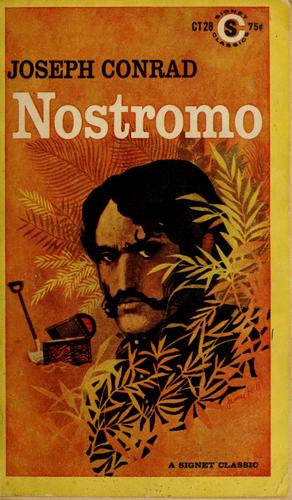
Joseph Conrad · Buy on Amazon
"I don’t think Conrad is interested in asserting any type of moral equivalency—I don’t think he believes the exploited and the exploiters have equal moral claims. Instead, what Conrad cares about is individuality—the possibility or impossibility of a world of individuals—and how each of them, each of us, might be trapped, or might resist being trapped, in the positions and circumstances into which we were born. This, in Nostromo , is best dramatized in the person of Charles Gould: is the mine his birthright? From there, it’s a very direct line to asking the question: To what degree are birthrights delusions, or self-invented? For Conrad, especially in Nostromo , it’s a question of personal ennoblement, of honour. So many of his characters have conflicting loyalties and are always trying to negotiate between them. Conrad is especially engaged with the ways in which people fail, or feel as if they have failed, the standards that were set for them. So, for him, “stepping up” as you put it, usually takes the form of a “stepping down,” a betrayal—not least of notions of Empire, or of duty. Sure. He was the displaced son of a Polish patriot who hated the Russians and spoke French and wrote in English. This, for him, is what the sea did. His style is ship style: when you work and live on a ship, it doesn’t matter where you’re from, or where your shipmates are from. The only thing that matters is that they can do their jobs, and that you can do your job. You’re forced to become mutually reliant, for survival. At sea, or on Conrad’s sea, problems of origin fall away or become translated into problems of individual talent and character. The sea, in Conrad’s imaginary, becomes a democracy, a meritocracy, of survival. This, at least, is the “governance” that his Europeans aspire to and are tried by. This is Conrad’s European way of understanding the “natives,” not by appropriating them culturally, but by enlisting and rallying them in a campaign against the elements, a campaign against the pitilessness of Nature."

Andrey Platonov & Robert Chandler (translator) · Buy on Amazon
"Platonov’s novel concerns the destruction of a Russian village or town and the digging of a foundation pit for a vast communist housing-block that the reader slowly realises will be the size of, or just will be, the world. The men who dig this hole are myriad: from true communist believers to convicts. And sometimes the convicts are the truest believers. To be clear, many of Platonov’s characters believe in communism, but their belief comes through a misapprehension of communism. To many of them, communism has become, or originally was, a religion: something like an early Christianity, something like a pre-Christian Christianity of Edenic charity and provision. Platonov’s pit-diggers are convinced of the brotherhood of man. In their innocence, they are convinced and so convicted. Many of Platonov’s characters regard communism as this abstract moral principle—a principle of equality. But then each of them—from worker to engineer—defines this equality differently. This, of course, is where the conflict comes in. What is a perfect world? How many simultaneous perfect worlds can there be? In Platonov, this notion of the perfectible is related to, or emerges from, language. Because the perfectible can only exist in language: it can only ever be just a word. What Brodsky said was this: “Woe to the people into whose language Andrei Platonov can be translated”? It was Brodsky’s notion that any language that can bear Platonov’s meanings is already degraded—in other words, it has already been manipulated and used for purposes of political obfuscation."

Doris Lessing · Buy on Amazon
"I remember, you don’t like this book. Why? It’s always been one of my dreams to make a text that appeals to an authority beyond myself—an authority greater than myself. If I write a book and my name is the name on the cover: it’s my fault. I’m to blame. I’m responsible. But what about all those texts that I grew up reading—all those texts that were, in many cases, poorly written, though that was OK, that was acceptable, because those texts were written by God, or at least I was told that they were? I’m thinking about my experiences of reading the Romans, the Greeks, the Sumerians—reading things that are millennia old, and how it’s the age itself that imparts their authority. “We become inured to the world in which we’re raised. The monstrous can come to seem the natural” The fact that these texts have survived, and have been commented on, and interpreted, for generations: this gives them a certain aura. I’ve always been interested in this aura, or in pursuing the aesthetics of this aura as a way to dissociate myself from my books—as a way to evade responsibility for them. In other words, I’ve always hoped to write a text that read like it was ‘found.’ And this is what Lessing succeeded in doing with The Cleft , which has all the authority of a ‘found text,’ without any trickery. She doesn’t say ‘this was found in a bottle washed up on a beach,’ or ‘this manuscript was dug up in my backyard.’ She just writes, and what follows doesn’t reads like a novel but like a fragment. There’s the sense that its flaws are the flaws of transmission: there are mistranscriptions, there are lacunae. Lessing’s version especially, because hers tells of an island of women—an entire female society based on an island—that is suddenly “disrupted” by the introduction of a new species: males. No men have ever existed before, and then, out of nowhere, one man appears, bringing sex with him, and so bringing chaos. It’s a creation myth, created out of creation myths."

Imre Kertész & Tim Wilkinson (translator) · Buy on Amazon
"This is one of the most beautiful short novels, or novellas, ever written. And only one thing ever happens: Kertész’s narrator looks out a window and sees a jeep go by flying the Union Jack. That’s it. But just the sight of this flag, and the context of the sighting, reminds Kertész that there’s an outside world: a world beyond Hungary, a world of freedom. He was one of the few, the very few, great writers who came through the Nazi death camps who wrote beyond the camps: who transposed the camps onto other structures. He once wrote that he was happiest in the camps, and he wasn’t being perverse, or he wasn’t only being perverse. What he meant was that, as a child in Hungary, all he knew were the camps, and so the rare moments that was able to sit in a field or have a fleeting conversation with a friend, became exceptionally joyous, exceptionally precious. We all become inured to the world in which we’re raised: this was Kertész’s point. The monstrous can come to seem, and too often does come to seem, the natural."

Bohumil Hrabal & Michael Henry Heim (translator) · Buy on Amazon
"A phenomenal book. A literal translation of the Czech title would be: Advanced Dancing Lessons for the Elderly. It consists of a single sentence: a monologue being delivered to a gang of women sunbathing topless—and perhaps also bottomless—behind a church. The subject of the monologue is nothing less than the fall of the Austro-Hungarian Empire. The narrator, who is and isn’t Hrabal, is concerned with elegance: not with decadence, but with elegance—in literature, painting, music, but especially in fashion. He is especially taken with army uniforms: soldiers, to his mind, should always be well-dressed. And there was no better-dressed army than Austria-Hungary’s. It becomes apparent, after a bit, that the narrator is drunk, and that his endless sermonizing is just drunk-talk: a harangue at the end of the bar. Hrbal himself was always intoxicated with intoxication as a literary, and political, principle: the notion that to live in this world you have to in some way numb your sensibilities. His characters essentially enter a pub under the monarchy and drink the pub dry. They emerge only to find that they’ve boozed their way through history: they’ve missed Nazism and communism, and they now have to stumble home, which is, of course, an imaginary ‘home’—an imaginary past—through the gaudy solicitations of the free-market. Hrabal’s characters drink so as not to be harmed by others. They prefer to harm themselves. I’m not sure. I don’t know whether it would be a good thing for the political novel to be in good shape, or a bad thing for it to be in good shape, or a good thing for it to be in bad shape, or a bad thing for it to be in bad shape. I think if there’s any lesson to be taken from my choice of books here, it’s this: the political must be founded in the individual. These writers, these characters, cannot be reduced to any one specific camp, or any one specific ideology: they resist this reduction and, in fact, would regard this reduction as a mechanism of oppression. That said, it’s the novelist’s tendency to refuse to agree with anyone: to agree is to be destroyed. Novelists must insist on their own words—it’s only by doing so that they can hope to speak against their time."