Jarle Breivik's Reading List
Jarle Breivik is a professor and head of the Department of Behavioral Medicine at the University of Oslo. He is internationally recognized for his research on the understanding of cancer, both from a scientific and a societal perspective. His thought-provoking analyses presented in PNAS , Scientific American , and the New York Times have stimulated profound debate. Breivik aims to change how people think and talk about cancer.
Open in WellRead Daily app →Cancer (2024)
Scraped from fivebooks.com (2024-09-22).
Source: fivebooks.com
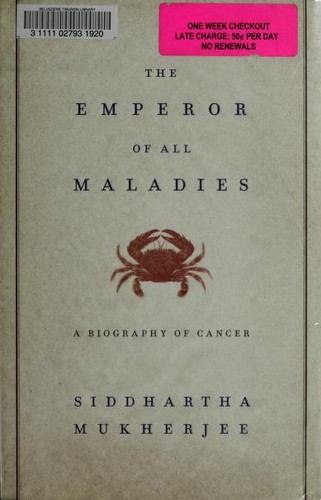
Siddhartha Mukherjee · 2010 · Buy on Amazon
"I’d say it has become a modern classic of cancer and maybe even of popular medical science. It is described, both in the subtitle and by many people, as ‘a biography of cancer.’ I would say it’s more like a biography of cancer research. It’s telling the story of cancer medicine, the development of cancer charities, and the politics around cancer, including Richard Nixon’s war on cancer, all the way to the present (or 2010, when the book came out). It’s a very good description of how cancer research has developed, and Mukherjee presents it in a very accessible manner. He writes about the science, the medicine and also the patient perspective and the suffering and the breakthroughs. So it’s a very good biography of cancer research, while I would argue that there’s another book on my list that is more a biography of cancer. Yes, Mukherjee is a hematologist. He includes the historic perspective—there are some notes on cancer going all the way back to the ancient Egyptians. But then we can also go back in evolutionary history. Mukherjee is presenting the human history of cancer, while other books are more about the biological history of cancer."

Atul Gawande · Buy on Amazon
"Yes, and this book is not so much about cancer. It’s more about aging and death—but, as I said, aging and cancer are two sides of the same coin, and death is the common denominator of both. This is another classic, where Gawande is asking us—and the medical community—to reconsider how we think about life and death in particular. The medical community is sustaining the modern fear of—and distance from—the concept of death, and it’s time to confront our own mortality. A dead patient is generally regarded as a failure of modern medicine. That’s also how we write about cancer—we say, ‘She lost her fight with cancer’—even though she might have had a rich life and reached 83 years of age. Is that a loss, or is that a win? I would say it’s a win. Atul Gawande bridges medicine and philosophy in a thoughtful manner, although it might not be a book for everybody. It is profound and philosophical. Yes. We do need a public conversation about death. Richard Smith, the former editor of the British Medical Journal, wrote a very provocative blog on the BMJ site, where he argued that cancer is the best death. He got a huge backlash for that. It’s about opening up the conversation about death and asking, ‘What is the best death’? Is the best death to die suddenly in your sleep, or to have a heart attack while you’re skiing? He said, ‘Maybe not. Maybe it’s better to have time to prepare, to say a proper goodbye.’ Is dementia any better than cancer? The answer is probably very individual. It all depends. But we need to have the conversation. It’s very easy to say, ‘Cancer is the worst death, and this is the bad enemy.’ That is how we have been taught to think about it. That’s the image cancer has in society. But as more and more people are going to die of cancer, is that a useful way to think about it? It’s a paradox. The healthier you are, the older you get, the more likely you are to get cancer in the end. So, if you want to live a long and healthy life, you should prepare to die of cancer. Being Mortal is all about accepting that death is a part of life. Unfortunately, I see more and more people refusing to accept that and looking to technology to solve the problem for us. As I mentioned, I’m afraid this approach will lead us astray, and that is also what Gawande is telling us."

Paul Kalanithi · 2016 · Buy on Amazon
"Yes, he was a very ambitious neurosurgeon. This is the book I’ve read most recently, and I must admit that it moved me, especially since I have a friend who is in a similar situation. What I was fascinated by was the dual perspective, where he’s both a patient and a doctor. And even though he’s a doctor, he’s just as vulnerable when he gets the disease. He’s a human being, just like everybody else—but he sees it through his professional eyes. He views himself as a patient in this medical system, which he is also representing, and he explains how he struggles with the different roles. Indirectly, he shows us how difficult it must be for patients without the professional perspective to understand and fit into this system of medical practice. Kalanithi explains, for example, how even though he’s a surgeon himself, his opinion is sometimes ignored by doctors. Of course, a lot of patients feel that the system is not listening to what they have to say, and this book makes you really think about how the medical system works. It’s also a very moving story—about family and disappointments in life and the silver linings. Kalanithi makes a poignant joke, ‘How do you save your marriage? You get a terminal cancer diagnosis.’ Sadly, he wasn’t able to finish his book, and it ends with an epilogue by his wife who describes the aftermath and shares the story about the daughter they had a few years before he died."

Kat Arney · Buy on Amazon
"I wanted a book about cancer biology, but most of the popular science books on the topic are either quite boring or misleading, presenting unrealistic ideas about miraculous cures. A surprisingly large number of authors seem to believe that there is a hidden quick-fix to the problem, or that the solution has already been discovered but that ‘Big Pharma’ is concealing it."

Robert Weinberg · Buy on Amazon
"I considered the renowned textbook, The Biology of Cancer by Robert Weinberg , which I highly recommend if you have some background knowledge of biology—but it’s still a textbook. Then I remembered the Rebel Cell by Kat Arney. Arney is a geneticist and science writer, and I would say that Rebel Cell is more a biography of cancer than The Emperor of all Maladies . The book is also very much in line with my own perspective on cancer. We both build on a fundamental evolutionary understanding of life, but whereas Arney goes deeper with regard to cancer biology, I aim to explain cancer in a broader medical, philosophical, and societal context. Rebel Cell explains how cancer is fundamentally related to multicellularity. We are multicellular organisms, and our bodies have not evolved to live forever: they are temporary vessels to propagate the germ cells and, more specifically, the genes to the next generation. In terms of evolutionary biology, that is why we get cancer. We are multi-cellular organisms, and the somatic cells of our body are there to do a job. They’re like the worker ants in an ant colony, where the queen is the germ cells that are going on to the next generation. So the value of this book is especially for this evolutionary perspective. As the author says, this is where the modern understanding of cancer is going, and it changes the perspective from this ‘enemy’ that we are going to eliminate to understanding that cancer is a consequence of aging and our multicellular nature. It is an integral part of who we are and what it means to be human. In fact, almost all animals are organized in this manner, and they all get cancer. And the longer they live, the more likely they are to get cancer. I meet many cancer patients, but not as their doctor. I’m purely academic now but these issues are highly integrated with working in the field of medical communication, behavioral medicine, and medical education. It is important how we talk about disease, and how we talk about cancer. But you make a good point. If I were a clinician treating cancer patients, I wouldn’t say things like ‘cancer is really a success story.’ Oncologists say to me, ‘What you’re saying isn’t something we can say to a cancer patient getting a diagnosis and being in shock.’ As I write in Making Sense of Cancer , understanding cancer as an evolutionary phenomenon isn’t very helpful for parents who are losing their child to leukemia. Yet, many cancer patients say that the book has helped them understand and accept the disease. Some even say that it made them less afraid of dying. Support Five Books Five Books interviews are expensive to produce. If you're enjoying this interview, please support us by donating a small amount . The hard reality of cancer may be unpleasant, but in a debate about society, about healthcare and technology we have to raise these questions. There is a time for everything, and the context matters. In the beginning, I was worried about talking about my book to cancer patients, but they are perhaps more receptive to this message than the medical community, which is so invested in curing the disease. There is this attitude of: ‘We should fight cancer by all means. What you’re saying is defeatism, you’re giving up the fight.’ But I think more and more people are realizing that this is not the way it works. The better we get at curing cancer, the more cancer there will be. Why is that? We need an explanation. A lot of people just assume that, ‘It’s because of all the toxins, we’re eating the wrong food and everything in society is wrong.’ There are a lot of conspiracies, ‘They’re trying to poison us’ or ‘Big Pharma is hiding the cure because they make more money this way—they would lose so much money if they found the cure.’ It’s amazing how many people actually believe that. But then you explain it in a sensible manner and say, ‘No, this is because we are now living a lot longer than before. It is an almost insurmountable dilemma and paradox. How will this end? What is going to happen? It is modern medicine that is responsible for the cancer epidemic.’ Yes, but not in the way they believe. People are trying to do good. Biomedicine is trying to keep people alive because that’s what all of us want. We’re the driving force. Every single one of us wants to live healthily for as long as possible, and we’re willing to spend almost anything to achieve that. That results in more older people with more disease. There is no simple solution to the problem, but we can’t pretend it isn’t happening. No, not at all. How the environment and lifestyle factors drive cancer development is a key aspect of the book. The evolutionary perspective on cancer is all about gene-environment interactions. Yes. We get cancer from living. The tougher we live—with tobacco and alcohol and unhealthy food and sunlight—the more we accelerate the process. But even if we live our lives as perfectly as possible and do everything right, if you’re unlucky, you can get cancer in your 40s or as a child. Mutations can happen in the wrong place, at the wrong time and the longer we live, the more likely they are to happen. We need to understand this. The body is a living community of cells, an ecosystem. Our cells are living entities that evolve in different directions. We’re back at Rebel Cell… ."

Kevin Donaghy · Buy on Amazon
"I became aware of this book because I’ve communicated with several of the contributors online. They reached out to me, and I reached out to them. The reason I chose Stories of Cancer and Hope is because it both supports and balances my own perspective in a nice manner. My message may seem somewhat brutal, and I sometimes get the response, ‘You are probably right, but we have to maintain hope. We have to believe.’ My answer to that is, ‘Yes, we have to maintain hope, but it shouldn’t be a false hope about eliminating cancer and every other disease. That’s not how it works.’ The good thing about this book is that it focuses on the personal stories. It’s about people sharing their feelings and their experiences as cancer patients. It’s about the silver linings and how something good comes out of even a cancer diagnosis. Life goes on even though we get cancer and some die far too early. That’s why I think this book conveys an important message, because that’s the kind of hope we should promote—and not this false hope about a future without cancer. Yes, Stories of Cancer and Hope is providing the human support. I’m trying to provide the intellectual support to broaden the conversation about cancer, to step away from the war metaphors and the enemy, and to see cancer in a different light—from many different perspectives. Most of all, it’s about understanding that cancer is a part of life and what it means to be human."