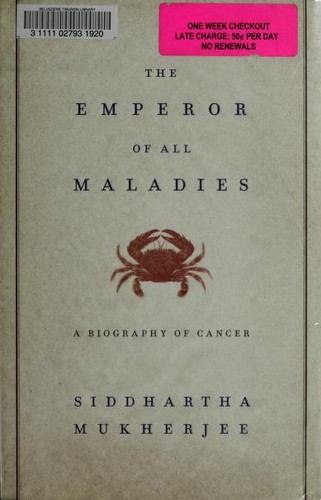
The Emperor of All Maladies: A Biography of Cancer
by Siddhartha Mukherjee · 2010
Buy on AmazonThe Emperor of All Maladies: A Biography of Cancer is a book written by Siddhartha Mukherjee, an Indian-born American physician and oncologist. Published on 16 November 2010 by Scribner, it won the 2011 Pulitzer Prize for General Non-Fiction.
Recommended by
"Winner"
Pulitzer Prize for General Nonfiction 2011 · pulitzer.org
"I’d say it has become a modern classic of cancer and maybe even of popular medical science. It is described, both in the subtitle and by many people, as ‘a biography of cancer.’ I would say it’s more like a biography of cancer research. It’s telling the story of cancer medicine, the development of cancer charities, and the politics around cancer, including Richard Nixon’s war on cancer, all the way to the present (or 2010, when the book came out). It’s a very good description of how cancer research has developed, and Mukherjee presents it in a very accessible manner. He writes about the science, the medicine and also the patient perspective and the suffering and the breakthroughs. So it’s a very good biography of cancer research, while I would argue that there’s another book on my list that is more a biography of cancer. Yes, Mukherjee is a hematologist. He includes the historic perspective—there are some notes on cancer going all the way back to the ancient Egyptians. But then we can also go back in evolutionary history. Mukherjee is presenting the human history of cancer, while other books are more about the biological history of cancer."
Cancer · fivebooks.com
"The book has to do with cancer, and radiation is of course closely associated with cancer. It has this dual personality of both causing and curing cancer. This book speaks to both of those aspects, and it does so from a human perspective. You see cancer through the eyes of the patients who are suffering from the disease, and you see it through the eyes of the physicians, who are frustrated in their efforts to cure people with the disease. I thought that was a great way to explain some very difficult scientific concepts to the public so they could then use that information to meaningfully affect their lives. A tremendous amount of cancer biology comes through in that book through the eyes of the victims and the people up close and personal. Mukherjee talks about what happened at the Dana-Farber Cancer Institute in Boston, where I did a fellowship. Dana-Farber is named after Sidney Farber and the Dana Foundation. When you’re there, there are reminders of Farber everywhere, on plaques and so on. So I already knew a little about Farber’s background and what he had achieved at the Institute over the decades of his leadership. But I didn’t know the interesting details about Farber’s scientific life, such as the fact that he was among the first to realize that more reliable methods to measure the size of tumours in the body were sorely needed for cancer research to make any progress, or that he pioneered the use of X-rays combined with drugs to treat pediatric cancers. Originally radiation was used in the correct way for the wrong reason. At the end of the 19th century, when X-rays were discovered, there were two types of physicians, the allopaths and the homeopaths. The allopaths believed in using noxious agents to drive disease out of the body, and the homeopaths had this idea that any drug or treatment that could cause disease symptoms could, in lower doses, reverse those symptoms. It’s not clear what the logic of that is, but because of that they gave very low doses of drugs and other treatments and they fractionated the dose, meaning they gave a treatment a little bit at a time, thinking that this would increase its potency. The very first person to try radiation as a treatment was an American homeopathic physician named Emil Grubbe, in 1896. He fractionated the doses, and it turns out that this is the perfect way to deliver the dose to tumours, but not for the reason he thought. The main reason is because when you split the dose, the time between doses allows normal tissue to repair the damage, whereas the tumour isn’t very good at repairing itself. “Some of the people who make the great breakthroughs are the newbies or naïve people, who either don’t know the scientific dogma or don’t care about it.” Every time you give a break in the treatment the normal tissue repairs while the tumour doesn’t, and by fractionating over many cycles you can get a bigger killing effect in the tumour. So he did the perfect thing. He got great results for the wrong reasons. We were very lucky that a homeopathic physician founded radiotherapy. That’s right. The theory is called ‘hormesis’ and it’s promoted by a small group of scientists. They see radiation almost as a nutrient that stimulates cells and boosts their capacity for repair. But the evidence for this is extremely weak. The problem with proving it is that at low doses we have problems measuring risk at all. We can’t distinguish whether low doses of radiation are protective or harmful. But we do know the mechanism by which radiation produces cancer and, in theory, even one interaction with a cell could produce a cancer. So, most scientists take the conservative route and assume that risk is simply proportional to dose. If you halve the dose, you halve the risk. What you then consider to be safe depends on how high a risk you are willing to accept."
Radiation · fivebooks.com
"But for spinning a yarn about the history of medical advances, there has been no better book in recent memory than “The Emperor of All Maladies: A Biography of Cancer,” by Siddhartha Mukherjee."
By the Book: Francis S. Collins · nytimes.com