Ian Mortimer's Reading List
Ian Mortimer is the bestselling author of the Time Traveller’s Guides series, as well as Medieval Horizons: Why the Middle Ages Matter and four critically acclaimed biographies. He was elected a Fellow of the Royal Historical Society in 1998 and a Fellow of the Society of Antiquaries in 2015. His work on the social history of medicine won the Alexander Prize in 2004 and was published by the Royal Historical Society in 2009. He lives with his wife on the edge of Dartmoor.
Open in WellRead Daily app →Life in the Tudor Era (2013)
Scraped from fivebooks.com (2013-03-21).
Source: fivebooks.com

Mark Dawson · Buy on Amazon
"I like this book for very similar reasons. There’s a wonderful book by Barbara Harvey, an academic who I think has now retired from Oxford, called Living and Dying in England 1100-1540: The Monastic Experience . In that book she took the accounts of the monks of Westminster and subjected them to minute detail in order to work out how people really lived their lives. Where was their food coming from? What was their life expectancy when they became members of the monastery? This author, Mark Dawson, has been inspired by Barbara Harvey’s book and he’s decided to do something similar for a 16th century aristocratic household, namely the Willoughby family of Wollaton Hall near Nottingham. He has gone to great depths working out what food they really ate, when they ate it, when they travelled etc. It’s rare to find a book that detailed, that scrupulous, that full of information which is reliable, with all this great context of this family house, which still stands by the way . It’s provided so many answers to questions I was asking, and it’s beautifully written as well. I thoroughly enjoyed Mark Dawson’s book because I’m fascinated by the reality of the past: not just the stories people told, but the way people physically did things, the things they ate. I really got a lot out of his book. I recommend it to anybody who is interested in how the great and the good lived in the late 16th century. I’m interested in diet and health, so having detailed accounts for when they stopped eating fish, for example. At what period did the Wednesday, Friday, and Saturday fish-eating days decline? Did they eat breakfast? That’s something I’ve written about at an academic level and he has some evidence to show for that. Lots of details like that, but also details of what was in the buildings, what was in the rooms. It’s a really brilliant study. Before about 1600 people tended not to eat breakfast. It’s in the last decades of the 16th century that breakfast became habitual. In the Middle Ages you would eat breakfast if you were going on a long journey and therefore getting up early, or if you were a worker working in a field, on a harvest day, which might be a 16 or 18 hour long working day. But on the whole most people didn’t eat breakfast. They had dinner in the late morning and then supper in the mid-to late afternoon. Those were the two meals of the day. There were a few exceptions – aristocratic families who started having ceremonial breakfasts in the 16th century and if you were ill you might have breakfast as well. But in the 16th century all the times started to get shifted around, because people increasingly worked for other people, rather than sorting out their own times of working during the day. Therefore they have to stay at work till much later, so they can’t have supper till much later, so they start eating lunch instead of dinner in the late morning and they have to have breakfast before they start. So there is a shift to a three meal pattern. The Willoughby family didn’t. Some of their staff who went on journeys did have breakfast, but on the whole it’s a very conservative, Catholic household. They didn’t eat much breakfast."

Samuel Schoenbaum · Buy on Amazon
"Everybody has an interest in Shakespeare, but if you have got a serious interest in Shakespeare, at some point or other you will imagine to yourself that there ought to be a big book that reproduces all the important documents relating to Shakespeare’s life and all the spurious ones as well, and give an account of everything in chronological order. This is the way I imagined somebody should produce that book and then I happened to be in Stratford-upon-Avon and there was the very thing! This was it, Shakespeare: A Documentary Life , which is still available in the cut down version. It was exactly what I had hoped for. I am passionate about the reality of the man and his experiences that led to all those plays being written and all that poetry. My own original training was as an archivist, so there’s the information angle as well. I want to know where this information comes from about him. I’m interested in the Shakespeare authorship debate too, so I’m very pleased to have this big book at my disposal. Every time I need to cite a particular document, I’ve got it there to hand. It’s a wonderful resource, and if anybody is interested in Shakespeare the man, it is an essential resource. No serious scholar would ever entertain the idea that Shakespeare didn’t write Shakespeare, but I don’t think anybody has properly articulated why there is this no-need-to-doubt. That’s the bit that interests me. Because of my medieval studies I cover historical evidence from a different point of view from most people in that you don’t take what is said at face value. Any piece of evidence you deconstruct to find out what was available information-wise to the person who created the evidence. So for a medieval chronicle, you don’t just see what the chronicle says, you work out how the information could have come to the person who wrote it down in the chronicle. For the Shakespeare authorship, there are enough documents showing he was William Shakespeare who is referred to as being one of the players. The most critical piece of information for me is the mentioning of Henry Condell and other players in his will, in his own hand, which is confirmed by the legal copy of his will, in 1616. So we know that the executor of William Shakespeare’s will knew William Shakespeare the man was William Shakespeare the player from the mention of the other players he was acting alongside. From looking at pieces of information like that, who knew what, who knew who, you can demonstrate that William Shakespeare of Stratford-upon-Avon was William Shakespeare the player and William Shakespeare the author. Now it is entirely possible, by some extraordinary feat, that somebody else had some ideas that fed through to William Shakespeare, and to a certain extent that’s true because other players helped with various lines, other playwrights helped with various lines. But the bulk of the genius we associate with the man is associated with William Shakespeare of Stratford-upon-Avon, because we can prove his contemporaries associated it with him, and that he knew those contemporaries. Apart from the wild dreams of circumstantial blithering idiots, there is no alternative. If you look at some of the arguments put forward, you just think “Oh my God! Go and do some historical research!” But I delight in the fact people question things, and tackling those questions is a pleasure to me. So Schoenbaum’s Documentary Life is a fantastic resource. There are so many current thoughts about Shakespeare. If you go to a specialist Shakespeare library and look at all the material that’s been written, and continues to be written, it’s a one-man industry. It would be impossible for me to encapsulate. I favour the writers who suggest the man derived his experience from growing up right in the middle of England, and yet also had experience of the court in London, and London at a time of growth. He’s got fingers in so many different pies. He’s familiar with aristocrats, he’s familiar with labourers in Stratford-upon-Avon and in London. He has a range of experiences which allow him to synthesize and or empathize with people in a wide range of different positions in life. Also, there was so much knowledge flooding into London, you can see how society is changing. He was well-positioned to be the author who describes London riding the crest of this brave new world at the end of the 16th century. He lost one of his children – that’s a tragedy. He clearly had an emotional life which was intense, to write those poems. You have to write from experience if you’re going to write anything as intense as that, so his love life must have been intense. It was varied, and it probably would have fallen well short of modern moral standards. But W.H. Auden remarked on the fact that most writers don’t have interesting lives, there’s no point in a writer writing an autobiography. Besides which if he’s got anything interesting to talk about that was worthwhile, he’d probably write it into his work anyway. I think Shakespeare, in many ways, is the proof of that. There is very little point of writing the life story of a man who spent his time at his desk with a pen in his hand, or on stage directing people."

James Clavell · Buy on Amazon
"Yes, I was 15, I think, when I read it. I couldn’t believe that no one had ever written other books like it. I remember going to my English master at school and saying “What else is like this? I want to read more books like this!” I can’t remember what he recommended, but I can remember picking them up and thinking they were nothing like Shogun . I was so entranced by the world of the 16th century he created that I’ve really had a fascination for it all my life. I never really enjoyed anything else that James Clavell wrote, but that book really stands tall. There’s so many clever ideas in there, like introducing Japanese lines so the reader flatters himself that he’s understanding a bit of Japanese as he goes through it. It’s a book that people can easily fall in love with. Yes, Will Adams of Gillingham in Kent. To think that, by the time of the death of Elizabeth I, there was an Englishman resident in Japan , really captured my imagination. Will Adams was a remarkable pilot, which doesn’t come through in the novel. He’d sought the North East passage, he’d been as far as the Falkland Islands in the South Atlantic, he’d been all over. He’d worked for the Barbary Company, so he had run the gauntlet of pirates in the mouth of the Mediterranean. He basically navigated around most of the known world long before he undertook that job for the Dutch sailing to the Far East. He was a very experienced man, one of the great English pilots, but of course there were so many English navigators like this, at the end of the century, because over the period from about 1540 to 1590 England just leapt ahead. Having been quite a backward nation in terms of seafaring, it suddenly became the furthest reaching and capable maritime nation. The real Will Adams did not become a samurai in quite the way Clavell describes, he doesn’t occupy anything like the position John Blackthorne occupies, but it’s based on truth. If it’s a good historical novel with something important to say, saying it is much more important than whether it’s accurate or not. There is no such thing as an accurate historical novel: they’re all all over the place. If you started to be accurate in a historical novel, you’d lose all your modern readers because you’d have to insist on so much deference, so much hierarchy, you’d have to insist on such a high level of cruelty in society. Society was fundamentally violent and fundamentally sexist – we couldn’t possibly tolerate anything that reflected that accurately. So accuracy to my mind – as long as there’s nothing stupid like having people live on after they’re dead – is much less important than having something to say. In James Clavell’s Shogun , he has this meeting of West and East so that you walk away from the book thinking “What would it really have been like to be the first Englishman in Japan?” You don’t have easy translations, there is no phrasebook you can go to, the culture is so different. It is, in some ways, a wonderland, and on the other hand, it’s a place of horror. In the novel, one of the crew is beheaded and not long after someone is boiled alive as a punishment. You have, on the one hand, the geishas and the beauty of the lords’ courts, and the poetry and, at the same time, you have the horror and you have to imagine what this world would have been like. So the fact it’s not wholly accurate in representing the real Will Adams’s experiences doesn’t bother me in the slightest. Well quite! Personal cleanliness is one of my specialist subjects from this period. One of my favourite lines on this is actually from a person who grew up in Exeter, not far from where I live, in the late 17th century. This character was kidnapped at the age of 14 by the Barbary pirates and he spent the next 20 years as a slave in North Africa. When he got home, he writes a “True Story of the Mohammedans” because he wants to put right all the stories about people living in North Africa. One of the things he emphasizes is how clean people are. If you were low status in the Western world, you didn’t have the highest standards of personal cleanliness – you couldn’t afford to. And it’s great looking at someone from the Western world describing the Middle East/North Africa, and being fascinated by these cleanliness rituals. James Clavell, unwittingly, though I’m sure he didn’t know the book I’ve been describing, does the same thing for John Blackthorne discovering the cleanliness of the Far East. So that’s another delight of the book, I quite agree with you."

Alison Uttley · Buy on Amazon
"It’s a magical book, it really is. I was so impressed. It is astoundingly well imagined and extraordinarily well researched. It is almost perfect. There are a couple of slight factual errors in there and in terms of accuracy, obviously what I was saying about cruelty you don’t have reflected in the details because it’s a children’s book. You couldn’t possibly reflect the horror things were for children in the late 16th century! It’s very lucid in the way it goes from the modern, to the 16th century, this girls goes to and fro seemingly without being able to control which period she’s living in. But the magic and the way she falls in love with the 16th century is so beautifully done, you cannot help but be carried away by it. I read it to my daughter two years ago, when she was ten, and it was such a privilege. We both could not get enough of it. Oh yes. One of the things I’m always at pains to emphasize is that history is not about the past, history is about people. If we want to understand people, we need to see them in different times from our own. We need to understand them over longer periods of time, or see them in extreme circumstances. We get a much better idea of what the human race is by looking at it over several hundred years, rather than just by looking at what it’s like today. A good example of this was a recent BBC opinion piece – a headline about how the young have never had it so bad. Well, as a historian, if you look back over the past 1000 years, frankly the youth have never had it so good as they’ve had it these past 30 years. Youth has never been treated well. If you go back a few decades it was treated pretty poorly, and if you go back to the pre-industrial period it was treated very poorly indeed. Good history is about people, not just about the past for the sake of it. This book is really bringing that to the fore. Because these are interesting people in extreme circumstances, because the book is so passionate about other people, it does deliver what these other great children’s books do."
Daily Life in Medieval England (2026)
Scraped from fivebooks.com (2026-03-08).
Source: fivebooks.com

Colin Platt · Buy on Amazon
"In the early 1990s, I was beginning to research social life in late medieval England. There were two historians who changed my entire perspective on what was possible. Both Colin Platt, the author of Medieval England , and Christopher Dyer—whose book we’ll come to in a minute—had one thing in common: they paid as much attention to archeological sources as they did historical ones. Chris Dyer is a historian who looks at archeology; Colin Platt is an archeologist who looks at historical sources. Historians and archeologists don’t always see eye to eye. You’d have thought they’d be trying to attain the same ends, but, frequently, archeologists proceed in complete oblivion to what the historical record says. Likewise, historians sit in their libraries and pontificate about what happened in the past without going and looking at the ground, the remains, the places, the artefacts. These two historians reversed that. In fact, they put an end to that way of proceeding. Chris Dyer was so successful within academic circles that he revolutionized the study of social history of medieval England, and probably further afield. Colin Platt is deceased now, but he was very thorough. He worked from the material culture outwards. His book showed me there is a way of integrating what I can go and look at for myself and the narrative about how medieval England changed—because medieval England changed so much between the 11th and the 16th centuries. You go from a world which is riven by violence, famine, hostility, hardship, slavery, fighting the Vikings, through to the age of Shakespeare . That’s an enormous transition. We talk about Shakespeare ‘speaking for us’, and yet Shakespeare would never have spoken for people in the early 11th century. Those transitional 500 years really made the modern world. So to have that explained through the things you see around you, and the objects and the buildings of southern England….it’s one of those books where the scales fall from your eyes. You feel you can see in greater detail than ever before. Medieval England made a huge impression on me about how much is possible when you tie the material culture with the written record."

Barbara Harvey · Buy on Amazon
"Barbara Harvey is one of those old-school academics, very rigorous and with a keen attention to primary sources. I don’t think she cites a secondary source in the entire book! For me, it’s about her scrutiny of the documents and the ways they could be used—and by documents, I mean those generated by the monks of Westminster Abbey and their staff. They include a lot of accounts, but also manuals and procedures. How did the monks live within the Abbey? It’s a very rich archive and she goes into it in painstaking detail. For example, she gets a statistician to use all the figures she’s collected from the registers of novices and acolytes—the young monks—until their deaths, to calculate life expectancy within the Abbey. Now, since the Abbey was very wealthy, most of the monks came from high-status families, and there was no risk of them being killed in battle, you’d have thought they would live much longer lives. Abbots frequently did live to very advanced years, but when you look at the monks as a whole, a remarkable fact emerges, which is that if you went into Westminster Abbey, you’d probably live five years less than the man in the street. So at a time when life expectancy at birth in society in general was about 35, life expectancy at Westminster Abbey was 30. This statistical approach to the documentation blew my mind. You wonder, ‘How can this be?’ Then you realize that all these monks were sleeping and eating and sharing all sorts of things together. It was a hotbed of disease because the monks were exposed to every infection that came to town. They didn’t have the means to understand contagion, and even if they did, they couldn’t really isolate the sick. So that’s Barbara Harvey’s approach to finding out how they were living and she goes across many different areas. What did the monks like to eat? Why was it that they introduced the misericord, a place where some monks could go off furtively and eat meat on certain days of the week, when they weren’t really meant to according to the rules of St Benedict? They really liked bacon and eggs, so that was a real indulgence. But despite these proteins, they really were suffering more than most members of society, because of their vulnerability to disease. So that book was very exciting for me, because it gave me exactly what I was looking for—a vision of what really was happening, based on primary sources with exactitude—and yet telling this fantastic story that I would not have otherwise known."
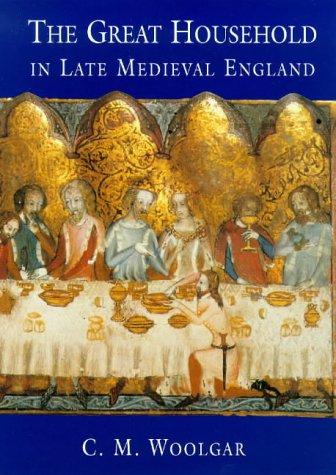
C. M. Woolgar · Buy on Amazon
"Like Barbara Harvey, Chris Woolgar has read an awful lot of accounts. In fact, he’s published a two-volume compendium of the medieval household accounts that survive for England. So he’s got a lot of experience in using primary sources. In The Great Household , which is aimed at a wider audience, he explores the culture of late medieval England through the prism of the wealthy. Not only are rich people able to afford many more things, but they have left many more accounts of their attitudes, their approaches to the tangible things around them, their ideas, their beliefs—religious beliefs, but also their personal beliefs, their outlook, their superstitions, their attitudes to medicine. It’s a concise compendium of how the wealthy lived. Chris Woolgar was working in the wake of Colin Platt, so he takes into account the fabric too. You’ll have attention paid to the rooms in a castle, and why we go from a society in the 12th century—when perhaps the lord of the manor would have had his own chamber but everybody else used to sleep in the hall—to a late medieval castle like Bodiam, built in the 1380s, where there were numerous private chambers for the officers of the household or for guests. Bodiam Castle had more than two dozen private chambers built within it. That changed the dynamics of a great household and charting that change is part of the book. But the book also deals with things like what people smelled and when they used makeup and perfume in the late Middle Ages. It’s the entire culture of the upper class—not because they’re special, but because they’ve left the best records, which allows us the greatest accuracy. And we do know the middle classes tended to try and ape the upper classes, so this is indicative of some of the things that the lower ranks of society were aiming to achieve as well. It’s a real keyhole view of how people lived."

Christopher Dyer · Buy on Amazon
"Yes, this is the book that really knocked my socks off in the reading room of the British Library back in the early 1990s. I can remember opening it at random and reading about how Chris Dyer was measuring the size of ruined peasant houses from the 14th century. I thought ‘Gosh. This takes everything to a whole new level.’ Previously, I’d been reading social histories that were not really pinned on accounts or objects or houses. They’d been drawn up by Victorian or early-twentieth-century historians, who were really working from the literary sources. So they’d read Chaucer, or Sir Gawain and the Green Knight , and then go on to tell you all about life in England based on these texts. This allowed no accuracy. They were full of impressions. The sources also tended to be written by the wealthy for an audience who were also wealthy, because they were the ones who were literate. I had never imagined that somebody would manage to revolutionize history to this extent—to look at how big a medieval peasant house really was. How was it heated? What did they make the door from? What was the calorific intake? Can you calculate, for a peasant family, what they had in calories every day? He did it, and it’s just extraordinary what he achieved. It also had repercussions. When it came to the Mary Rose excavation, the archeologists did the same thing. They worked out the calorific intake of all the sailors on the Mary Rose, given what was documented to be taken on board. This way of approaching history, this real insight into the past, was just mind-blowing. I can still remember that moment. After seeing the measurements of peasant houses, and then the calculation of peasant calorific intake, I just thought, ‘Yes! History like I want it to be possible, is possible.’ I was very excited, as you can probably tell. You’re right. It was difficult to get protein in the Middle Ages if you were low status. And, most importantly, this affects our understanding of what things were worth. In Mortimer’s A to Zs of English History , I refer to the difficulties of comparing prices over time. If you want to know, say, what the equivalent of five pounds in today’s money was in the 13th century, there are two reputable machines online for doing this. One is the Bank of England’s inflation calculator. The other one is run by the National Archives. Both start in the 13th century, around 1270, and go through to the present day. Now, if you take a median household income—which is £38,000 pounds today—and try to work out what that was 700 years ago, the Bank of England and the National Archives calculator will come out at around the same figure, around £60. This is totally wrong and misleading, because £60 pounds in 1325 was the equivalent to the manorial income from around 15,000 acres of land. You’d have had to be lord of three manors to have that sort of income in the past—and it’s one-and-a-half times as much money as you would have needed to be knighted in the early 14th century. The fundamental error is that these calculators have regarded all things as having equal value to society down the centuries. But you really can’t compare because food was so scarce and more valuable in the Middle Ages. So I use the unit of currency called the chicken. I point out that in the late 14th century, one day’s skilled labor—as, say, a thatcher or mason—would be the equivalent of one chicken. By Elizabethan times, it was about 10 pence for a day’s skilled labor, and about six pence for a chicken. By Restoration times, a day’s wage was about two shillings, and a chicken a shilling. In Regency times, you’re up to about ten shillings for labor and two and a half shillings for a chicken, so roughly a three-to-one ratio. Today, of course, a skilled laborer receives the equivalent of about 11-12 free range chickens for his money. Because food has become so much more affordable and is, in relative terms, less valuable, it’s thrown out all these figures. Now, I started that comparison in the late 14th century after the Black Death of 1347-51. Before that event, the population was roughly twice as high—but there weren’t many more chickens. Protein was really, really scarce. If it hadn’t been for cheese, what would people have done in the 13th and early 14th centuries? You would not have seen the population grow to the level it did, because getting protein was so difficult. In the 13th century, things were tough. The reason for so many gangs in the late 13th/early 14th century was simply starvation. People didn’t have enough food to live. After the Black Death, it was easier to get food. There is an irony in that the consequence of the Black Death was an increased life expectancy. You don’t think of animals being different in the 14th century, but they were. And not just the ones we ate. All the squirrels were red. None of the modern dog breeds existed—they had different dog breeds. Animals like cows, sheep and pigs have been bred and bred and bred all the way through. Sizes started changing in the 14th century, but in the 18th century they grew massively. A large Devon cow today—my local breed—is roughly 10 times the size of the average one from the Middle Ages. So I began the book with A for animals, because that was one way of opening the door to things being different in ways you can’t necessarily anticipate. I wrote four Time Traveller’s Guides , which are attempts to show what life would be like in a particular period of time, if you could go there. So if you could go to the 14th century or Elizabeth I’s reign or Restoration England or Regency Britain, what would you eat or drink? What would you wear? Where would you stay? It presents a whole range of aspects of everyday life that people might want to know if they could go there. I wrote all those books a number of years ago, and gave talks about each of them in the form of an A to Z of interesting things. There’d be big themes in there, and tiny things to make people realize all the things they didn’t know about the past. I wrote these talks expressly for people’s enjoyment, so one day I thought, ‘Why not publish them?’ I can include everything I’ve learned from this whole 25 years of looking at the past in the present tense. So writing Mortimer’s A to Zs of English History was just great fun. It includes five A to Zs: the medieval one, the Elizabethan one, the Restoration, the Regency, and then my conclusions on the whole lot. So I can ask questions like: When was the best time to be a woman in the last 700 years? How does the class system survive? What can we learn from glass? Questions addressing the last 700 years of this country’s history that you can’t ask as a traditional historian suddenly become possible. Now, definitely! I know too much about the past to want to go back there. I have no illusions. Some people think, ’Oh, you’d be alright if you were one of the wealthy.’ Well, consider this: between 1660 and 1700 there were 35 royal pregnancies. Of those 35 royal pregnancies, three children lived to adulthood. So you’re looking at less than 10% survival, and that’s for the royal family—who had access to the best physicians. We’re not talking about the Middle Ages here. We’re talking about the 17th century, the time of the Scientific Revolution! And when children die, it’s indicative of suffering throughout the whole family and society. It’s not just a lack of resources—though it is that for many families—it’s indicative of a lack of understanding, a lack of medical facilities to make things easier for everybody. It’s a real barometer of how much suffering there is. It was really tough surviving in the past. We are the descendants of survivors. We aren’t the descendants of the ‘ordinary person’, because the ordinary person had such a hard time getting by that most of them died without children. We are the descendants of the lucky ones. The median age was under 21, which is horrific. It means society was full of young people, on the one hand. It also means it was full of reckless people, because they didn’t have the life experience to calm them down. Some people lived to an advanced old age, but very, very few of them. Just 5% of the population lived to 60. I’m coming up 60 myself, so that’s a salutary thought… Things weren’t much better in the 16th century; the Little Ice Age of the late 17th century was particularly tough. The Industrial Revolution was even worse. Life expectancy dropped as low as 13 in the unsewered parts of the industrial towns in the north. Life expectancy in working-class areas was 13¾ in some places, the lowest recorded anywhere on Earth at any time. You were better off being a slave on the plantations than growing up in Ashton-under-Lyne or Preston in the 1820s and 1830s. So I have no illusions about the past being a wonderful place of freedom and exploration. It was a place of misery, and we are lucky that our ancestors survived to have us."

Carole Rawcliffe · Buy on Amazon
"My PhD was in the social history of medicine. I concentrated on the 17th century; this book is about the medieval period. It’s an approachable study of the relationship between people in general and medical knowledge and medical treatment. The great thing about the medical approach is that it’s a litmus test for how things are in general. If you want to understand how a society is getting by, look at people’s health, look at their diets and the impact on their bodies—because it’s the underpinning of everything they do. Some of the earliest universities—Salerno, for example, in Italy—were founded to teach people medical texts. They offered didactic courses and there wasn’t much experimentation. They were largely forcing down students’ throats text translated back into Latin from Arabic sources which were preserved ancient sources, like the texts of Galen, written from the third century onwards. So medieval doctors were not without knowledge. You and I would not trust it because, on the whole, the man and woman in the street today knows better than a medieval physician, surgeon, or apothecary. But they were able to impart hope to people. And, in some cases, especially with surgery, they did have good skills. They could conduct reliable operations. It has to be admitted that the chances of infection with a lot of these operations were very high because they had zero understanding of the necessity of cleanliness. They did not understand germ theory—no one did until the 1870s. But increasingly through the 14th to 15th century, medical knowledge was one of the few areas of life where you can say without fear of contradiction that there was progress. It became more efficacious, more successful. There were English medical practitioners who were widely respected in their own day. John of Arderne, for example, wrote a book about how to proceed with an operation for anal fistula, which many men got from riding horses in wet weather for too long. His procedure for this was carried out many times successfully, apparently. Then you have John Bradmore, who successfully managed to extricate an arrowhead that went into Prince Henry’s face at the Battle of Shrewsbury in 1403. How do you get out a barbed arrowhead that’s gone into the prince’s face without killing him? Well, Bradmore did it and wrote a treatise about how he did it, which is now in the British Library. The medical men of the day were faced with huge challenges, but they rose to them. There’s a degree of courage in what they did. There’s a degree of knowledge in their achievements too. There’s also a social impact, basically buoying everybody and carrying them along. You get an ailment and it’s not necessarily the end. She covers a huge array of medical dimensions and social attitudes towards medicine and food in a relatively short book. I’d recommend it to anybody who’s got any interest in medieval society."