Henry Normal's Reading List
Henry Normal is a writer, poet and TV and film producer. He is the founder of the Manchester Poetry Festival (now the Manchester Literature Festival) and co-founder of the Nottingham Poetry Festival. In June 2017 he was honoured with a special Bafta for services to television.
Open in WellRead Daily app →Human Imperfection (2010)
Scraped from fivebooks.com (2010-06-13).
Source: fivebooks.com

Spike Milligan · Buy on Amazon
"I’d read a lot of Spike Milligan before I read this. I read them in my teens and I’ve read all the Goon Show Scripts . I’d read all these comedy books and then this new book came out, so I got it the first week it came out. I was surprised because it was serious. The fact that he was so serious and that it made me laugh so much really impressed me, not only that he could be serious but that he wanted to be serious. I liked that. There was one particular poem in there, I think it’s You’re Ugly Said the Mirror , about a young girl looking in the mirror. I found it so devastating that within a short number of words Spike Milligan could make me cry. I think it’s only about twelve lines long, the piece. That book so excited my imagination, that by the end of it he had opened a new world to me. I think it’s because of that book that I became a poet. Not only was he funny, but also in the serious poetry, he’s accessible. And in a way, it’s not a million miles from the Liverpool poets or Adrian Mitchell – it’s within that, sort of, 1960s movement. He was using everyday language, rather than a more traditional poetic language, and was using domestic images and everyday experiences. Even though I was a lot younger and lived on a council estate in Nottingham, I could understand the images far more than a lot of the poetry that we were reading in school. Every poem in it is about sensitivity and about looking at the world in a different way. The whole book, it’s got one foot off the ground. It feels like you’re holding your breath while you read it and there was something about that, rather than this strident, “I know exactly what I’m doing, I’m telling you the world is like this”. It was asking a question, so I loved it."

Alan Sillitoe · Buy on Amazon
"I could have chosen Saturday Night and Sunday Morning . But the image at the end of The Loneliness of the Long-Distance Runner has been something that’s haunted me all my life. I was born in Nottingham. It’s all set in Nottingham where I grew up. It very much captured the world of the back-to-back housing. I was born in the St Anne’s district and the opening shot of Saturday Night and Sunday Morning , pans over towards that area. My dad worked at Raleigh for 40 years, my brother worked at Raleigh, so there was always the chance that I would work in Raleigh if I wasn’t clever enough to get a job in an office. So, that world was very much ingrained in me and was the world that I inhabited. The story of The Loneliness of the Long-Distance Runner, it could almost be the story of an autistic person if you think about it. The loneliness and the self-obsession within the piece. It is quite striking. I read it in my teens. It was one of the first books I bought, as with Small Dreams of a Scorpion . It wasn’t given to us in school. I went out and bought it. For me, at that time, to buy something that wasn’t a comedy book, was a big thing. “It’s an image that defines a working-class thought – that you’d sooner fail on your own terms than win on somebody else’s” There’s something about a vivid image that even within a couple of paragraphs, can stay with you for the rest of your life. So, the image at the end, of the central character deciding to walk instead of run, and therefore throw the race – therefore not do what everybody wants him to do – and do what he wants to do. I think it’s a universal image. It’s an image that defines a working-class thought – that you’d sooner fail on your own terms than win on somebody else’s. That one or two paragraphs has, I think, defined a lot of my decisions over the years. I think all Sillitoe’s work is radical, but he just managed to capture something with that story. And in a way, the whole of the story just leads up to that moment and to have envisaged that moment in such a way that it encapsulates a way of looking at life – it’s brilliant! If I could write two paragraphs like that, I’d be very happy. The whole book is about this runner. He is, by the standards of society, a failure. But, by his own thought process, he is going to win on his own terms. This idea of how do we define ourselves. Is it by others or is it by ourself? It’s quite a key question."

George Orwell · 1949 · Buy on Amazon
"Similar to Sillitoe, with Orwell, there are a few books of his I could have chosen but there is something about 1984 that still lurks within society. It’s a story about people struggling against a system that is suppressing individuals and lacks all humanity, it just wants people to be slaves. I think, at times, we all feel like we’re in some sort of 1984 scenario to a greater or lesser extent. Particularly in some countries. Though here in the United Kingdom in 2018, it’s probably less so. It depends how deep you go into questioning things. I’m not one who personally goes around with conspiracy theories, but I think it’s good to see what the problem could be, in order to avoid the problem. And, I think the idea of the excesses of dehumanisation is well-captured in 1984. Well, the moment, near the end, where the main character, Winston Smith, says the most haunting line, “Not me. Do it to her.” That cowardice is a human imperfection. And then having to live with that. You wonder how many people would rise above it. Did you know George Orwell’s original title was ‘1948’? It was originally titled 1948, but the publisher said to him that was too close. They had to push it back, so he just changed it around to 1984. I’ve been in room 101, at the BBC, which he refers to in the book. He worked at BBC Radio and they still have all the rooms there that he worked in. So, it’s quite weird. There is a quote of George Orwell on the outside of the BBC building, “ If liberty means anything at all, it means the right to tell people what they don’t want to hear.”"

Eric Carle · Buy on Amazon
"I think some of the best children’s stories encapsulate a story that works for everybody. I’m a big fan of Alice in Wonderland and Alice Through the Looking Glass . There’s a lot of great children’s stories that you can read again and again as an adult. “The moral of the story is to be yourself. And that’s a great moral” This book, in particular, has a great lesson for everybody – that you have to accept who you are. In this case, the chameleon doesn’t like who he is and wants to be another animal so he goes around trying to have the attributes of all the other animals and finally ends up mixed-up and unable to function. I just think it’s brilliant. I still read Johnny children’s books now because he enjoys them for bedtime, but this has always been my favourite to read. You see somebody and you say, ‘I wish I was taller like them,’ or, ‘I wish I had got their sense of style,’ or, ‘I wish I got their sense of humour,’ but not wanting the whole package, just wanting to cherry pick the best, not realising that the world is not like that. You can’t cherry pick, because with one thing comes another. People sometimes are resilient because they’ve had a lot of challenges, or they have a sense of humour because they’ve had a lot of hardship. There is an old Russian phrase: “pain is the grooves into which you pour happiness”. Meaning that the more pain you have, the more capacity you have for happiness. So, when you cherry pick, you don’t cherry pick the balance. You want just the benefit, not the cause – just the effect. People are as they are usually because of the challenges of their daily lives. So, if you to try and be like them, you wouldn’t last long because you’d have to wake up the next day and do it again, and the next. So, the moral of the story is to be yourself. And that’s a great moral. There are always people better or worse than you at something."
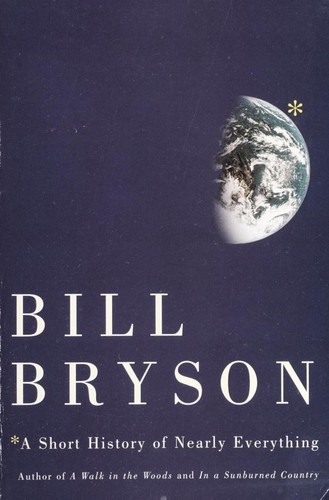
Bill Bryson · 2003 · Buy on Amazon
"It’s quite a daunting task for somebody to write. It does more-or-less what it says on the cover! As a human being, reading about the beginning of time and the vastness of the universe, the way matter is constructed and the way human beings have evolved since the year dot puts your small, temporary existence in perspective. He does it with such wit and warmth that you come away feeling the wonder rather than the weight of the universe. There are many stories in the book which are fascinating in themselves. My favourite was about the man who invented CFC’s and put lead in petrol. So, he was possibly one of the worst inventors in the entire world. He finally contracted some disease and so he invented a machine for turning himself over in bed but it strangled him! “Whenever you see any human imperfection, you should think, “Yeah, that’s good. That is creative”” I love the way that Bill Bryson picks out these things, things that no-one else had ever told me about. I find it full of fascinating stories. Another that the first dinosaur bones were found by a woman in Sussex but her husband then claimed the credit and he tried to get famous for having found these bones. He ended up in a rival’s lab – his bones as the lab skeleton. It’s full of human stories within all this information which makes it entertaining, as well as informative. And this feeds that hunger to keep going and to learn more. I would say if you could only read one science book, then this is the one for you. Well, one of the things I think he says in the book is that the reason why anything exists is because when the big bang happened, it wasn’t perfect symmetry. If everything was perfect, if all the hydrogen atoms were exactly equal distance from each other, then nothing could exist because gravity couldn’t then force them together and if they’re not forced together, then they can’t form suns and other elements – life wouldn’t have begun. So, it’s the imperfection at the beginning of the universe that means anything exists at all. So, whenever you see any human imperfection, you should think, yeah, that’s good. That is creative."